
Compare Home Insurance Plans in Ohio
Find your best options in less than 2 minutes



Does Home Insurance Cover Basement Flooding?
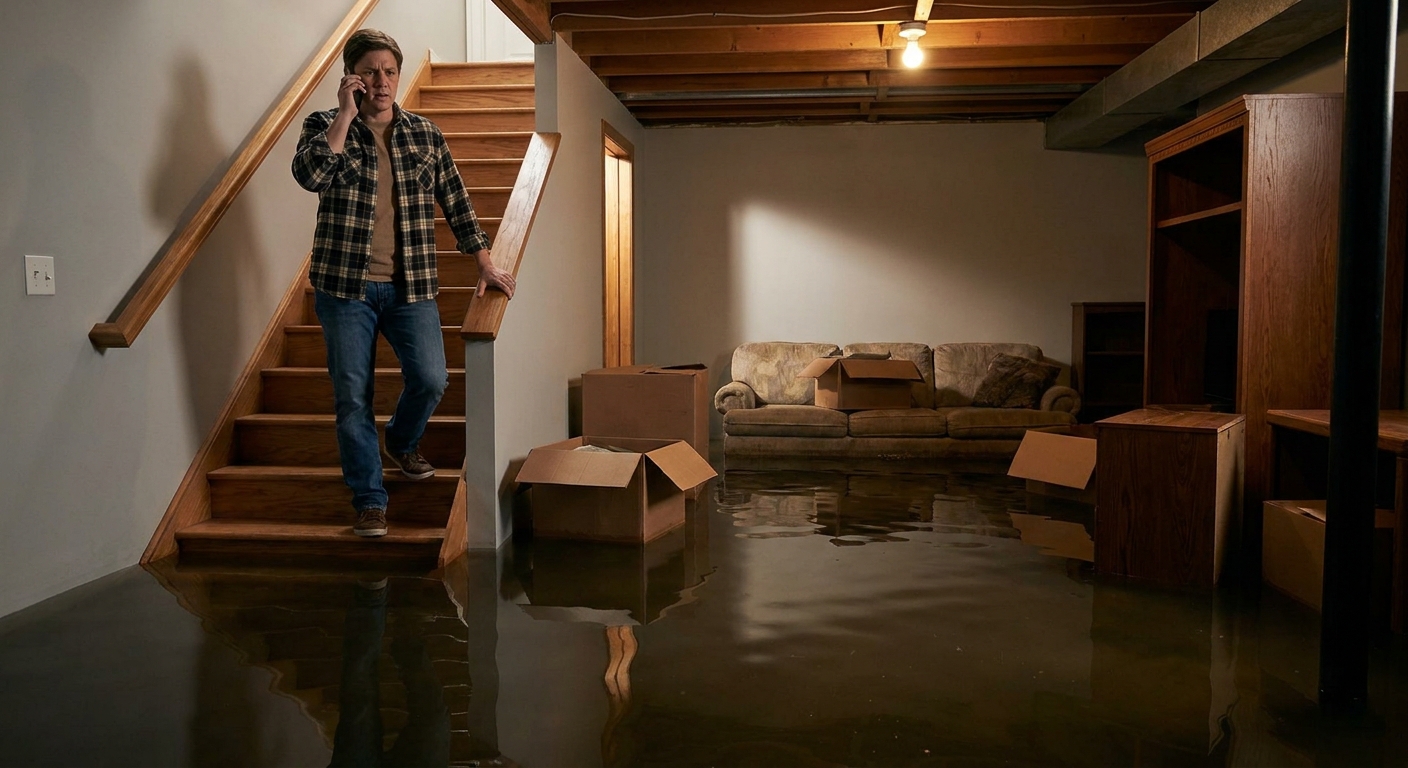
The answer is: it depends entirely on the source of the water. Standard homeowners insurance covers burst pipes and appliance failures but excludes groundwater seepage, surface water from rain, rising water from rivers or storms, and sewer or drain backups unless a specific rider has been added. Understanding where your policy draws the line is critical before disaster strikes, especially since the average cost to clean up a flooded basement is about $4,000, with prices running from $1,500 to $15,000, and most projects ranging from $2,000 to $10,000.
What Standard Home Insurance Covers (and What It Doesn't)
Your standard HO-3 homeowners policy covers water damage that originates inside your home due to an unexpected, accidental event. It does not cover water that enters your home from the outside or that backs up through municipal systems.
✅ Covered: Sudden & Accidental Water Damage
| Cause | Covered? | Notes |
|---|---|---|
| Burst or frozen pipes | ✅ Yes | Must be sudden, not from neglect |
| Water heater failure/overflow | ✅ Yes | Sudden discharge only |
| Washing machine or dishwasher overflow | ✅ Yes | Accidental malfunction |
| Overflow from plumbing fixtures | ✅ Yes | Toilets, sinks, bathtubs |
| Fire-related water damage (sprinklers) | ✅ Yes | Tied to a covered peril |
| Ice dam interior water intrusion | ✅ Yes | Coverage varies by state |
Learn more about burst pipe coverage and how your policy responds to sudden internal failures.
❌ Not Covered: Common Basement Flooding Causes
| Cause | Covered? | Solution |
|---|---|---|
| Flooding from heavy rain or storms | ❌ No | Separate flood insurance (NFIP) |
| Groundwater seepage through walls/floor | ❌ No | Flood insurance or waterproofing |
| Sewer or drain backup | ❌ No | Water backup endorsement |
| Sump pump failure | ❌ No | Sump pump endorsement |
| Long-term leaks or neglect | ❌ No | No coverage available |
| Overflowing rivers, storm surge | ❌ No | Separate flood insurance (NFIP) |
These exclusions are why so many homeowners are blindsided after a basement flood. For a full breakdown of what your policy leaves out, see common home insurance exclusions.

Compare Home Insurance Plans in Ohio
Find your best options in less than 2 minutes
The Water Backup & Sump Pump Endorsement Explained
For most homeowners, the water backup and sump pump endorsement is the single most important add-on you can purchase. It fills one of the biggest gaps left by your standard policy: damage from sewers, drains, and sump pump failures. Following the record-wet late 2025 storm season, many carriers have tightened endorsement wording, raised special deductibles on water-related perils, and now require verified mitigation (backwater valve, battery backup) before approving broader limits.
What Does the Endorsement Cover?
This affordable rider covers water damage caused by:
- Sewer or drain backup into your basement
- Sump pump overflow or mechanical failure
- Clogged interior drain lines that back up
- Resulting damage to your home's structure (walls, flooring, foundation)
- Personal property losses (furniture, electronics, appliances)
- Cleanup and water extraction costs
Typical 2026 Costs and Coverage Limits
| Coverage Option | Annual Cost | Typical Limit |
|---|---|---|
| Basic water backup endorsement | $30 to $70/yr | $5,000 to $10,000 |
| Standard water backup endorsement | $70 to $150/yr | $10,000 to $25,000 |
| Enhanced water backup endorsement | $150 to $250/yr | $25,000+ |
| Standalone sump pump rider | $30 to $75/yr | Varies by insurer |
A water backup endorsement typically costs $30 to $250 per year, with base $5,000 limits running roughly $30 to $70 annually and each additional $5,000 adding about $25 to $35. NerdWallet's 2026 quote sampling found rates as low as $7 per year in some markets for around $8,000 of coverage, while high-limit policies with $25,000+ in protection can run up to $250 annually depending on your ZIP code, home age, and prior claims history.
For a deeper dive into this coverage type, check out this guide to water backup coverage for your home.

Protect your home with State Farm
Average Rate:
Homeowners who bundle and save with State Farm save an average of $1,000 per year!

You're in Good Hands® with Allstate
Average Rate:
Get comprehensive home coverage with flexible policy options.

Customize your home coverage
Average Rate:
Only pay for the coverage you need with personalized home insurance.

Smart coverage for your home
Average Rate:
Protect what matters most with award-winning home insurance.
Flood Insurance vs. Water Backup Coverage: Know the Difference
These two coverage types are often confused, but they are not interchangeable. One covers water coming in from outside; the other covers water backing up from inside.
NFIP Flood Insurance in 2026: What You Should Know
The National Flood Insurance Program (NFIP), managed by FEMA, is the primary source of flood coverage for most US homeowners. FEMA's Risk Rating 2.0 has been fully implemented since April 1, 2023, and it prices NFIP policies based on individual property risk rather than flood zone alone. Key 2026 facts:
- Requires a 30-day waiting period before coverage takes effect, though there are exceptions for new mortgages at closing and 1-day waits for properties newly mapped into a Special Flood Hazard Area
- Maximum residential coverage limits remain $250,000 for building and $100,000 for contents
- The NFIP national average premium is about $926 per year, though NerdWallet's 2026 analysis puts the figure closer to $976 based on the latest NFIP rates
- Annual rate increases are capped at 18% per year for most policyholders under Risk Rating 2.0
- Communities in the Community Rating System (CRS) can earn premium discounts of up to 45% depending on their class rating
- Covers building structure and systems (foundation, HVAC, electrical) but provides limited basement contents coverage
- Does not cover temporary living expenses or vehicles
Under FEMA's Risk Rating 2.0 pricing model, typical new NFIP policies fall between $250 and $1,500 per year, while high-risk coastal ZIP codes (like parts of South Florida) frequently exceed $2,800 and can top $4,000 in the private flood market. Under Risk Rating 2.0, roughly 77% of policyholders have seen premium increases, though FEMA reports that 96% of policyholders see changes of $20 per month or less at renewal. For full details on costs and coverage zones, read our complete guide to water damage and home insurance.
Many experts recommend carrying both NFIP flood insurance AND a water backup endorsement because each covers scenarios the other does not. A creek flooding your basement requires flood insurance; a sewer backing up during a storm requires water backup coverage.
If your home is also at risk from sewer line damage, a service line endorsement may also be worth considering to cover underground pipe repair costs. Learn more about service line coverage for your water and sewer lines, which typically runs just $20 to $100 per year in 2026 (clustering at $30 to $60 for $10,000 to $25,000 in coverage).
Filing a Basement Flood Claim: Documentation & Common Scenarios
Step-by-Step Documentation Checklist
Proper documentation is the difference between a paid claim and a denied one, especially now that insurers are leaning heavily on AI-driven claims tools in 2026. Follow these steps immediately after a basement flood:
- 📸 Photograph and video everything: capture wide shots from doorways and close-ups of water entry points, stains, and structural damage. Include timestamps.
- 🔍 Identify and document the water source: take photos of the burst pipe, backed-up drain, or sump pit. This is critical for proving the cause was covered.
- 📋 Create a written inventory: list all damaged possessions with descriptions, serial numbers, receipts, and estimated replacement costs.
- 🔧 Get contractor repair estimates: collect detailed written estimates before any permanent repairs begin.
- 📁 Review your policy: confirm coverage limits, deductibles, and which endorsements are active before you file.
- 📬 Submit promptly: file your claim with all supporting documentation and follow your insurer's specific submission guidelines.
Common 2026 Claim Scenarios at a Glance
| Scenario | Covered By | Likely Payout |
|---|---|---|
| Pipe bursts and floods basement | Standard HO-3 | Repairs + contents, minus deductible |
| Water heater fails and floods | Standard HO-3 | Repairs + contents, minus deductible |
| Sump pump fails during storm | Water backup endorsement | Up to endorsement limit ($5K to $25K) |
| Heavy rain causes groundwater seepage | Flood insurance (NFIP) | Building structure, limited contents |
| Sewer backs up through floor drain | Water backup endorsement | Up to endorsement limit |
| River overflows and floods basement | Flood insurance (NFIP) | Building structure, limited contents |
| Slow leak ignored for months | No coverage | Out of pocket |
Water damage can also lead to mold growth, a secondary issue that carries its own coverage complications. Learn about mold coverage in home insurance to understand when remediation costs are reimbursed, since most 2026 policies cap mold payouts between $1,000 and $10,000.
Prevention Measures Insurers May Require or Reward
Preventing basement flooding isn't just smart, it can lower your premiums by 5% to 15% and may be required by your insurer to maintain certain endorsements. Because carriers are tightening backup wording after 2025 storm losses, mitigation is more valuable than ever:
- Battery-backup sump pump: reduces risk during power outages; often required for sump pump coverage
- Backwater valves: prevents sewer water from flowing back into your home; may qualify for municipal subsidies and 5% to 12% insurance discounts
- Perimeter or interior drainage systems: signals lower risk to adjusters and may earn 5% to 10% discounts
- Full basement waterproofing: strengthens borderline claims and may reduce endorsement costs
- Elevating utilities above base flood elevation: reduces NFIP premiums and limits damage potential
- Smart leak detectors and water shutoff valves: some carriers offer additional premium discounts
For a broader view of how water damage impacts your policy, review our guide on water damage coverage rules. You can also see how these same rules apply to broader plumbing coverage questions in your home, or check whether your foundation is protected from water-related structural damage.
Frequently Asked Questions
Does homeowners insurance cover a flooded basement from heavy rain?
No. Standard homeowners insurance does not cover basement flooding caused by heavy rain, groundwater, or any water that originates outside your home. You would need a separate flood insurance policy, typically through NFIP, to be covered for rain-driven flooding. The 30-day waiting period means you must purchase this coverage well before a storm season begins.
What is the difference between water backup coverage and flood insurance?
Water backup coverage (an endorsement on your homeowners policy) covers damage from sewer or drain backups and sump pump failures, water originating inside your plumbing system. Flood insurance covers damage from external water events like rising rivers, storm surge, or heavy rainfall pooling outside and entering your home. They cover different causes, and you may need both for complete basement protection.
How much does a water backup endorsement cost in 2026?
Most homeowners can add a water backup and sump pump endorsement to their existing policy for roughly $30 to $250 per year in 2026, with basic $5,000 limits available for as little as $30 to $70 annually. Each additional $5,000 of coverage typically adds about $25 to $35 per year. The exact cost depends on your insurer, home location, home age, and the coverage limit you choose.
Will insurance cover a flooded basement if my sump pump fails?
Not under a standard homeowners policy, since sump pump failure is explicitly excluded. However, if you have added a water backup and sump pump endorsement, the resulting water damage would typically be covered up to your endorsement's limit (commonly $5,000 to $25,000). Note that the endorsement covers the damage caused by the failure, not the cost to repair or replace the sump pump itself.
What should I do immediately after my basement floods to protect my insurance claim?
Stop the water source if it is safe to do so, then document everything thoroughly with timestamped photos and video before moving or discarding anything. Identify and photograph the source of the water entry, create an inventory of all damaged property, and contact your insurer to report the claim as soon as possible. Do not make permanent repairs until your adjuster has inspected the damage, since premature repairs can complicate or reduce your settlement.