
Compare Home Insurance Plans in Ohio
Find your best options in less than 2 minutes



What Standard Home Insurance Does (and Doesn't) Cover for Sewer Lines
When it comes to your home's sewer system, most homeowners operate under a dangerous assumption: that their homeowners insurance policy has them covered. The reality is far less reassuring. Standard homeowners insurance does not cover sewer line repair or replacement in most circumstances. While your policy protects your home against sudden, accidental perils like fire, lightning, or windstorms, it draws a firm line at the underground pipes running from your home to the city main.
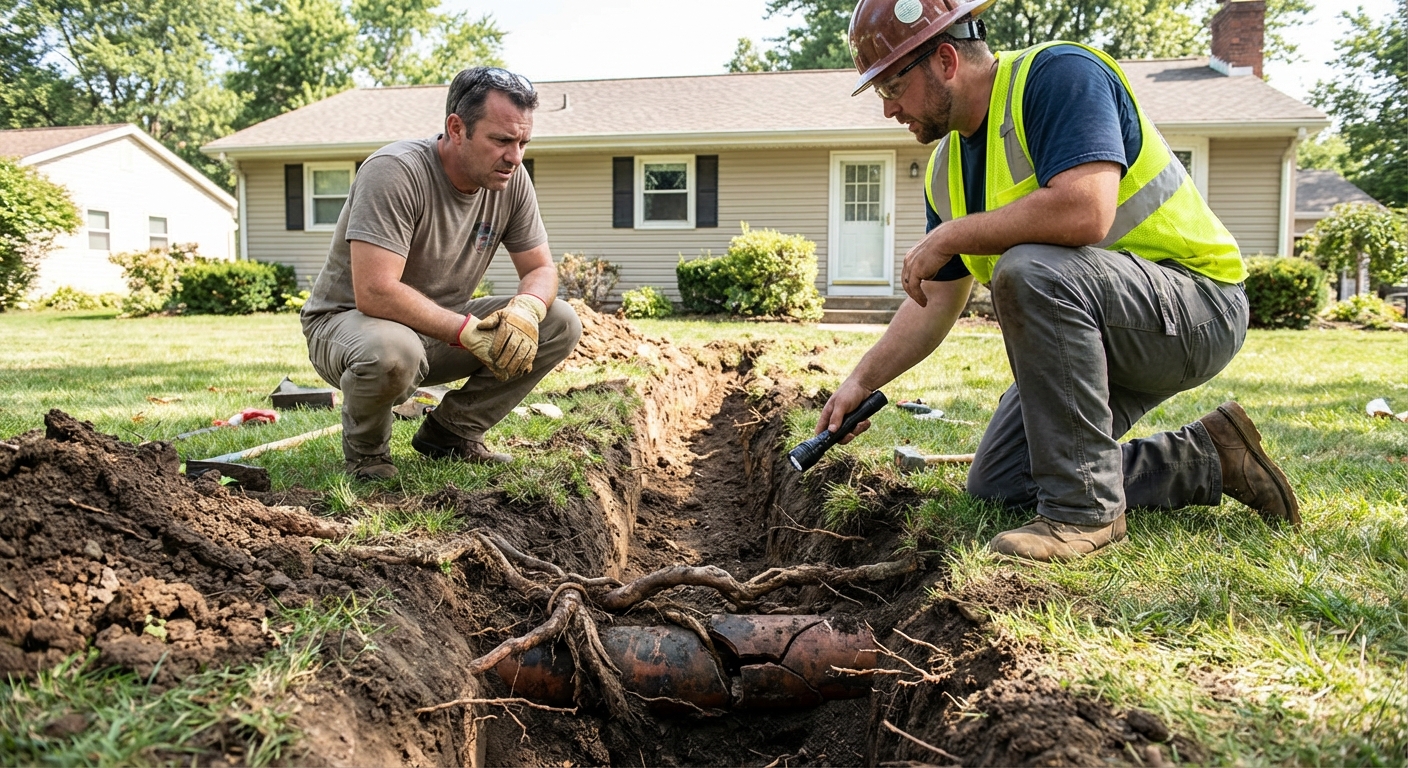
Your sewer lateral, the pipe that connects your home to the municipal sewer system, runs beneath your yard and is entirely your responsibility as a homeowner. Standard homeowners insurance typically excludes the sewer lateral outside your home because policies are built around sudden, accidental events, not the gradual deterioration of buried pipes. If a contractor's excavator cracks that line, or a decades-old clay pipe finally collapses, the bill lands squarely on you.
When Standard Coverage *May* Apply
There is a narrow exception. A standard homeowners insurance policy can protect your sewer line from covered perils including severe weather, explosions, falling objects such as a tree, fires, vandalism, and damage caused by a vehicle or aircraft. Your policy's "other structures" coverage (Coverage B) might then apply, typically capped at 10% of your dwelling limit. For example, on a $300,000 home, that's a $30,000 ceiling, but only for damage from a covered event, not the everyday causes that actually destroy most sewer lines.
What Standard Policies Exclude for Sewer Lines
| Excluded Cause | Why It's Not Covered |
|---|---|
| Tree root intrusion | Considered a maintenance issue, not a sudden peril |
| Pipe corrosion or rust | Normal wear and tear |
| Ground shifting or soil movement | Gradual process, not a covered event |
| Clogs or poor maintenance | Homeowner's responsibility |
| Aging or deteriorating pipes | Excluded under wear and tear |
| Floods or earthquakes | Require separate policies |
For a deeper look at how insurers treat pipe-related issues, see our guide on homeowners insurance plumbing coverage.

Compare Home Insurance Plans in Ohio
Find your best options in less than 2 minutes
Sewer Backup Coverage vs. Sewer Line Coverage: They Are Not the Same
This is where many homeowners get confused, and where a coverage gap can cost you tens of thousands of dollars. Sewer backup coverage and sewer line coverage are two entirely different products, and you likely need both.
Sewer Backup Coverage (Water Backup Endorsement)
A sewer backup occurs when sewage or water reverses course through your pipes and floods into your home through floor drains, toilets, or utility sinks. This is a nightmare scenario, and sewage cleanup alone can run $3,000 to $10,000 or more.
A sewer backup endorsement (sometimes called water backup coverage) protects against the damage inside your home caused by this event. This includes damage to floors, walls, cabinets, drywall, and carpeting, plus damage to personal property like furniture and appliances such as the furnace or water heater. However, it does not pay to fix the sewer line or underground pipe that caused the backup. Learn more in our full water backup coverage guide.
Sewer Line Coverage (Service Line Endorsement)
A service line endorsement is designed specifically to cover the repair or replacement of the underground pipe itself, including the digging, the repair, pipe replacement, and restoring your lawn afterward. It does not cover the water damage inside your home that resulted from a backup.
Bottom line: For complete protection, most homeowners need both endorsements. Our service line coverage guide explains how these add-ons work together across major insurers.

Protect your home with State Farm
Average Rate:
Homeowners who bundle and save with State Farm save an average of $1,000 per year!

You're in Good Hands® with Allstate
Average Rate:
Get comprehensive home coverage with flexible policy options.

Customize your home coverage
Average Rate:
Only pay for the coverage you need with personalized home insurance.

Smart coverage for your home
Average Rate:
Protect what matters most with award-winning home insurance.
How Service Line Coverage Endorsements Work and What They Cost
Adding sewer line protection to your homeowners policy is often surprisingly affordable. A service line coverage endorsement is a rider you attach to your existing policy, no separate insurer needed in most cases.
What It Covers
Service line coverage can pay to fix damaged water, gas, sewer, or other underground utility lines. Insurers typically cover damage from wear and tear, leaks, root invasion, mechanical or electrical failure, blockage, bursting or collapse, rust or corrosion, freezing, and rodents or other animals.
Service line endorsements typically include:
- Repair or full replacement of a broken sewer lateral
- Excavation to access buried pipes
- Restoring your lawn, driveway, or landscaping after the dig
- Other buried utilities: water, gas, electrical, and telecom lines (varies by policy)
Typical Costs and Coverage Limits in 2026
The cost of service line coverage depends on where you live and how much coverage you want. Most homeowners pay roughly $20 to $100 per year in 2026, with many carriers clustering around $30 to $60 annually for a standard endorsement. Some insurers advertise plans as low as $9 per year for newer homes, while enhanced or higher-limit plans can push premiums toward $75 to $100. Coverage limits typically fall between $10,000 and $25,000 per occurrence, with a $500 deductible being the most common (some insurers use $1,000).
Alternatives: Service Line Warranty Programs
If your insurer doesn't offer a service line endorsement, or if you want coverage focused on wear-and-tear failures, a standalone service line warranty (offered by third-party providers like Service Line Warranties of America, often marketed through your city or utility company) may be an option. In 2026, SLWA plans commonly run from around $5 to $15 per month for individual line plans, with some broader multi-line packages ranging as high as $50 per month depending on ZIP code and benefit amount. Typical example rates include roughly $5.99/month for exterior water line coverage (about $7,000 annual benefit) and $6.24/month for exterior sewer/septic line coverage (about $10,000 annual benefit), with no service call fees on most plans.
| Feature | Insurance Endorsement | Service Line Warranty |
|---|---|---|
| Typical Annual Cost | $20 to $100 | $60 to $180 |
| Coverage Limit | $10,000 to $25,000 | $7,000 to $10,000 per incident |
| Covers Wear & Tear | Often Yes | Yes |
| Interior Damage Covered | No (separate add-on) | No |
| Deductible/Service Fee | ~$500 | None |
| Claims History Impact | Yes (insurance claim) | No |
For most homeowners, an insurance endorsement offers broader coverage limits at a lower annual cost, but warranty programs offer a no-deductible, turnkey repair experience. Explore how service line protection compares across major home insurance providers.
What Causes Sewer Line Damage? (And Why Insurance Often Won't Pay)
Understanding why sewer lines fail is key to understanding why most damage isn't covered by standard insurance, and why an endorsement is so valuable.
The Top 3 Causes of Sewer Line Damage
1. Tree Root Intrusion
Tree roots are the leading cause of residential sewer line failures. Roots naturally seek out the moisture and nutrients inside underground pipes. They infiltrate through tiny cracks or loose pipe joints, common in older clay or cast iron lines, and grow until they crack, block, or collapse the pipe entirely. Because this is a gradual process, standard insurance excludes it entirely.
2. Aging and Corroded Pipes
Homes built before the 1980s often have clay, cast iron, or Orangeburg pipes that are well past their useful life. These materials become brittle over time and are vulnerable to cracking. Hydrogen sulfide gas from waste breakdown reacts with moisture to form sulfuric acid, which slowly eats through pipe walls. Insurance classifies this as wear and tear, an exclusion in virtually every standard policy. Similar issues affect indoor plumbing, as detailed in our guide to water damage coverage.
3. Ground Shifting and Soil Movement
Soil expands and contracts with seasonal moisture changes, and in earthquake-prone or clay-heavy regions, ground movement can crack or misalign underground pipes. Construction activity, settling foundations, and even heavy vehicle traffic can stress rigid pipes enough to cause breaks. Again, because this is typically gradual, standard home insurance doesn't cover it.
If you have a septic system rather than a sewer connection, our septic system insurance guide explains how coverage rules differ. And if you're worried about flooding as a secondary risk, review the basement flooding coverage guide.
Frequently Asked Questions
Does homeowners insurance cover a broken sewer pipe?
Standard homeowners insurance only covers a broken sewer pipe if it was caused by a listed covered peril, such as a sudden explosion or vandalism. Damage from tree roots, aging, ground shifting, or corrosion (the most common causes) is typically excluded as wear and tear. To cover most real-world sewer pipe breaks, you'll need to add a service line endorsement to your policy.
What's the difference between sewer backup and sewer line coverage?
Sewer backup coverage (also called water backup coverage) pays for water and sewage damage inside your home, such as flooring, drywall, and belongings. Sewer line coverage (a service line endorsement) pays to repair or replace the actual pipe underground. They cover different parts of the same problem, which is why many homeowners need both.
How much does it cost to add sewer line coverage to a home insurance policy in 2026?
A service line endorsement typically costs between $20 and $100 per year in 2026, with most carriers clustering around $30 to $60 for a standard $10,000 limit. Higher $25,000 limits or premium endorsements can run $75 to $100 annually, and the standard deductible is usually $500. Given that a full sewer line replacement can cost $50 to $250 per linear foot, this is one of the most affordable and valuable endorsements available.
Does home insurance cover main sewer line replacement if roots are involved?
No, in nearly all cases tree root damage to a sewer line is excluded from standard homeowners insurance as a maintenance-related issue. However, if you've added a service line endorsement, root damage is often a covered cause. Always verify the specific causes listed in your endorsement before a problem arises.
Are service line warranties worth buying instead of an endorsement?
Service line warranties can be useful, particularly for older homes with pipes prone to wear-and-tear failures, and they typically have no deductible and no claim on your insurance record. However, they usually offer lower per-incident coverage limits ($7,000 to $10,000) at a similar or slightly higher annual cost than an insurance endorsement. For most homeowners, a service line endorsement added to an existing policy provides broader value, but a warranty program is a reasonable backup if your insurer doesn't offer one.