
Compare Home Insurance Plans in Ohio
Find your best options in less than 2 minutes



What Is Service Line Coverage?
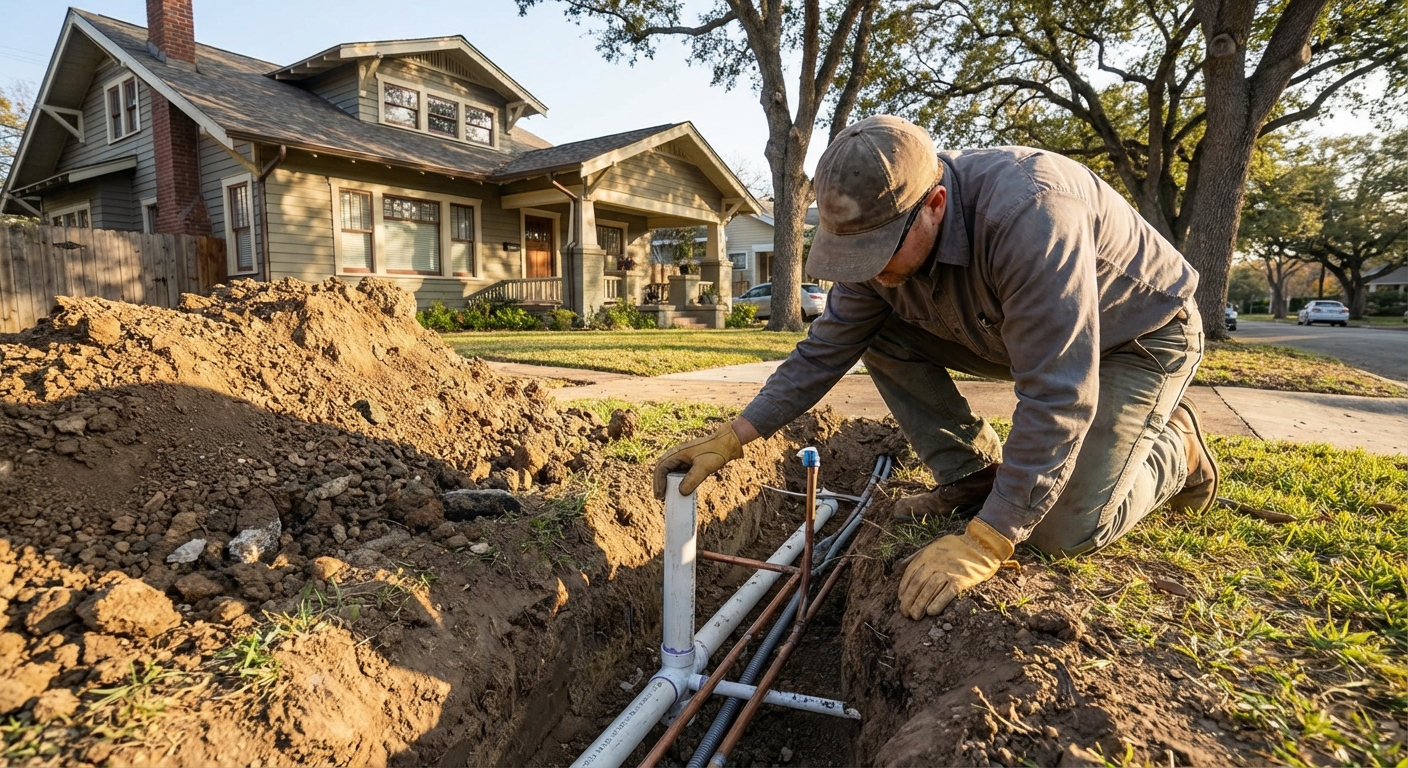
Service line coverage is an optional endorsement you can add to your homeowners insurance policy that protects the underground utility lines running between your home and the public utility connection at the street. These lines, including water, sewer, gas, electrical, and often cable, phone, internet, or fiber optic, are entirely your financial responsibility once they cross onto your property. Most homeowners don't realize this until they're staring at a $5,000+ repair bill.
Standard homeowners insurance treats underground service lines as a maintenance responsibility, not a covered peril. That means damage caused by wear and tear, corrosion, tree root intrusion, or ground movement is excluded from your base policy. Service line coverage fills that gap by paying for excavation, pipe repair or replacement, and even landscaping restoration after the work is done.
Coverage limits in 2026 typically range from $10,000 to $25,000 per occurrence, with most policies carrying a $500 deductible (buy-up tiers up to $50,000 are available from some carriers). Many insurers offer the endorsement through a specialty underwriter such as Hartford Steam Boiler, which is why the terms look similar across carriers. Safeco, for example, covers up to $12,000 for physical loss or damage caused by a service line failure and prices the endorsement at less than $3 per month (around $30 per year). Nationwide's endorsement goes further, also covering the cost of repairing or replacing outdoor property like trees, shrubs, plants, lawns, and sidewalks, and paying additional living expenses if you have to vacate the home during repairs. The Hanover pays up to the limit on your policy for covered service line failures, and may pay up to 150% of replacement cost when green materials are used. The endorsement is widely available from major insurers including Allstate, State Farm, Nationwide, Farmers, American Family, The Hanover, Liberty Mutual, Travelers, Progressive, Auto-Owners, Country Financial, Erie, Mercury, Safeco, Westfield, Andover, Lemonade, and Kin, though terms and availability vary by state.

Compare Home Insurance Plans in Ohio
Find your best options in less than 2 minutes
Why Standard Homeowners Insurance Won't Cover This
Your homeowners insurance is designed to cover sudden and accidental damage to your home's structure, not the gradual deterioration of underground utility infrastructure. Insurers classify service line damage as a maintenance issue, which places it squarely outside the scope of dwelling or other structures coverage.
Here's the key boundary to understand: your utility company owns and maintains the main lines in the street. The moment those lines cross onto your property, ownership and maintenance responsibility transfers entirely to you. That includes the full run of pipe or wire from the property line to your home's connection point.
So when a tree root cracks your sewer line 20 feet from the street, or a deep freeze splits your water main underground, you're on the hook. Not your utility company. Not your standard homeowners policy.
To fill this gap, your options are:
- Add a service line endorsement to your existing homeowners policy (most cost-effective)
- Purchase a standalone service line protection plan through your utility company or a warranty provider (often more expensive)
- Self-insure by keeping emergency savings on hand (risky given today's repair costs)
Learn more about how water damage coverage works under a standard homeowners policy and where the gaps exist. For a broader look at policy add-ons, our home insurance endorsements guide explains how riders can close other common coverage gaps.

Protect your home with State Farm
Average Rate:
Homeowners who bundle and save with State Farm save an average of $1,000 per year!

You're in Good Hands® with Allstate
Average Rate:
Get comprehensive home coverage with flexible policy options.

Customize your home coverage
Average Rate:
Only pay for the coverage you need with personalized home insurance.

Smart coverage for your home
Average Rate:
Protect what matters most with award-winning home insurance.
How Much Does a Broken Service Line Cost to Repair?
The financial risk is real, and 2026 repair costs have continued to climb with labor and material inflation. Costs vary widely based on the type of line, depth, length, and repair method, but they're rarely cheap once excavation is involved. Here's a realistic breakdown of what homeowners face today.
Sewer Line Repair Costs (2026 National Averages)
| Repair Type | Average Cost Range |
|---|---|
| Spot repair (crack or joint) | $1,200 – $4,500 |
| Broken pipe segment repair | $2,500 – $7,000 |
| Partial replacement (up to 50 ft) | $3,000 – $8,000 |
| Trenchless lining or pipe bursting | $4,000 – $15,000 |
| Full excavated replacement (50 to 80 ft) | $4,000 – $12,000 |
| Complex full replacement (100+ ft, deep) | $10,000 – $30,000+ |
Per 2026 HomeAdvisor data, the national average sewer line replacement runs about $3,319, with most homeowners spending between $1,388 and $5,323. Broader 2026 industry data now places typical residential sewer replacement in the $3,000 to $10,000 range, with per-foot pricing of $50 to $250 and $150 per foot as a common national midpoint. Trenchless pipe bursting typically runs $80 to $200 per linear foot, and cured-in-place lining (CIPP) runs $135 to $250 per linear foot. National mid-range benchmarks from other 2026 guides sit closer to $6,000 to $8,000, and complex urban jobs can push totals well past $15,000. Seattle homeowners, for example, now pay between $10,000 and $32,000 for a full sewer line replacement in 2026, and 100-foot suburban replacements can exceed $30,000 once driveways and landscaping factor in.
Water Service Line Repair Costs (2026)
| Repair Type | Average Cost Range |
|---|---|
| Small leak or valve repair | $350 – $1,700 |
| Corroded or broken pipe (partial) | $1,500 – $3,500 |
| Full trenched replacement | $2,500 – $8,000 |
| Trenchless pipe bursting | $3,200 – $8,000 |
| Long or urban runs (100+ ft) | $8,000 – $15,000+ |
Most 2026 water line replacement projects land between $2,500 and $8,000, with a national median near $5,500 for a typical 50 to 80 foot residential service line. The cost driver in nearly every case is excavation, not the pipe itself. Per-foot costs typically run $50 to $150 for traditional dig-and-replace, with trenchless methods running $70 to $250+ per foot. Lead service line replacements are particularly expensive: the EPA estimates an average cost of about $4,700 per line, with a cited range of $1,200 to $12,300. However, fuller cost models from EPA and AWWA data now put average full lead line replacement closer to $9,900 to $12,500 once utility-side work and restoration are included, and cities like Washington, D.C. have reported per-line replacement costs above $21,000, with Chicago averaging near $31,000 per line. Once you factor in permits, hardscape replacement (concrete driveways, sidewalks), and landscape restoration, even a "simple" job can quickly exceed $10,000.
Common Causes of Service Line Damage
Understanding why lines fail helps you assess your own risk level:
- Tree root intrusion. The #1 cause of sewer line damage. Roots exploit tiny cracks and separated joints in aging pipes, then expand to cause blockages and eventual collapse. Older clay, cast iron, and galvanized lines are especially vulnerable.
- Aging and corrosion. Homes built before the 1980s typically used cast iron, galvanized steel, or clay pipes. Lead service lines last 50 to 70 years, galvanized steel roughly 40 to 50, and soil chemistry and water minerals accelerate breakdown.
- Freezing and frost heave. Water inside service lines freezes and expands during extreme cold, causing pipes to burst or crack. Older installations often sit above the modern frost line and are especially at risk.
- Ground shifting and soil movement. Erosion, heavy rainfall, drought, seismic activity, or nearby construction can shift soil and stress buried pipes, causing misalignment or joint separation.
- Excavation and physical damage. Landscaping accidents, fence installations, and pool projects damage lines when contractors dig without properly locating utilities first.
- Rodents and animals. Rodents can chew through cable, fiber, and softer plastic utility lines, causing service interruptions and expensive repairs.
- Artificially generated electric current. Stray voltage or arcing can damage electrical service lines, and most endorsements list this as a covered cause of loss.
For burst-pipe risks specifically, see our guide on how homeowners insurance covers plumbing and how to qualify for coverage.
Service Line Coverage vs. Water Backup Coverage
These two endorsements are often confused, and sometimes sold together, but they protect against very different problems. Understanding the distinction helps you make sure you're not overpaying for redundant coverage or, worse, assuming you're covered when you're not.
In plain terms:
- Service line coverage = the pipe or line outside your home breaks and needs to be repaired or replaced
- Water backup coverage = a drain, sewer, or sump pump inside your home backs up and causes interior water damage
Both are optional endorsements excluded from standard homeowners policies, and both are worth considering, especially for older homes. Many insurers offer a discount when you bundle them together. For more on the interior-damage side, see our full water backup coverage guide and learn how basement flooding coverage fits in.
Do You Need Service Line Coverage?
For some homeowners, this endorsement is a near-must-have. For others, the risk may be lower. Here's how to evaluate your situation.
Who Needs It Most
Owners of older homes face the greatest exposure. Homes built before the 1980s likely have clay, cast-iron, or galvanized steel service lines that are decades past their intended lifespan. Corrosion and structural degradation are virtually inevitable.
Homes with mature trees are at elevated risk of root intrusion, particularly when large trees (willow, poplar, silver maple, elm) are planted within 10 to 15 feet of underground lines. Roots can travel 30+ feet in search of moisture.
Homeowners in freeze-prone regions face seasonal risks from pipe bursting due to deep frost penetration and freeze-thaw soil movement.
Homes in areas with unstable soil, expansive clay, or frequent seismic activity face higher risk of ground-shift damage to underground lines.
Cost of the Endorsement (2026)
| Coverage Type | Typical Annual Cost | Coverage Limit |
|---|---|---|
| Service line endorsement | $30 – $60/year | $10,000 – $25,000 |
| Higher-limit endorsement ($20k+) | $50 – $80/year | $20,000 – $50,000 |
| Newer-home discount rates | As low as $9/year | $10,000 |
| Utility company plan | $85 – $240/year per line | Varies |
| Self-insuring (emergency fund) | $0/year | Whatever you save |
At $30 to $60 per year, a service line endorsement added to your homeowners policy is the most cost-effective option for most homeowners. For comparison, standalone utility protection programs, such as Service Line Warranties of America and the NYC DEP Service Line Protection Program, charge roughly $85 for water line coverage and $143+ for sewer line coverage, totaling well over $200 per year. Stack that against average repair claims of $3,500 to $8,500, and the math is straightforward.
This endorsement pairs well with equipment breakdown coverage, which protects your home's major systems and appliances from sudden mechanical failure, another gap your standard policy won't fill. For a deeper dive on sewer-specific coverage, see our sewer line repair coverage guide and our companion breakdown of common home insurance exclusions.
Homeowners with private wells or septic systems should also review our well water coverage guide and septic system coverage breakdown, since service line endorsements typically exclude these self-contained systems.
Frequently Asked Questions
Does homeowners insurance cover sewer line replacement?
No, standard homeowners insurance does not cover sewer line repair or replacement. Sewer lines are considered a maintenance responsibility of the homeowner, and damage from causes like root intrusion, corrosion, or aging is excluded from base policies. You'll need to add a service line endorsement to your homeowners policy to get this protection. For a deeper dive, see our guide on sewer line repair coverage.
What is the difference between service line coverage and water backup coverage?
Service line coverage pays for the repair or replacement of underground utility lines outside your home (water, sewer, gas, or electrical) when they are damaged. Water backup coverage pays for interior water damage caused by a backed-up drain, sewer, or sump pump failure inside your home. They address different problems: one covers the buried infrastructure, the other covers damage inside your living space. Many homeowners benefit from carrying both.
How much does a service line endorsement cost per year in 2026?
Most service line endorsements cost between $30 and $60 per year in 2026 when added to an existing homeowners insurance policy, with newer homes sometimes qualifying for rates as low as $9 per year. Higher limits of $20,000 to $25,000 typically run $50 to $80 per year, and the broader market range across carriers is $20 to $100. Utility company protection programs tend to cost significantly more, often $85 to $240 per year for combined water and sewer line coverage, making the endorsement route the better value for most homeowners.
What types of service lines are covered?
A service line endorsement typically covers water supply lines, sewer and drain lines, natural gas lines, electrical lines, and often cable, phone, internet, and fiber optic lines as well. Coverage applies to lines that are on your property, owned by you or legally your maintenance responsibility, and run from the public utility connection to your home. Septic systems, water wells, irrigation lines, and liquid fuel tanks are typically excluded.
Are older homes worth adding service line coverage to?
Absolutely. Older homes are actually the highest priority for service line coverage. Homes built before the 1980s often have original clay, cast-iron, or galvanized steel service lines that are well past their useful life and highly susceptible to corrosion, cracking, and root intrusion. For these properties, a service line failure is less a matter of if and more a matter of when, and the low annual cost of the endorsement makes it a smart financial safeguard.