
Compare Home Insurance Plans in Ohio
Find your best options in less than 2 minutes



Average Home Insurance Costs in Arizona
Arizona sits in the middle of the national pack for homeowners insurance, but the "average" varies widely depending on whose data you look at and how much dwelling coverage you carry. For a typical owner-occupied home with $300,000 of dwelling coverage, most 2026 analyses put Arizona's average premium in the $2,300 to $2,600 range. Insurance.com pegs Arizona at about $2,344 per year, LendingTree lists $2,623, Insure.com's 2026 study lands at $2,468, and Insuranceopedia reports $2,355 as of June 2026. That's slightly below the national average of roughly $2,490 to $2,543 depending on the source.
A reasonable planning range for 2026 is $2,300 to $2,800 per year for a standard policy, with premiums trending upward. Realtor.com, citing Consumer Federation of America data, reports Arizona's average annual premium rose about 48% from 2019 to 2024, far outpacing general inflation. For a broader look at how rates are moving nationwide, see our guide on cheapest and most expensive states.
Average premiums by Arizona city
Rates can swing significantly between metro Phoenix, the high country, and rural southern Arizona. Here's how the major markets stack up for a mid-range home in 2026:
| City | Estimated Annual Premium | Key Risk Factors |
|---|---|---|
| Phoenix | $2,700 - $2,900 | Monsoon wind, hail, extreme heat |
| Tucson | $2,400 - $3,000 | Monsoon storms, wildfire on city edges |
| Scottsdale | $2,800 - $3,500 | Higher rebuild costs, wildfire adjacency |
| Flagstaff | $2,500 - $4,000 | Wildfire, winter weather, hail |
Insurify lists Phoenix at $2,709, MoneyGeek at $2,792, Insuranceopedia at $2,811, and Insure.com at $2,886, so a working average near $2,800 per year is realistic for the state capital. Scottsdale typically runs higher because home values and replacement costs sit well above the state median. Flagstaff and Tucson bounce between the state average and much higher figures depending on wildfire exposure and dwelling size. LendingTree data shows Arizona city rates ranging from $2,080 in San Luis to $3,458 in Forest Lakes, showing how much geography matters.

Compare Home Insurance Plans in Ohio
Find your best options in less than 2 minutes
Why Arizona Is Cheaper Than Many States
Compared to states like Texas, Oklahoma, Florida, and Louisiana, Arizona still enjoys relatively moderate home insurance premiums. A few structural reasons explain why:
- No hurricanes or coastal wind exposure. Arizona is landlocked, so insurers don't price in coastal hurricane risk the way they do for Gulf and Atlantic states like Florida.
- Limited tornado activity. Arizona sees far fewer severe tornadoes than the Plains, sparing homeowners from the steep wind/hail percentage deductibles common in Oklahoma's home insurance market.
- No earthquakes of consequence. Unlike Washington's seismic exposure, Arizona doesn't require routine earthquake endorsements.
- Lower humidity and freeze losses. Pipe bursts, ice dams, and mold claims that drive up rates in colder Midwest states are rare across most of Arizona.

Protect your home with State Farm
Average Rate:
Homeowners who bundle and save with State Farm save an average of $1,000 per year!

You're in Good Hands® with Allstate
Average Rate:
Get comprehensive home coverage with flexible policy options.

Customize your home coverage
Average Rate:
Only pay for the coverage you need with personalized home insurance.

Smart coverage for your home
Average Rate:
Protect what matters most with award-winning home insurance.
Wildfire and Monsoon Storm Risks
While Arizona avoids hurricanes and earthquakes, the state faces two major natural perils that directly affect coverage and cost: wildfires and the summer monsoon.
Wildfire is the dominant peril
Wildfire is considered the largest insured peril for Arizona homeowners, and 2026 is a pivotal year for how the market handles it. A University of Arizona Cooperative Extension analysis found the statewide non-renewal rate was about 0.8% in 2023, well below Florida's 2.99% but with certain Arizona counties hitting up to 4.8% in a single year. Reporting on carrier behavior since 2022 identifies wildfire-sensitive corridors like Cave Creek, New River, Anthem, Carefree, and the Prescott foothills as places where non-renewals have accelerated. A 2025 Cotality analysis cited by Axios found Arizona has nearly 124,000 homes at moderate or higher wildfire risk, with Scottsdale and Prescott among the most exposed markets.
Insurers use tools like a fire line score that rates your property based on surrounding vegetation, slope, road access, and distance to fire response resources. Homes with higher scores typically pay higher premiums and may struggle to find coverage at all. Arizona does not have a state-run FAIR Plan, so once admitted carriers decline, homeowners must turn to surplus lines carriers that often charge 30% to 100% more. For deeper strategies, see our guide to high-risk home insurance options.
Standard homeowners policies do cover wildfire damage to the dwelling, other structures, personal property, and additional living expenses. For a deeper look at coverage gaps in fire-prone areas, see our guide to wildfire insurance coverage.
Monsoon storms bring wind, hail, and flooding
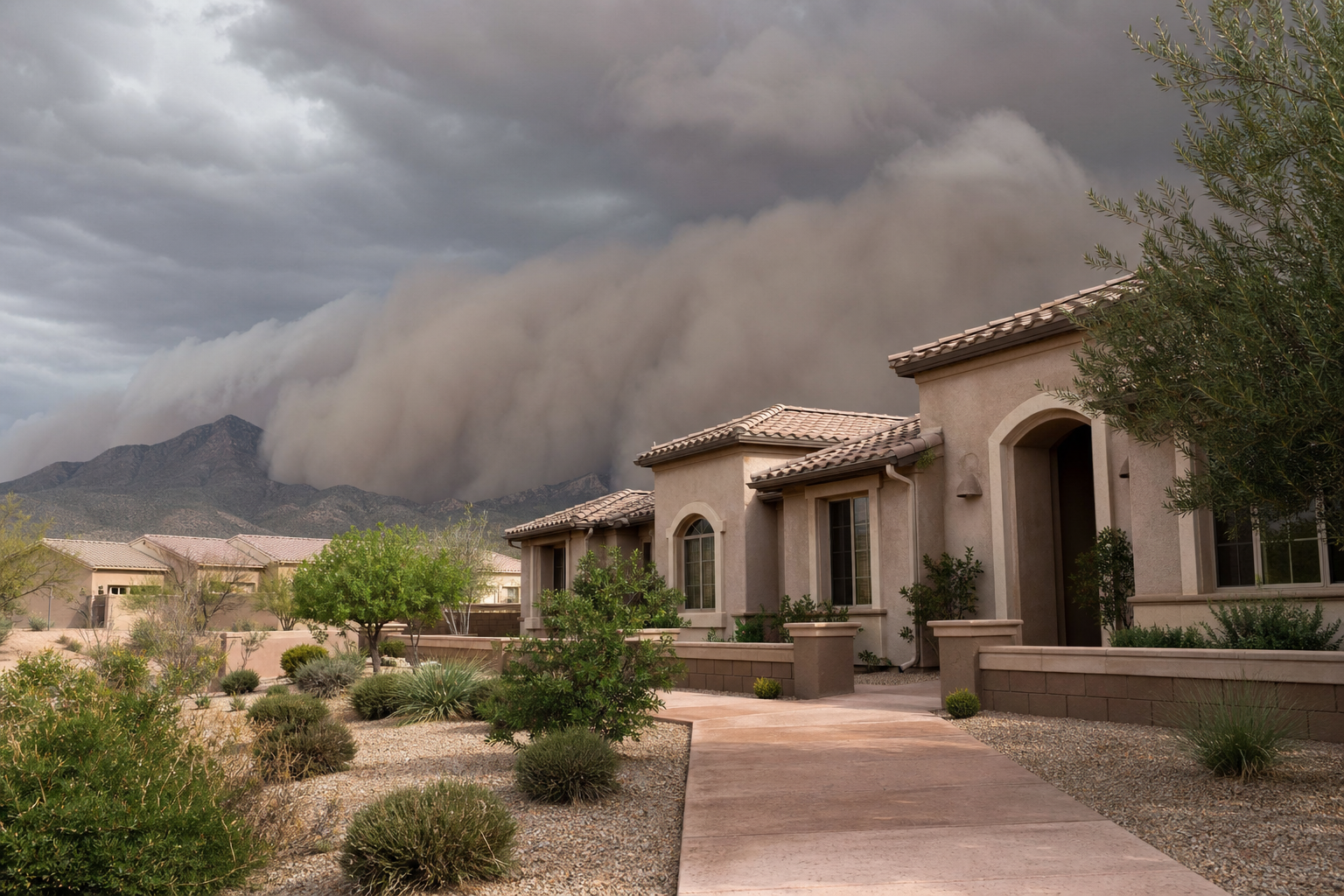
Arizona's monsoon season runs roughly from mid-June through September and delivers severe thunderstorms with high winds, dust storms (haboobs), hail, lightning, and intense rainfall. Wind and hail damage to roofs, siding, and windows is generally covered under standard policies, though some carriers apply percentage-based wind/hail deductibles. Our guide to severe convective storms and home insurance explains how these deductibles work.
Standard Arizona home insurance policies exclude flood damage, including the flash flooding that monsoon storms routinely cause. If your property sits near a wash, in a low-lying area, or downstream of a burn scar, you need a separate flood policy through the NFIP or a private flood insurer.
Common Coverage Requirements in Arizona
Arizona doesn't legally require homeowners insurance, but if you have a mortgage, your lender will. Most standard HO-3 policies in Arizona include six core coverages:
| Coverage | What It Pays For |
|---|---|
| Dwelling (Coverage A) | Rebuild or repair the home structure |
| Other Structures (B) | Detached garages, sheds, fences, walls |
| Personal Property (C) | Furniture, electronics, clothing, belongings |
| Loss of Use (D) | Hotel, food, and living costs during repairs |
| Personal Liability (E) | Injury or property damage lawsuits |
| Medical Payments (F) | Minor guest injuries regardless of fault |
Lenders typically require dwelling coverage at least equal to your loan balance and liability limits of $100,000 to $300,000. Most Arizona homeowners should consider raising liability to $300,000 or $500,000 and adding an umbrella policy if they have meaningful assets. Because Arizona is a "use and file" rate state under A.R.S. § 20-385, insurers can raise rates and then file the change within 30 days, so shopping annually is more important than ever.
Top-Rated Home Insurance Companies in Arizona
Several insurers consistently rank at the top of Arizona homeowner reviews for 2026. LendingTree, Insurance.com, Insuranceopedia, and ValuePenguin all name State Farm as the best overall pick for most Arizona homeowners, thanks to below-average rates (roughly $1,334 to $1,740 annually in several samples, about 49% below the state average per MoneyGeek) and a large local agent network. Travelers, Chubb, USAA, American Family, Amica, and Auto-Owners round out the top tier.
Rates by carrier vary widely. Insuranceopedia's 2026 data puts State Farm at $1,450 annually in Arizona and USAA at $1,700, with Farmers around $2,030. ValuePenguin found State Farm averaging $1,084 per year for a $350,000 dwelling policy, about half the statewide average. Allstate typically runs higher, with LendingTree showing it at $3,331 annually, roughly 90% above State Farm.
For a broader comparison across national carriers, our roundup covering the home insurance affordability crisis ranks strategies for finding cheaper coverage.
Manufactured Home Insurance in Arizona
Arizona has one of the largest manufactured home populations in the country, and dedicated mobile home policies (usually written on the HO-7 form) are widely available. State law doesn't require manufactured home insurance, but lenders almost always do, and mobile home parks typically require liability coverage as part of the lease.
For 2026, most Arizona manufactured home owners pay $500 to $1,500 per year, with Phoenix metro premiums often clustering in the $750 to $1,200 range according to specialized market analyses. Older homes in high wildfire areas can push past $2,000 or even $4,000 annually. Major writers include Foremost (the top-rated Arizona pick per Insuranceopedia), Progressive, American Modern, Assurant, State Farm, Kin, Allstate, American Family, and Farmers. Policies mirror standard homeowners coverage with a few manufactured-home specifics:
- Replacement cost options for the home and contents
- Trip/move coverage that protects the home while being relocated
- Other structures coverage for sheds, carports, and awnings
- Liability protection that travels with you across the property
For a deeper comparison of specialty carriers, our mobile home insurance guide covers HO-7 policy details in depth.
Tips for Getting Affordable Quotes in Desert and Rural Arizona
Whether you're insuring a Phoenix tract home or a cabin near Greer, a few proven strategies can dramatically lower your premium.
1. Bundle home and auto
Most Arizona insurers offer 10% to 25% off when you combine policies. Bundling is one of the fastest ways to cut your total insurance spending in the state.
2. Raise your deductible strategically
Moving from a $500 to $1,000 or $2,500 deductible can cut your premium 10% to 20%. Just make sure you can comfortably cover the deductible out of pocket if the worst happens.
3. Harden against wildfire
Defensible space (clearing brush within 30 feet, keeping the first five feet of the home noncombustible), Class A roofing, ember-resistant vents, and metal gutters can all qualify you for wildfire mitigation discounts and keep you insurable in higher-risk zip codes. The new DIFI Wildfire Prevention Authority also prioritizes funding to communities that adopt fire-resistant building codes, so mitigation is becoming a community-level advantage too.
4. Upgrade what matters
Newer roofs, updated electrical and plumbing, central security monitoring, and water leak sensors all unlock discounts. Roof age in particular drives Arizona pricing. Hail-prone areas can borrow ideas from the Colorado impact-resistant roofing playbook, where similar mitigation discounts apply.
5. Shop independent agents in rural areas
In Flagstaff, Sedona, Prescott, Payson, and other higher-fire-risk towns, an independent agent who works with both admitted carriers and surplus lines markets can find coverage when direct writers decline. The broader impacts of climate change on home insurance are hitting rural Arizona especially hard, making local expertise essential.
6. Maintain strong credit
Arizona allows insurers to use credit-based insurance scores. In NerdWallet's Arizona analysis, policyholders with poor credit paid roughly 60% more than those with good credit, so improving your score can noticeably lower your renewal premium.
Frequently Asked Questions
Is home insurance required by law in Arizona?
No, Arizona law does not require homeowners insurance. However, mortgage lenders universally require it as a condition of financing, and many HOAs and manufactured home parks also require proof of coverage. Even if you own your home outright, going without coverage exposes you to potentially catastrophic out-of-pocket losses.
Does Arizona home insurance cover monsoon flood damage?
No. Standard homeowners policies cover wind, hail, and lightning damage from monsoon storms, but they specifically exclude flood damage, including flash flooding from heavy monsoon rains. You need a separate flood insurance policy through the NFIP or a private flood insurer to be protected against rising water.
How much does home insurance cost in Phoenix?
Phoenix home insurance averages between $2,700 and $2,900 per year in 2026 for a typical $300,000 dwelling policy. Insurify lists Phoenix at $2,709, MoneyGeek at $2,792, Insuranceopedia at $2,811, and Insure.com at $2,886. Your actual rate depends on home value, roof age, ZIP code, and the carrier you choose.
Which home insurance company is best in Arizona?
State Farm is the most commonly cited best overall pick for 2026, thanks to rates roughly 49% below the state average per MoneyGeek and a large local agent network. Chubb ranks highest for high-value homes, USAA is excellent for military families, and Amica, American Family, and Travelers all show up frequently in top-carrier rankings.
Is wildfire damage covered by Arizona home insurance?
Yes, standard Arizona homeowners policies cover wildfire damage to your home, other structures, personal property, and additional living expenses if you're forced to evacuate. However, insurers heavily price wildfire risk using fire line scores, and homes in high-risk areas may face higher premiums, stricter underwriting, or non-renewals with 30 days' notice. Arizona's new 2025-2026 DIFI wildfire data call is tracking these terminations closely.