
Compare Home Insurance Plans in Ohio
Find your best options in less than 2 minutes



What Makes Colorado Home Insurance Unique?
Colorado is one of the most expensive states in the country for home insurance, and for good reason. The state sits in one of the most severe convective storm corridors in North America, exposing homeowners to frequent hail, high winds, wildfires, and dramatic weather shifts year-round. Unlike most states where a single major peril drives costs, Colorado homeowners face a combination of threats that insurers price very carefully.
Colorado home insurance rates rose roughly 100.8% from 2020 to 2025, the fastest cumulative increase in the nation. As of 2026, average annual premiums range from about $3,400 to $4,900 for standard coverage depending on the source, with high-risk wildfire zones pushing costs to $6,500 to $15,000+ per year. Colorado now ranks as the sixth most expensive state in the U.S. for homeowners insurance, with the average premium representing about a 61% jump compared with 2023.
Understanding the specific factors that drive Colorado rates, and how to work around them, is the key to finding affordable coverage without leaving your home underprotected. Learn more about the broader forces at play in our guide on why home insurance premiums keep rising.

Compare Home Insurance Plans in Ohio
Find your best options in less than 2 minutes
Average Home Insurance Costs in Colorado
Colorado's premiums vary significantly depending on your city, elevation, proximity to wildfire zones, and age of your home. Here's a snapshot of average annual premiums by source for a typical policy in 2026:
| Source | Average Annual Premium |
|---|---|
| Bankrate ($300K dwelling) | $3,412 |
| LendingTree | $4,717 |
| NerdWallet ($500K dwelling) | $4,605 |
| Insurance.com ($300K dwelling) | $4,963 |
| Insurify statewide | $4,164 |
| ColoradoBiz statewide | $4,310 |
Note: Rates assume standard dwelling coverage with a $1,000 deductible. Homes in high-risk wildfire zones or with older roofs may be significantly higher.
NerdWallet's Colorado average of $4,605 is 53% more expensive than the national average of $3,005 per year for the same amount of coverage. The gap is driven almost entirely by the state's exposure to severe convective storms and wildfires, two perils that have grown more costly and more frequent in recent years. To understand how these storms affect coverage nationwide, read our in-depth guide on severe convective storms and home insurance.
What's Driving Colorado's Rate Increases?
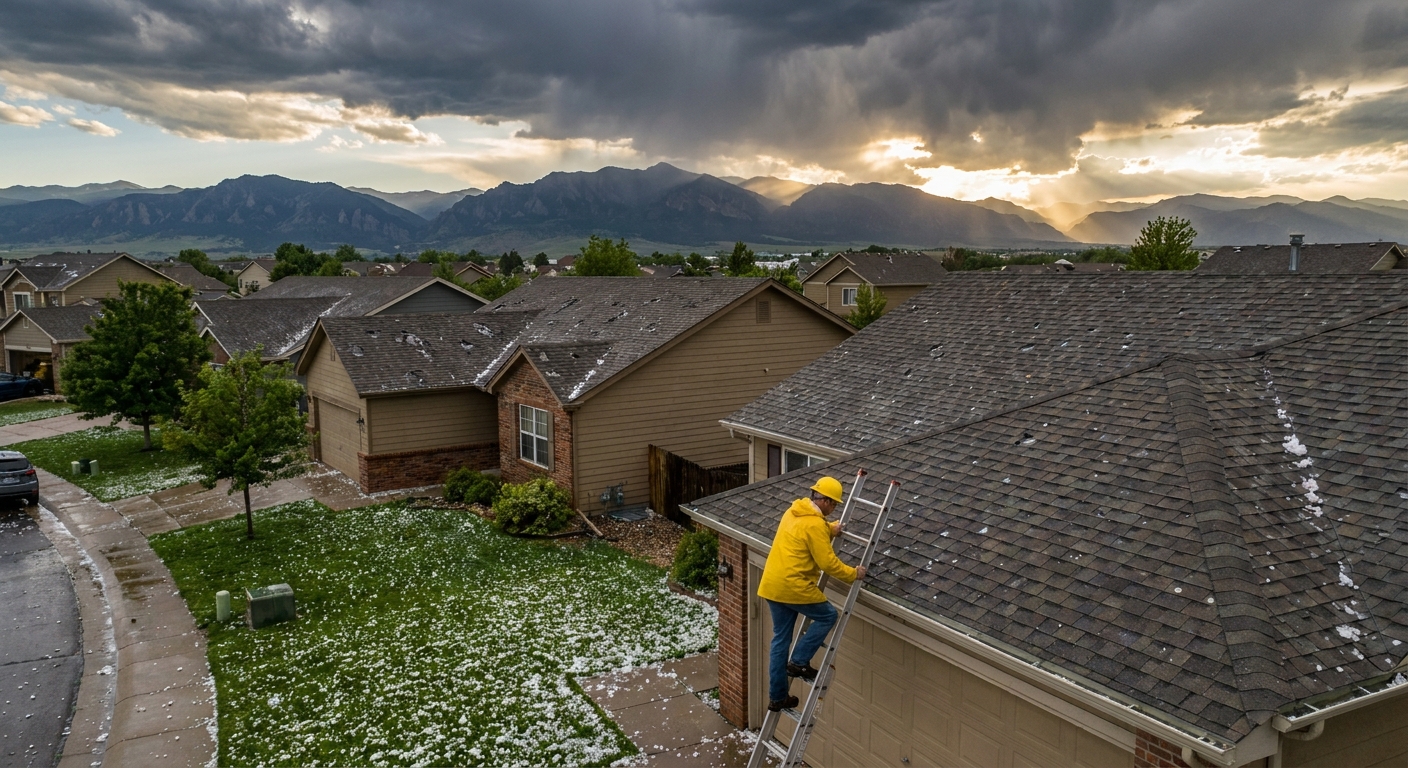
The root cause of Colorado's surging rates is severe convective storm losses. Colorado sits in a prime hail corridor where supercell thunderstorms regularly produce baseball- to golf ball-sized hailstones. These storms cause widespread roof, siding, and window damage across entire zip codes simultaneously, making it extremely costly for insurers to operate here. Hail accounts for a large share of premium costs statewide, even in mountain counties that rarely experience storms directly.
Additionally, rising rebuild costs, labor inflation, and tighter reinsurance markets have pushed every insurer in the state to raise rates. Our breakdown of climate change and home insurance costs details how extreme weather is reshaping premiums nationwide.

Protect your home with State Farm
Average Rate:
Homeowners who bundle and save with State Farm save an average of $1,000 per year!

You're in Good Hands® with Allstate
Average Rate:
Get comprehensive home coverage with flexible policy options.

Customize your home coverage
Average Rate:
Only pay for the coverage you need with personalized home insurance.

Smart coverage for your home
Average Rate:
Protect what matters most with award-winning home insurance.
Best Home Insurance Companies in Colorado
Not all insurers are created equal in Colorado. Some excel at pricing, others at claims handling, and a few specialize in high-value or high-risk mountain properties. Here are the top-rated companies for 2026:
| Company | Best For | Est. Annual Premium | Key Strength |
|---|---|---|---|
| Auto-Owners | Overall value | ~$1,733 | Lowest premiums with strong coverage |
| USAA | Military families | ~$2,010 | J.D. Power score of 737/1,000 |
| Allstate | Budget shoppers | ~$1,645 | Very competitive Bankrate sample |
| State Farm | Existing customers | ~$3,142 | Nearly 100 agents in Colorado |
| Chubb | High-value homes | ~$4,152 | Comprehensive high-end coverage |
| American Family | Mid-market value | ~$3,631 | Solid Colorado presence |
Auto-Owners is widely considered the cheapest and best overall home insurance company in Colorado at roughly $1,733 annually per MoneyGeek's 2026 analysis, while USAA costs about $2,010 per year for $300,000 dwelling coverage per Bankrate's sample. Allstate posted the lowest sample premium at around $1,645 per year for budget-focused shoppers.
Note that State Farm stopped accepting new homeowners policies in Colorado in 2023, so if you don't already have a State Farm policy, you'll likely need to look elsewhere. If you've been declined or non-renewed, our guide on high-risk home insurance options walks through every alternative.
Hail Coverage & Deductibles in Colorado
Hail is the single biggest insurance issue in Colorado. Approximately 50-60% of all home insurance claims in the state are hail-related, and that frequency has driven insurers to restructure how they handle hail deductibles.
How Hail Coverage Works
Standard HO-3 homeowners policies cover hail damage to:
- Roof (shingles, tiles, metal panels)
- Siding and exterior walls
- Windows and skylights
- Gutters and downspouts
- Detached structures (garages, fences, sheds)
- Personal property damaged by hail entry (broken windows, roof breaches)
Vehicles are not covered under home insurance. That requires comprehensive auto coverage.
Hail Deductibles Have Shifted to Percentages
Standard flat $1,000 all-perils deductibles are largely gone for hail-prone Colorado homes. Most policies now carry separate wind and hail percentage deductibles of 1 to 2 percent of Coverage A, and sometimes 5 percent for older roofs. According to a 2026 Fox21 study, the average wind and hail deductible in Colorado is $5,664 on an average home coverage of $431,130, which works out to about 1.3% of home coverage. Here's how the numbers work:
| Deductible Type | How It Works | Example ($500K Home) |
|---|---|---|
| Flat Dollar (rare now) | Fixed amount (e.g., $2,500) | You pay $2,500 |
| 1% Percentage | 1% of insured value | You pay $5,000 |
| 2% Percentage | 2% of insured value | You pay $10,000 |
| 5% Percentage | 5% of insured value | You pay $25,000 |
Under Colorado Senate Bill 38, it is illegal for any roofer to pay, waive, or rebate that deductible, so beware of contractors offering to "cover" your out-of-pocket costs. Always document damage with photos and videos immediately, save receipts for temporary repairs, and get a professional roof inspection before filing. Learn more about how wind and hail deductibles work, or read our full guide on filing a hail damage claim.
Impact-Resistant Roofing: A Colorado Game-Changer
Installing a Class 3 or Class 4 impact-resistant roof is the single most effective way to lower your Colorado premium. Colorado homeowners who install Class 4 impact-resistant shingles typically qualify for premium discounts of 15% to 30% on the dwelling coverage portion of their homeowner policy, often worth $400 to $1,200 per year.
Under SB 26-155, signed into law in June 2026 and effective August 12, 2026, the state creates the Strengthen Colorado Homes Enterprise within the Division of Insurance. Insurers offering multiperil homeowner's policies will pay an annual fee equal to 0.5% of premium beginning in 2027, and insurers are explicitly prohibited from passing that fee through as a surcharge to policyholders. The new enterprise is authorized to offer as much as $20 million in grants annually beginning in 2027 to help Colorado homeowners retrofit with resilient, hail-resistant roof systems, and at least 85% of fee revenue must go directly to homeowner grants. Beginning with rate filings submitted on or after January 1, 2027, insurers must also demonstrate that savings from resilient roof installations are passed through to homeowners as discounts or reduced premiums.
Mountain Homes, Wildfires & Unique Colorado Risks
Colorado's mountain communities face a distinct set of insurance challenges that go beyond hail. Whether you're in Evergreen, Conifer, Boulder, Estes Park, or Bailey, the combination of wildfire exposure, limited carrier availability, and mountain-specific perils creates a much more complex insurance picture.
Wildfire Risk & Non-Renewals
Colorado saw a 77 percent increase in policy non-renewals from 2018 through 2023, and the trend has continued into 2025 and 2026. Major national carriers have non-renewed thousands of Colorado policies in foothill and mountain communities over the last 18 months, particularly in Boulder, Larimer, and El Paso counties.
Homes in or near wildland-urban interface (WUI) zones can face premiums of $6,500 to $15,000+ annually. For homeowners who've been declined by three or more carriers, the Colorado FAIR Plan is the last-resort option.
The Colorado FAIR Plan, which sold its first policies in 2025, provides basic property insurance with a $750,000 residential coverage cap (property and contents combined, at actual cash value) and a $5 million cap for commercial property. Coverage is limited to essential protections such as fire, lightning, smoke, windstorm/hail, explosion, riot, aircraft, vehicles, volcanic eruption, and vandalism. To qualify, you need three formal declines from licensed standard insurance companies, and you must work with a licensed insurance agent to confirm eligibility and apply. Premiums are typically 2 to 4 times the cost of comparable private coverage. For a deeper dive, read our guide on wildfire insurance and coverage in fire-prone areas.
New Wildfire Transparency Rules (HB 25-1182)
HB 25-1182 took effect on July 1, 2026 and gives Colorado homeowners more visibility into how wildfire risk models, catastrophe models, and scoring methods are used in property insurance decisions. Any insurer using such a model must file details with the Division of Insurance, provide policyholders with their wildfire risk score in writing, post available mitigation discounts on their website, and offer an appeals process for homeowners who have completed mitigation work. Insurers must also disclose the range of possible scores and how mitigation affects your score.
Mountain-Specific Risks Standard Policies May Exclude
| Risk | Covered by Standard Policy? | Solution |
|---|---|---|
| Wildfire | Sometimes (check exclusions) | Surplus lines carrier or FAIR Plan |
| Snow/Ice load on roof | Rarely | Add a rider |
| Frozen/burst pipes | Conditional | Winterization + rider |
| Landslide | No | Separate earth movement policy |
| Flooding | No | NFIP or private flood insurance |
Mitigation Strategies That Lower Premiums
- Create defensible space by clearing brush, trees, and pine cones within 30 to 100 feet of your home
- Use fire-resistant roofing materials (metal, Class A-rated shingles)
- Obtain a fire mitigation certificate from your local fire department
- Work with a specialized broker who accesses surplus and non-admitted markets
- Appeal your wildfire risk score under HB 25-1182 if you've completed mitigation work
For homeowners struggling with affordability, our guide on what to do when home insurance is too expensive covers every available option, including FAIR plans and surplus lines alternatives.
How to Find Cheap Home Insurance in Colorado
Despite Colorado's elevated risk environment, there are real, proven ways to reduce what you pay without gutting your coverage.
Top Discounts Available in Colorado
| Discount | Typical Savings |
|---|---|
| Bundle home + auto | 15-25% |
| Class 4 impact-resistant roof | 15-30% |
| Security/smoke/fire alarm systems | 5-20% |
| Wildfire mitigation (HB 25-1182) | Varies by carrier |
| Claims-free history | Varies |
| Good credit score | Meaningful in most cases |
| Paperless billing | Small |
Practical Tips for Colorado Homeowners
- Raise your standard deductible to $1,000 or $2,500 to reduce premiums, but keep in mind that percentage-based wind/hail deductibles are separate
- Upgrade to a Class 4 roof since it's the single biggest discount lever in Colorado's hail-prone market, and watch for SB 26-155 grants launching in 2027
- Avoid small claims because filing a $1,500 claim for minor hail damage can trigger a rate increase that costs more over 3 to 5 years than paying out of pocket
- Improve your credit score since Colorado insurers use credit-based insurance scores
- Work with an independent agent who can access multiple carriers simultaneously and find specialty options for mountain or high-risk homes
For a comprehensive deep dive, check out our list of 17 ways to lower your home insurance premium. Also worth reviewing: our overview of 2026 home insurance legislation across states and a comparison with other high-cost storm states like our Missouri storm coverage guide and Illinois insurance breakdown.
Frequently Asked Questions
Why is home insurance so expensive in Colorado?
Colorado home insurance is expensive primarily because of the state's severe hail and storm exposure. Approximately 50-60% of all Colorado claims are hail-related, and Colorado experienced the fastest cumulative rate increase in the nation from 2020 to 2025 at about 100.8%. Add wildfire risk in mountain and foothill communities, rising rebuild costs, and tighter reinsurance markets, and you have a state where premiums have effectively doubled since 2020. SB 26-155 launches a resilient-roof grant program in 2027 aimed at slowing that trend.
What is the average cost of home insurance in Colorado in 2026?
Estimates for the 2026 average vary by source, ranging from about $3,412 per year (Bankrate) to $4,963 per year (Insurance.com) for standard dwelling coverage, with LendingTree reporting $4,717, NerdWallet $4,605 for $500,000 in dwelling coverage, and Insurify at $4,164 statewide. In major cities like Denver, Aurora, and Colorado Springs, premiums typically run $3,500 to $4,700 annually. Homes in wildfire-prone mountain areas can see premiums of $6,500 to $15,000 or more per year, while lower-risk areas like Grand Junction remain more affordable.
Does home insurance in Colorado cover hail damage?
Yes, standard HO-3 homeowners policies in Colorado cover hail damage to your roof, siding, windows, gutters, detached structures, and personal property damaged by hail intrusion. However, most Colorado policies now include a separate percentage-based wind/hail deductible of 1-5% of your home's insured value, which can mean $5,000 to $25,000 out of pocket on a $500,000 home before insurance pays anything. Under SB 38, roofing contractors cannot legally pay or rebate your deductible.
Can I get home insurance if I live in a Colorado wildfire zone?
Yes, but it can be challenging and expensive. Major carriers frequently restrict or cancel policies in high wildfire-risk areas like Evergreen, Conifer, Boulder, and Estes Park. If you've been declined by three standard insurers, you may qualify for the Colorado FAIR Plan, which provides last-resort coverage up to $750,000 on an actual cash value basis but excludes liability, additional living expenses, and replacement-cost contents. Working with an independent agent who specializes in high-risk properties is usually the best path forward.
What is the best home insurance company in Colorado in 2026?
Auto-Owners is widely rated the best overall for value at roughly $1,733 per year, though availability varies by area. USAA is the top pick for military families with rates around $2,010 for $300,000 dwelling coverage and the highest J.D. Power satisfaction score in the state (737/1,000). Allstate is often called the best budget option at about $1,645 per year in Bankrate's sample, while Chubb tops the list for high-value homes. Because State Farm has stopped writing new policies statewide, most new buyers will need to compare quotes from Auto-Owners, Allstate, USAA (if eligible), American Family, and specialty carriers.