
Compare Home Insurance Plans in Ohio
Find your best options in less than 2 minutes



What Does Home Insurance Cost in Michigan in 2026?
Michigan homeowners pay an average of $2,195 to $2,415 per year for home insurance, roughly $183 to $201 per month depending on the data source and coverage amount. NerdWallet pegs the 2026 average at $2,415 for a policy with $400,000 in dwelling coverage, while MoneyGeek reports Michigan's average at $2,195 annually. That places Michigan just below the national average of about $2,490 per year, but rates have climbed rapidly. Michigan's average home insurance premium jumped 21.6% between 2024 and 2025, one of the largest single-year increases in the nation, following a 6.3% increase the year prior. Real estate analytics firm Cotality projects an additional 8% increase in 2026 and another 8% in 2027. Understanding what's driving those numbers is the first step toward getting the right coverage at the best possible price.
Average Michigan Home Insurance Rates by City
Where you live within Michigan makes an enormous difference in what you'll pay. Detroit homeowners face some of the highest urban insurance costs in the Midwest, while smaller cities and rural communities enjoy far lower premiums.
| City | Monthly Premium | Annual Premium |
|---|---|---|
| Detroit | $304 | $3,643 |
| Warren | $205 | $2,456 |
| Pontiac | $176 | $2,109 |
| Sterling Heights | $164 | $1,972 |
| Grand Rapids | $141 | $1,690 |
| Lansing | $140 | $1,675 |
| Ann Arbor | $131 | $1,572 |
| Ahmeek (UP) | $134 | $1,607 |
Some national datasets show even higher Detroit numbers, with LendingTree reporting an average premium of $6,931 in Detroit (172% above the state average) and NerdWallet at roughly $5,035 per year. Either way, Detroit rates reflect higher crime rates, older housing stock, and elevated claims density, while rural and smaller metro areas like Ann Arbor come in at roughly half that cost.
For a broader perspective on how Michigan compares to other states, check out our guide on the best home insurance companies nationally.
What Factors Drive Michigan Home Insurance Rates?
Several state-specific factors push Michigan premiums higher:
- Age of housing stock. Older homes with outdated electrical, plumbing, or heating systems cost more to insure than newer builds
- Crime rates. Urban areas like Detroit carry higher theft and vandalism risk
- Weather exposure. Roughly 75% of all Michigan home insurance claims are due to wind or hail events, driven by lake-effect snow, ice storms, and severe thunderstorms
- Roof age. Michigan insurers now flag roofs 15+ years old, triggering ACV settlements, surcharges, or non-renewals
- Proximity to water. Homes near the Great Lakes or in flood-prone areas pay elevated premiums
- Credit score. Rates are typically quoted for homeowners with good credit; in Michigan, policyholders with poor credit average significantly more

Compare Home Insurance Plans in Ohio
Find your best options in less than 2 minutes
Michigan's Unique Home Insurance Risks
Michigan presents a distinct set of hazards that go beyond what homeowners in most other states deal with. From brutal winters to Great Lakes shoreline erosion, understanding these risks helps you make sure your policy actually covers what you need.
Winter Weather: Ice Dams, Frozen Pipes & Snow Load
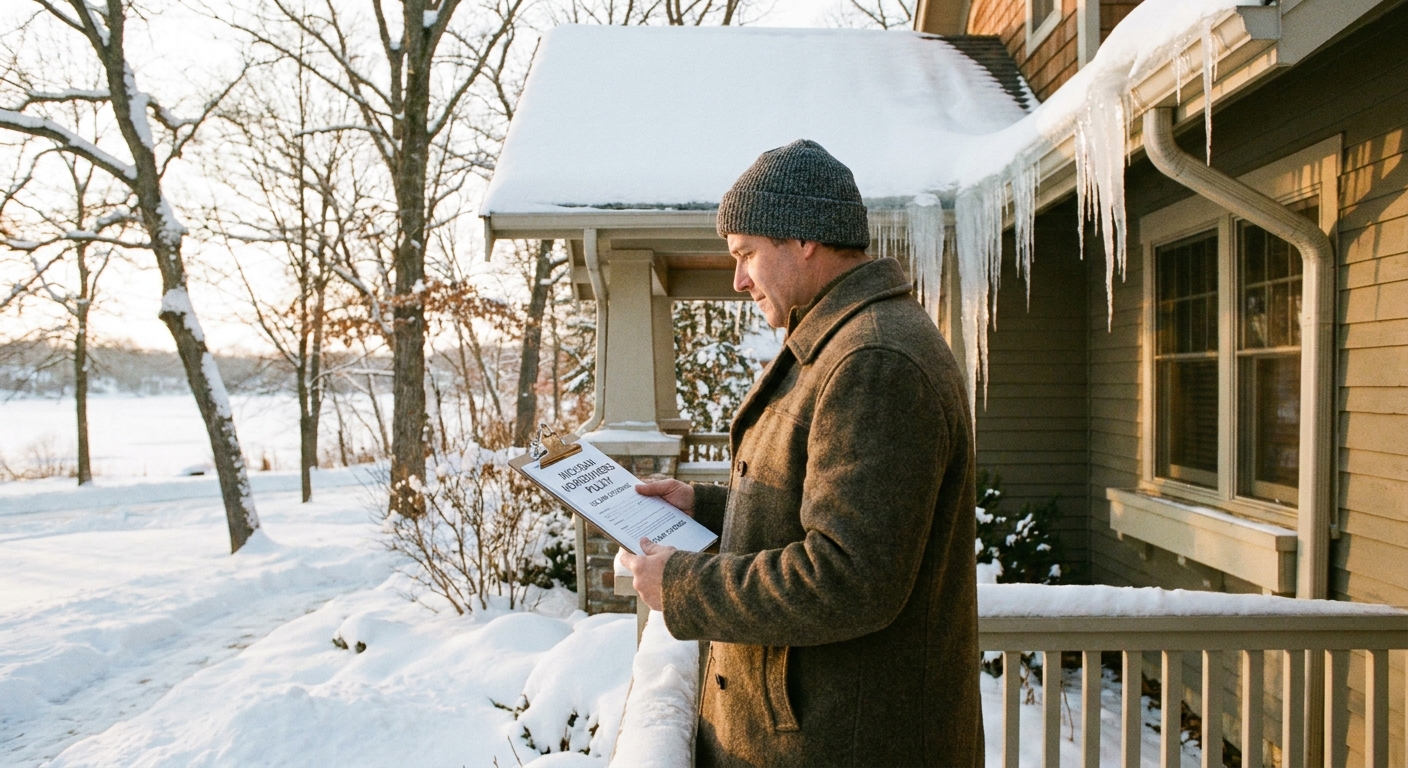
Michigan winters are relentless, and standard HO-3 policies do cover many winter-related perils, but with important conditions.
| Winter Risk | What Can Happen | Covered? | Key Condition |
|---|---|---|---|
| Ice Dams | Water seeps under shingles, damages ceilings and walls | ✅ Yes | Home must be properly maintained |
| Frozen Pipes | Pipes burst, flooding the interior | ✅ Yes | Home must be heated to at least 65°F |
| Snow Load | Roof collapses under heavy snow accumulation | ✅ Yes | Must not be a pre-existing structural issue |
| Snowmelt Flooding | Water enters basement from outside | ❌ No | Requires separate flood insurance |
For a deeper look at ice-related claims, our guide on ice dam damage coverage covers documentation and denial-prevention tactics in detail.
Great Lakes Proximity: An Elevated Risk Zone
Michigan's 3,288 miles of Great Lakes coastline create unique exposure for lakefront and near-shore homeowners. Beyond deep snow, shoreline homeowners face:
- Coastal flooding from rising lake levels and storm surge
- Seiche events (standing waves from wind and pressure changes) that push lake water inland
- Shoreline erosion that can undermine foundations over time
- Enhanced thunderstorms and high winds that damage roofs and siding
Standard home insurance does not cover flooding from lake surge or rising water levels, and Great Lakes coastal erosion is almost never covered by any insurance (standard, FAIR Plan, or flood). Michigan's Department of Insurance and Financial Services (DIFS) reminds homeowners that most home and renters policies exclude flood damage entirely. Michigan's typical NFIP flood premium runs about $630 to $785 per year, with high-risk zones (A/AE inland and V/VE Great Lakes shoreline) running $1,200 to $3,000 or more. NFIP building coverage is capped at $250,000 with $100,000 for contents. Note that Congress has currently authorized the NFIP only through September 30, 2026, so timing your policy renewal matters. Our water damage coverage guide explains the flood insurance gap in more detail.
Freeze-Thaw Cycles & Foundation Damage
One of Michigan's most underappreciated home risks is what repeated freezing and thawing does to foundations. As ground moisture freezes and expands, then thaws and contracts, it exerts enormous pressure on concrete and block foundations, causing cracks, bowing walls, and water intrusion over time.
The 2026 Roof-Age Trap
Michigan carriers now closely scrutinize any roof 15+ years old, and roof-age non-renewals have become the top reason Michigan families are being pushed into expensive high-risk policies or the state FAIR Plan. According to a Weather Shield Roofers analysis, roughly 70% of major insurance carriers now impose stricter roof-age rules than they did in 2020, and many use satellite imagery and AI-driven drone inspections to assess condition. Roofs over 20 years old typically face ACV-only settlement (which deducts depreciation) or non-renewal. If your roof is approaching 15 years, get documentation ready before your next renewal. Our guide on old roof age requirements walks through exactly what documentation to gather.

Protect your home with State Farm
Average Rate:
Homeowners who bundle and save with State Farm save an average of $1,000 per year!

You're in Good Hands® with Allstate
Average Rate:
Get comprehensive home coverage with flexible policy options.

Customize your home coverage
Average Rate:
Only pay for the coverage you need with personalized home insurance.

Smart coverage for your home
Average Rate:
Protect what matters most with award-winning home insurance.
Water Damage Coverage: What Michigan Policies Cover (and What They Don't)
Water damage is one of the most common, and most misunderstood, areas of home insurance in Michigan. The key distinction insurers make is between sudden and accidental damage versus gradual or flood-related damage. Learn more about burst pipe coverage before winter hits.
What Standard Coverage Includes
A standard HO-3 policy in Michigan typically covers:
- Burst pipes (common in Michigan winters)
- Appliance overflow (washing machine, dishwasher)
- Water damage from a covered roof leak after a storm
- Resulting damage from ice dams (interior water staining, drywall)
What You'll Need Endorsements or Separate Policies For
Sump pump backup coverage is an endorsement that costs roughly $40 to $250 per year and provides $5,000 to $25,000 in coverage for water that backs up through your sump pump or drains. Given Michigan's high water table and heavy snowmelt seasons, this add-on is considered essential by most local insurance agents. The state DIFS specifically points out that damage from a failing sump pump or sewer backup can be covered by your homeowners policy (not flood insurance) if you have the right endorsement in place.
Best Home Insurance Companies in Michigan for 2026
Not all insurers are created equal when it comes to Michigan-specific risks. The best companies combine competitive pricing, strong financial ratings, and coverage options tailored to the state's climate and regional hazards. For a national comparison, see our guide on lowering home insurance premiums.
Top Michigan Home Insurance Providers
| Company | Best For | Avg. Annual Rate | AM Best Rating |
|---|---|---|---|
| Auto-Owners | Best overall; lowest complaints | ~$1,116 ($93/mo) | A++ |
| AAA / Auto Club Group | Cheapest statewide rates | ~$1,726 | A |
| Allstate | Cheapest large national carrier | ~$1,410 | A+ |
| State Farm | Best bundling discounts | ~$1,542–$2,040 | A++ |
| Frankenmuth | Michigan-based; local expertise | ~$1,948 | A |
| Chubb | High-value and lakefront homes | ~$1,198–$1,808 | A++ |
| Amica | Best consumer experience | Competitive | A+ |
| USAA | Military families | ~$2,140 | A++ |
Auto-Owners Insurance
Auto-Owners consistently ranks as the top overall pick for Michigan homeowners. MoneyGeek scored Auto-Owners 4.6 out of 5 for 2026, ranking it #1 for the state's lowest premiums combined with strong customer satisfaction. Insurify data shows Auto-Owners at roughly $93 per month, the cheapest in the state. USAA, Chubb, State Farm, and Farmers round out MoneyGeek's top five.
AAA / Auto Club Group
If price is your primary concern, AAA is a strong option. On average, Auto Club Group (AAA) is the cheapest home insurance company in Michigan by a wide margin at all coverage levels, ranging from about $1,448 a year at $200,000 in coverage to $4,510 at $1,000,000.
Allstate
LendingTree named Allstate the best homeowners insurance company in Michigan for 2026, citing low rates and a wide range of coverage options. Allstate is also the cheapest option in Detroit with rates around $1,985 per year, less than half the citywide average.
Frankenmuth Insurance
As a Michigan-based carrier, Frankenmuth has deep roots in the state and a strong understanding of regional weather patterns, from Great Lakes snow belts to the Upper Peninsula. Local expertise and low complaint ratios make it a standout regional option, and ValChoice consistently ranks it among Michigan's top insurers.
If you're struggling to find affordable coverage on an older Michigan home, our guide on insuring older homes covers proven ways to lower your premium without sacrificing protection.
How to Save Money on Michigan Home Insurance
Michigan homeowners have several powerful tools available to reduce their premiums without cutting critical coverage. Here are the strategies that deliver the biggest savings in this state.
1. Bundle Home and Auto Insurance
Bundling home and auto insurance in Michigan currently delivers savings of roughly 10% to 25% for most households. State Farm and Farmers offer some of Michigan's largest bundle discounts, and Amica goes further nationally, offering combined discounts when you add umbrella and life insurance.
2. Raise Your Deductible
Increasing your deductible from $500 to $1,000 can reduce your annual premium by 10% to 25%. Forbes data shows Michigan's average annual cost at $2,439 with a $500 deductible drops to $2,336 at $1,000 and $2,131 at $2,000. Just make sure you have that deductible amount accessible in savings before making this change.
3. Upgrade Older Home Systems and Your Roof
Older homes, particularly those built before 1980 with galvanized pipes, aluminum wiring, or outdated heating, cost significantly more to insure. Installing an impact-resistant or wind-rated roof is one of the highest-ROI upgrades a Michigan homeowner can make, and many insurers now require documentation of roof age and materials at renewal.
4. Install Smart Home Safety Devices
Professionally monitored security systems, smart water leak detectors, and temperature sensors reduce your risk profile in the eyes of insurers. These devices typically earn discounts of 5% to 15% and can help prevent costly claims, especially frozen pipe detection during Michigan winters.
5. Maintain a Claims-Free History
Going claim-free for three or more years typically earns discounts of 5% to 15%, with some carriers offering up to 25%. If you have a minor issue you can afford to fix out-of-pocket, it may be worth not filing a claim to preserve your discount status.
6. Shop Quotes Annually
Michigan's insurance market is competitive, and rates change frequently. Comparing quotes from at least 3 to 5 insurers every year is one of the most effective ways to ensure you're not overpaying. For an in-depth walkthrough, see our guide on Ohio home insurance shopping strategies, which applies the same comparison process used across Midwest states, or our Illinois home insurance guide for another Great Lakes state comparison.
Frequently Asked Questions About Michigan Home Insurance
Is home insurance required by law in Michigan?
No, Michigan state law does not require homeowners to carry home insurance. However, if you have a mortgage, your lender will almost certainly require it as a condition of the loan. Failing to maintain coverage can result in your lender purchasing a more expensive "force-placed" policy on your behalf and billing you at a much higher premium than you'd pay on your own.
Does Michigan home insurance cover basement flooding?
Standard HO-3 policies cover basement water damage only if it results from a sudden and accidental event, like a burst pipe. Water that enters from outside (groundwater, snowmelt, or rising lake levels) is excluded and requires a separate flood insurance policy through the NFIP. Sewer and sump pump backup is also excluded unless you add a specific endorsement, which typically costs $40 to $250 per year.
Why is Detroit home insurance so expensive compared to the rest of Michigan?
Detroit homeowners pay an average of $3,643 per year (with some analyses reporting $5,000 to nearly $7,000), well over double the state average. This is driven by higher rates of theft and property crime, an older housing stock with elevated rebuild costs, greater claims density in urban areas, and the overall risk profile insurers assign to the region. Homeowners in suburban communities like Sterling Heights or Ann Arbor pay significantly less.
What is the best home insurance company in Michigan for 2026?
Auto-Owners Insurance is widely rated the best overall home insurer in Michigan for 2026, thanks to its A++ AM Best rating, low complaint ratio, and strong local agent network. AAA and Allstate are the top picks for lowest average rates, while Frankenmuth stands out as the best Michigan-based regional carrier. The right choice depends on your coverage needs, home value, and location within the state.
Does Michigan home insurance cover ice dam damage?
Yes, most standard Michigan home insurance policies cover water damage resulting from ice dams, which form when melting snow refreezes at roof edges and allows water to seep underneath shingles. However, coverage can be denied if the insurer determines that poor maintenance (such as clogged gutters or inadequate attic insulation) contributed to the problem. Taking preventive steps like installing proper roof insulation and cleaning gutters each fall can protect both your home and your coverage eligibility.