
Compare Car Insurance Rates in Ohio
See if you qualify for a lower rate in less than 2 minutes



The 12:01 AM Rule: When Your Policy Actually Ends
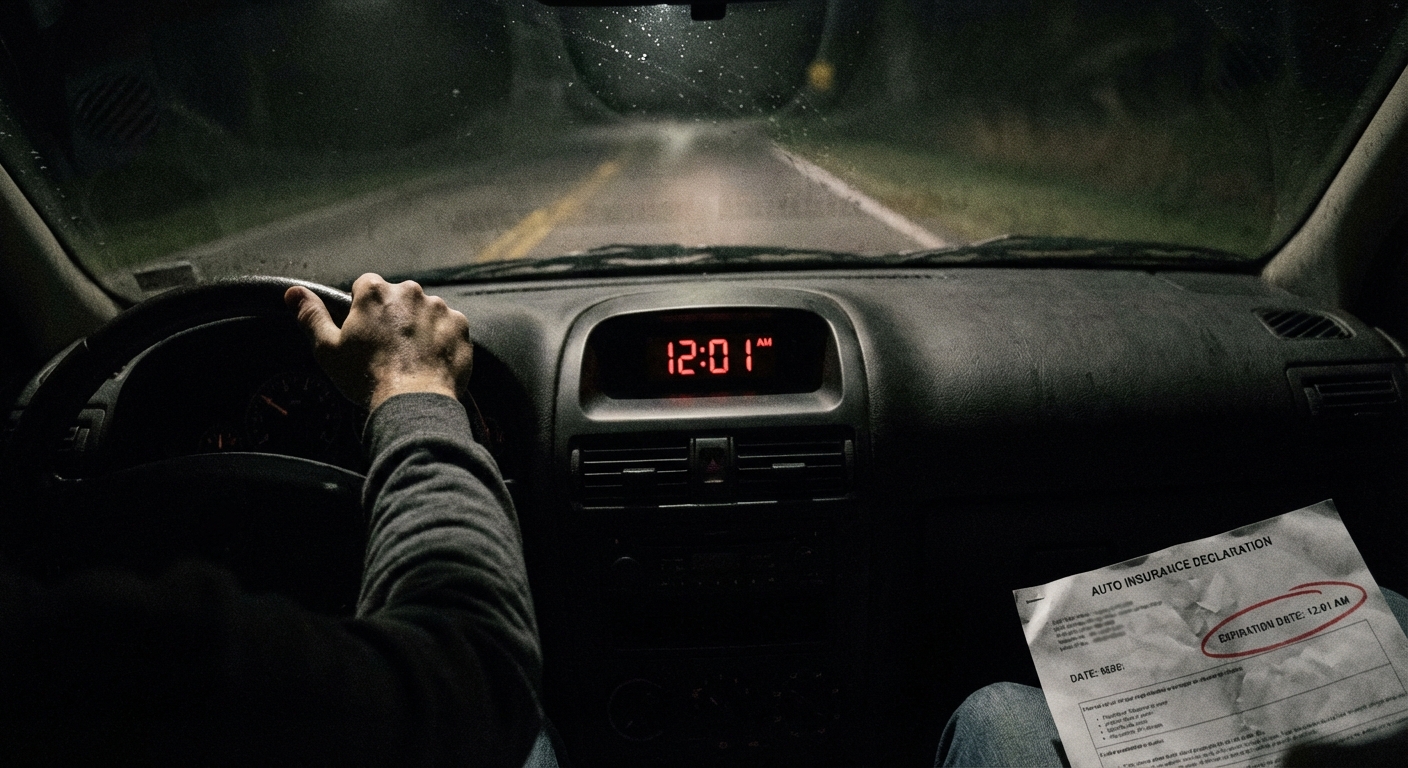
Most drivers assume their car insurance covers them for the entire day listed as the expiration date. This is one of the most dangerous, and costly, misconceptions in auto insurance. The truth is that most auto insurance policies are set to terminate at 12:01 a.m., so if you look at your insurance card, policy or payment notice, you'll see coverage only exists up to the expiration date. That means by the time you wake up on your expiration date, your coverage has already been gone for hours.
Why 12:01 AM instead of midnight exactly? The expiration time is almost always 12:01 a.m. in your local time zone on the date your policy ends, and the standard industry practice is to set the effective time of an auto insurance policy to 12:01 a.m. This avoids any ambiguity around which "midnight" applies (the start or the end of a day). This one-minute buffer is a legal convention used industry-wide, and it's clearly documented on your policy's declarations page (also called the "dec page").
Where to Confirm Your Exact Expiration Time
Your declarations page will usually list the time as well as the date, and virtually all policies start and expire at 12:01 a.m. Here's what to look for:
| Document | What It Shows |
|---|---|
| Declarations Page | Exact expiration date AND time (typically 12:01 AM) |
| Insurance ID Card | Expiration date only (no time shown) |
| Renewal Notice | New term start date and premium |
| Digital Insurer App | Policy status and expiration date |
The expiration date printed on your insurance card can be misleading. If your card says your policy expires on March 15, your actual coverage ended at 12:01 AM on March 15, meaning you are uninsured for all but one minute of that day. For more on how these key policy dates work, see our guide on inception vs. effective dates and how policy activation timing works in our waiting period guide.

Compare Car Insurance Rates in Ohio
See if you qualify for a lower rate in less than 2 minutes
Common Misconceptions About Expiration Dates
Confirming when your policy actually ends is critical to avoiding dangerous assumptions. Here are the most widespread myths drivers believe about their expiration dates:
Myth #1: "I'm Covered All Day on My Expiration Date"
False. As covered above, coverage ends at 12:01 AM on the expiration date. Driving at 9 AM on your expiration date without having renewed means you are driving uninsured. According to the Insurance Research Council's 2025 study, 15.4% of motorists (more than one in seven drivers) were uninsured in 2023, and one in three drivers (33.4%) were either uninsured or underinsured, a 10 percentage point increase in the combined rate since 2017. Learn more about the uninsured motorist crisis in 2026 and how it affects premiums nationwide.
Myth #2: "I Can Renew On My Expiration Date and Still Be Covered"
False, if you wait too long. Even if you renew online on your expiration date, your old coverage is already gone. You'll need to confirm the exact minute your new policy takes effect. There may be a window (even just hours) during which you have no coverage at all. Learn more about waiting periods and when coverage starts so you know exactly when a new policy activates.
Myth #3: "My Policy Auto-Renews, So I Don't Need to Worry"
Partially true, but risky. Many policies do auto-renew, but only if your payment method is valid and up to date. If your credit card expired, your bank account has insufficient funds, or your insurer has flagged a change in your risk profile, automatic renewal can fail silently, leaving you unaware that your policy lapsed. Always confirm your renewal was successful.
Myth #4: "Grace Periods Give Me Extra Time After Expiration"
Not for expiration, only for missed payments. A payment grace period of 7 to 30 days applies to missed payments, not to expiration dates themselves. If your policy expires because the term ended, you are not automatically granted a grace period to keep driving with coverage.

Protect your car with Farmers
Average Rate:
Find coverage options that fit your budget.

The insurance savings you expect.
Average Rate:
Enjoy personalized policies, comprehensive coverage & more.

See how much you could save today!
Average Rate:
Drivers who switch their auto insurance and save with State Farm save $764 on average!

Safe Drivers Save with Allstate®
Average Rate:
Get rewarded with savings for having a clean driving record.
What Happens If You Have an Accident on Your Expiration Date
This is where the 12:01 AM rule becomes very real. If you get into an accident at any point on your expiration date, whether it's 7 AM, noon, or 10 PM, and your policy expired at 12:01 AM that morning, you are effectively driving without insurance.
The Financial and Legal Consequences
The consequences of a lapse in coverage on or after your expiration date are severe:
- If you're at fault: You are personally liable for all medical bills, property damage, lost wages, and pain and suffering for the other party. The injured driver may use their own uninsured motorist coverage to pay their claim and then pursue you for reimbursement.
- If you're not at fault: In most states, you can still pursue the at-fault driver's insurance. However, in some states like New Jersey, having a lapsed policy can limit or eliminate your right to sue entirely.
- No-fault states: States like Florida and Michigan require your own Personal Injury Protection (PIP) to cover your medical bills, but a lapsed policy means no PIP coverage.
- No retroactive coverage: Renewing your policy after an accident does not cover a claim that occurred during the lapse. There are no exceptions to this rule.
Learn more about what to do immediately after a lapse so an accident during the gap doesn't compound your financial risk.
State Penalties for Driving Uninsured
Beyond claim liability, driving without insurance (even for a single day) carries stiff legal penalties that vary by state. Fines and fees have trended upward in 2025 and 2026 due to inflation and stricter enforcement. Here's a snapshot of current 2026 penalties:
| State | First Offense Fine | Additional Penalty | SR-22 Required? |
|---|---|---|---|
| Alabama | $500 (up to $3,000 repeat) | Registration suspension; $200 reinstatement fee | Yes (1 to 3 yrs) |
| Alaska | $500 per offense | 90 days to 1 year license suspension | Yes (3 yrs) |
| Arizona | $500+ | License and registration suspension 90 days | Yes (2 to 3 yrs) |
| California | $100 to $500+ | Possible impound; SR-22 after accident | Possible |
| Colorado | $500 minimum | Possible license suspension; possible jail | Yes (3 yrs) |
| Louisiana | $500 to $1,000 | Vehicle impoundment; plate confiscation | Possible |
| Mississippi | $1,000 (reducible to $100) | 1-year license suspension | Yes (3 yrs) |
| New Jersey | $300 to $5,000 | Community service; impound; possible jail | Yes |
| New York | Up to $1,500 | Possible impound; up to 1-year revocation | No |
| Texas | $175 to $350 (1st); up to $1,000 (2nd) | License/registration suspension up to 2 yrs | Yes (2 yrs after accident) |
State Notification Requirements
States require insurers to give you advance warning before your policy expires or is canceled. These notification windows vary and have seen major legislative updates in 2026:
| State | Nonrenewal Notice Required | Notes |
|---|---|---|
| Indiana | 30 days (auto) / 60 days (home) | HB 1260 signed by Governor March 4, 2026; effective for policies issued or renewed on or after June 30, 2026 |
| Louisiana | 60 days | Notice period doubled to 60 days effective July 1, 2026 |
| Texas | 60 days | TDI standard: at least 60 days' notice of nonrenewal; 10 days before cancellation |
| New Jersey | 60 days | Certified mail; must state reasons |
| Illinois | 30 to 60 days | 30 days if policy in force less than 5 years |
| New York | 45 to 60 days | Reasons must cite specific policy provisions |
| Most other states | 20 to 45 days | Varies by state and reason |
A related 2026 Texas update you should know about: under HB 2067, a new Texas law requires insurance companies to explain, in writing, why they declined, canceled, or didn't renew an individual's auto or home insurance. Insurers must automatically provide these written explanations, without requiring the customer to request them, for decisions made after January 1, 2026.
While your insurer is required to notify you, it's your responsibility to act on that notice. Don't assume a lack of communication means you're still covered. If you receive a cancellation notice from your insurer, review our step-by-step cancellation guide to understand your rights and next steps.
How to Renew Before Expiration and Avoid Coverage Gaps
The best strategy is simple: never let your policy expire before your new one begins. Whether you're renewing with the same insurer or switching to a new provider, timing your coverage change correctly is everything.
Step-by-Step: Switching Policies Without a Gap
- Shop at least 2 to 4 weeks before your expiration date. Give yourself enough time to compare rates and make a decision.
- Set your new policy's start date at least one day before your old policy expires. A one-day overlap is ideal and usually results in only a small overlapping premium cost.
- Confirm your new policy is active before canceling the old one. Get written confirmation with the exact effective date and time.
- Notify your lender or lienholder. If you have a car loan or lease, your lender requires proof of continuous coverage.
- Cancel your old policy officially. Don't just stop paying. Contact your insurer to cancel and request a pro-rated refund for any unused premium. Understanding the difference between short-rate vs. pro-rata cancellation helps you maximize your refund.
How a Coverage Lapse Affects Your Premiums
Even a one-day lapse doesn't just put you at legal and financial risk in the moment. It follows you. According to ValuePenguin's analysis, drivers with a coverage lapse of 30 days or less saw an 8% average car insurance rate increase, and those with a coverage lapse greater than 30 days saw an average rate increase of 35%. Other data points to different hikes: MoneyGeek shows a lapse of 30 days or fewer raises rates by about 10.6% ($149/year) while gaps longer than 30 days average 22.4% ($315/year). Insurance.com data also shows an average 11% increase after a lapse of seven days, 14% after 30 days and 22% after 45 days. Some high-risk carriers such as The General are even steeper, applying about 48% for a 30 to 60-day gap. You may also lose:
- Continuous coverage discounts. Many insurers reward 6+ months of uninterrupted coverage.
- Loyalty discounts. Long-term customers who lapse can lose accumulated savings instantly.
- SR-22-free status. Some states impose SR-22 requirements even after a first lapse, adding 30 to 100% to your premium for 2 to 3 years.
The good news: under Louisiana's Act 476 (effective January 1, 2026), an insurer cannot increase the premium rate or add a surcharge on a first lapse in coverage, provided the lapse does not exceed 90 days. Learn what to do after a lapse to recover quickly, or review the reinstatement guide for your options.
Tips for Tracking Your Expiration Date
Never let your expiration sneak up on you again. Here are the most effective methods for staying on top of your policy:
| Reminder Method | How It Works | Best For |
|---|---|---|
| Calendar Alert | Set a recurring reminder 30, 15, and 7 days before expiration | All drivers |
| Insurer App Notifications | Enable push notifications in your insurer's mobile app | Tech-savvy drivers |
| Email Reminders | Opt into renewal notices from your insurer | Anyone without a smartphone |
| Auto-Pay Confirmation | Confirm auto-pay processed successfully each renewal period | Drivers with auto-renewal |
| Annual Review Reminder | Set a yearly calendar event to review and shop your policy | Budget-conscious drivers |
An annual policy review is one of the fastest ways to catch a looming expiration date before it becomes a problem.
Understanding what happens when your car insurance lapses can also help you anticipate why acting a few weeks early is worth it, and building strong continuous coverage habits protects your long-term rates.
Frequently Asked Questions
Does car insurance expire at midnight or 12:01 AM?
Car insurance policies almost universally expire at 12:01 AM on the expiration date, not at midnight at the end of that day. The reason for this specific time is to eliminate legal ambiguity, since "midnight" could technically refer to either the very beginning or the very end of a day. Always check your declarations page for the exact time, as this is where the precise expiration is documented. Your insurance ID card only shows the date, not the precise time your coverage ends.
What should I do if my car insurance already expired?
Stop driving immediately and contact your insurer or a new insurance provider to get coverage reinstated or a new policy started. Do not drive your vehicle until you have active, confirmed coverage in place. If you were in an accident after your policy expired, contact an attorney, since coverage questions can be complex depending on your state's laws and the exact time of the accident. See our step-by-step guide on what to do after a lapse for detailed next steps.
Can I get in trouble for driving on my policy's expiration date?
Yes. Since your policy expires at 12:01 AM on the expiration date, driving at any point during that day means you are operating an uninsured vehicle. Penalties vary by state but can include fines ranging from $100 to $5,000 or more for a first offense, vehicle impoundment, license suspension, and mandatory SR-22 filing for 2 to 3 years. Being in an accident while uninsured adds significant personal financial liability on top of those penalties.
Will my insurer notify me before my car insurance expires?
Most states require insurers to send a nonrenewal notice 20 to 60 days before your policy expires. Major 2026 updates include Indiana's HB 1260 (signed March 4, 2026), which extends auto nonrenewal notice to 30 days and homeowners to 60 days for policies issued or renewed on or after June 30, 2026, Louisiana doubling its notice period to 60 days (effective July 1, 2026), and Texas HB 2067 requiring automatic written reasons for any decline, cancellation, or nonrenewal decision made after January 1, 2026. However, this notice is a courtesy, not a guarantee of continued coverage, so it's your responsibility to renew, switch, or verify that any auto-renewal payment processed successfully.
Does a one-day gap in car insurance really affect my future rates?
Yes. Even a gap of one day is flagged as a coverage lapse by insurers. A short lapse of 30 days or less can raise your premium by roughly 8 to 11% on average per ValuePenguin and Insurance.com, while a 30-day gap can push rates up by about 14 to 22% (MoneyGeek and Insurance.com), and lapses of 45 days or more can climb to 35% or higher depending on your state and insurer. You may also lose continuous coverage discounts and, in some states, face SR-22 requirements that further elevate your rate for 2 to 3 years. Louisiana's first-lapse rate protection (effective January 2026) offers relief for qualifying customers, but driving uninsured remains illegal everywhere.