
Compare Car Insurance Rates in Ohio
See if you qualify for a lower rate in less than 2 minutes



Understanding Car Insurance Waiting Periods
The term "waiting period" often causes confusion when purchasing car insurance. Unlike health insurance or other coverage types, car insurance typically doesn't have traditional waiting periods. Most insurers activate liability coverage immediately upon purchase or on a future date you specify, giving you flexibility and control over when your protection begins.
A car insurance waiting period essentially refers to the time between purchasing your policy and when coverage becomes active. In most cases, this period can be zero, meaning your coverage starts the moment you complete your purchase and payment. The key factor is understanding your policy's effective date, which is the official start of your coverage. Most carriers set the effective time to 12:01 a.m. on the effective date you choose, so even if you buy mid-day, coverage is treated as active from 12:01 a.m. that same day.
Insurance companies design their systems to accommodate drivers who need protection right away. Whether you're buying a new car at a dealership, adding a newly licensed teen to your policy, or switching providers, most insurers offer same-day activation. The process has become increasingly streamlined with digital technology, allowing you to secure coverage within minutes.
Important Note for 2026: While liability coverage typically starts immediately, some insurers (particularly in California) may impose a 10 to 14-day waiting period on certain optional coverages like collision, comprehensive, rental reimbursement, or roadside assistance. Always ask your insurer specifically which coverages are active on day one and get it confirmed in writing on your declarations page.
Understanding how inception dates and effective dates differ also helps you avoid gaps when switching carriers or renewing your policy.

Compare Car Insurance Rates in Ohio
See if you qualify for a lower rate in less than 2 minutes
How Same-Day Car Insurance Coverage Works
Same-day car insurance coverage has become the industry standard, with most major insurers offering instant activation. The process typically takes 15 to 30 minutes from start to finish when you apply online or by phone. Here's what makes immediate coverage possible and how you can secure protection within minutes.
The Application and Activation Process
Getting same-day car insurance requires providing basic information about yourself, your vehicle, and your driving history. You'll need your driver's license number, vehicle identification number (VIN), current address, and details about any other drivers in your household. Once you complete the application and make your first payment, liability coverage activates immediately.
Insurance companies verify your information electronically through databases that track driving records, vehicle ownership, and claims history. This instant verification allows them to assess risk and provide immediate coverage without manual underwriting delays. Learn how the full car insurance application process works, from gathering your documents to the moment your coverage activates.
Binding Coverage Over the Phone
Binding coverage is a critical concept for obtaining instant car insurance protection. When an authorized insurance agent or representative binds your coverage, they're creating a temporary insurance agreement (called an insurance binder) that provides immediate legal protection. This verbal commitment becomes a legally enforceable contract even before you receive formal policy documents.
In 2026, most large carriers can issue a digital binder or ID card within minutes of binding, often making a separate binder document unnecessary since the policy itself is issued almost instantly. Binders are typically valid for 30 to 90 days depending on the company and state (Texas caps them at 30 days, Florida at 60 days, and Utah allows extensions up to 150 days), giving the insurer time to complete underwriting and issue the formal policy. Learn more about how an insurance binder protects you before your official policy starts.
The binding process works by phone, online, or in person. An agent with binding authority confirms your coverage details, including policy limits, deductibles, and premium amount. Once you agree and provide payment information, coverage is bound, meaning you're officially insured from that moment forward.
Getting Instant Proof of Insurance
Digital insurance cards have revolutionized how quickly drivers can obtain proof of coverage. After purchasing and activating your policy, you receive instant proof through several convenient methods. As of 2026, 49 states plus Washington, D.C. accept electronic proof of insurance. New Mexico is currently the only state where officers are not required to accept a digital insurance card, while Massachusetts prints insurance information directly on the vehicle registration rather than issuing a separate card. Always keep a paper backup in your glove box just in case.
Methods to Access Your Digital Insurance Card:
- Email: Most insurers send a PDF version of your insurance card immediately after purchase
- Mobile app: Download your insurer's app and access a live digital ID card that updates in real-time
- Online portal: Log into your account and download or print your insurance card instantly
- Digital wallet: Save your insurance card to Apple Wallet or Google Wallet for quick access
- Text message: Some companies text a link to your insurance card immediately after activation
Your digital insurance card contains all essential information: policy number, effective dates, vehicle details, coverage limits, and insurer contact information. Law enforcement, DMV offices, and dealerships accept electronic proof of insurance in most states.
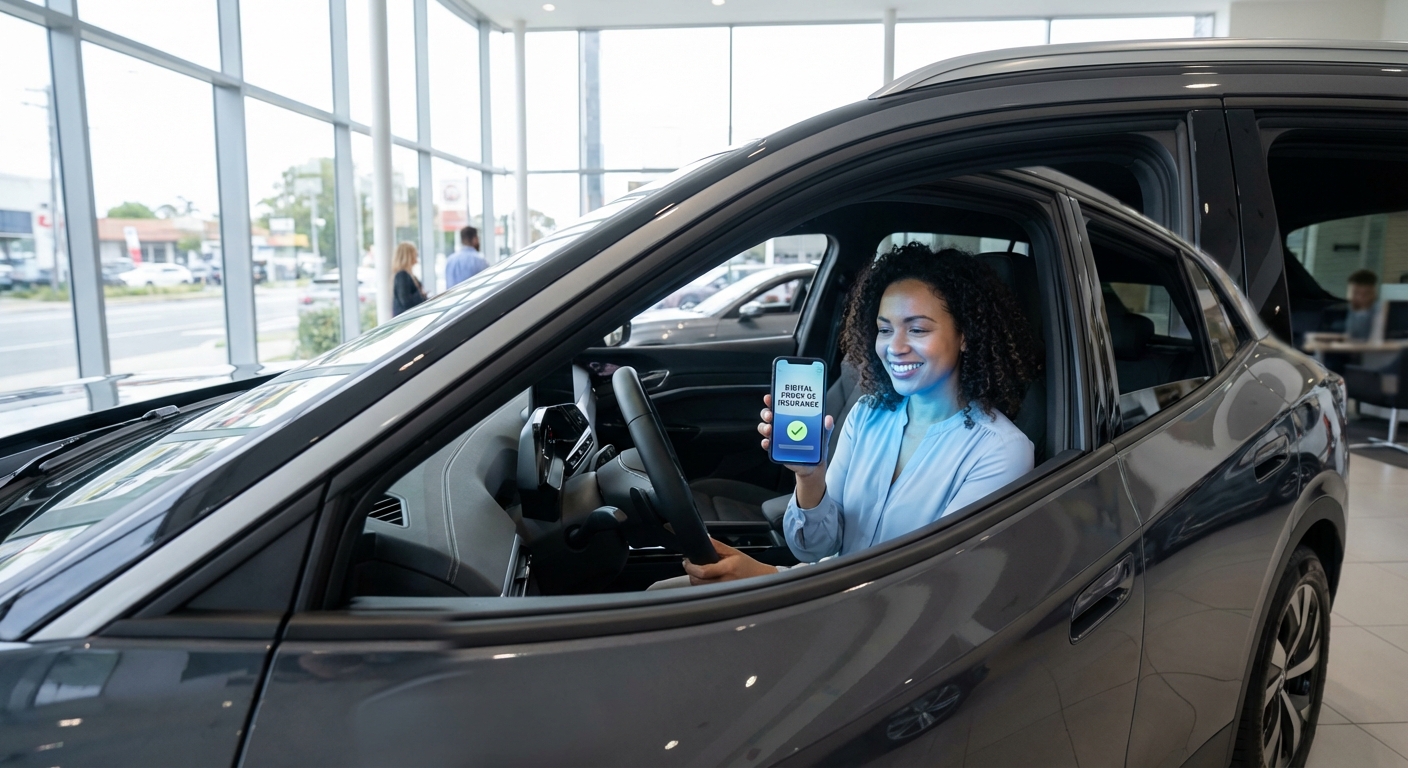
The ability to access proof instantly makes same-day coverage truly functional. You can purchase insurance on your phone while standing in a dealership, show digital proof to the salesperson, and drive away legally protected, all within 20 to 30 minutes. Be sure you also understand when car insurance expires, since most policies end at 12:01 AM (not midnight) on the expiration date. You can also explore temporary car insurance options if you need coverage for a very short period.

Protect your car with Farmers
Average Rate:
Find coverage options that fit your budget.

The insurance savings you expect.
Average Rate:
Enjoy personalized policies, comprehensive coverage & more.

See how much you could save today!
Average Rate:
Drivers who switch their auto insurance and save with State Farm save $764 on average!

Safe Drivers Save with Allstate®
Average Rate:
Get rewarded with savings for having a clean driving record.
Backdating Policies and Effective Date Rules
Understanding the difference between effective dates, purchase dates, and backdating rules protects you from coverage gaps and potential fraud allegations. Insurance companies maintain strict policies about when coverage can begin, and attempting to circumvent these rules carries serious consequences.
Why Backdating Is Generally Not Allowed
Backdating car insurance (making coverage appear active before you actually purchased it) is prohibited by nearly all insurance companies and is considered fraudulent in most states. This restriction exists because insurance operates on the principle of prospective risk, meaning you purchase protection against future events, not past incidents.
If insurers allowed backdating, drivers could purchase coverage after an accident and claim it was active at the time of the incident. This would fundamentally break the insurance system. Attempting to backdate coverage can result in claim denials, policy cancellation, criminal fraud charges, and significant penalties.
The only legitimate exception involves minor administrative processing delays. If your insurer experiences a system error or paperwork delay, they may backdate coverage by a day or two, but only if you sign a statement (typically an ACORD 37 no-loss statement) confirming no accidents or losses occurred during that brief gap.
Understanding these rules becomes especially important if you've experienced a coverage lapse and need to restart coverage. Your new policy's effective date will be the date you purchase it, not the date your previous policy ended, which may create a gap affecting your future rates. Review the guide on what to do after a car insurance lapse to minimize the impact.
Effective Date vs. Purchase Date Explained
The distinction between your purchase date and effective date determines exactly when your insurance protection begins and when premium charges start accruing. These dates don't always match, and understanding the difference helps you avoid coverage gaps.
Purchase Date: The day you sign up for insurance and complete payment
Effective Date: The day your coverage actually begins and insurance protection becomes active
| Scenario | Purchase Date | Effective Date | Result |
|---|---|---|---|
| Immediate Need | July 21 | July 21 | Coverage starts same day at 12:01 AM |
| Future Planning | July 21 | August 1 | Coverage starts on your chosen future date |
| Renewal | July 25 | August 1 | New policy begins when old one expires |
| Binding Coverage | July 21, 3:00 PM | July 21, 12:01 AM | Protection extends to that date's start |
You can choose a future effective date if you're shopping for insurance ahead of time. For example, if your current policy expires on July 31st and you shop for a new policy on July 15th, you can set the effective date for August 1st to prevent double-paying for overlapping coverage.
Premium calculations begin on your effective date, not your purchase date. If you buy a policy on July 21st with an August 1st effective date, your premium charges start August 1st. Some insurers impose brief waiting periods for optional coverages like roadside assistance or rental reimbursement, though liability coverage typically activates immediately on your effective date.
Situations Requiring Immediate Car Insurance Coverage
Certain situations demand instant insurance activation, leaving no room for waiting periods or delayed effective dates. Understanding these scenarios helps you prepare and ensures you're never caught driving without legal protection.
Buying a Car: Dealership Requirements
Purchasing a vehicle creates the most urgent need for immediate car insurance. Dealerships cannot legally allow you to drive a car off the lot without proof of insurance, and lenders require coverage before finalizing auto loans. This applies whether you're buying new or used, from a dealer or private seller.
If You Currently Have Auto Insurance: Your existing policy typically provides automatic coverage for a newly acquired vehicle for 7 to 30 days, depending on your insurer. Progressive and Allstate commonly offer up to 30 days, GEICO around 9 days, and State Farm generally 7 to 14 days depending on your state. Michigan and several other states do not recognize a statutory grace period, so you must have coverage before driving off the lot. This grace period usually mirrors the broadest coverage on your existing insured vehicles but requires you to formally add the new vehicle within that timeframe. Learn more about the new car insurance grace period and how long you have to add a vehicle.
If You Don't Currently Have Auto Insurance: You must purchase a new policy before taking possession of the vehicle. Call insurance companies from the dealership, get quotes, bind coverage over the phone, and receive digital proof instantly. Phone activation typically takes 5 to 15 minutes with proof generated on the spot.
If you're financing, your lender will typically require full coverage. You'll also want to understand what your declarations page shows so your lender is properly listed as a loss payee.
Vehicle Registration and Updated State Minimum Requirements
Registering your vehicle with your state's DMV requires valid proof of insurance in all 50 states. Several states raised their minimum liability requirements in 2025 and 2026. Make sure you meet the latest thresholds:
| State | Old Minimums (BI/PD) | New Minimums | Effective |
|---|---|---|---|
| California | 15/30/5 | 30/60/15 | Jan 1, 2025 |
| Utah | 25/65/15 | 30/65/25 (+ $3K PIP) | Jan 1, 2025 |
| Virginia | 30/60/20 | 50/100/25 | Jan 1, 2025 |
| North Carolina | 30/60/25 | 50/100/50 | Jul 1, 2025 |
| New Jersey | 25/50/25 | 35/70/25 | Jan 1, 2026 |
| Hawaii | 20/40/10 | 40/80/20 (+ $10K PIP) | Jan 1, 2026 |
| Florida | 10K PIP + 10K PDL | 25/50 BI + $5K MedPay | Jul 1, 2026* |
BI = Bodily Injury per person/per accident; PD = Property Damage. Florida is transitioning from no-fault PIP to at-fault BI liability effective July 1, 2026, with policies automatically updating at renewal. Virginia and North Carolina also require matching UM/UIM coverage.
When registering a vehicle, the DMV verifies your insurance electronically in most states. Your insurance company reports your active coverage to state databases, which DMV employees can access during registration. Approximately 34 states now use real-time or near-real-time verification systems, with Kansas fully operational by July 2026 and New York targeting 2028 implementation. You'll still need to present your insurance card as backup documentation.
Other Common Scenarios
Beyond buying vehicles and registration, several situations demand immediate insurance activation:
Adding a Newly Licensed Driver: When your teenager passes their driving test, they must be added to your policy immediately before driving your vehicles. Adding a driver takes 10 to 20 minutes online or by phone, and most insurers activate coverage within 24 to 48 hours.
Switching Insurance Providers: When changing insurers to save money, timing your coverage transition prevents gaps. You should activate your new policy to begin exactly when your current policy expires. Even a single day without insurance can increase your future rates and violate state continuous coverage requirements. Having a proof of prior coverage letter ready can also help you qualify for continuous coverage discounts.
Policy Lapse or Cancellation: If your insurance was canceled for non-payment, you need immediate coverage to legally drive again. In 2026, national average full-coverage premiums range from approximately $2,237 per year (Insurify) to $2,926 per year (Experian), or roughly $186 to $244 per month. Drivers with recent lapses face significant rate increases: short lapses of 30 days or fewer average around 8% higher premiums, while lapses longer than 30 days average around 35% higher, based on analyses of Allstate, State Farm, and USAA rate data. Very long lapses of 60 to 90+ days can push increases above 40 to 50%, and the surcharge can last 3 to 5 years. Louisiana's Act 476 (effective January 2026) now protects a first lapse of 90 days or less from triggering a rate hike, with a 5-year reset rule.
Starting a Rideshare or Delivery Job: If you're beginning work with Uber, Lyft, DoorDash, or similar services, you need specialized coverage before your first shift. Personal auto insurance doesn't cover commercial activities. Many insurers offer rideshare endorsements that activate immediately when added to your existing policy.
Moving to a New State: Relocating requires updating your insurance within a specified timeframe, typically 10 to 90 days depending on the state. New state minimums (especially in California, Virginia, North Carolina, New Jersey, Hawaii, and Florida's 2026 transition) may differ significantly from your previous coverage, potentially requiring immediate policy adjustments to maintain legal compliance.
Frequently Asked Questions About Car Insurance Waiting Periods
Can I get car insurance and use it the same day?
Yes, most car insurance policies activate liability coverage immediately upon purchase and payment. You can buy coverage online or by phone and have it become effective within minutes, with most carriers setting the effective time to 12:01 a.m. of your chosen start date. Insurance companies provide instant digital proof through email or mobile apps, which is legally accepted in 49 states plus Washington, D.C. Note that some optional coverages like roadside assistance or rental reimbursement may have short waiting periods of 10 to 14 days depending on your insurer and state.
Is there a 24-hour waiting period for new car insurance?
No, there is no mandatory 24-hour waiting period for liability car insurance in most cases. While some companies may take 24 to 72 hours to process applications in certain high-risk or non-standard situations, most major insurers activate liability coverage immediately or within 30 minutes of purchase. You can bind coverage over the phone or online and receive digital confirmation instantly. However, certain optional or specialty coverages may have short contractual waiting periods, so always ask your insurer which coverages activate immediately.
Can insurance companies backdate a policy to cover an accident?
No, insurance companies will not backdate a policy to cover an accident that already occurred. This is considered insurance fraud in most states and is strictly prohibited. Insurance operates on the principle of prospective risk, so you purchase protection against future events, not past incidents. The only narrow exception is a minor administrative processing delay where the insurer experienced a system error, but this requires a signed ACORD 37 no-loss statement confirming no losses occurred during the gap.
How quickly do I need insurance after buying a car?
You need insurance immediately, before driving your new car off the lot. Dealerships cannot legally allow you to drive away without proof of insurance, and in nearly every state, driving uninsured is a misdemeanor with fines, potential license suspension, and SR-22 requirements. If you already have an existing policy, it typically provides automatic coverage for your new vehicle for 7 to 30 days depending on your insurer, though some states like Michigan do not recognize any statutory grace period. If you don't have insurance, you must purchase a new policy before taking possession, which most buyers handle at the dealership by calling an insurer, binding coverage over the phone, and receiving digital proof within minutes.
What's the difference between the effective date and purchase date?
The purchase date is when you sign up for insurance and complete payment, while the effective date is when your coverage actually begins. These dates can be the same if you need immediate coverage, or you can choose a future effective date if you're planning ahead. For example, you might purchase a policy on July 15th but set the effective date for August 1st when your current policy expires. Premium charges begin on your effective date (typically 12:01 a.m. of that day), not your purchase date, so choosing a future effective date prevents paying for overlapping coverage while ensuring seamless protection.