
Compare Car Insurance Rates in Ohio
See if you qualify for a lower rate in less than 2 minutes



What Is a Software-Defined Vehicle?
A software-defined vehicle (SDV) is a car where software, not just hardware, controls its core functions. Unlike traditional vehicles built around fixed mechanical and electrical systems, SDVs use centralized computing platforms that can be updated, modified, and expanded through software long after the car leaves the factory.
In 2026, the shift is accelerating. Market estimates for the global SDV sector range widely by definition, from roughly $72 billion (Precedence Research) to $633 billion (Future Market Insights) in 2026, with compound annual growth rates of 16% to 34% through the mid-2030s. KPMG's synthesis puts the current core SDV market at approximately $250 to $300 billion, with potential to reach beyond $1 trillion over the next decade. GMInsights projects the market at $239.5 billion in 2026 growing to $1.86 trillion by 2035, while MarketsandMarkets estimates $447.55 billion in 2026 rising to $1.7 trillion by 2035. Electric vehicles account for a large share of the SDV market, and OEMs like Tesla, BMW, Rivian, and BYD are leading the charge while tech giants like NVIDIA and Qualcomm supply the foundational AI platforms. Learn more about how ADAS features impact your insurance rates as these systems grow more complex.
Critical Functions Now Controlled by Software
Modern SDVs don't just use software for infotainment. They rely on it for safety-critical systems, including:
| Vehicle Function | Software Role |
|---|---|
| Lane-Keeping Assist | AI interprets camera and sensor data to make real-time steering adjustments |
| Automatic Emergency Braking | Software orchestrates braking responses faster than human reaction |
| Adaptive Cruise Control | Algorithms manage acceleration, deceleration, and following distance |
| Energy Management (EVs) | AI optimizes battery usage, charging cycles, and power distribution |
| Remote Lock/Unlock | Cloud-connected software controls physical vehicle access |
| Cybersecurity Patches | OTA updates close vulnerability gaps in real time |
This means that the "car" you insured on day one may function quite differently after a software update, and your policy may not reflect that change.

Compare Car Insurance Rates in Ohio
See if you qualify for a lower rate in less than 2 minutes
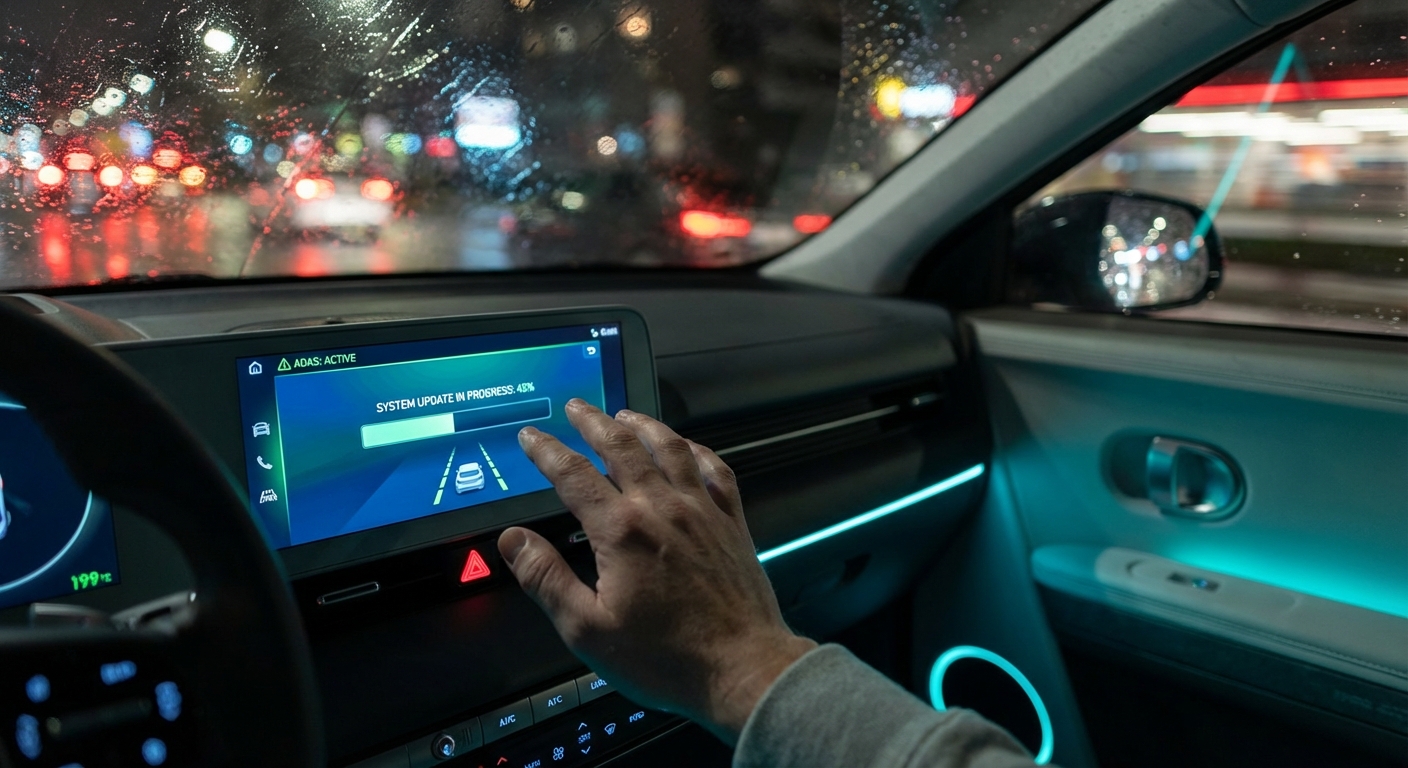
The OTA Update Problem: When Your Car Changes Overnight
Over-the-air (OTA) updates are one of the most powerful features of software-defined vehicles and one of the most misunderstood insurance risks. OEMs now push safety, performance, and customer experience updates on weekly or monthly cycles, compared to the hardware-dependent schedules of previous vehicle generations. In 2026 alone, automakers have issued a wave of OTA-based safety recalls:
- Ford Recall 26C10 (largest of 2026): 4,380,609 trucks and SUVs recalled in February 2026 for an Integrated Trailer Module issue that could disable trailer stop lamps, turn signals, and brake function. Ford began pushing the OTA fix on March 17, 2026, with full OTA deployment completed by May. The recall covers certain 2021-2026 F-150, 2022-2026 F-250 Super Duty, 2024-2026 Ranger, 2022-2026 Expedition, 2022-2026 Lincoln Navigator, 2022-2026 Maverick, and 2026 E-Transit vehicles.
- Ford Recall 26S21: A separate Image Processing Module A software update for certain 2022-2025 Lincoln Navigator, 2024-2025 Lincoln Nautilus, 2025 Lincoln Aviator, and 2025 Ford Explorer vehicles, remedied via dealer or OTA update.
- Chevy Equinox EV (2025 to 2026): Over 80,000 units recalled for a pedestrian warning system software problem, remedied via body control module OTA updates for capable vehicles.
- GM Silverado HD and Sierra HD (2025 to 2026): Recalled in March 2026 for an engine control module software error, with GM pushing wireless OTA updates to eligible vehicles.
- 2026 GMC Sierra EV and Chevy Silverado EV: Recalled for a stability control issue, with GM dealerships reprogramming the electronic brake control module or delivering the fix remotely via OTA.
- 2025 to 2026 Chevy Corvette: Roughly 33,000 units affected by a turn-signal software glitch, resolved with a lighting control module OTA update for compatible cars.
- Stellantis (August 2026): 955,000 vehicles recalled because radio software could disrupt the rearview camera, remedied via an OTA radio software update delivered through the vehicle's media screen.
How OTA Updates Create New Liability Questions
When a manufacturer pushes an update that alters braking sensitivity, changes ADAS behavior, or introduces a new autopilot mode, the question becomes: who is responsible if something goes wrong after that update?
Key manufacturer policies reveal how consequential this issue has become. GM's official Limited Warranty and Owner Assistance materials for 2025 and 2026 vehicles explicitly state that owners are responsible for installing OTA updates within 45 days of availability, and damage related to out-of-date software may not be covered under warranty. Tesla's current warranty booklet takes a similar position, warning that coverage may be excluded when owners fail to install vehicle software updates after notification. Telematics logs embedded in modern vehicles now allow insurers and manufacturers to verify whether updates were applied, shifting blame to owners who delayed installations when a related incident occurs.
Key liability scenarios to understand:
- Update causes damage: If an OTA update directly causes vehicle damage, manufacturers typically cover it, but only if you installed the update within the required timeframe.
- Skipping updates voids protection: Failing to apply required updates can void OEM warranty coverage and may cause insurers to deny claims related to outdated software behavior.
- Undisclosed changes may affect your policy: OTA updates that significantly alter performance or safety ratings may legally qualify as "vehicle modifications," potentially invalidating coverage if not disclosed to your insurer.
- Extended warranties don't fill the gap: Third-party warranty providers typically exclude pure software and firmware failures, deferring those to the manufacturer.
Two Identical Cars, Two Different Risks
Here's a scenario that surprises most drivers: two people buy the same make and model on the same day. One keeps up with every update; the other declines several. Six months later, their cars may have completely different safety capabilities, sensor calibrations, and braking logic, making them statistically different insurance risks, even though they look identical on paper.
This reality is forcing insurers to rethink how they assess risk for vehicles that can change specification without a trip to the dealer. Learn more about how autonomous vehicle liability is evolving as these challenges compound across all levels of automation.

Protect your car with Farmers
Average Rate:
Find coverage options that fit your budget.

The insurance savings you expect.
Average Rate:
Enjoy personalized policies, comprehensive coverage & more.

See how much you could save today!
Average Rate:
Drivers who switch their auto insurance and save with State Farm save $764 on average!

Safe Drivers Save with Allstate®
Average Rate:
Get rewarded with savings for having a clean driving record.
Cyber Risks: Your Car Is Now a Hacking Target
Connected cars face the same cybersecurity vulnerabilities as laptops and smartphones, but with physical consequences. Today's vehicles run on over 100 million lines of code, and every connected system is a potential attack surface.
How Bad Is the Problem in 2026?
The data from Upstream Security's 2026 Global Automotive and Smart Mobility Cybersecurity Report is striking. Researchers documented 494 publicly reported automotive and smart mobility cybersecurity incidents in 2025, with ransomware attacks more than doubling year over year to make up 44% of all incidents. 92% of attacks were carried out remotely and a striking 67% involved telematics and cloud systems, while 68% resulted in data or privacy breaches, underscoring that the primary exposure is now in backend infrastructure, APIs, and remote management platforms.
The trend has accelerated through 2026. VicOne recorded 405 automotive cybersecurity incidents in Q1 2026 and 477 in Q2 2026, a nearly 20% quarter-over-quarter jump, with the Americas overtaking Europe as the region with the highest reported volume (245 vs 113 in Q2). PCA Cyber Security's Q1 2026 report identified 265 new automotive CVEs, a 28% jump from Q4 2025 and a 102% year-over-year increase. That momentum grew in Q2 2026, when PCA logged 345 unique automotive vulnerabilities (up 30% quarter-over-quarter and 220% year-over-year) and 161 high-severity findings, more than double the 75 recorded in Q1. Ransomware activity dipped slightly quarter-over-quarter (from 180 incidents in Q1 to 160 in Q2 per VicOne), but Dykema's 2026 Automotive Trends Report notes ransomware and extortion now sit at the top of industry concern at 50%, up 5 percentage points from 2025.
Real-world attack vectors include:
- Ransomware lockouts: Attackers gain remote access through companion apps, lock owners out, manipulate functions like ignition and door locks, and demand ransom.
- Supply chain breaches: Third-party supplier compromises remain the most common pathway to OEM networks. Ecosystem-scale ransomware campaigns disrupted OEMs, suppliers, and dealership networks throughout 2025 and into 2026, with VicOne reporting cross-region, multi-business incidents more than tripling year-over-year to 161 of 610 recorded cases.
- OBD port and CAN bus attacks: Hackers connect through accessible hardware interfaces to override engine and starter systems.
- Keyless entry spoofing: Still one of the most common methods of vehicle theft, and Kaspersky expects new theft-enabling vulnerabilities to surface throughout 2026.
- AI-exploited APIs and backends: Well-organized ransomware groups now leverage AI-driven backend platforms and APIs to orchestrate large-scale campaigns.
How Insurers Are Pricing & Covering SDV Risks in 2026
The insurance industry is actively reshaping how it prices and covers software-defined vehicles, but there are still significant gaps between what drivers need and what standard policies actually provide.
How Premiums Are Being Calculated
Insurers are shifting toward data-driven, precision pricing for connected and software-defined vehicles, moving away from broad categories and toward real-time risk metrics. This includes evaluating software configuration states, OTA update histories, AI governance frameworks, telematics behavior, and even how aggressively ADAS systems are engaged. Explore how AI-driven car insurance pricing is making underwriting more sophisticated than ever.
The cost picture for SDV and EV owners remains elevated in 2026:
| Cost Factor | Details |
|---|---|
| Average EV full-coverage premium (Insurify 2026) | $3,159/year (42% higher than $2,218 for gas cars) |
| EV full-coverage average (MoneyGeek 2026) | $3,281/year across 33 EV models |
| Top-selling EV average premium gap | 18% higher than comparable gas vehicles (Insurify) |
| ADAS sensor recalibration | $485 to $688 per system, required on 28% to 36% of collision estimates |
| Section 232 auto parts tariffs | 25% tariffs pushing repair costs upward year-over-year |
Rising auto parts tariffs and repair cost inflation are major drivers. Proprietary software-linked parts, specialized labor, and expensive sensor systems all add up after even a minor incident. See our full guide on EV battery replacement coverage for model-specific cost breakdowns.
Standard Policy Coverage vs. Software-Related Gaps
Understanding what your current policy does and doesn't cover is critical for SDV owners.
Emerging Coverage Options to Consider
The market is beginning to respond with more targeted products:
- HSB Cyber for Auto Endorsement: Hartford Steam Boiler (a Munich Re company) offers "Cyber for Auto" as an endorsement designed to sit on partner insurers' personal auto policies. It covers cyber-attacks on the vehicle's systems, malware and virus damages, ransomware demands, and identity theft tied to data stored in the car.
- HSB Commercial Cyber for Auto (Launched February 2026): A standalone product for internet-connected commercial fleets, available through commercial insurance companies that partner with HSB. It covers hackers, lost business income, cyber extortion, identity theft, and alternative transportation costs when targeted work vehicles cannot be operated.
- Verisk Auto Hacking Expense Coverage: An optional endorsement for private passenger autos and light/medium trucks that helps cover diagnosing, restoring, and repairing a vehicle after a hack, including computer-system repair, temporary transportation, and even ransom payments.
- OEM-Embedded Insurance Programs: Car manufacturer insurance programs from Tesla, GM, and others use real-time vehicle data to price coverage based on actual software configuration and driving behavior. You may also want to explore embedded car insurance at the dealership level as another option.
- AI-Assisted Claims Processing: The rise of AI-powered claims automation means software-related incidents can be assessed faster, but disputes over liability between drivers and OEMs remain a significant challenge.
- Usage-Based Insurance (UBI): If your SDV's software makes you a demonstrably safer driver, telematics-based UBI programs can reward that with lower premiums. The car insurance industry trends shaping 2026 include insurers partnering directly with OEMs to access vehicle data and refine underwriting accuracy.
Frequently Asked Questions
Does standard car insurance cover OTA update failures?
Generally, no. Standard auto insurance policies treat OTA update failures as manufacturer defects, which fall outside the scope of personal auto coverage. If an update corrupts your vehicle's systems, your first point of recourse is typically the manufacturer's warranty, not your insurer. Third-party extended warranties also typically exclude software and firmware failures, so don't assume that coverage fills the gap either.
Who is liable if my car's software causes an accident?
This is one of the most contested legal questions in automotive insurance today. At lower automation levels (Level 1 to 2), the driver is still considered in control and bears primary liability. As automation increases to Level 3 and above, liability begins shifting toward the manufacturer or software provider. Courts and regulators are still developing frameworks, and outcomes often depend on which software version was running at the time of the incident. Learn more about how autonomous vehicle liability is being resolved in 2026.
Can my car be hacked, and does insurance cover it?
Yes. Upstream Security documented 494 automotive cyber incidents in 2025 with ransomware accounting for 44% of all incidents, and PCA Cyber Security identified 345 new automotive CVEs in Q2 2026 alone (a 220% year-over-year increase). Standard personal auto policies do not cover cyber-related losses. You'll need a separate cyber endorsement, such as HSB's Cyber for Auto or Verisk's Auto Hacking Expense Coverage, to be protected against hacking, ransomware lockouts, or data theft events.
Do I need to tell my insurer about OTA updates?
You may, particularly if an update significantly changes your vehicle's performance, activates new ADAS features, or alters capabilities that affect risk. Insurers can treat undisclosed capability changes as modifications that affect policy validity. GM's official 2025 and 2026 warranty materials require owners to install OTA updates within 45 days of availability, and Tesla's warranty booklet warns coverage may be excluded when owners fail to install updates after notification. Telematics logs can prove whether you complied, so failing to apply mandatory updates on schedule can also complicate future insurance claims.
Are software-defined vehicles more expensive to insure?
Yes, in most cases. SDVs and EVs with advanced technology features cost significantly more to insure than comparable gas-powered vehicles in 2026, with Insurify data showing EV full-coverage averages of $3,159 per year (42% higher than $2,218 for gas vehicles) and MoneyGeek reporting $3,281 per year across 33 EV models. The primary cost drivers are expensive sensor and software-linked repairs and uncertain liability frameworks. However, usage-based insurance programs that leverage your vehicle's own telematics data can help offset those costs if you're a demonstrably safe driver. Learn how Tesla insurance costs compare by model if you own or plan to buy one of the most software-defined vehicles on the market.