
Compare Car Insurance Rates in Ohio
See if you qualify for a lower rate in less than 2 minutes



What Is ADAS and What Features Does It Include?
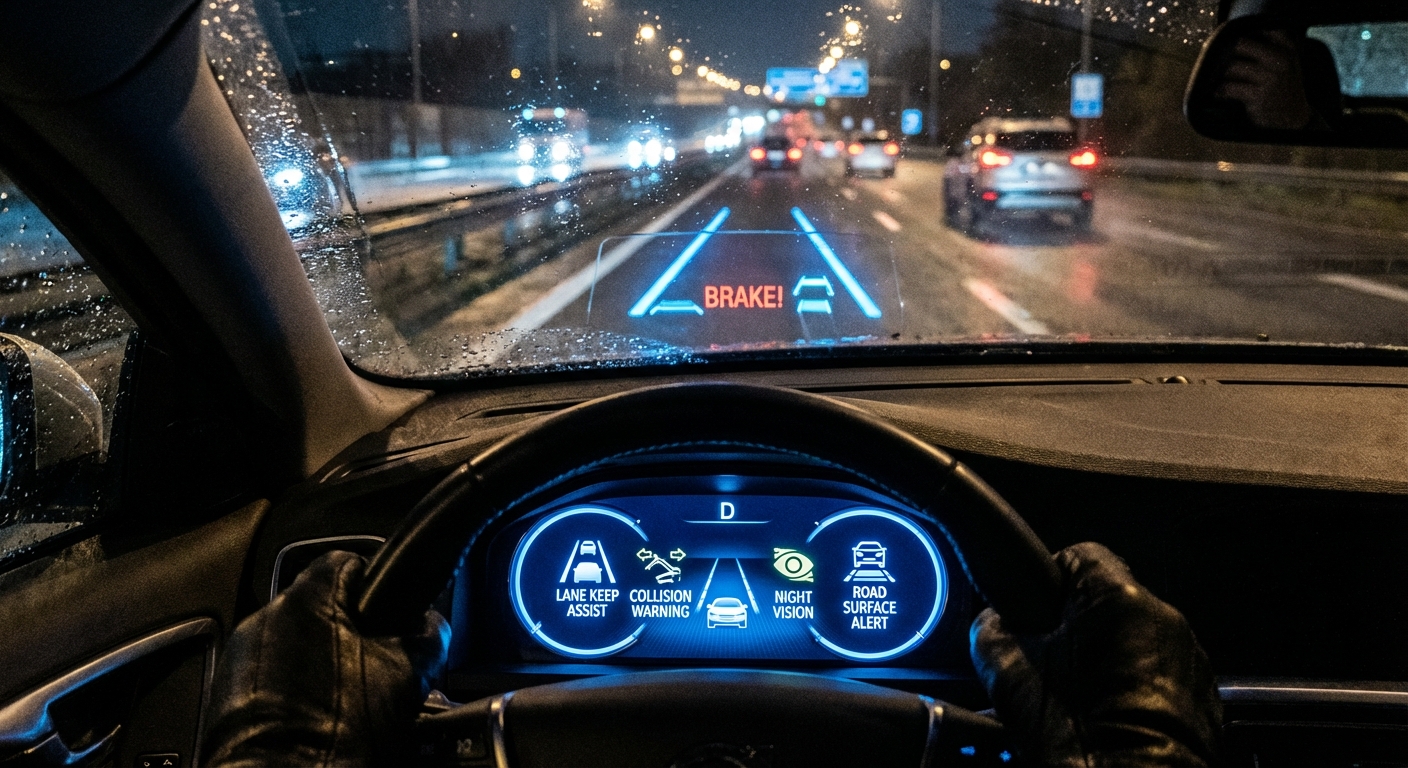
Advanced Driver Assistance Systems (ADAS) is an umbrella term for the collection of sensor-driven, software-powered technologies built into modern vehicles to assist (not replace) the driver. These systems use cameras, radar, ultrasonic sensors, and LiDAR to interpret the driving environment and either warn the driver or take limited corrective action.
As of 2026, ADAS is now mainstream in new U.S. vehicles. Industry data shows over 90% of new U.S. vehicles roll off the line with some form of ADAS, and roughly 78% of new passenger vehicles integrate Level 1 or Level 2 features. However, the total registered U.S. fleet still lags: the Highway Loss Data Institute projects five ADAS systems will be present on half or more of registered vehicles by 2028. NHTSA's finalized FMVSS 127 rule will federally require AEB with pedestrian detection on all new U.S. light vehicles beginning September 1, 2029. A Spring 2025 Unified Agenda NPRM proposed extending the compliance window by two years to give manufacturers more time on the most challenging test scenarios, and the rule remains the subject of active litigation in the D.C. Circuit as of Q1 2026. Here's a breakdown of the most common systems and what they actually do:
| ADAS Feature | How It Works | Safety Benefit |
|---|---|---|
| Automatic Emergency Braking (AEB) | Detects imminent forward collisions and applies brakes automatically | Reduces rear-end injury claim frequency by ~52% |
| Lane Keep Assist (LKA) | Monitors lane markings and gently steers back if you drift without signaling | Reduces lane-departure crashes by ~30 to 40% |
| Blind Spot Monitoring (BSM) | Alerts via lights or sounds when vehicles enter your blind spot | Reduces lane-change collision claims by ~37% |
| Adaptive Cruise Control (ACC) | Maintains a set speed and safe following distance, braking or accelerating with traffic | Reduces highway speed-variance incidents by ~29% |
| Forward Collision Warning (FCW) | Audio/visual alert for a potential front impact before AEB activates | Reduces bodily injury claims by up to 17.3% |
| Driver Drowsiness Detection | Monitors steering patterns and eye behavior to warn tired drivers | Prevents fatigue-related crashes |
These systems work together to form what the industry calls Level 2 automation, where the car can manage both steering and speed simultaneously, but the driver must stay fully engaged. ADAS is not self-driving technology. It is a co-pilot.

Compare Car Insurance Rates in Ohio
See if you qualify for a lower rate in less than 2 minutes
How ADAS Affects Your Car Insurance Premiums
The relationship between ADAS and car insurance costs is not straightforward. Safety technology can push your premiums in two opposite directions at the same time, which is why understanding both sides of the equation is essential.
The Case for Lower Premiums
Insurers care about risk. Fewer accidents mean fewer claims, and ADAS-equipped vehicles statistically file fewer claims. LexisNexis analysis of 11 million U.S. vehicles is still the foundational reference for how ADAS is priced today:
| Coverage Type | Claim Frequency Reduction (ADAS vs. Non-ADAS) |
|---|---|
| Bodily Injury | -23% to -27% |
| Property Damage | -14% to -19% |
| Collision | -8% to -11% |
| Weighted Portfolio Average | -3.1% |
Vehicles with 4+ ADAS features show an 11.7% claim frequency reduction, and richer ADAS "clusters" reach 15.2%. These numbers are significant enough that many major insurers now offer safety feature discounts for vehicles with factory-installed ADAS. In 2026, feature-specific discounts typically look like: AEB paired with forward collision warning earning 5% to 15% off related coverages, AEB with pedestrian detection earning up to 12% in states like California and Massachusetts, lane departure and lane-keeping discounts staying minimal (some insurers offering only $12 to $15 per policy annually), adaptive cruise control usually treated as a secondary feature with little standalone weight, and full ADAS packages reaching 5% to 15% total savings depending on carrier stacking. Most carriers require at least two qualifying systems to apply the discount. Vehicles like the Honda Accord, which comes standard with AEB, lane-departure warning, and blind-spot detection, regularly rank among the cheapest to insure in 2026. Learn more about car insurance industry trends shaping how insurers are pricing ADAS technology today.
However, not all insurers apply these discounts the same way. Many now embed ADAS effects into the overall vehicle rating rather than showing a large line-item discount, meaning the savings are baked in but not obvious on your declarations page. Some carriers still do not offer explicit ADAS discounts at all, and a 10% ADAS discount often only applies to a portion of the premium (not the whole policy). It pays to ask your insurer specifically whether your car's ADAS features qualify and confirm your VIN is correctly decoded. Our guide to what affects car insurance rates explains how vehicle safety features fit into the broader rating picture.
The ADAS Paradox: Safer Cars, Higher Repair Bills
Here's the uncomfortable truth that many car buyers don't realize until after their first claim: ADAS-equipped vehicles cost significantly more to repair after even minor accidents. This is the ADAS paradox. A vehicle that prevents more crashes can still drive your insurance costs up because every fender-bender now involves sophisticated sensor hardware.
Consider this: a minor bumper scrape on a modern vehicle might require replacing a radar sensor, recalibrating a camera system, and performing a full diagnostic scan. The August 2026 IIHS-HLDI analysis (covering 2017 to 2022 model year vehicles) found that collision claim frequency was about 10% lower for vehicles equipped with a bundle of ADAS features, but collision claim severity ran about 10% higher for those same vehicles versus otherwise identical models without them. The net effect was still positive for consumers: overall losses were about 5% lower for collision coverage and nearly 30% lower for property damage liability on crash-avoidance vehicles. The reason severity climbs is that ADAS prevents many low-speed fender benders, so the crashes that do happen tend to be higher-speed and more damaging. Industry analysts in the UK and U.S. estimate the average repair bill for an ADAS-equipped vehicle now runs roughly 35% to 40% higher than for a non-ADAS equivalent.
On top of that, the 25% U.S. Section 232 tariff on imported auto parts remains in force in 2026. USMCA-qualifying parts are treated as exempt, but there is no offset for most aftermarket, repair, or warranty parts, and the Supreme Court's February 2026 ruling on IEEPA-related tariffs explicitly did not disturb Section 232 duties. The Bureau of Industry and Security opened a January 2026 inclusion window and an April 1 to 14, 2026 inclusion window, letting more parts get added to the 25% tariff rather than removed. The Commerce Department's recurring quarterly inclusions process means tariff coverage is still expanding through 2026 and 2027, and a separate 25% semiconductor tariff that took effect January 15, 2026 hits ADAS sensors, radar, cameras, and ECUs directly. Mitchell's March 2026 outlook flagged that parts inflation, moderate in early 2025, accelerated once the Section 232 duties fully took effect. Learn more about how auto tariffs are driving car insurance costs heading into 2027.
This cost-severity tradeoff is why insurers aren't simply rewarding you for having safer technology. They're also accounting for what it will cost them when that technology gets damaged. For a deeper look, see how insurance companies assess car damage after an accident.

Protect your car with Farmers
Average Rate:
Find coverage options that fit your budget.

The insurance savings you expect.
Average Rate:
Enjoy personalized policies, comprehensive coverage & more.

See how much you could save today!
Average Rate:
Drivers who switch their auto insurance and save with State Farm save $764 on average!

Safe Drivers Save with Allstate®
Average Rate:
Get rewarded with savings for having a clean driving record.
ADAS Calibration: The Hidden Insurance Cost
One of the least-discussed yet most financially impactful aspects of ADAS ownership is calibration. After any event that disrupts your vehicle's sensors or cameras (a windshield replacement, a front-end collision, even a wheel alignment), most ADAS systems must be professionally recalibrated before they function correctly again. CCC Intelligent Solutions data now shows ADAS recalibration appears on 35.6% of all collision repair estimates, up from 26.9% a year earlier and 21.8% two years ago. Broader industry counts put ADAS calibration on roughly 60% of collision repair orders nationally when supplements are included, and calibration is projected to appear on roughly half of all first-look estimates by 2027 as ADAS-equipped vehicles make up a larger share of the fleet. Average calibration billing has climbed from about $250 a year ago to $500 and rising, with insurer-paid billing ranging from $300 to $1,400 per job depending on the system and OEM.
Why Calibration Is Required
Replacing a windshield disturbs the camera mounting bracket and the reference surface that forward-facing cameras rely on. Even a misalignment of fractions of a degree can cause systems to generate false collision warnings, fail to detect lane drift, or shut down entirely. Vehicle manufacturers mandate calibration after most glass replacements to restore original safety performance.
What Calibration Costs
Industry sources in 2026 place typical calibration prices between $300 and $600 per system for mainstream vehicles, with multi-system jobs frequently higher. Dealership pricing commonly runs $400 to $600+ per system, and full ADAS suite resets on luxury vehicles (Tesla, BMW, HUD-equipped) or major collisions can reach $1,500 or more. Modern estimates routinely carry one to three calibration lines on a single claim.
| Calibration Type | Description | Typical Cost (2026) |
|---|---|---|
| Static Calibration | Performed in-shop using precision targets | $250 – $450 |
| Dynamic Calibration | Requires a controlled road test on specific routes | $150 – $300 |
| Forward Camera (post-windshield) | Camera recalibration behind rearview mirror | $250 – $500 |
| Front / Rear Radar Sensors | Adaptive cruise and collision avoidance systems | $300 – $600 |
| Blind Spot Monitoring | Rear sensor recalibration | $300 – $400 |
| 360° Surround-View | Multi-camera calibration | $350 – $550 |
| Multi-System Collision | Camera + radar + parking sensors after collision | $400 – $900 |
| Luxury / Full ADAS Suite | Tesla, BMW, HUD-equipped vehicles | $800 – $1,500+ |
These costs are on top of whatever the original repair cost. A windshield replacement that once cost $200 can now easily run $600 to $1,500+ when ADAS calibration is factored in. Understanding car insurance glass coverage is critical if your vehicle has a camera-equipped windshield.
Does Your Insurance Cover ADAS Calibration?
The good news is that most comprehensive insurance policies cover ADAS calibration when it's tied to a covered claim, such as a windshield replacement or collision repair. However, coverage is not guaranteed and depends on:
- Whether you use an insurer-approved or OEM-certified shop
- Whether proper documentation is provided (OEM position statements, pre/post-repair diagnostic scans, proof of I-CAR or IMI TechSafe technician certification)
- Whether your specific policy explicitly includes electronic calibration
State and federal action is picking up momentum in 2026. New York's GBL § 392-k disclosure law and Arizona's SB 1410 impose calibration disclosure duties with penalties, Maryland's SB 789 licensing bill was gutted to a study and effectively died at sine die on April 13, 2026, and federal H.R. 7389 (the Motor Vehicle Modernization Act of 2026), which incorporates the ADAS Functionality and Integrity Act as Section 221, cleared the House Energy and Commerce Committee 48-1 on May 21, 2026 and now awaits a full House floor vote. If enacted, that federal framework would direct NHTSA to define calibration tolerances and validation testing for MY 2028+ vehicles, and require automakers to share tolerance and system-sensitivity data with NHTSA and owners within 30 days of releasing a new model. For a deep dive into exactly what's covered and how to avoid claim denials, see our complete guide to ADAS calibration and car insurance coverage.
How Insurers View ADAS and What the Future Holds
How Today's Insurers Price ADAS Vehicles
Insurance companies are still catching up to ADAS technology. Most major insurers now use VIN-based vehicle data to identify which safety features a car has and incorporate that information into rate calculations. However, the application is inconsistent across the industry:
Insurers also view comprehensive coverage for sensor damage through a strict lens. A claim for damaged radar sensors in a bumper, LiDAR units, or camera modules may be approved, but only if the shop uses OEM-compliant equipment and provides thorough documentation of the repair necessity. Adjusters who are not familiar with ADAS requirements may initially deny valid claims, which is why working with a certified repair shop matters. Photo-estimating tools now handle roughly 26.4% of repairable claim inspections, but they often miss ADAS calibration needs, so make sure your final estimate accounts for them. Learn more about AI-powered photo estimating for car insurance claims.
Pairing your ADAS vehicle with a telematics-based program can compound your savings. Policygenius data shows drivers using telematics save an average of about 20% (roughly $332 per year), with Progressive Snapshot users averaging $922 in annual savings. If your ADAS systems show you're a lower-risk driver, and your telematics data confirms careful driving habits, you can stack discounts for an even bigger reduction. See our breakdown of how AI is shaping car insurance pricing in 2026, and how insurance for software-defined vehicles is evolving as cars become more connected.
The Future: Automation, Liability, and Changing Premiums
As vehicles inch toward higher levels of automation, the insurance landscape is shifting in fundamental ways. Some projections worth noting:
- AEB will be federally required on all new U.S. light vehicles by September 1, 2029 under NHTSA's finalized FMVSS 127 rule (with an NPRM circulating in early 2026 that could add two years to the compliance window, and active D.C. Circuit litigation still pending as of Q1 2026)
- Over 90% of new U.S. vehicles now ship with some form of ADAS, and roughly 78% have Level 1 or Level 2 features from the factory
- Federal calibration standards under H.R. 7389 Section 221 could reshape shop and manufacturer liability starting with model year 2028 if the bill passes the full House and Senate
- Liability continues to shift toward manufacturers at higher autonomy levels (Level 4 to 5) as courts hear more cases involving driver-assist and self-driving systems
- The federal SELF DRIVE Act (H.R. 7390) was forwarded out of subcommittee 12-11 on February 10, 2026, but as of mid-2026 the House Energy and Commerce Committee had not reached bipartisan consensus and the bill remained stalled in committee
This shift also means autonomous vehicle insurance and OEM manufacturer insurance programs are rapidly evolving topics that every connected-car owner should follow.
In the near term, expect repair costs to remain elevated on ADAS vehicles even as accident frequency continues to fall. The tariff environment, rising labor costs for certified technicians, increasingly complex sensor arrays, and ongoing parts import dependencies all contribute to keeping claim severity high through at least 2027. This dynamic is especially relevant if you own an older ADAS vehicle. Read our guide to the growing gap between standard and high-risk car insurance rates to understand how insurers are segmenting drivers today.
Frequently Asked Questions
Does having ADAS features automatically lower my car insurance?
Not automatically. While ADAS-equipped vehicles statistically have fewer accidents and many insurers recognize this with lower base rates, direct discounts vary widely by company. LexisNexis data still shows ADAS vehicles cut bodily injury loss cost by 23% and property damage by 14%, which is significant enough to influence your rate. Features like AEB paired with forward collision warning are most likely to earn explicit discounts of 5% to 15% on affected coverages, and full ADAS packages typically deliver 5% to 15% in total savings. Most insurers require at least two qualifying systems, so always ask your insurer directly which ADAS features qualify and confirm your VIN is correctly decoded.
Why did my insurance go up even though my car has safety technology?
This is the ADAS paradox at work. While your car may get into fewer accidents, when accidents do occur, ADAS-equipped vehicles cost meaningfully more to repair. The August 2026 IIHS-HLDI analysis pegged the collision claim severity increase at about 10% for crash-avoidance vehicles because the systems prevent low-speed fender benders, leaving mostly higher-speed crashes in the data. The 25% Section 232 tariff on imported auto parts (still in force in 2026 after the Supreme Court's February 2026 ruling on IEEPA tariffs left Section 232 untouched) and a new 25% semiconductor tariff hitting ADAS chips and cameras are both pushing claim severity higher across the board. See our full breakdown of how car insurance premiums are calculated to understand why these factors matter.
Will my insurance cover ADAS sensor damage after a collision?
Most comprehensive and collision policies do cover ADAS sensor repairs and recalibration when they result from a covered event. However, coverage can be denied if you use a non-certified shop, lack OEM documentation, or your policy explicitly excludes electronic recalibration. Always confirm with your insurer before repairs begin, and use an I-CAR certified or OEM-approved body shop to protect your claim. Understanding your ADAS calibration coverage details before an accident happens is the best way to avoid surprises.
Do I need ADAS calibration after every windshield replacement?
If your vehicle has a camera or sensor mounted to or near the windshield (which applies to the vast majority of vehicles built after 2018), then yes, calibration is required after windshield replacement. Typical 2026 calibration costs run $300 to $600 per system at independent shops and $400 to $600+ at dealerships, with multi-sensor jobs pushing $600 to $900 and luxury full-suite resets exceeding $1,500. Skipping calibration can cause your safety systems to malfunction, generate false warnings, or fail entirely. Beyond safety, an insurer or manufacturer may deny future claims if it is discovered calibration was bypassed.
How will ADAS affect car insurance in the next 5 to 10 years?
The trend points toward lower premiums over time as ADAS becomes ubiquitous, repair costs normalize, and automation reduces overall accident rates. HLDI projects five ADAS systems will be present on half or more of the U.S. registered fleet by 2028, which should meaningfully cut aggregate claim frequency. In the near term (2026 to 2030), expect mixed effects: more widespread ADAS discounts, continued upward pressure on claim severity from tariffs and complex sensors, and evolving federal standards through H.R. 7389 and the SELF DRIVE Act if either advances. Liability models are also continuing to shift toward manufacturers as autonomous features become more sophisticated. Learn more about autonomous vehicle insurance as coverage frameworks continue to evolve.