
Compare Car Insurance Rates in Ohio
See if you qualify for a lower rate in less than 2 minutes



What Is a Software-Defined Vehicle?
A software-defined vehicle (SDV) is a car where software — not just hardware — controls its core functions. Unlike traditional vehicles built around fixed mechanical and electrical systems, SDVs use centralized computing platforms that can be updated, modified, and expanded through software long after the car leaves the factory.
In 2026, the shift is accelerating. Market estimates for the global SDV sector range from $270 billion to $475 billion in 2025, growing at compound annual rates of 25–34% through the 2030s — with no major analyst revising growth expectations downward. By 2029, SDVs are forecasted to comprise at least 90% of new vehicle sales. OEMs like Tesla, BMW, Rivian, and BYD are leading the charge, while tech giants like NVIDIA and Qualcomm supply the foundational AI platforms. Advanced Driver Assistance Systems (ADAS) alone captured 36% of the SDV market share in 2024 — a figure that continues to climb. Learn more about how ADAS features impact your insurance rates as these systems grow more complex.
Critical Functions Now Controlled by Software
Modern SDVs don't just use software for infotainment. They rely on it for safety-critical systems, including:
| Vehicle Function | Software Role |
|---|---|
| Lane-Keeping Assist | AI interprets camera and sensor data to make real-time steering adjustments |
| Automatic Emergency Braking | Software orchestrates braking responses faster than human reaction |
| Adaptive Cruise Control | Algorithms manage acceleration, deceleration, and following distance |
| Energy Management (EVs) | AI optimizes battery usage, charging cycles, and power distribution |
| Remote Lock/Unlock | Cloud-connected software controls physical vehicle access |
| Cybersecurity Patches | OTA updates close vulnerability gaps in real time |
This means that the "car" you insured on day one may function quite differently after a software update — and your policy may not reflect that change.

Compare Car Insurance Rates in Ohio
See if you qualify for a lower rate in less than 2 minutes
The OTA Update Problem: When Your Car Changes Overnight
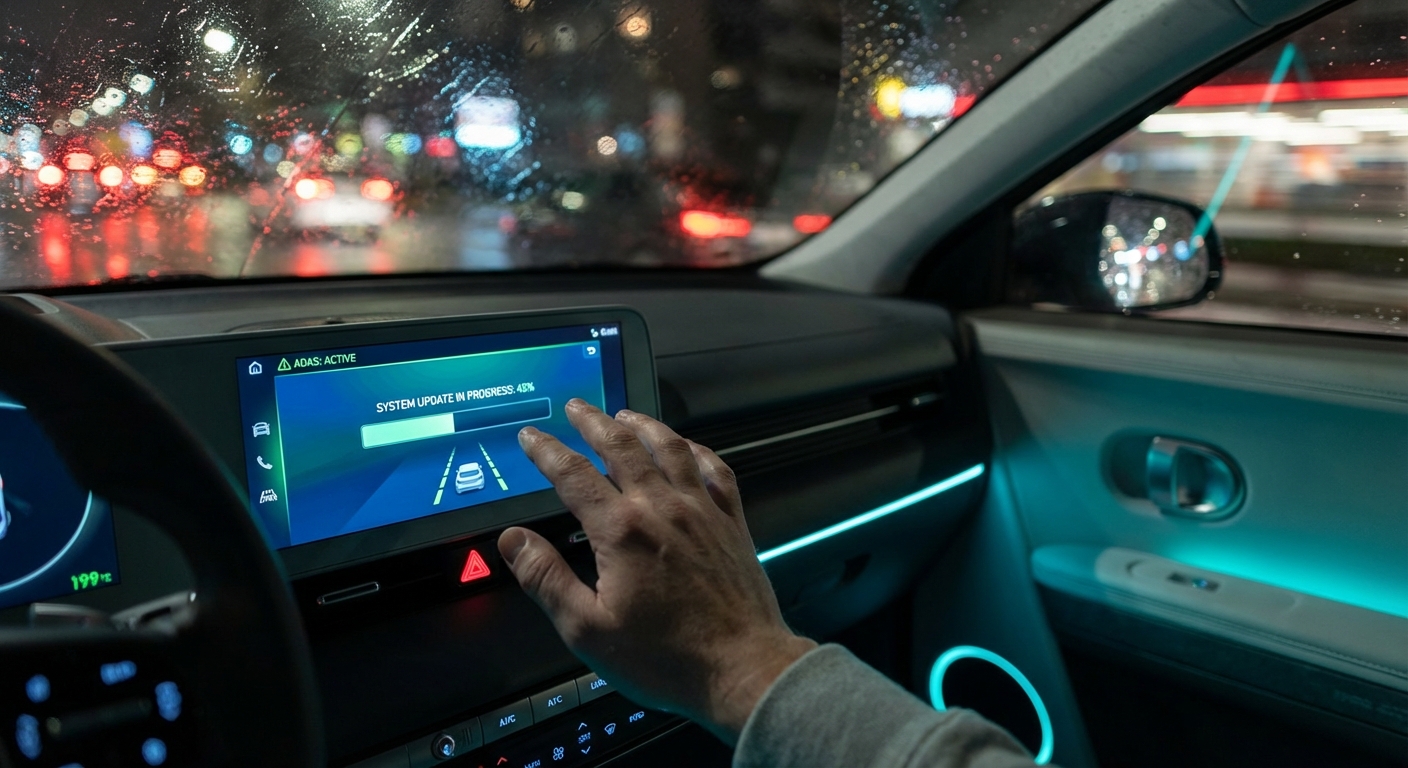
Over-the-air (OTA) updates are one of the most powerful features of software-defined vehicles — and one of the most misunderstood insurance risks. OEMs now push safety, performance, and customer experience updates on weekly or monthly cycles, compared to the hardware-dependent schedules of previous vehicle generations. In 2025–2026 alone, major OTA-based recalls affected millions of U.S. vehicles — including a Ford campaign covering approximately 4.38 million vehicles for trailer module software issues, and GM campaigns addressing lighting control modules across 2025–2026 Corvettes and fleet vehicles — highlighting just how central software has become to fleet-wide safety management.
How OTA Updates Create New Liability Questions
When a manufacturer pushes an update that alters braking sensitivity, changes ADAS behavior, or introduces a new autopilot mode, the question becomes: who is responsible if something goes wrong after that update?
Key manufacturer policies reveal how consequential this issue has become. GM now requires owners to install OTA updates within 45 days — and explicitly states that damage resulting from failing to install an update within that window is excluded from warranty coverage, similar to skipping a required oil change. Telematics logs embedded in modern vehicles now allow insurers and manufacturers to verify whether updates were applied — shifting blame to owners who delayed installations when a related incident occurs.
Key liability scenarios to understand:
- Update causes damage: If an OTA update directly causes vehicle damage, manufacturers typically cover it — but only if you installed the update within the required timeframe.
- Skipping updates voids protection: Failing to apply required updates can void OEM warranty coverage and may cause insurers to deny claims related to outdated software behavior.
- Undisclosed changes may affect your policy: OTA updates that significantly alter performance or safety ratings may legally qualify as "vehicle modifications" — potentially invalidating coverage if not disclosed to your insurer.
- Extended warranties don't fill the gap: Third-party warranty providers typically exclude pure software and firmware failures, deferring those to the manufacturer. Coverage only applies to hardware components that are affected by or revealed through an update.
Two Identical Cars, Two Different Risks
Here's a scenario that surprises most drivers: two people buy the same make and model on the same day. One keeps up with every update; the other declines several. Six months later, their cars may have completely different safety capabilities, sensor calibrations, and braking logic — making them statistically different insurance risks, even though they look identical on paper.
This reality is forcing insurers to rethink how they assess risk for vehicles that can change specification without a trip to the dealer. Learn more about how autonomous vehicle insurance liability is evolving as these challenges compound across all levels of automation.

Protect your car with Farmers
Average Rate:
Find coverage options that fit your budget.

The insurance savings you expect.
Average Rate:
Enjoy personalized policies, comprehensive coverage & more.

See how much you could save today!
Average Rate:
Drivers who switch their auto insurance and save with State Farm save $764 on average!

Safe Drivers Save with Allstate®
Average Rate:
Get rewarded with savings for having a clean driving record.
Cyber Risks: Your Car Is Now a Hacking Target
Connected cars face the same cybersecurity vulnerabilities as laptops and smartphones — but with physical consequences. Today's vehicles run on over 100 million lines of code, and every connected system is a potential attack surface.
How Bad Is the Problem in 2026?
The data from 2025 is striking. Upstream Security documented 494 publicly reported automotive and smart mobility cybersecurity incidents — a 39% year-over-year increase and an all-time high. Ransomware accounted for 44% of all incidents, more than doubling compared to 2024. A significant 71% of incidents were attributed to black hat actors (up from 65% the year before), and 92% of attacks were carried out remotely — with 86% requiring no physical proximity to the target vehicle. Most alarming: 61% of incidents had the potential to impact thousands to millions of vehicles simultaneously, and 68% resulted in data or privacy breaches.
Real-world impact in 2025 was severe. A Russia-linked ransomware group disrupted approximately 15,000 dealerships for two weeks causing roughly $1 billion in losses, while a separate breach exposed SSNs and personal data for 2.7 million vehicle owners. Jaguar Land Rover suffered a production halt of over three weeks tied to a cyber incident, with estimated losses of $2.5–$2.67 billion.
Real-world attack vectors include:
- Ransomware lockouts: Attackers gain access to remote vehicle command systems, locking owners out and demanding payment to restore ignition and door access. Incidents in Russia in June 2025 demonstrated this threat against consumer vehicles via companion apps.
- OBD port and CAN bus attacks: Hackers connect through accessible hardware interfaces to override engine and starter systems.
- Keyless entry spoofing: Still one of the most common methods of vehicle theft.
- Supply chain breaches: Third-party supplier compromises remain the most common pathway to OEM networks — attackers target the weakest link.
- AI-exploited APIs and backends: Ransomware groups are now leveraging AI to identify vulnerabilities at scale, with 67% of 2025 incidents occurring via telematics or cloud channels.
The automotive cybersecurity market is responding — but insurance coverage has not kept pace.
How Insurers Are Pricing & Covering SDV Risks in 2026
The insurance industry is actively reshaping how it prices and covers software-defined vehicles — but there are still significant gaps between what drivers need and what standard policies actually provide.
How Premiums Are Being Calculated
Insurers are shifting toward data-driven, precision pricing for connected and software-defined vehicles — moving away from broad categories and toward real-time risk metrics. This includes evaluating software configuration states, OTA update histories, AI governance frameworks, telematics behavior, and even how aggressively ADAS systems are engaged. Tools like S&P Global Mobility's SDV Suite are being deployed by underwriters to gain visibility into vehicle architectures, supplier chains, and real-time vehicle data for more accurate claims reconstruction and repair cost prediction. Explore how AI-driven car insurance pricing is making underwriting more sophisticated than ever.
The cost picture for SDV and EV owners remains elevated:
| Cost Factor | Details |
|---|---|
| Average EV full-coverage premium | $3,281–$4,058/year (vs. ~$2,732 national average for gas vehicles) |
| SDV/EV premium increase vs. gas vehicles | 15–49% higher depending on model and market |
| Average repairable EV collision claim | ~$6,200–$6,400 per incident (approx. 50% higher than comparable ICE vehicles) |
| Sensor recalibration after minor collision | $150–$1,200+ per event — required on 35.6% of all collision estimates |
| ADAS share of minor repair bills | 13–71% of total repair cost depending on damage type |
| Tariff-driven parts cost increases | 25% import tariffs pushing repair costs upward year-over-year |
Rising vehicle repair cost inflation is a major driver — proprietary software-linked parts, specialized labor, and expensive sensor systems all add up after even a minor incident.
Standard Policy Coverage vs. Software-Related Gaps
Understanding what your current policy does — and doesn't — cover is critical for SDV owners.
Emerging Coverage Options to Consider
The market is beginning to respond with more targeted products:
- Vehicle Cyber Insurance Endorsements — Covers hacking, ransomware vehicle lockouts, data breaches, cyber extortion, and betterment costs to upgrade hardware after an attack. Carriers like Travelers offer up to $1M in cyber breach response for SDVs, while GEICO has rolled out "Digital Shield" riders that cover repair or replacement if a hack totals the vehicle's value. Talk to your agent about what's available for your specific make and model.
- OTA Update Failure Coverage — Add-ons from providers like State Farm cover towing, rental car, and dealer reprogramming costs resulting from failed OTA updates. These typically exclude manufacturer recalls but cover "non-recall failures" where a software push corrupts vehicle systems.
- OEM-Embedded Insurance Programs — Car manufacturer insurance programs from Tesla, GM, and others use real-time vehicle data to price coverage based on actual software configuration and driving behavior. These programs offer a more accurate risk picture than traditional policies — though always compare rates independently before committing. You may also want to explore embedded car insurance at the dealership level as another option.
- Parametric Auto Policies — Trigger-based payouts that don't require fault determination — useful in SDV accidents where liability is contested. Learn how parametric auto insurance works and whether it fits your situation.
- Usage-Based Insurance (UBI) — If your SDV's software makes you a demonstrably safer driver, telematics-based UBI programs can reward that with lower premiums — reducing claims frequency by 10–15% for safe drivers, according to current market data. The car insurance industry trends shaping 2026 include insurers partnering directly with OEMs to access vehicle data and refine underwriting accuracy. Learn more about how telematics programs work and whether they fit your driving profile.
For a deeper look at the full legal landscape — including how the SELF DRIVE Act is reshaping liability for automated vehicles — read our guide on software-defined vehicle insurance challenges in 2026.
Frequently Asked Questions
Does standard car insurance cover OTA update failures?
Generally, no. Standard auto insurance policies treat OTA update failures as manufacturer defects, which fall outside the scope of personal auto coverage. If an update corrupts your vehicle's systems or causes a malfunction, your first point of recourse is typically the manufacturer's warranty — not your insurer. That said, if the update failure leads to a collision, your collision coverage may still apply depending on fault determination. Third-party extended warranties also typically exclude software and firmware failures, so don't assume that coverage fills the gap either.
Who is liable if my car's software causes an accident?
This is one of the most contested legal questions in automotive insurance today. At lower automation levels (Level 1–2), the driver is still considered in control and bears primary liability. As automation increases to Level 3 and above, liability begins shifting toward the manufacturer or software provider. Courts and regulators are still developing frameworks — and outcomes often depend on which software version was running at the time of the incident and whether all required updates were current. Learn more about how autonomous vehicle liability is being resolved in 2026.
Can my car be hacked, and does insurance cover it?
Yes — Upstream Security documented 494 automotive cyber incidents in 2025 alone, a 39% year-over-year increase and all-time high, with ransomware more than doubling. Supply chain breaches, keyless entry spoofing, and AI-exploited vehicle APIs are all active, documented threats — with 92% of attacks carried out remotely. Standard personal auto policies do not cover cyber-related losses. You'll need a separate cyber endorsement or a specialty policy to be protected against hacking, ransomware lockouts, or data theft events — talk to your insurer about what's available for your specific vehicle.
Do I need to tell my insurer about OTA updates?
You may — particularly if an update significantly changes your vehicle's performance, activates new ADAS features, or alters capabilities that affect risk. Insurers can treat undisclosed capability changes as modifications that affect policy validity. As a best practice, keep a log of major updates applied to your vehicle and contact your agent if a software update substantially changes how your car drives or what it can do. Manufacturers like GM now require updates within 45 days, and telematics logs can prove whether you complied — failing to apply mandatory updates on schedule can also void OEM warranty protection and complicate future claims.
Are software-defined vehicles more expensive to insure?
Yes, in most cases. SDVs and EVs with advanced technology features are averaging 15–49% higher premiums than comparable gas-powered vehicles in 2026, with full-coverage costs commonly ranging from $3,281 to $4,058 per year versus the ~$2,732 national average for gas vehicles. The primary cost drivers are expensive sensor and software-linked repairs — with average EV collision claims running approximately $6,200–$6,400, roughly 50% more than comparable ICE vehicles — along with uncertain liability frameworks and the complexity of claims involving automated systems. However, usage-based insurance programs that leverage your vehicle's own telematics data can help offset those costs if you're a demonstrably safe driver.