
Compare Car Insurance Rates in Ohio
See if you qualify for a lower rate in less than 2 minutes



How AI Analyzes Risk Factors for Car Insurance
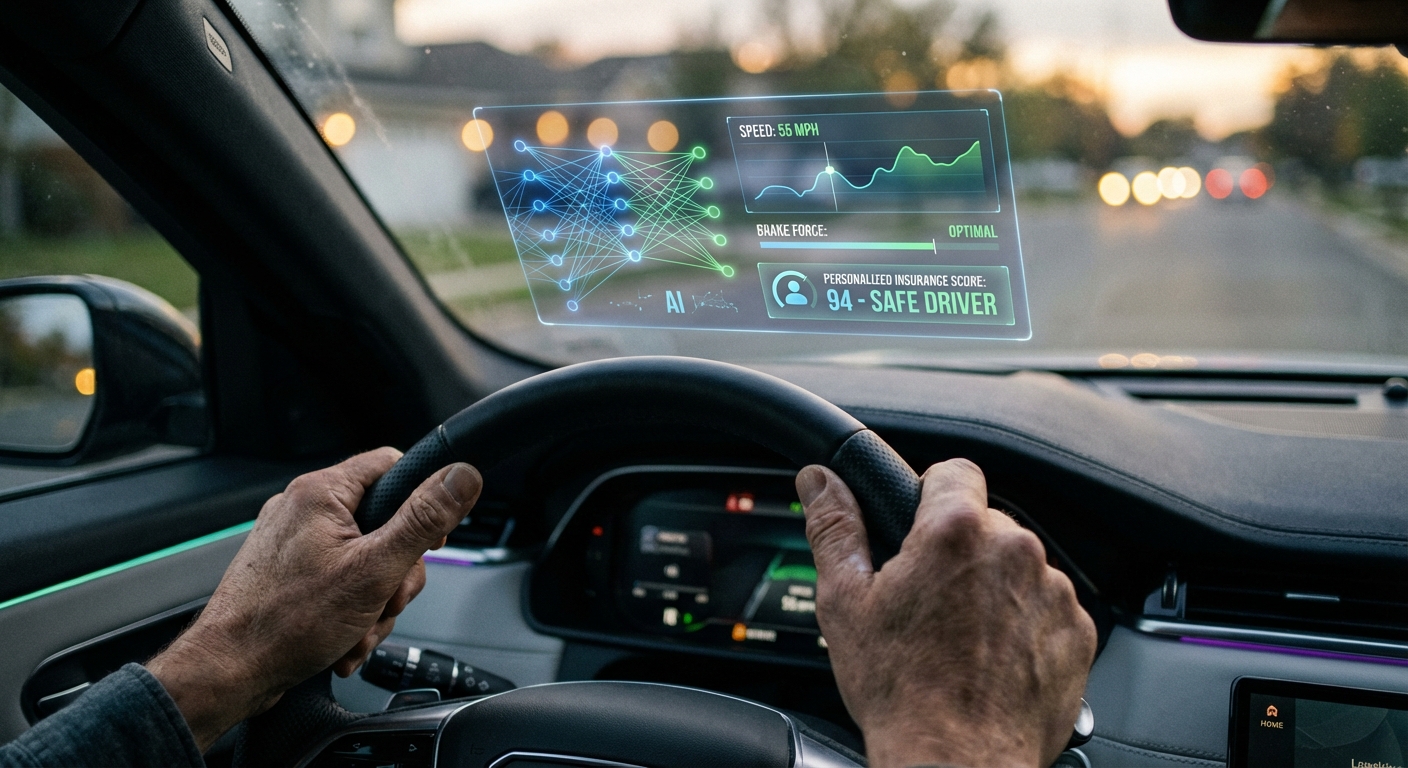
Gone are the days when a handful of actuarial variables (age, gender, ZIP code) were enough to determine your premium. In 2026, insurers deploy machine learning models that process hundreds of data points simultaneously to build a highly granular picture of your individual risk. Understanding what goes into that picture is the first step toward managing it.
The Data AI Uses to Set Your Rate
AI-driven underwriting pulls from a wide range of sources, including:
| Data Category | Examples |
|---|---|
| Telematics / Driving Behavior | Speed, braking force, acceleration, cornering, mileage, time of day |
| Vehicle Data | Make, model, year, safety ratings, ADAS features, theft rates |
| Historical Record | Prior accidents, violations, past claims |
| Location Signals | Traffic density, crime rates, accident statistics, road quality |
| Credit & Financial Proxies | Credit-based insurance score, payment history |
| External Conditions | Weather patterns, local repair costs, litigation trends |
Traditional insurers collected this data periodically and updated rates at renewal. AI systems, by contrast, can process it in real time, continuously refining your risk profile. The NAIC Big Data and Artificial Intelligence Working Group survey found that 88% of auto insurers report current or planned AI usage across their operations. A 2026 Simplifai study found that 99% of insurers in the US and Europe now have generative-AI projects underway, showing just how quickly AI has moved from experimentation to core infrastructure.
Telematics data is the crown jewel of AI pricing. Sensors and smartphone apps track exactly how you drive, not just whether you have a clean record. Learn more about how insurers assess your risk and what data they collect.
How AI Differs From Traditional Actuarial Methods
Traditional actuarial pricing works on static, population-level statistics. Actuaries group drivers into broad risk pools and charge premiums based on what people in similar categories historically cost to insure. This means a 23-year-old in an urban ZIP code pays elevated rates regardless of whether they're actually a careful driver.
AI models flip this equation. Instead of pooling, they individualize. Key differences include:
AI and algorithmic pricing are already standard at most major auto insurers, often using data beyond your driving record. AI already determines your rate at most major carriers, though it often works alongside traditional actuarial models. This shift enables predictive analytics for claims. AI can forecast not just whether you might file a claim, but estimate severity, frequency, and even the type of incident. For a deeper look at how insurers evaluate your full profile, see our guide on how premiums are calculated.

Compare Car Insurance Rates in Ohio
See if you qualify for a lower rate in less than 2 minutes
Benefits of AI Pricing: Personalization, Fraud Detection & Savings
When implemented fairly, AI-based pricing offers genuine advantages for consumers, particularly those who drive safely and infrequently.
Personalized Premiums for Safe Drivers
The most direct benefit: your premium reflects your actual behavior, not the behavior of people who happen to share your demographic profile. Safe drivers, low-mileage commuters, and those who drive primarily during off-peak hours can qualify for significantly lower rates.
Here's how the leading programs stack up in 2026:
| Program | Sign-Up Discount | Max Discount | Typical Savings | Can Rates Increase? |
|---|---|---|---|---|
| Nationwide SmartRide | ~10% | Up to 40% | ~15-25% | No (discount only) |
| Progressive Snapshot | ~$169 first 6 mo. | Up to 30% | ~$322/yr avg | Yes (varies by state) |
| State Farm Drive Safe & Save | ~10% | Up to 30% | ~10-20% | Rarely |
| Liberty Mutual RightTrack | ~5-10% | Up to 30% | ~10-20% | Yes |
| USAA SafePilot | ~5-10% | Up to 30% | ~10-20% | Generally no |
| GEICO DriveEasy | State-dependent | Up to 25-30% | ~10-20% | Yes |
- Progressive advertises an average of $169 in initial savings in the first six months for new Snapshot users, and customers who complete the Snapshot program save an average of $322 per year
- Progressive Snapshot Data is used to determine your personalized rate for each enrolled vehicle, which may result in a discount or, in some states, a surcharge to your policy premium depending on your driving habits and conditions
- A discount comparison notes State Farm and USAA offer among the biggest telematics discounts, with maximum savings up to 30% for safe drivers
- 32% of auto insurance shoppers now use artificial intelligence tools during their search for coverage, according to J.D. Power, so more consumers are actively engaging with AI on the buying side.
This is a meaningful departure from rating factors that determine your premium under traditional models, where age and ZIP code dominate regardless of actual driving performance.
Fraud Detection That Benefits Everyone
Insurance fraud costs American consumers hundreds of billions of dollars every year, and the good news is that AI is getting better at catching it, though the stakes are also rising. 98% of insurers say AI editing tools are fueling digital fraud, only 32% of insurers feel very confident detecting deepfakes, and 55% of Gen Z consumers say they would consider editing a claim photo or document. Deepfake fraud attempts are up 2,137% since 2023, and document fraud enabled by AI tools like fake repair estimates, fabricated medical records, and manipulated damage photos has surged by 3,000% in the same period.
AI-powered fraud detection works by:
- Flagging GPS data mismatches and inconsistent driving patterns
- Using computer vision to detect altered or reused vehicle damage photos
- Running graph analytics to uncover coordinated fraud rings across multiple insurers
- Applying NLP to identify collusive language patterns in claims statements
In the United States, AI-enhanced insurance fraud cases grew from roughly 20,000 in 2022 to over 80,000 in 2025. When fraud losses fall, those savings can translate into more competitive premiums for honest policyholders. Learn more about how AI-powered claims automation is transforming settlements.
Faster Quotes, Claims, and Service
AI also dramatically accelerates the consumer experience:
| Area | Pre-AI Timeline | AI-Improved (2026) |
|---|---|---|
| Quote generation | Days | Seconds |
| Simple claims (straight-through) | ~10 days average | Minutes to hours |
| Minor damage claims | 7-14 days | 24-48 hours |
| AI photo damage assessment | Manual inspection | 26.4% of repairable claim inspections |
For a closer look at how this affects your repairs, see our guide on photo estimating claims and the step-by-step claims process.

Protect your car with Farmers
Average Rate:
Find coverage options that fit your budget.

The insurance savings you expect.
Average Rate:
Enjoy personalized policies, comprehensive coverage & more.

See how much you could save today!
Average Rate:
Drivers who switch their auto insurance and save with State Farm save $764 on average!

Safe Drivers Save with Allstate®
Average Rate:
Get rewarded with savings for having a clean driving record.
Concerns: Algorithmic Bias, Discrimination & Lack of Transparency
AI pricing is not without serious risks. The same power that makes these models precise can also make them unfair, and in ways that are difficult to detect or challenge.
The "Black Box" Problem
AI algorithms are notoriously opaque. If your premium increases after a renewal cycle, understanding why, based on which specific variable or data combination, can be nearly impossible without explicit regulatory requirements for explanation. The NAIC AI Systems Evaluation Tool is in pilot in 12 states through September 2026, with a nationwide rollout expected by November 2026. It requires carriers to disclose data inputs feeding any pricing-relevant model, enhancing transparency around AI-driven rating factors. Note that the tool itself is a voluntary supervisory framework, not a binding law.
Protected Classes at Risk
Research confirms that auto insurance pricing disproportionately impacts certain groups through proxy variables. A landmark 2024 D.C. Department of Insurance study found that Black drivers paid on average 46% more than white drivers for auto insurance in the District, while Hispanic drivers paid 20% more, even after controlling for driving record and coverage. Consumer Federation of America research also found that good drivers in predominantly African American ZIP codes were quoted premiums 70% higher than similar drivers in largely white ZIP codes.
| Protected Group | Proxy Variable at Risk |
|---|---|
| Racial/ethnic minorities | ZIP code, neighborhood data |
| Low-income drivers | Credit-based insurance scores |
| Younger drivers | Age proxies in behavioral models |
| Women | Gender correlates in historical training data |
| People in rural or underserved areas | Road type, distance from repair shops |
Huskey v. State Farm, which alleges State Farm's claims-handling algorithms produce racially disparate outcomes for Black homeowners under the Fair Housing Act, remains an active class action in the U.S. District Court for the Northern District of Illinois. Phase I discovery has been formally limited to algorithmic decision-making tools employed by State Farm to screen out potentially fraudulent or complex claims from straightforward homeowners insurance claims. As of the latest Clearinghouse docket update in 2026, discovery is ongoing. While the case concerns homeowners insurance, it is widely considered a bellwether for algorithmic bias claims in auto insurance as well.
The impact of credit-based insurance scoring is one of the most documented examples of proxy discrimination, with poor-credit drivers paying 69-98% more than excellent-credit drivers. Understanding the widening gap between standard and high-risk pricing provides important context for how AI is amplifying that divide, and reviewing common car insurance myths can help you separate marketing from reality.
The Broader Fairness and Privacy Debate
Proponents argue that behavior-based pricing is more fair than demographic averages, but critics point out that behavioral data itself can reflect systemic inequities. A driver who works night shifts or lives in a high-traffic urban area may generate "risky" telematics signals through no fault of their own.
Privacy is also a growing concern. The FTC finalized an order with General Motors and OnStar settling allegations that they collected, used, and sold consumers' precise geolocation data and driving behavior data from millions of vehicles without adequately notifying consumers and obtaining their affirmative consent. GM is prohibited for five years from disclosing consumers' geolocation or driving behavior data to consumer reporting agencies. For the 20-year life of the order, GM must obtain affirmative express consent before collecting, using, or sharing connected vehicle data. For a broader look at how connected vehicles reshape coverage, see our guide on OEM insurance programs and software-defined vehicle risks.
State Regulations, Consumer Rights & How to Fight Back
The Regulatory Landscape in 2026
Regulation of AI in insurance remains a patchwork of state-level rules with no comprehensive federal framework. However, several major developments have taken effect or are imminent as of mid-2026:
| State/Jurisdiction | Key Update | Status |
|---|---|---|
| Colorado SB 21-169 | Insurance-specific algorithmic anti-discrimination law | In force |
| Colorado SB 26-189 | Repealed and replaced original Colorado AI Act | Signed May 14, 2026; effective Jan 1, 2027 |
| NAIC AI Systems Evaluation Tool | Voluntary supervisory framework piloted in 12 states | Nationwide rollout expected Nov 2026 |
| NAIC AI Model Bulletin | Adopted by 25 jurisdictions (as of April 2026) | Guidance in force |
| FTC GM/OnStar Consent Order | 5-yr ban on sharing driver data with CRAs; 20-yr consent framework | Finalized January 2026 |
- Colorado Governor Polis signed SB 26-189 into law on May 14, 2026, repealing and replacing Colorado's landmark 2024 AI law. The new law takes effect January 1, 2027, but enforcement is already subject to a legal challenge that has thrown the entire framework into limbo.
- Colorado's new automated decision-making technology law requires pre-use consumer notices, 30-day adverse-outcome explanations, meaningful human review, and developer documentation, all effective January 1, 2027.
- The NAIC AI Systems Evaluation Tool is being piloted in 12 states through September 2026, with a nationwide rollout expected by November 2026, and it requires carriers to disclose data inputs feeding any pricing-relevant model.
Your Consumer Rights
Even without sweeping AI-specific legislation, drivers retain meaningful rights:
- Request an explanation. Ask your insurer to explain what factors drove your rate. Many states require adverse action notices if you're charged higher rates based on external data.
- Opt out of telematics. You are not required to enroll in usage-based programs. Opting out may forfeit a discount, but it protects your behavioral data.
- File a complaint. If you believe your rate reflects discriminatory pricing, file a complaint with your state's Department of Insurance.
- Appeal a rate decision. Document discrepancies and request human review of any AI-generated decision that affected your coverage or pricing.
- Shop competing quotes. AI models vary significantly by insurer. Drivers who actively compare quotes can save up to $1,100 annually by switching carriers.
How Drivers Can Benefit From or Challenge AI-Based Pricing
The smartest move is to use AI pricing to your advantage when possible, and fight back with information when it works against you.
Reviewing car insurance industry trends can help you understand whether your premium moves are market-driven or algorithm-driven. Comparing the best auto insurance companies side-by-side and reviewing 15 proven ways to lower your car insurance can help every driver find real savings. If you're weighing whether to enroll in a specific program, our Progressive review covers Snapshot in detail, and our Liberty Mutual review breaks down RightTrack. Drivers with heavy road time should also read our guide on high mileage car insurance.
Frequently Asked Questions
Can AI really lower my car insurance rates?
Yes. For safe drivers, AI-based pricing can meaningfully lower premiums compared to traditional demographic-based models. By analyzing your actual driving behavior through telematics, AI can reward low-mileage, smooth-braking, and off-peak driving with personalized discounts. Nationwide SmartRide offers up to 40% off and is marketed as a discount-only program, while Progressive Snapshot users average roughly $322 in annual savings, though Progressive, GEICO, and Liberty Mutual can raise your rate if your data reveals risky driving habits.
What data does AI use to set my car insurance premium?
AI models draw on telematics data (speed, braking, acceleration, mileage, time of day), vehicle specifications and safety ratings, your claims and driving history, location factors like traffic density and local accident rates, credit-based insurance scores, and predictive signals like weather patterns and regional repair costs. The exact data points vary by insurer and state. Insurers may also use connected car data from OEM programs, a practice now facing significant scrutiny following the January 2026 FTC consent order against GM and OnStar, which imposes long-term consent and data-sharing restrictions on behavior data flowing to consumer reporting agencies used by insurers.
Is AI insurance pricing legal and regulated?
AI insurance pricing is legal in most states but operates within an evolving patchwork of regulations. As of April 2026, 25 U.S. jurisdictions have adopted the NAIC AI Model Bulletin, and the NAIC's AI Systems Evaluation Tool is being piloted in 12 states with a nationwide rollout expected by November 2026. Colorado's SB 21-169 remains the strictest insurance-specific rule in force, and Colorado's replacement AI Act (SB 26-189) takes effect January 1, 2027, imposing new consumer notice and human review rights.
How do I dispute an AI-based insurance rate decision?
Start by requesting a written explanation from your insurer detailing what factors influenced your rate. Review your telematics data for inaccuracies and document any discrepancies. If you believe the rate is unfair or discriminatory, file a complaint with your state's Department of Insurance. You can also consult a consumer attorney if you believe a protected characteristic was used, directly or through a proxy, to set your premium, especially given that ongoing civil rights litigation like Huskey v. State Farm is shaping courts' willingness to scrutinize algorithmic decision-making in insurance.
Does AI insurance pricing discriminate against minorities?
Research confirms that auto insurance pricing can produce racially disparate outcomes through proxy variables like ZIP codes, credit scores, and neighborhood characteristics. A 2024 D.C. Department of Insurance study found Black drivers paid 46% more than white drivers, and Consumer Federation of America research found good drivers in predominantly African American ZIP codes were quoted premiums 70% higher than similar drivers in largely white ZIP codes. Colorado's SB 21-169 remains the strongest in-force protection against algorithmic discrimination in insurance, and drivers in historically underserved communities are encouraged to compare quotes from multiple insurers and report suspicious pricing patterns to their state insurance commissioner.