
Compare Car Insurance Rates in Ohio
See if you qualify for a lower rate in less than 2 minutes



How AI Is Transforming the Car Insurance Claims Process
Filing a car insurance claim used to mean phone tag with adjusters, waiting weeks for inspections, and hoping your check arrived before your repair shop got impatient. That experience is rapidly becoming a relic. Among the 82% of insurance companies now using AI in claims, average processing time has dropped from 10 days to roughly 36 hours at AI-enabled carriers, and industry researchers project 91% of insurance organizations will have AI-powered claims automation in production by the end of 2026. Average claims cycles at AI-enabled carriers have compressed from about 30 days to about 7.5 days (a 75% reduction), and the simplest cases now close in hours. Understanding how these tools work gives you the edge to navigate the process faster and more confidently.
Snap a Photo, Get an Estimate
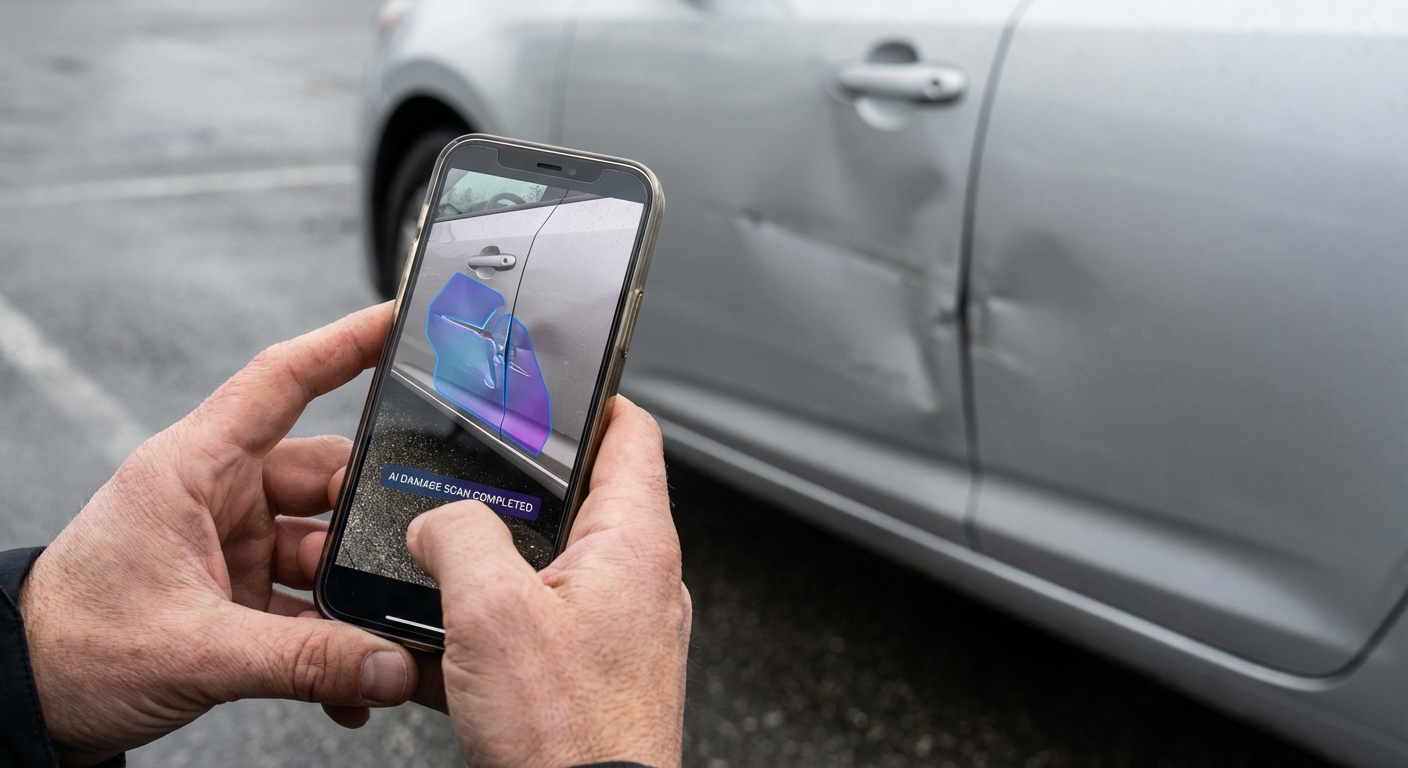
One of the most visible changes in the car insurance damage assessment process is the rise of AI-powered photo damage estimation. Rather than waiting days for an adjuster to physically inspect your vehicle, insurers now let you upload damage photos through a mobile app and receive a repair estimate within 24 hours, and sometimes in minutes.
AI photo estimating now accounts for 26.4% of all repairable claim inspections, according to CCC's Crash Course 2026 data, and delivers preliminary estimates within 24 hours for roughly 78% of claims (versus 5 to 7 days for traditional field inspection). Here's how the technology works:
| Step | What AI Does |
|---|---|
| Object Detection | Identifies vehicle parts (bumpers, doors, panels, glass) using computer vision models |
| Damage Classification | Labels damage type and severity (e.g., "Moderate dent on rear fender") |
| Cost Estimation | Cross-references parts catalogs and labor pricing databases to generate a repair quote |
| Claim Routing | Auto-approves minor claims or flags complex ones for human review |
Independent 2026 testing shows visual identification of surface damage hitting 95%+ accuracy under controlled conditions, while final repair-cost estimates land within roughly 80 to 90% of the actual bill on routine claims. Tractable's estimates are typically within 5 to 10% of human appraiser estimates on standard exterior damage, and the vendor now handles roughly $2 billion in vehicle repairs annually across 35+ of the world's top 100 carriers. Accuracy drops sharply for hidden or structural damage not visible in photos, ADAS sensor damage (required on 35.6% of DRP collision repair estimates in 2026), or complex incidents involving multiple parties. CCC's mobile estimating tools capture roughly 84% of final estimate value in under 80 seconds on typical submissions, but even leading vendors acknowledge photo tools can miss suspension, frame, and calibration issues. That's why human adjusters haven't disappeared entirely. Learn more about how photo estimating claims work and when virtual inspections fall short.
Straight-Through Processing for Minor Claims
For low-severity claims, many carriers now offer straight-through processing (STP), fully automated handling from FNOL (first notice of loss) to payment with no human involvement required. Insurers that have deployed advanced AI solutions report STP rates that have jumped from the 10 to 15% range to 70 to 90% for qualifying claims. Traditional claims that once took 30 days on average are resolved in 7 to 9 days at AI-enabled carriers, and minor auto damage claims can be processed end-to-end in 24 to 48 hours. Industry-wide STP is still much lower (under 10% overall for full P&C, with nearly 60% of insurers reporting no STP at all), because many claims remain complex and require human review, but the top personal-lines carriers now approach 35% on eligible claim types, and WTW's 2026 survey found that 36% of insurers plan to introduce STP in claims workflow automation (up from a current 14%).

Compare Car Insurance Rates in Ohio
See if you qualify for a lower rate in less than 2 minutes
AI Chatbots Handling First Notice of Loss (FNOL)
The first step in any claim is reporting the incident, and this is where AI chatbots have made the biggest customer-facing impact. Modern conversational FNOL agents now operate across chat, SMS, voice, and mobile apps 24 hours a day, 7 days a week, and carriers running agentic AI workflows have cut FNOL-to-triage time from 4 to 8 hours down to under 5 minutes.
When you report an accident through one of these systems, the chatbot:
- Collects incident details using natural language processing (NLP)
- Confirms your policy coverage in real time
- Accepts photo uploads for instant damage assessment
- Routes your claim to the right team or auto-approves it on the spot
- Sends you status updates throughout the process
AI-driven FNOL systems are delivering measurable results in 2026. Processing costs per claim have fallen by roughly 30 to 40% (from $40 to $60 down to $25 to $36), first-contact resolution for routine cases hits 70 to 85%, and claim intake time has dropped from 24 to 72 hours down to just 5 to 15 minutes. IDC now projects that by the end of 2026, at least 65% of all auto, homeowners, and commercial claims will touch AI in some part of the workflow, 82% of insurers already use AI somewhere in the claims pipeline, and full company-wide AI deployment among insurers jumped from 8% in 2025 to 34% in 2026. Learn more about how photo estimating and digital claims work at each step of the process.

Protect your car with Farmers
Average Rate:
Find coverage options that fit your budget.

The insurance savings you expect.
Average Rate:
Enjoy personalized policies, comprehensive coverage & more.

See how much you could save today!
Average Rate:
Drivers who switch their auto insurance and save with State Farm save $764 on average!

Safe Drivers Save with Allstate®
Average Rate:
Get rewarded with savings for having a clean driving record.
AI Fraud Detection: Catching Bad Actors Before They Cost You Money
Insurance fraud costs the U.S. approximately $308.6 billion annually (about $900 per policyholder, with roughly 10% of property-casualty losses stemming from fraud per the Coalition Against Insurance Fraud), and AI fraud detection is now the industry's sharpest weapon against it. Using pattern recognition and multimodal analysis, AI systems can analyze thousands of data points per claim across images, metadata, text, telematics, and network relationships. Per Deloitte research, AI has lifted fraud detection accuracy from 20 to 40% (traditional methods) to 70 to 80% with machine learning models, with some 2026 platforms now claiming 85 to 90% detection accuracy while false positive rates drop by around 40 to 50%. Roughly 54% of carriers now use AI fraud detection, and Shift Technology alone catches over $5 billion in insurance fraud annually.
How AI Spots Fraud
AI fraud detection systems analyze text, images, audio, geospatial data, and telematics to build a picture of whether a claim is legitimate. Techniques include anomaly detection, graph AI (mapping connections between suspicious claimants), and deep learning models trained on millions of historical claims.
The growing concern is that fraudsters are fighting back with their own AI tools. Verisk's 2026 State of Insurance Fraud Report (based on surveys of 1,000 U.S. consumers and 300 claims professionals) found that 98% of insurers say AI editing tools are fueling digital fraud, 99% have already encountered manipulated or AI-altered claim documentation, and 76% say AI-altered submissions have grown more sophisticated in the past year. Only 32% feel very confident detecting deepfakes, 62% of consumers say people use AI to manipulate claim documents often or very often, and 44% of consumers who used AI editing tools said their edited photo or document looked "very realistic." Broken down by category, AI-generated fake receipts now make up 34% of AI-related fraud cases, synthetic medical documents 28%, AI-generated damage photos 19%, and deepfake video evidence 12%. You can learn more about the broader issue in our guide on car insurance fraud types and penalties.
Benefits, Concerns & When You Still Need a Human Adjuster
The Real Benefits of AI Claims Processing
- Faster settlements: AI-enabled claim cycles compress from about 30 days to 7 to 9 days, with simple cases closing in hours
- 24/7 claim filing: No waiting until Monday morning after a weekend accident
- Lower processing costs: AI cuts cost per claim by 30 to 40% (from $40 to $60 down to $25 to $36), creating potential for more competitive premiums
- Greater consistency: Automated systems follow the same rules every time, reducing arbitrary decisions
- Massive projected savings: Deloitte projects $80 billion to $160 billion in cumulative AI-enabled fraud savings for P&C insurers by 2032
For a broader look at how AI is reshaping your costs, see our guide on AI in car insurance pricing and broader industry trends shaping coverage in 2026.
Legitimate Consumer Concerns
Speed is great, but AI isn't without flaws. Claims may be rapidly denied with little explanation and no human contact to walk you through the decision. Consumer trust in AI-driven claims remains uneven and, by some measures, is going backwards. Smart Communications' 2026 Customer Experience Benchmarks report found overall consumer confidence in AI within insurance slid to 40%, down from 46% a year earlier, and J.D. Power reported that 47% of consumers are uncomfortable with AI processing their claims. J.D. Power's 2026 U.S. Auto Insurance Study also found that 32% of shoppers now use AI tools when searching for coverage, and its 2026 U.S. Property Claims Satisfaction Study shows the industry-wide average cycle time from FNOL to final payment is still 40.7 days, one of the longest since tracking began in 2008, suggesting AI benefits are concentrated at digitally mature carriers.
| Survey Source | Finding |
|---|---|
| Insurity 2026 | 39% say it's a "good idea" for insurers to use AI (up from 20% in 2025) |
| Insurity 2026 | Only 22% are comfortable with AI filing a claim; 16% with AI canceling/renewing a policy |
| J.D. Power 2026 | 47% of consumers are uncomfortable with AI processing their claims |
| Smart Communications 2026 | Overall AI trust in insurance fell to 40%, down from 46% in 2025 |
| KPMG UK 2026 | 90% say human interaction is important in claims handling; 64% want humans handling claims |
| Claims Journal 2026 | 75% of claims professionals believe AI needs human oversight |
AI systems also have documented issues with algorithmic bias. Federal analyses have found Black communities may pay up to 71% higher auto premiums via algorithms trained on biased historical data. Regulators are increasingly scrutinizing AI-driven decisions. Colorado's insurance-specific AI rule (SB 21-169) was expanded on October 15, 2025 to reach private passenger auto and health benefit plans, requiring insurers to inventory algorithms, test for discriminatory outcomes, and file annual compliance reports. Colorado's rewritten AI Act (Senate Bill 26-189, signed by Governor Polis on May 14, 2026) takes effect January 1, 2027, shifting to a transparency and disclosure regime for automated decisions. It preserved the definition of "consequential decisions" so insurance underwriting, pricing, and claims outcomes remain in scope, and it requires deployers to provide a plain-language explanation of any adverse ADMT-driven decision within 30 days. At the national level, the NAIC Model Bulletin on the Use of Artificial Intelligence Systems by Insurers continues to gain traction, with 25 jurisdictions adopted as of April 2026, and the NAIC's AI Systems Evaluation Tool is on track for nationwide rollout by November 2026.
When Human Adjusters Are Still Essential
Despite all the automation, there are claims scenarios where a human claim adjuster remains indispensable:
| Claim Type | Why AI Falls Short |
|---|---|
| Multi-vehicle accidents | Disputed liability requires nuanced judgment |
| Serious injury cases | AI cannot assess pain, suffering, or long-term medical impact |
| Structural or hidden damage | Not visible in photos; needs hands-on inspection |
| ADAS sensor damage | Calibration required on 35.6% of DRP collision repairs, undetectable from photos alone |
| Total loss determinations | Complex valuations involving depreciation and market value (record 23.1% total loss frequency in 2026) |
| Deepfake fraud edge cases | Human intuition remains critical for novel AI-generated schemes |
For these situations, working with an experienced adjuster (or consulting a public adjuster) remains your best path to a fair settlement. For a broader view, check out our roundup of the best car insurance mobile apps that lead in digital claims filing, or brush up on the full claims process step by step.
Frequently Asked Questions
Can I file a car insurance claim entirely through an app using AI?
Yes, many major insurers now offer end-to-end digital claims through their mobile apps. You can report the incident, upload damage photos, receive an AI-generated estimate, and receive payment without speaking to a human representative. Per Lemonade's public disclosures, roughly 55% of its claims are now fully automated end-to-end and more than half are paid instantly, with the fastest recorded claim settled in 3 seconds. This process works best for minor, straightforward damage claims with no injury involved.
How accurate are AI photo damage estimates for car insurance?
AI photo estimates excel at visible surface damage such as dents, scratches, and broken glass, hitting 95%+ accuracy on visual identification under controlled conditions and typically landing within 80 to 90% of the final repair bill on routine claims. However, accuracy drops significantly for hidden or structural damage, ADAS sensor issues, and anything requiring hands-on inspection. Most insurers use a hybrid approach where AI handles initial triage and low-confidence estimates are routed to human adjusters, especially when ADAS recalibration (now required on 35.6% of DRP collision repairs) is involved.
What happens if my AI-processed claim is denied unfairly?
You have the right to appeal any claim denial, even one made by an automated system. Request a written explanation of the denial, document your evidence thoroughly, and escalate to a human supervisor or your state's Department of Insurance if needed. Colorado's insurance-specific AI rule (expanded October 2025) and its rewritten AI Act (SB 26-189, effective January 1, 2027) require a plain-language explanation of adverse automated decisions within 30 days, and the NAIC Model Bulletin (adopted in 25 jurisdictions) sets similar transparency expectations. Also consider filing a complaint with your state insurance commissioner and consulting a public adjuster for larger disputes.
How does AI help detect car insurance fraud?
AI fraud detection systems analyze thousands of data points per claim, including duplicate photos, metadata inconsistencies, billing anomalies, and network connections between claimants, to flag suspicious activity in real time. Per Deloitte research, AI lifts fraud detection accuracy from 20 to 40% with traditional methods to 70 to 80% with machine learning models (some 2026 platforms claim 85 to 90%), while false positive rates drop by 40 to 50%. However, fraudsters are increasingly using generative AI to create convincing fake accidents, with Verisk's 2026 study finding 99% of insurers have encountered manipulated documentation, 98% say AI editing tools are fueling digital fraud, and deepfake attempts across financial services are up 2,137% in three years.
Which insurance companies are the most advanced in AI claims processing?
Lemonade remains the clearest pure-play leader in claims automation, with roughly 55% of claims fully automated (about 96% of first notices of loss taken by AI Jim without human intervention) and some settled in seconds. Among traditional carriers, Allstate stands out for using GPT-based AI to draft roughly 50,000 daily claims communications, while State Farm, Progressive, and Geico have deployed comparable AI photo-estimating and FNOL systems for auto claims. On the vendor side, Tractable (~$2 billion in vehicle repairs annually across 35+ top carriers), CCC Intelligent Solutions (auto estimating workflows), and Shift Technology (fraud detection, catching over $5B in fraud annually) power much of the industry's back-end automation.