
Compare Car Insurance Rates in Ohio
See if you qualify for a lower rate in less than 2 minutes



The Damage Assessment Process: Step by Step
After an accident, your insurer does not simply write you a check. There is a structured evaluation process designed to determine how much your damage is worth, and understanding each step can help you avoid leaving money on the table.
Here is how it typically unfolds:
| Step | What Happens |
|---|---|
| 1. Claim Filed | You report the accident via phone or app, submitting photos, a police report, and witness details |
| 2. Adjuster Assigned | An insurance adjuster is assigned to your claim and schedules an inspection |
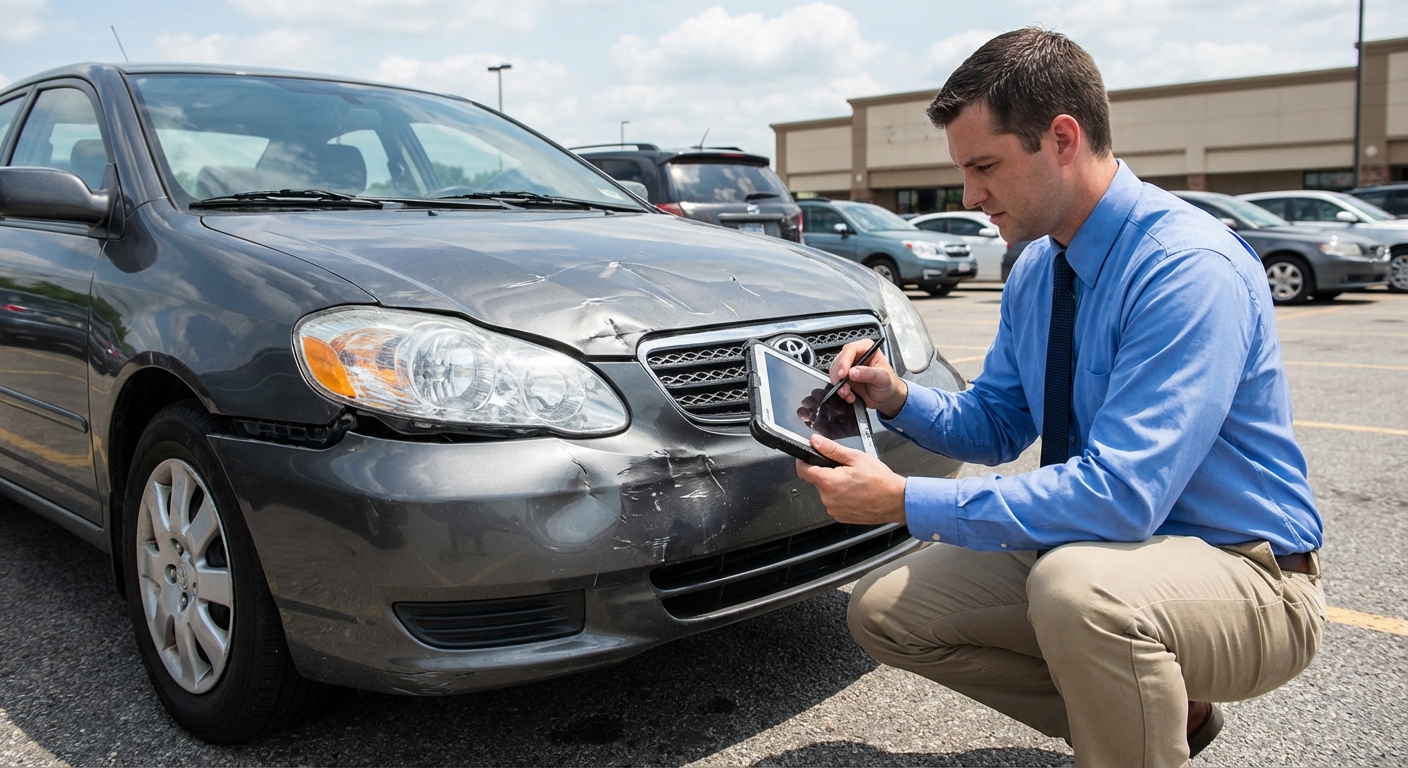
| 3. Initial Inspection | The adjuster performs a visual inspection, in-person or virtual, and documents visible damage |
| 4. Estimate Generated | Using industry software, the adjuster produces a repair cost estimate |
| 5. Repair or Total Loss | Your insurer compares repair costs to your vehicle's actual cash value (ACV) to decide the outcome |
| 6. Supplements Filed | If hidden damage is found during repairs, a supplemental claim is submitted for additional coverage |
Photo documentation plays a critical role at every stage. Take your own timestamped photos from multiple angles immediately after the accident. This evidence supports your claim and can counter disputes over damage scope. For a full walk-through, review our step-by-step claims process guide.
How Technology Is Changing the Process in 2026
Insurers have rapidly embraced AI-powered tools to speed up the claims process. Based on 2026 industry data, roughly 58% to 82% of insurers use AI tools in their operations, while just 12% report fully mature AI capabilities. Meanwhile, 65% of insurers are actively scaling AI agents for claims processing this year, with top personal-lines carriers reporting AI-assisted teams resolving eligible claims up to 75% faster and cutting per-claim costs by 30% to 40%. Platforms like Tractable and CCC Estimate now power AI-powered virtual inspections that can process straightforward claims in as little as 24 to 48 hours, compared with 7 to 10 days previously. Tractable reports that its claim automation handles roughly 70% of cases without human involvement, and some carriers now issue same-day payouts on simple physical damage claims.
Photo estimating and touchless claims now cover a growing share of auto claim inspections. In 2026, over 35% of auto claims are touchless, submitted via photo upload, assessed by computer vision AI, and paid out within minutes for straightforward cases. However, AI-generated estimates carry the same limitations as any initial assessment: they are based only on what is visible. AI cannot detect internal frame damage from photos alone, and it requires physical laser measurement or specialized inspection equipment. Hidden structural damage, ADAS sensor misalignment, and frame issues still surface during teardown, meaning supplemental claims remain just as important as ever.

Compare Car Insurance Rates in Ohio
See if you qualify for a lower rate in less than 2 minutes
Who Assesses Your Car: Adjusters vs. Appraisers
Knowing who is evaluating your vehicle, and whose interests they represent, is key to understanding the damage assessment process.
Insurance Adjusters
An insurance adjuster handles the full claims process: inspecting damage, determining coverage and liability, estimating repair costs, and negotiating your settlement. There are three types:
- Staff Adjusters: Employees of your insurance company; the most common type for routine claims
- Independent Adjusters: Contractors hired by insurers during high claim volumes (for example, after major storms)
- Public Adjusters: Hired by you, the policyholder, to represent your interests and argue for a higher payout
Staff and independent adjusters work on behalf of the insurer. A public adjuster works exclusively for you. Learn more about how adjusters work and when hiring one makes financial sense.
Independent Appraisers
An independent appraiser focuses specifically on valuing vehicle damage, without the broader claim-handling authority of an adjuster. They provide a neutral assessment, making them especially useful in disputes. Unlike adjusters, they do not negotiate settlements or determine coverage. Their role is strictly valuation.

Protect your car with Farmers
Average Rate:
Find coverage options that fit your budget.

The insurance savings you expect.
Average Rate:
Enjoy personalized policies, comprehensive coverage & more.

See how much you could save today!
Average Rate:
Drivers who switch their auto insurance and save with State Farm save $764 on average!

Safe Drivers Save with Allstate®
Average Rate:
Get rewarded with savings for having a clean driving record.
How Estimates Are Created and Why Gaps Exist
How Insurers Build Their Estimates
Insurance companies use industry-standard software platforms such as Mitchell, CCC ONE, and Audatex to generate repair estimates. These programs pull localized labor rates, parts pricing, and standard repair times to calculate costs. Insurers typically favor:
- Aftermarket or third-party parts over original equipment manufacturer (OEM) parts
- Minimum labor times based on industry benchmarks
- Depreciation adjustments that reduce payout on older components
The result is an estimate built to satisfy your policy obligations at the lowest defensible cost. This is entirely legal, but it is not the same as what a body shop would charge. Understanding betterment and depreciation charges can help you avoid an unpleasant surprise at settlement.
Repair Shop Estimates vs. Insurance Estimates
Gaps between what the shop charges and what your insurer offers are extremely common, often by hundreds or even thousands of dollars. Per CCC's Crash Course 2026 report, the preliminary average total cost of repair (TCOR) was $4,818 in 2025, an increase of 1.7% over 2024, representing the lowest percentage increase since 2017. Major structural damage frequently exceeds $7,000 to $12,000, driven significantly by advanced driver-assistance systems (ADAS). ADAS calibrations now appear on 28.3% of all repairable estimates in 2025, up from 21.8% in 2024, a 30% relative increase in a single year, and in Direct Repair Program claims that share reaches roughly 35.6%. Multi-sensor recalibrations can exceed $1,000 on a single repair, with the average calibration adding about $688 per estimate when one is required. Recalibrating sensors, cameras, and radar after a collision often gets added as a supplement after the initial estimate. Learn more about how ADAS is reshaping repair costs and insurance rates.
| Factor | Insurance Estimate | Repair Shop Estimate |
|---|---|---|
| Parts | Aftermarket / third-party | OEM preferred |
| Labor rates | Lowest local benchmark | Shop's actual rate |
| Damage scope | Visible damage only | Includes teardown findings |
| ADAS recalibration | Often excluded initially | Included as needed |
| Goal | Minimize payout | Full restoration |
Supplemental Claims for Hidden Damage
Once a repair shop tears down your vehicle, technicians often discover damage that was not visible during the initial inspection: frame misalignment, damaged ADAS sensors, or internal structural issues. Because ADAS recalibration appears on far fewer initial estimates than the number of vehicles that actually need it, supplemental claims are especially common. These findings must typically be reported within 30 to 60 days of the original claim, depending on your insurer and state.
Here is how the supplemental claim process works:
- Shop identifies additional damage during disassembly and documents it with photos and a revised estimate
- Insurer is notified, usually by the shop directly, with updated documentation
- Adjuster reviews the supplement and may reinspect the vehicle before approving
- Additional funds are approved and repairs proceed
Most reputable shops handle supplement submissions on your behalf, but always stay in the loop. Delays in reporting hidden damage can lead to denials, so timely communication is essential. You can also review how claim reimbursement works to understand what out-of-pocket costs may be recoverable.
Disputing Your Assessment and Getting an Independent Appraisal
If you believe your insurer's damage estimate is too low, you do not have to accept it. Here is a proven strategy to push back effectively.
Step 1: Request a Written Explanation
Ask the adjuster to provide a written breakdown of how they calculated the estimate. This lets you identify specific line items to challenge (parts pricing, labor rates, or damage that was overlooked).
Step 2: Gather Your Own Evidence
Build a counter-case with:
- Your own accident and damage photos
- Repair estimates from one or more independent body shops (remember, you have the right to choose your repair shop)
- Comparable vehicle values from Kelley Blue Book or NADA (especially for total loss disputes)
- A professional appraisal report if damage is significant
Step 3: Invoke the Appraisal Clause
Most standard auto insurance policies include an appraisal clause, a built-in dispute resolution mechanism. Under this process:
- Both you and the insurer each select a competent independent appraiser
- If the two appraisers cannot agree, they jointly select a neutral umpire
- A decision agreed upon by any two of the three parties is binding
- Each side pays for their own appraiser; the umpire cost is split
This is faster and far less expensive than litigation. Important 2026 update: Texas SB 458 took effect for policies delivered, issued, or renewed on or after January 1, 2026, requiring every personal auto and residential property policy in Texas to include a binding appraisal clause. Either party can demand appraisal unilaterally, with hard deadlines built in. Under SB 458, a demand for appraisal must be made within one year from the date the insurer gives you notice that they have accepted coverage. Illinois HB 4160 was signed into law by Governor Pritzker on August 7, 2026 as Public Act 104-0767, making the right to appraisal mandatory effective July 1, 2027, and Washington's SB 5721 is advancing similar reforms. Learn more about how the appraisal clause works and when to invoke it.
Step 4: Consider a Public Adjuster or Attorney
If the dispute is significant, a public adjuster can evaluate your claim with your interests in mind. For complex cases involving liability disputes or bad faith practices, an attorney may be warranted. You can also file a formal complaint with your state's Department of Insurance if you believe the insurer acted unfairly. Our guide on how to dispute a settlement offer walks through your options in detail.
What About Diminished Value?
After repairs are complete, your vehicle's resale value is typically lower than a comparable car without accident history. This is called inherent diminished value, and it is the most commonly claimed type.
Most insurers use the 17c formula to calculate it:
- Apply a 10% base loss cap to your vehicle's pre-accident ACV
- Apply a damage multiplier (0.00 = no structural damage; up to 1.00 = severe structural damage)
- Apply a mileage multiplier (1.00 = under 20,000 miles; drops to 0.20 at 80,000+ miles)
The 17c formula is widely criticized for undervaluing actual losses. Independent appraisals routinely produce results 40% to 60% higher than what the formula generates, because they use market-based comparisons rather than a fixed 10% cap. Professional diminished value appraisals typically cost between $275 and $600, with court-ready reports running $650 to $1,200 or more. Average recoveries typically fall between 10% and 25% of the vehicle's pre-accident value, with many services reporting typical recoveries in the $3,000 to $8,000 range. Note that only four states (Georgia, Kansas, Louisiana, and North Carolina) routinely allow first-party diminished value claims, so check your state's rules before filing.
Frequently Asked Questions
How long does a car insurance damage assessment take?
Most initial damage assessments are completed within 1 to 3 business days of scheduling an inspection. AI-powered virtual inspections via insurer apps can happen much faster, often within 24 to 48 hours of photo submission for minor claims. Per 2026 industry benchmarks, digital-first carriers close personal auto claims in about 15 days versus the roughly 24-day industry average, and simple property damage claims typically settle in 2 to 4 weeks total. Complex claims or those requiring supplements for hidden damage may take longer.
Can I choose my own repair shop for an insurance claim?
In most states, you have the right to choose any licensed repair shop, and your insurer cannot legally force you to use a specific shop. However, insurers often have preferred direct repair program (DRP) networks that streamline the process and now handle a substantial share of claims. If you use an out-of-network shop, expect the insurer to apply their own labor rates and parts pricing, which may require you to negotiate any gaps with the shop directly. Review your policy or ask your adjuster about your state's specific rules.
What happens if the repair shop finds more damage than the insurer estimated?
When a shop discovers hidden damage during disassembly, they file a supplemental claim with your insurer. An adjuster reviews the new findings and approves, modifies, or denies the additional coverage. Reputable shops handle this process routinely and will submit documentation on your behalf, but make sure to report hidden damage within your policy's filing window, typically 30 to 60 days. Stay in communication with both your shop and your insurer throughout the process.
When does insurance declare a car a total loss instead of repairing it?
If repair costs exceed a certain percentage of your vehicle's actual cash value (ACV), your insurer will declare it a total loss. The threshold varies by state, ranging from around 50% to 100%, while many states use a Total Loss Formula (TLF) instead of a fixed percentage. CCC's Crash Course 2026 report found that total loss frequency reached 23.1% of all claims, a new industry record, with non-comprehensive total loss frequency hitting 23.9%, driven by rising vehicle complexity, ADAS repair costs, and aging fleets. Learn more about total loss determinations and how to negotiate a better payout.
Is it worth hiring an independent appraiser to dispute my damage estimate?
It depends on the dollar amount in dispute. Independent appraisers typically charge $275 to $600 for repair damage-dispute appraisals, with diminished value reports running $400 to $600 through most national specialty firms. If the gap between the insurer's estimate and the shop's estimate is significantly larger than that fee, it is almost always worth it. An independent appraisal provides documented, professional evidence that strengthens your negotiating position and supports the appraisal clause process, and it is far less expensive than hiring an attorney or going to court.