
Compare Car Insurance Rates in Ohio
See if you qualify for a lower rate in less than 2 minutes



How Photo Estimating Works in 2026
According to CCC Intelligent Solutions' Crash Course 2026 report, photo estimating accounted for 26.4% of repairable claim inspections in 2025, up 0.8 percentage points year over year, while Direct Repair Program (DRP) inspections rose to 46.7% (+1.1 pp). That is a dramatic shift from the days when every fender bender required a trip to a body shop or a visit from an adjuster, and the trend continues to accelerate. CCC reported in Q1 2026 that more than 6,500 repair facilities were using its AI estimating capability, and Tractable's Mobile Jumpstart AI estimating tool has now surpassed an annualized run rate of over 1 million estimates, cutting preparation time from 30 minutes to under two minutes.
Here is how it works step by step:
- File your claim through your insurer's mobile app or website (First Notice of Loss).
- Receive a guided photo link via text or in-app prompt.
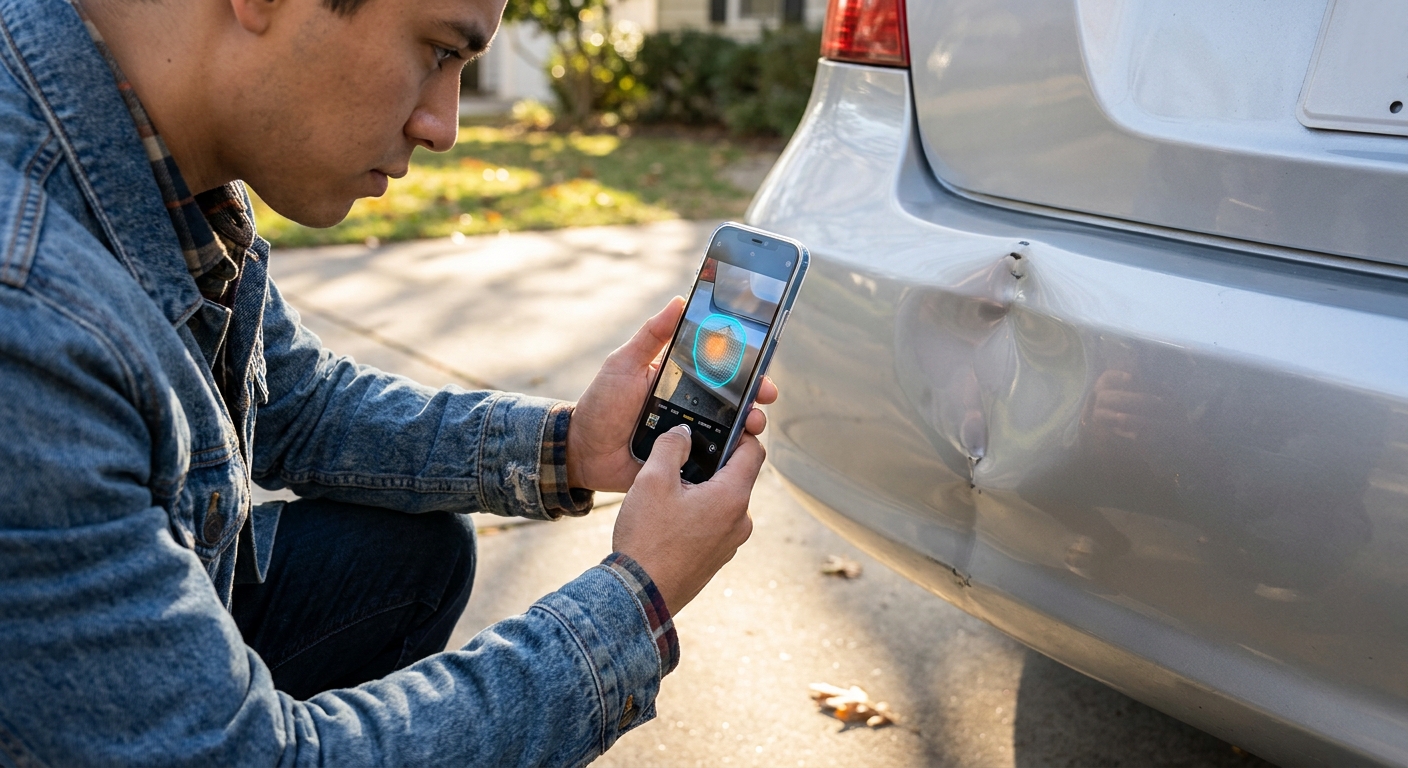
- Photograph the damage from multiple required angles, typically all four sides of the vehicle, close-ups of damage, plus VIN, license plate, and odometer readings.
- Upload the photos directly through the app. The process typically takes 10 to 20 minutes.
- AI analyzes the damage using computer vision trained on millions of historical claim images to detect visible damage, flag potential total losses, and generate a preliminary repair estimate.
- A human adjuster reviews the AI-assisted output for low-confidence or high-severity cases. High-confidence, low-severity claims may be auto-approved with a same-day payout.
- You receive a payout or repair authorization, which you bring to the body shop of your choice.
Major insurers including GEICO, State Farm, Progressive, and Allstate all offer app-based photo submission, most powered by vendors like CCC Intelligent Solutions and Tractable. GEICO's Easy Photo Estimate lets you complete the photo set in about 20 minutes, with payment issued on average within 26 hours of upload completion. Tractable's platform is now used by more than 35 of the world's top 100 insurers and processes roughly $2 billion in vehicle repairs annually, while CCC reported in Q2 2026 that it is embedding AI even deeper into higher-value workflows like parts procurement and estimate reviews. Notably, Tractable and CCC ended their long-running trade secrets and antitrust dispute with a January 2025 settlement, removing legal uncertainty for insurers scaling AI claims tools throughout 2026. To see how this fits into the broader shift, our guide on AI-powered car insurance claims automation explains the full technology stack.

Compare Car Insurance Rates in Ohio
See if you qualify for a lower rate in less than 2 minutes
Photo Estimates vs. In-Person Inspection: Which Damage Qualifies?
Not all damage is created equal when it comes to photo estimating. Understanding what type of damage you have can help you predict whether a virtual estimate will be sufficient, or whether you'll need a physical inspection to get an accurate payout.
Photo estimates work best when the damage is visible, external, and limited in scope. A scratched door panel, cracked tail light, or minor rear bumper dent are ideal candidates. Case studies from AI vendors show that some insurers now process roughly 90% of auto glass and bumper claims fully touchless, with the majority of assessments completed in under 15 minutes.
However, moderate to severe collisions present a very different picture. Any impact with enough force to shift panels, crumple bumper foam, or affect the vehicle's frame introduces damage that simply cannot be seen in photos. This is where photo estimates frequently fall short, and why a thorough car insurance damage assessment by a trained adjuster remains essential for complex claims. This matters more than ever in 2026, with total loss frequency now at a record 23.1% of all auto physical damage claims per CCC data, meaning many of the "repairable" claims still moving through the system are increasingly complex.

Protect your car with Farmers
Average Rate:
Find coverage options that fit your budget.

The insurance savings you expect.
Average Rate:
Enjoy personalized policies, comprehensive coverage & more.

See how much you could save today!
Average Rate:
Drivers who switch their auto insurance and save with State Farm save $764 on average!

Safe Drivers Save with Allstate®
Average Rate:
Get rewarded with savings for having a clean driving record.
Accuracy Concerns and Supplement Claims
The biggest practical limitation of photo estimating is what you can't see in a photograph. Insurance companies use photo estimates as a starting point, not a final accounting of all needed repairs. While Tractable reports its platform reviews vehicle damage with roughly 95% accuracy on visible damage, that accuracy drops sharply for complex, hidden, or borderline cases, which is why virtually every carrier still routes those claims through a human adjuster.
When Estimates Fall Short
- Hidden damage behind panels: Bumper covers, quarter panels, and trunk lids conceal structural components. An impact that cracks a bumper cover often damages the foam backing, bumper beam, brackets, and sensors underneath.
- Lighting and angle limitations: Poor lighting, bad angles, or lack of perspective can cause the AI to underestimate the depth or extent of damage.
- ADAS component damage: Cameras, radar sensors, and ultrasonic sensors embedded in bumpers and windshields can be damaged without any visible external sign. CCC's Crash Course 2026 shows ADAS calibrations now appear on 28.3% of all repairable estimates (up from 21.8% the year before, a 30% jump) and 35.6% of DRP estimates, while Enlyte's 2026 Envision Trends Report puts calibrations on 34.7% of all collision repair estimates. Yet Caliber Insights and Protech Automotive Solutions data indicate roughly 60% to 65% of 2026 collision repairs actually require an ADAS calibration, with industry analysts estimating the true share at closer to 65%. That gap of nearly 30 percentage points means many calibration needs are simply missed at the initial photo estimate stage. Learn more about how ADAS affects your insurance claims and costs.
How Supplement Claims Work
When your body shop discovers damage beyond what the photo estimate covered, they submit a supplement claim to your insurer. This is extremely common with photo-based workflows, and insurers essentially expect it. With the average total cost of repair now at $4,818 in 2025 per CCC (up 1.7% year over year) and closer to $5,300 on vehicles with ADAS involvement per AAA data, supplements adding 10% to 30% to the initial estimate are routine for late-model vehicles. Enlyte reports the average calibration cost when present is $688 per estimate, and calibration line items grew 31.4% year over year in 2025.
| Stage | What Happens |
|---|---|
| Photo estimate issued | Initial repair cost generated by AI + adjuster review |
| Vehicle torn down at shop | Hidden damage discovered during disassembly |
| Shop submits supplement | Additional repair costs submitted to insurer for approval |
| Insurer reviews supplement | Adjuster may re-inspect; approves or disputes the additional costs |
| Additional payment issued | Insurer pays difference (less your deductible) |
You have the right to a detailed explanation of any supplemental repair. If the insurer denies a legitimate supplement, you may be able to invoke the insurance appraisal clause in your policy to resolve the dispute. Our guide on how to file a supplemental car insurance claim walks through the documentation and timing requirements in detail.
Settlement Speed, Insurer Requirements, and When to Demand In-Person Inspection
The Speed Advantage Is Real
The time savings from photo estimating are significant. For minor property damage, photo-based workflows typically deliver an estimate and initial payment within about one business day, compared to roughly a week for a traditional adjuster inspection. Tractable's computer vision now powers same-day claim resolution for insurers who issue immediate payouts after a few photos, and high-volume damage types like glass and bumpers are frequently resolved end to end in under 15 minutes.
| Metric | Traditional In-Person | Photo Estimate (2026) |
|---|---|---|
| Time to first estimate | 3 to 7 business days | Often within 1 business day |
| Time to full settlement | 10 to 21 days | 3 to 7 days |
| Submission effort | Adjuster visit or shop trip | 10 to 20 min photo upload |
| Supplement likelihood | Lower | Higher |
For a minor fender bender with no hidden damage, photo estimating delivers a clear consumer benefit. For a fuller walkthrough of the process, see our guide on how car insurance claims work step by step.
What Insurers Require for Photo Submissions
To avoid delays or rejected submissions, follow these photo requirements carefully:
- All four sides of the vehicle, even panels that appear undamaged
- Close-up shots of every area of damage (scratches, dents, broken glass, deployed airbags)
- Wide scene shots showing the accident context
- VIN number, license plate, and odometer reading
- High-resolution, well-lit photos taken with your smartphone. Never submit old or edited images
Allstate's MyClaim flow requires new photos taken live from a mobile device (not previously uploaded images). GEICO's Easy Photo Estimate typically asks for about 10 photos including proof of ownership, and the app guides camera framing. Progressive and State Farm use similar app-guided flows, and app quality can be a real tiebreaker when choosing a carrier (see our roundup of the best car insurance mobile apps in 2026). If your photos are rejected for poor quality or incomplete angles, your claim stalls and you'll be asked to resubmit, losing any speed advantage.
When You Should Insist on In-Person Inspection
Despite the convenience of photo estimating, there are situations where pushing for a physical inspection protects your financial interests:
- Any accident involving significant collision force, even if exterior damage looks minor
- Vehicles with ADAS features, since cameras, radar, and LiDAR require diagnostic scanning, not just visual inspection
- Deployed airbags, which always require in-person assessment
- Frame or suspension concerns, which cannot be confirmed through photos
- When the photo estimate seems dramatically lower than body shop quotes you've gathered independently
If a physical inspection feels warranted, you have the right to request one. In many states, insurers are obligated to accommodate that request. Working directly with your car insurance claim adjuster can help escalate the request. If the initial offer still comes in low, our guide on how to dispute a car insurance settlement explains how to build a counter-offer and invoke the appraisal clause. You also retain the right to choose your own repair shop, regardless of which inspection method the insurer prefers.
Frequently Asked Questions
Is a photo estimate legally binding?
No. A photo estimate is a preliminary assessment, not a final settlement. It establishes a starting point for your claim, and if your repair shop discovers additional damage during teardown, they can and should submit a supplement claim. The insurer is then obligated to review and pay for covered repairs that exceed the original estimate, up to your policy limits.
Can I refuse a photo estimate and demand an in-person inspection?
In most cases, yes. While insurers increasingly prefer photo estimates for efficiency, policyholders generally retain the right to request a physical inspection by a licensed adjuster. This is especially important if you suspect structural damage, ADAS sensor involvement, or if the photo estimate is significantly lower than independent body shop quotes.
How long does a supplement claim take to process?
Supplement timelines vary by insurer, but most are processed within 3 to 10 business days after submission by the repair shop. Complex supplements, particularly those involving ADAS calibration or frame damage, may take longer if the insurer requires a re-inspection. Keeping your rental car documentation during this window is important if your policy includes rental reimbursement, which our claim reimbursement guide covers in more depth.
Will using a photo estimate affect my right to dispute the settlement?
Not inherently. You can still dispute a settlement that came from a photo estimate by gathering independent repair quotes, requesting a re-inspection, or invoking the appraisal clause in your policy. The appraisal clause allows both sides to hire independent appraisers whose findings are binding, which can be a powerful tool when photo estimates significantly undervalue your repairs.
Do all insurers offer photo estimating, and is it ever mandatory?
Most major national insurers including GEICO, State Farm, Progressive, and Allstate offer photo estimating via their apps. In some cases, especially for minor damage claims, certain insurers may default to requiring photo submission before scheduling an adjuster. However, if your damage is complex or you are uncomfortable with the process, contact your claims representative directly and request an alternative inspection method.