
Compare Car Insurance Rates in Ohio
See if you qualify for a lower rate in less than 2 minutes



What Is ADAS Calibration and Why Does It Matter?
Advanced Driver Assistance Systems (ADAS) are the suite of safety technologies built into modern vehicles, things like automatic emergency braking, lane departure warnings, adaptive cruise control, and blind spot monitoring. These systems rely on a network of cameras, radar units, LiDAR sensors, and ultrasonic detectors to function properly.
ADAS calibration is the process of precisely aligning and fine-tuning all of these sensors and cameras so they operate exactly according to manufacturer specifications. Think of it like calibrating a compass: even being off by one degree can cause the system to misread the road and make dangerous decisions. A misaligned camera off by just one degree can place a vehicle's collision detection point roughly 8 feet off target at 100 feet of distance, meaning a car traveling at 30 mph may not stop until after impact.
According to industry data, nearly 90% of 2023 and newer vehicles require ADAS calibration after windshield replacement, up from just 25% in 2016. This is no longer a luxury car concern; it affects everyday drivers across every major brand. Learn more about how ADAS technology affects your insurance rates and claims process as newer models dominate the roads.
What Triggers a Calibration Requirement?
ADAS calibration is not a routine maintenance item. It is required specifically after repairs or events that can physically shift sensor positioning. Even a small movement of just a few millimeters can throw off a system's accuracy enough to cause failures.
Common repairs that require ADAS recalibration:
| Repair Type | ADAS Systems Affected |
|---|---|
| Windshield replacement | Forward cameras, lane departure, AEB |
| Front bumper repair | Radar sensors, adaptive cruise control |
| Rear bumper repair | Rear radar, blind spot monitoring |
| Wheel alignment | Steering angle sensor, lane keep assist |
| Collision frame work | Multiple systems across the vehicle |
| Suspension repairs | Steering sensors, stability control |
According to CCC Intelligent Solutions' Crash Course 2026 report, calibrations saw an almost 6.5 percentage point increase, from 21.8% to 28.3% of repairable estimates year-over-year, which equates to a 30% jump in the number of repairable estimates including a calibration. Within Direct Repair Programs (DRPs), the calibration rate reached 35.6% by Q3 2025, up from 26.9% a year earlier, and Caliber Insights now projects calibration will be needed on 65% of auto repairs in 2026 and 75% by 2027.
Static vs. Dynamic Calibration: What's the Difference?
Not all calibrations are performed the same way. There are two primary methods, and the right one (or combination) depends on your vehicle and what was repaired.
Some manufacturers, including Toyota, Honda, Ford, Subaru, Mazda, and Tesla, require both static and dynamic calibration after certain repairs, which can significantly increase the total cost and time required. Always ask your repair shop which method your vehicle's manufacturer requires, and insist they reference the OEM service manual for your specific model and year.

Compare Car Insurance Rates in Ohio
See if you qualify for a lower rate in less than 2 minutes
ADAS Calibration Costs: What to Expect in 2026
ADAS calibration is not cheap, and costs vary based on vehicle type, the number of systems involved, and which calibration method is required. Based on the latest 2026 industry benchmarks, most single-system calibrations run $150 to $600, with $300 to $600 as the typical range for a mainstream vehicle. Luxury, EV, and multi-camera vehicles frequently push past $1,000 when several systems need calibrating or the work is dealer-only. Per Mitchell's 2026 data cited in CCC's Crash Course, the average calibration line on an insured estimate now runs $688, while insurer reimbursement on standalone calibration events averages closer to $275 according to collision-network data.
Typical cost ranges by system type (2026):
| System Calibrated | Estimated Cost | Time Required |
|---|---|---|
| Windshield / Forward Camera | $250 to $500 | 1 to 1.5 hours |
| Front / Rear Radar Sensors | $300 to $600 | 1 to 2 hours |
| Lane Keep / Blind Spot | $300 to $400 | Varies |
| Park Assist (Ultrasonic) | $100 to $250 | 0.5 to 1 hour |
| Multi-System Calibration | $400 to $800 | 2+ hours |
| Full ADAS Suite Reset | $800 to $1,500+ | 2+ hours |
Independent shops typically land in the $250 to $500 range per system, while dealerships commonly run $400 to $650+ per system, with luxury and EV platforms sometimes exceeding $900. Static calibration alone usually adds $185 to $375, and dynamic calibration another $145 to $275 in labor. Enlyte's 2026 Trends Report tracked calibration line penetration climbing 31.4% year-over-year in 2025, with the number of calibrations per repair rising nearly 10% from 2024.
When your vehicle requires multiple systems calibrated, or both static and dynamic methods, total ADAS costs can easily exceed $1,000 for a single repair event. Luxury vehicles and EVs tend to sit at the higher end of these ranges due to more complex sensor configurations. Understanding how your repair shop choice affects premiums is key to budgeting for any modern vehicle repair.

Protect your car with Farmers
Average Rate:
Find coverage options that fit your budget.

The insurance savings you expect.
Average Rate:
Enjoy personalized policies, comprehensive coverage & more.

See how much you could save today!
Average Rate:
Drivers who switch their auto insurance and save with State Farm save $764 on average!

Safe Drivers Save with Allstate®
Average Rate:
Get rewarded with savings for having a clean driving record.
Does Car Insurance Cover ADAS Calibration?
The short answer: yes, most policies cover it, but only under the right conditions. Coverage depends on your policy type, the nature of your claim, and the documentation your shop provides.
Comprehensive vs. Collision Claims
If your windshield was damaged by a rock or hail, that's a comprehensive claim under your car insurance glass coverage, and calibration is typically included. If a collision caused bumper or front-end damage, that falls under comprehensive coverage, which also covers calibration when properly documented.
What is NOT covered:
- ADAS calibration performed as routine maintenance
- Recalibration after a non-covered event (wear and tear, owner modifications)
- Calibration costs that exceed your insurer's "reasonable and customary" reimbursement cap
- Work performed at a shop without OEM-certified tools or I-CAR/IMI TechSafe accreditation
When Insurers Deny ADAS Calibration Claims
Insurance companies deny ADAS calibration claims more often than you might expect, especially when calibration is added as a supplement after repairs begin. Per CCC, roughly 60% of calibrations are identified on supplement one or later, meaning the majority are added after the initial estimate, where they're more likely to be scrutinized or denied. Common 2026 denial triggers include:
- Missing pre-scan: No proof from a diagnostic scan report that calibration was actually needed
- VIN mismatch: Scan report VIN doesn't match the claim vehicle
- Generic "ADAS calibration" line item: No breakdown of which specific systems were calibrated
- No OEM procedure reference: Adjusters now expect the VIN-specific OEM procedure attached
- No timestamps or setup photos: Can't verify when or how calibration was performed
- Cost-control pressure: Insurers may attempt to cap reimbursements below shop rates
- Non-certified shop: Insurers increasingly require certified tools and I-CAR or IMI TechSafe-accredited technicians
Understanding how insurers assess car damage, including ADAS recalibration, can help you navigate the claims process more effectively. If your claim is denied, our guide on why claims get denied walks through the appeals process step by step.
How to Ensure Your ADAS Calibration Is Covered
Follow these steps to maximize your chance of full reimbursement:
- Verify coverage before repairs begin. Call your insurer and confirm ADAS calibration is included in your claim.
- Get pre-authorization. Have the shop contact your insurer for approval before performing calibration.
- Request itemized documentation. Ensure each calibration appears as a separate line item with the specific system named (forward camera, blind-spot radar, lane-keep camera, etc.).
- Submit VIN-specific OEM procedures. Not the general brand statement, the actual procedure for your VIN's repair scope.
- Include pre- and post-scan reports. Diagnostic reports showing fault codes before, and sensor verification after.
- Attach calibration certificates. Include target setup photos, timestamps, and technician sign-off.
- Have the vehicle owner contact the insurer directly. Customer advocacy often yields better results than shops calling alone.
- File a supplemental claim for any calibration discovered after repairs begin. Learn how to file a supplemental claim properly.
Full glass coverage is one of the best-value add-ons for ADAS-equipped vehicles. Our glass coverage guide explains how it can eliminate your deductible entirely on windshield claims, making calibration costs fully covered. Remember, you have the right to choose your own repair shop after a claim, which can make a big difference in ADAS-related work.
What Happens If You Skip ADAS Calibration?
Skipping calibration to save money is a significant safety and financial risk. A camera misaligned by even one degree can place a vehicle's AEB detection point 8 feet off at 100 feet of distance, meaning a car traveling at 30 mph may not stop until after impact. Lane departure systems may actively steer a vehicle toward danger rather than away from it.
Safety consequences of uncalibrated ADAS:
- Adaptive cruise control may fail to maintain proper following distance
- Lane keep assist can "zig-zag" between lanes or make unintended steering corrections
- Automatic emergency braking may activate at the wrong time, or not at all
- Blind spot monitoring may give false clearances, increasing collision risk
- "Silent failure" is a growing concern, where ADAS appears to function but doesn't intervene when needed
Beyond safety, there are serious financial implications. If an accident occurs and investigators determine that a miscalibrated ADAS system contributed to the crash, your insurance company may deny the resulting claim entirely. Insurers also increasingly require proof of calibration to process claims for related repairs, so skipping it upfront can put your future coverage at risk.
Whether you're dealing with a minor repair or a major collision, skipping calibration to save a few hundred dollars upfront can cost thousands or more later. This is especially true for software-defined vehicles and autonomous vehicles, where ADAS is central to daily operation.
State Laws and Federal Action on ADAS Calibration
The regulatory landscape around ADAS calibration is evolving quickly, but not always in the direction the industry expected. Key 2025 to 2026 developments include:
| Jurisdiction | Action | Status |
|---|---|---|
| New York | GBL § 392-k (signed Dec. 19, 2025) requires glass shops to disclose ADAS calibration needs, confirm OEM-spec capability, keep a claim number on file before starting work, and provide itemized written estimates | In effect, $2,500 per-occurrence penalty; A9461 pending amendment would add a graduated penalty ladder |
| Arizona | SB 1410 (A.R.S. § 20-463.02) requires ADAS calibration disclosure, itemized descriptions, and OEM specs; bars shops from claiming insurer will pay unless coverage confirmed | Enacted, $2,500 civil penalty per violation |
| Maryland | SB 789 (2026 session) originally proposed ADAS calibration licensing under the MVA; amended down to a study-only bill, passed the Senate, then died in the House at sine die on April 13, 2026 | Failed, no carryover; would need reintroduction |
| Federal | ADAS Functionality and Integrity Act folded into H.R. 7389 Motor Vehicle Modernization Act of 2026 as Section 221; House Energy and Commerce Committee approved 48-1 on May 21, 2026 | Advanced to House floor, Senate action pending |
| Federal | NHTSA FMVSS 127 requires AEB on all new light vehicles by September 1, 2029 (September 1, 2030 for small-volume manufacturers) | Final rule in force, September 2029 compliance date unchanged |
Maryland's SB 789 had originally proposed a first-in-the-nation licensing regime for ADAS calibration providers under the Motor Vehicle Administration, but the bill was amended down to a study-only version that would have required the MVA to study ADAS repair and report recommendations by January 1, 2027. The Senate passed the study version, but it stalled in House Rules and died when the session adjourned sine die on April 13, 2026. Because Maryland bills do not carry over, the licensing framework will need to be reintroduced in a future session. The failed bill still signals where regulators are heading: OEM-mandatory procedures, pre- and post-repair scans, controlled calibration environments, and restrictions on insurers denying OEM-recommended calibrations.
At the federal level, H.R. 7389's Section 221 (the ADAS Functionality and Integrity Act) would direct NHTSA to study the impact of the most common vehicle modifications on ADAS functionality, publish guidelines for calibration tolerances and test procedures, and require automakers to share ADAS tolerance data with owners and NHTSA. The bill cleared the House Energy and Commerce Committee 48-1 on May 21, 2026, and is now awaiting a full House vote, with Senate consideration still pending. California, Illinois, and Virginia are also moving their own auto glass and calibration disclosure bills in the 2026 session, joining Florida, Kentucky, Utah, and New York in a growing list of states with ADAS-specific requirements on the books.
NHTSA's FMVSS 127 rule still requires automatic emergency braking, pedestrian AEB, and forward collision warning to be standard on all new passenger cars and light trucks by September 1, 2029 (September 1, 2030 for small-volume and final-stage manufacturers). Despite active petitions for reconsideration and a January 2025 delay of the rule's effective date to March 20, 2025, the September 2029 compliance deadline has not moved. Either way, the standard will dramatically increase post-repair calibration requirements in the years ahead. Until federal standards are formally settled, your best protection is working with a qualified shop, maintaining thorough documentation, and understanding how insurers process damage claims.
If your insurer offers photo estimating or an AI-driven claims process, be aware that these tools often miss calibration requirements. Push for an in-person assessment when ADAS work is involved, and know how reimbursement works if you end up paying out of pocket first.
Frequently Asked Questions
Does comprehensive insurance cover ADAS windshield calibration? Yes, in most cases. When a windshield is replaced under a comprehensive claim due to rock chips, hail, or vandalism, ADAS calibration is typically covered as part of the repair. If you have a full glass endorsement on your policy, you may owe nothing out of pocket. Confirm coverage with your insurer before the shop begins work, as not all policies automatically include calibration without proper OEM documentation.
Why won't my insurance pay for ADAS calibration after a collision? Most 2026 denials come down to documentation gaps: a missing pre-scan, no VIN-specific OEM procedure, a generic "ADAS calibration" line item without the specific systems named, or no target-setup photos and timestamps. Some insurers also require certified shops using specific OEM-approved tools, and work performed at non-certified facilities may be denied outright. To appeal, submit the OEM procedure printout, pre- and post-scan reports with matching VINs, the calibration certificate, and a supplement that itemizes each calibrated system separately.
How much does ADAS calibration cost out of pocket if insurance won't pay? Most ADAS calibrations cost between $150 and $600 per system in 2026, with $300 to $600 typical for a mainstream vehicle. Per Mitchell's 2026 data, the average calibration line on an insured estimate runs about $688 when present. Windshield camera calibration typically runs $250 to $500 at independent shops and $500 to $1,200 at dealerships, while radar sensor calibrations run $300 to $600. When multiple systems require calibration, total costs commonly exceed $1,000, and insurers frequently reimburse in-house calibrations at flat rates between $250 and $450 per system.
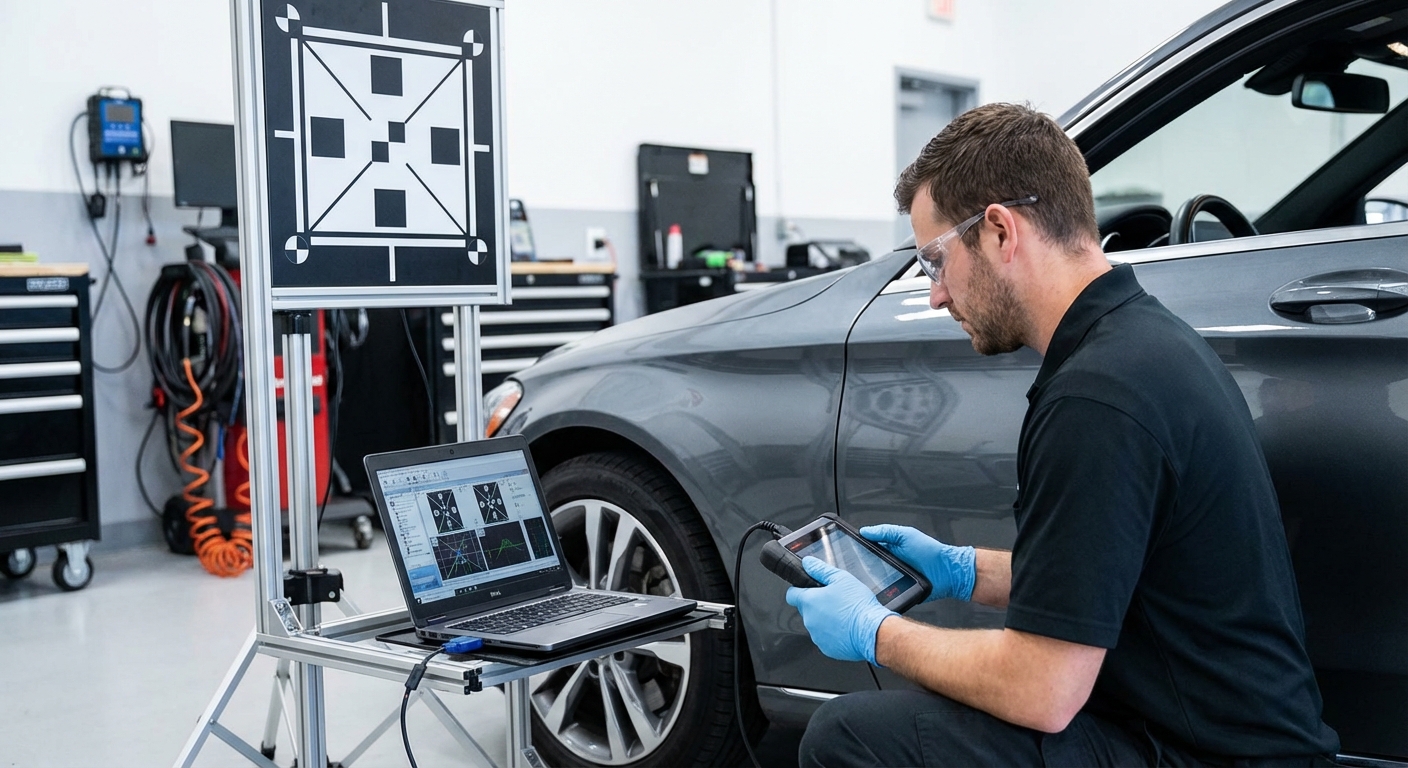
What is the difference between static and dynamic ADAS calibration? Static calibration is performed in a controlled shop environment using specialized target boards to precisely align sensors and cameras. Dynamic calibration is performed while driving the vehicle under specific conditions like certain speeds on roads with clear lane markings, allowing the system to self-calibrate in real-world conditions. Some vehicle manufacturers, including Toyota, Honda, Ford, Subaru, Mazda, and Tesla, require both types after certain repairs, which increases cost and time. Your repair shop should reference the OEM service manual to determine which method is required for your specific vehicle.
Is ADAS calibration required by law after a windshield replacement? Federal law does not yet mandate calibration nationally, but state-level rules are expanding. New York's GBL § 392-k (signed December 19, 2025) requires glass shops to tell customers when calibration is needed, confirm they can perform it to OEM specs, keep a claim number on file before starting work, and provide itemized estimates, with a $2,500 per-occurrence penalty for violations. Arizona's SB 1410 imposes similar disclosure duties and a $2,500 civil penalty. Maryland's SB 789 attempted a full licensing regime but was gutted to a study and then died in the House at sine die on April 13, 2026, while federal H.R. 7389 with Section 221 cleared committee 48-1 in May 2026 and awaits a full House vote.