
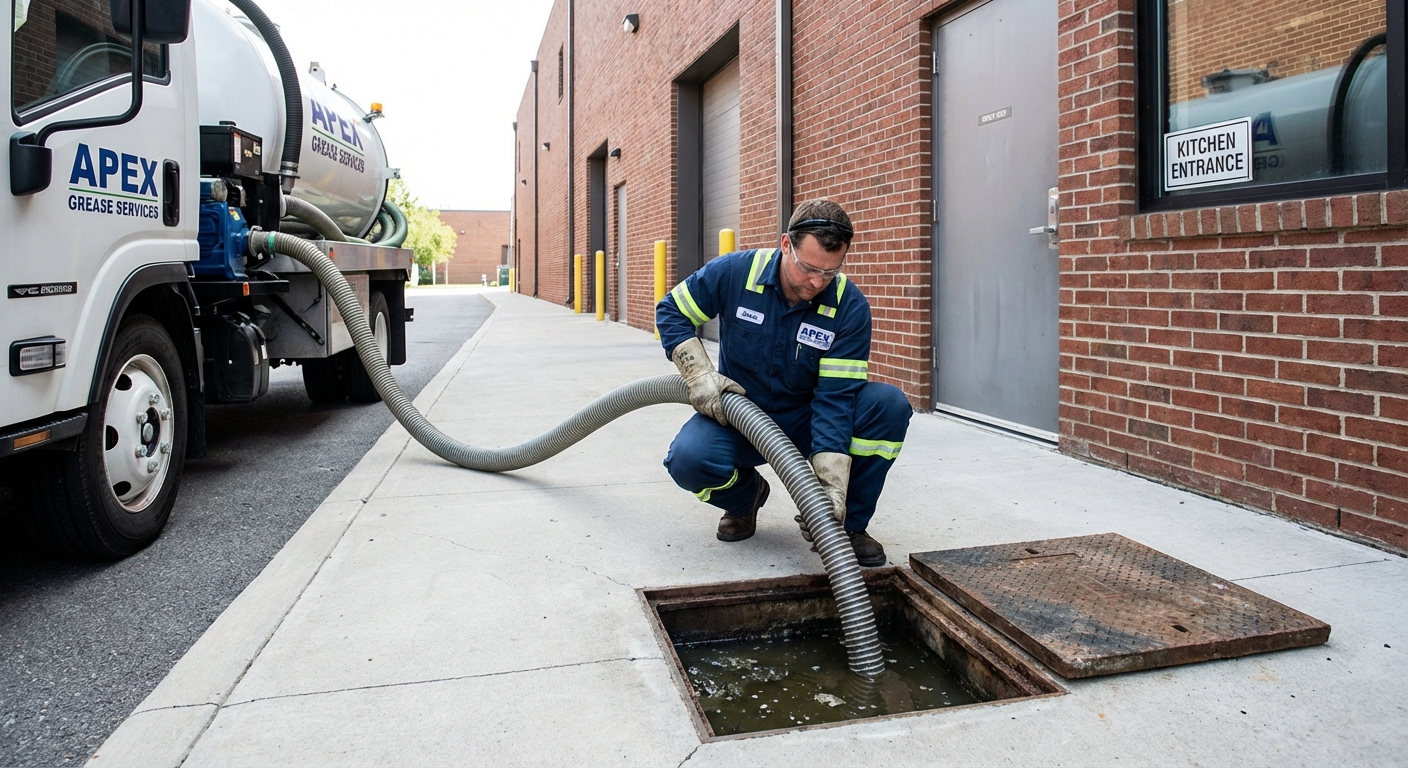
What Does a Grease Trap Do, and Why Does It Matter?
A grease trap (also called a grease interceptor) is a plumbing device installed in commercial kitchens to capture fats, oils, and grease, commonly referred to as FOG, before wastewater enters the municipal sewer system. As wastewater flows through the trap, it slows down, allowing FOG to cool, solidify, and float to the top, while food solids sink to the bottom. The cleaner middle layer of water is then released into the sewer.
Without a functioning grease trap, FOG solidifies inside sewer pipes and causes blockages, backups, and costly emergency repairs. Beyond your own plumbing, a failing grease trap can damage municipal sewer infrastructure, making it both a business liability and an environmental concern. Nearly every commercial kitchen in the U.S. is legally required to have one. If you're dealing with recurring drain issues related to FOG, it's worth reading up on commercial plumbing services to understand the full scope of what your system may need.
Grease Traps vs. Grease Interceptors
| Feature | Grease Trap (Indoor) | Grease Interceptor (Outdoor) |
|---|---|---|
| Size | 20-100 gallons | 750-2,000+ gallons |
| Location | Under sink or nearby | Underground/outside |
| Best For | Cafes, low-to-mid volume kitchens | High-volume restaurants, hotels |
| Cleaning Frequency | Monthly (sometimes more) | Quarterly to semi-annually |
| Cost Per Service | $125-$475 | $225-$2,500 |

Find Trusted & Licensed Plumbers in Ohio
Get matched with companies for your specific needs
Health Code Requirements & Compliance Rules in 2026
Grease trap regulations in the U.S. are not set at the federal level. They are enforced by local municipalities, county health departments, and state environmental agencies. However, there are common compliance standards that most jurisdictions follow, and 2026 has brought stricter enforcement across many regions:
- The 25% Rule: This is the most universally recognized benchmark. You must clean your grease trap before FOG and solids reach 25% of the trap's total liquid depth. Beyond this point, the trap is considered no longer effective at separating grease from wastewater, and many jurisdictions have formally codified this rule into law.
- Minimum Cleaning Intervals: Many cities mandate cleaning at least once every 90 days. Cities like Durham, NC and Wilmington, NC now require monthly pumping for many establishments, and Jacksonville, FL (JEA) requires biweekly cleaning for all traps under 50 gallons.
- Licensed Service Providers Only: Most municipalities require that grease trap waste be pumped and transported by a licensed grease hauler who disposes of it at a state-permitted facility. Florida statute 403.0741, for example, now prohibits self-pumping for most food service establishments.
- Service Documentation: Health inspectors will expect to see maintenance logs and manifests going back at least 3 years, including dates, volumes removed, disposal facility, and the service provider's signature.
- New Installation Rules: Many cities, including Greensboro, NC and Los Angeles, CA, now require at least a 1,000-gallon outdoor grease interceptor for new construction or major remodels (often triggered by remodels over $100,000).
Non-compliance doesn't just mean a fine, it can trigger a temporary shutdown of your business until violations are corrected. Staying current on commercial plumbing services and maintenance contracts is one of the most reliable ways to stay ahead of regulatory issues.
How Often Should a Commercial Grease Trap Be Cleaned?
Cleaning frequency depends on three primary factors: trap size, kitchen volume, and local regulations. Industry guidance in 2026 generally recommends cleaning commercial grease traps every 1 to 3 months, with the 25% rule overriding any calendar schedule. Always confirm with your local authority.
| Kitchen Type | Trap Size | Suggested Frequency |
|---|---|---|
| Small café or bakery | 20-50 gallons | Every 2-6 weeks |
| Casual dining restaurant | 50-200 gallons | Every 4-8 weeks |
| High-volume restaurant / bar | 200-750 gallons | Monthly to every 6 weeks |
| Large outdoor interceptor | 750-2,000 gallons | Every 30-90 days |
| Hotel / institutional kitchen | 2,000-5,000 gallons | Quarterly to semi-annually |
Signs Your Grease Trap Needs Immediate Cleaning
Don't wait for your scheduled service if you notice any of the following red flags:
- Slow or standing water in kitchen sinks
- Foul, sulfur-like odors coming from drains or the trap itself
- Drain backups or overflows, especially near the trap area
- Visible grease buildup around inlet or outlet pipes
- Increased presence of pests like fruit flies around drains
- Gurgling sounds from drain lines
These are signs the trap is at or beyond capacity. A full grease trap can quickly become a kitchen sink clog, or something far worse. If you're seeing backups in multiple fixtures, your issue may extend into the main line and could require a drain cleaning service or even hydro jetting to fully clear.
The Professional Grease Trap Cleaning Process
A professional grease trap cleaning is typically completed in 30 minutes to one hour, depending on trap size and how heavily it's loaded. Here's what a licensed technician will do:
- Initial Inspection: The technician assesses the trap's current condition, measures the FOG and solids layer, and checks for any damage or wear on baffles and gaskets.
- Pumping: Using a vacuum truck, all FOG, solids, and wastewater are fully pumped out of the trap into a sealed holding tank.
- Scraping & Washing: The inside walls, baffles, and screens of the trap are manually scraped to remove caked-on grease, then thoroughly washed down.
- Component Inspection: Baffles, inlet/outlet pipes, and gaskets are inspected for damage. Minor repairs are often handled on-site.
- Flow Test: Water is run through the system to verify the trap is functioning properly.
- Service Documentation: A detailed service report and manifest are provided, including volume removed, disposal facility name, condition notes, and the technician's signature for your compliance records.
Grease Trap Cleaning Costs in 2026
Costs vary significantly based on trap size, location, service frequency, and local market rates. The U.S. grease trap cleaning service market was valued at roughly $4.2 billion in 2025 and continues to grow, which has kept per-visit pricing relatively stable into 2026. The numbers below reflect current U.S. averages:
| Service Type | Cost Per Visit | Estimated Annual Cost |
|---|---|---|
| Small indoor trap (20-50 gal) | $125 - $180 | $1,000 - $2,160 |
| Medium indoor trap (50-200 gal) | $150 - $475 | $1,800 - $5,700 |
| Large outdoor interceptor (500-1,500 gal) | $225 - $1,040 | $900 - $4,160 |
| Extra-large interceptor (2,500-5,000 gal) | $1,000 - $2,500 | $2,000 - $5,000 |
Factors that affect your cost:
- Trap accessibility: buried or hard-to-reach interceptors cost more to service
- Condition of the trap: neglected traps require more labor and disposal volume
- Emergency vs. scheduled service: one-off calls can cost 2 to 3x more than contracted rates
- Geographic location: urban markets like New York and San Francisco run higher
Penalties for Grease Trap Non-Compliance
Ignoring grease trap maintenance is one of the costliest mistakes a restaurant owner can make. Penalties in 2026 vary by jurisdiction but can be severe:
- Fines: New York City imposes penalties from roughly $1,000 to $15,000 for grease trap violations, with possible criminal charges in severe cases. Houston fines range from $500 to $10,000 per violation, and California cities commonly impose $500 to $10,000+ per offense.
- Daily Accrual: The U.S. Small Business Administration notes that fines for grease trap violations can reach up to $15,000 per day of non-compliance. In Atlanta, transporting or disposing grease waste without proper manifests can carry penalties of up to $50,000 per day.
- Health Code Citations: Overflowing or odorous traps are a direct health code violation that shows up on inspection reports, and those reports are often public.
- Business Closure: Health departments can temporarily shut down your establishment until the issue is resolved and reinspected.
- Sewer Liability: If a municipality traces a sewer overflow or blockage back to your kitchen, you can be held financially liable for the full cost of cleanup, plus potential business license suspension.
- Criminal Charges: Repeat or willful violations (including falsified manifests) can result in criminal prosecution and, in extreme cases, jail time of up to three years for responsible parties.
Sewer-related liability from neglected FOG management can be compared to what happens when you ignore a failing sewer line. Small problems compound into expensive emergencies fast.
How to Choose a Licensed Grease Trap Cleaning Service
Not all grease trap services are created equal. Using an unlicensed hauler puts your business at risk. You could face fines even if you thought someone was handling it correctly. Many states (including Florida) now require licensed haulers to renew permits annually and submit manifests for every service call.
Questions to Ask Before Hiring
- Are you licensed to transport and dispose of grease waste in this city/state?
- What exactly does your cleaning process include, do you scrape baffles and run a flow test?
- What documentation and manifests will you provide after each service?
- Do you offer a service agreement for scheduled maintenance?
- How do you handle emergency calls, and what are the after-hours rates?
- Where is the collected grease waste taken for disposal?
Choosing the right provider is similar to evaluating any commercial plumbing service. Licensing, experience, and transparency should be your top filters. Request quotes from at least three providers and verify reviews before committing to a contract.
Frequently Asked Questions
What is the 25% rule for grease traps?
The 25% rule is the industry-standard benchmark for grease trap maintenance. It states that a grease trap must be cleaned when the combined depth of FOG and solids reaches 25% of the trap's total liquid depth. Beyond this point, the trap can no longer effectively separate grease from wastewater, leading to FOG passing directly into the sewer. Most U.S. municipalities have formally codified this rule into their 2026 compliance requirements.
Can I clean my own commercial grease trap?
Technically, some smaller indoor grease traps can be manually cleaned by kitchen staff. However, most municipalities require that the waste be disposed of by a licensed grease waste hauler. Florida's 2026 rules, for example, explicitly prohibit self-pumping for food service establishments. For larger traps and interceptors, professional vacuum equipment is necessary, and DIY cleaning without proper disposal can still result in compliance violations and fines.
How do I know what size grease trap my restaurant needs?
Grease trap sizing is typically determined by your kitchen's daily flow rate and FOG output, which depends on the number of fixtures (sinks, dishwashers, fryers) and meal volume. Many cities now use a peak-flow (gpm) times 30-minute retention formula and require a minimum 1,000-gallon outdoor interceptor for new construction. A licensed commercial plumber can assess your kitchen and recommend the appropriate capacity, since undersizing is a common compliance issue.
Does grease trap cleaning smell bad?
Yes, the process involves pumping out decomposing fats, oils, grease, and food solids, which produce hydrogen sulfide gas (the rotten egg smell). Professional technicians are equipped to handle this safely, and the odor typically dissipates quickly after the trap is sealed and the area is cleaned. Scheduling service during off-hours (early morning before opening) is a common strategy to minimize disruption to staff and customers.
What happens to the grease collected from my trap?
Licensed grease haulers transport collected FOG and used cooking oil to state-permitted processing facilities. In 2026, the vast majority of recycled grease is converted into biodiesel or renewable diesel fuel, with federal and state policies actively favoring waste-derived fuels over virgin vegetable oils. Smaller portions are used in animal feed additives, industrial burner fuel, and oleochemical products like soaps and cosmetics. This is why it's important to use a licensed hauler, illegal dumping carries severe penalties, and your business can be held liable if the hauler disposes of waste improperly.