
How Long Do Cast Iron Pipes Last?
Cast iron pipes were the plumbing standard for most of the 20th century, and millions of older American homes still rely on them today. Under ideal conditions (stable soil, moderate water chemistry, and proper maintenance) cast iron drain and sewer pipes can last 50 to 100 years. However, real-world conditions often cut that lifespan short. Residential pipes frequently begin showing signs of serious deterioration between 50 and 75 years of age, and in high-humidity coastal markets like Florida or Louisiana, failures can begin even sooner due to mineral-heavy water and salt-influenced soil.
Several factors directly accelerate deterioration:
- Expansive clay soils that shift and crack pipes seasonally
- Tree root intrusion through aging joints and hairline fractures
- Hard water mineral scale that builds up inside pipes and restricts flow
- Hydrogen sulfide gas produced by wastewater that corrodes pipe walls from the inside out
- Grease accumulation that traps corrosive bacteria against pipe walls
If your home was built before 1975 and you've never had your plumbing inspected, there's a strong chance your cast iron pipes are at or near the end of their serviceable life. Reviewing our guide on old house plumbing problems can help you understand the broader picture of aging home plumbing systems.

Find Trusted & Licensed Plumbers in Ohio
Get matched with companies for your specific needs
Warning Signs Your Cast Iron Pipes Need Replacing
Catching pipe failure early can mean the difference between a manageable repair and a full-blown plumbing emergency. Here are the most common red flags:
Visible Rust, Cracks, or Leaks
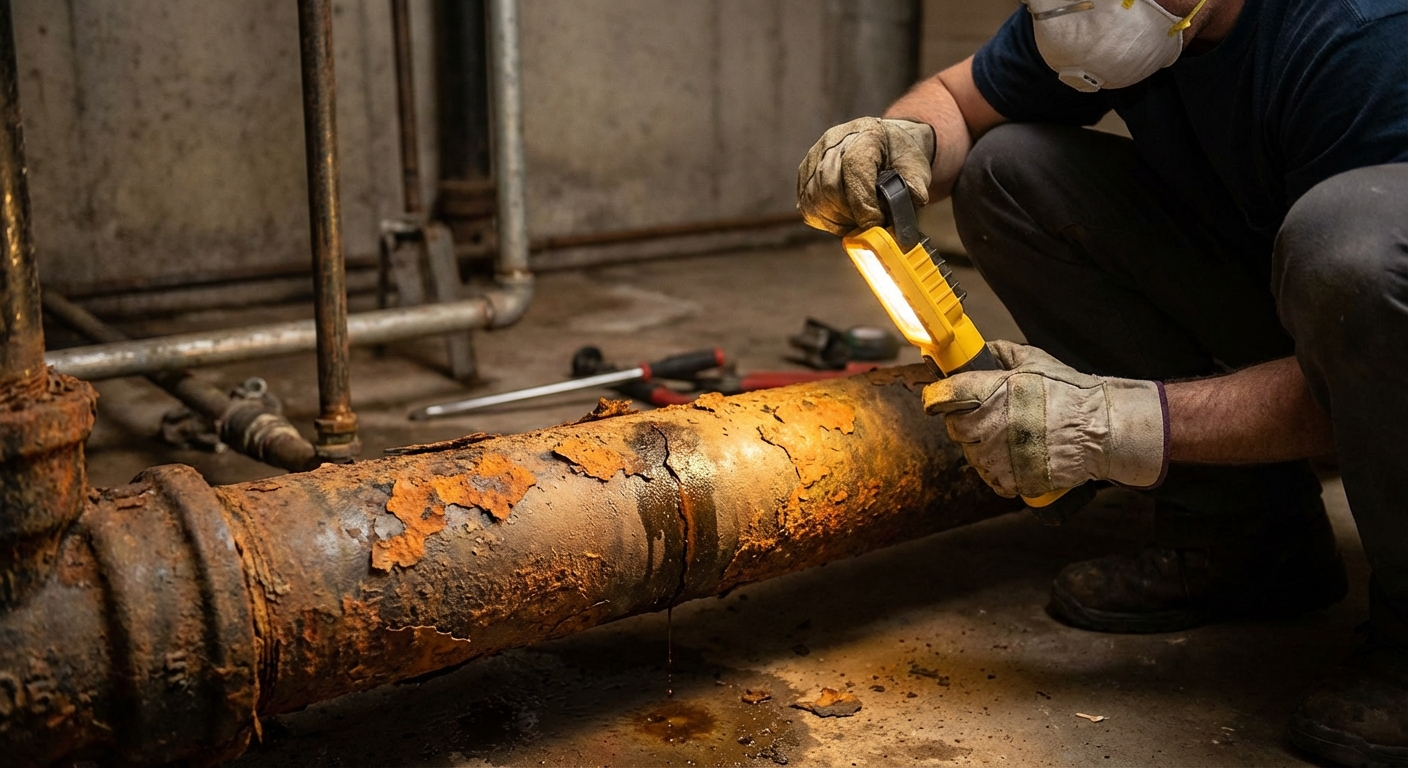
Cast iron corrodes from both the inside (from wastewater gases) and the outside (from soil moisture). If you can see exposed sections of pipe in your basement or crawl space, look for orange-brown rust staining, flaking metal, visible cracks, or damp spots on surrounding concrete or walls. Any of these are serious warning signs.
Frequent Drain Backups and Slow Drains
Recurring slow drains or sewage backups, especially affecting multiple fixtures at once, suggest a systemic problem deeper in your drain line. Mineral scale, corrosion deposits, and collapsed sections all restrict flow over time. Learn more about plumbing red flags that indicate deeper problems.
Foul Odors or Mold Near Drains
Sewer gas smell inside the home or persistent mold growth near drain areas can indicate cracked pipes that are leaking hydrogen sulfide or wastewater into wall cavities and subfloor spaces.
Sinkholes or Soggy Yard Spots
Outdoor sewer line leaks saturate the surrounding soil. If you notice unexplained wet patches, sunken areas, or unusually lush grass over your sewer line path, an underground leak is a likely culprit.
Root Intrusion
Tree roots naturally seek out moisture and nutrients. Once even a hairline crack forms in a cast iron joint, roots can work their way in and expand, eventually causing a full blockage or structural pipe collapse. A plumbing camera inspection is the fastest way to confirm root damage without tearing up your yard.
Inspection Methods & Replacement Options
How Plumbers Inspect Cast Iron Pipes
The gold standard for cast iron pipe diagnosis is a sewer video camera inspection (also called a sewer scope). A plumber inserts a flexible waterproof camera through a cleanout access point, drain opening, or vent stack and visually inspects the interior of the pipe in real time. This reveals:
- Internal rust and wall thinning
- Cracks, fractures, or full collapses
- Root intrusion
- Joint separation
- Blockages or heavy scale buildup
In 2026, a standard residential sewer camera inspection typically costs $250 to $500 when the home has an accessible exterior cleanout, with a national average around $280 and most jobs falling between $125 and $500. Homes without a cleanout require pulling and reinstalling a toilet for access, pushing costs into the $175 to $750 range. HD or specialty pan-and-tilt cameras add $100 to $400, and emergency or after-hours service can add another $100 to $300. If you're buying an older home, adding a sewer scope to your standard home inspection typically costs an extra $100 to $250. Our guide on pre-purchase plumbing inspections walks through what buyers should expect in detail.
Partial vs. Full Replacement
Not every aging cast iron pipe requires a full-system overhaul. Here's how to think about it:
Cast iron pipes in walls or under slabs require specialized access. Plumbers typically use jackhammers or tunneling to break up concrete for under-slab access, which significantly increases cost and restoration time. Slab tunneling and concrete demolition alone can add $3,500 to $7,500 or more, and in some Texas markets, complex under-slab jobs have been quoted at $50,000 to $60,000. If you suspect under-slab damage, our slab leak repair guide covers detection and repair options.
Traditional Excavation vs. Trenchless Replacement (2026 Pricing)
| Method | Cost Per Linear Foot | Typical Total Cost | Best For |
|---|---|---|---|
| Traditional Excavation | $100 – $300 | $10,000 – $30,000+ | Full replacement, collapsed pipes |
| Trenchless Pipe Lining (CIPP) | $100 – $225 | $5,000 – $20,000 | Cracked/corroded pipes with structure intact |
| Trenchless Pipe Bursting | $120 – $250 | $6,000 – $15,000 | Full replacement without open trenching |
Whole-house cast iron replacement in 2026 commonly runs $20,000 to $30,000 for most older slab-on-grade homes, with straightforward jobs closer to $15,000 and high-complexity projects reaching $30,000 to $50,000+ when deep slab tunneling is involved.
Trenchless pipe lining (Cured-In-Place Pipe or CIPP) involves inserting a resin-saturated liner into the existing pipe and curing it in place, creating a smooth new pipe within the old one. It's less invasive but only works when the existing pipe still has enough structural integrity to support the liner.
Pipe bursting threads a new pipe through the old one while simultaneously fracturing the cast iron outward. This is ideal for complete replacement without open trenching. Trenchless methods typically save homeowners 30% to 50% on total project cost once you factor in avoided landscaping, driveway, and hardscape restoration. For a deeper look at costs, check out our sewer line replacement cost guide, or explore trenchless sewer repair options in detail.
Best Replacement Materials & Insurance Coverage
Modern Pipe Material Options
When replacing cast iron, you have several excellent modern alternatives. Here's how the top options compare:
PVC (Polyvinyl Chloride) is the go-to choice for replacing cast iron sewer and drain lines in 2026. It's lightweight, corrosion-proof, easy to cut and join, and costs a fraction of cast iron. It carries an expected lifespan of up to 100 years and has a smooth interior that resists the buildup that destroys older systems.
ABS (Acrylonitrile Butadiene Styrene) is another solid choice for drain-waste-vent systems. It's strong, easy to install, and performs well underground, though it's slightly less flexible than PVC and can degrade more over time. Both ABS and PVC are accepted by most building codes for residential drain replacement.
PEX is the preferred modern material for water supply lines (not drain lines). Its flexibility makes it easy to route through walls and tight spaces, a major advantage when doing partial replacements without full wall demolition. To understand how PEX and other materials protect against future failures, read our guide on corrosion-resistant plumbing pipes.
If you're considering a full plumbing overhaul beyond just the drain lines, our whole house repiping guide walks through costs and material comparisons in detail.
Does Homeowners Insurance Cover Cast Iron Pipe Replacement?
This is one of the most common, and most misunderstood, questions homeowners have.
The short answer: Homeowners insurance typically does not cover the cost of the pipes themselves, but it may cover water damage caused by a sudden pipe failure and the tear-out labor costs to access and reinstall the surrounding structure.
| Coverage Type | Typically Covered? | Notes |
|---|---|---|
| Gradual corrosion or rust | ❌ No | Considered normal wear and tear |
| Sudden pipe burst or failure | ✅ Maybe | Must be accidental and unexpected |
| Water damage to floors/walls/ceilings | ✅ Often yes | If caused by a covered peril |
| Pipe removal and access labor | ✅ Sometimes | Can be 90% of the total job cost |
| Sewer backup cleanup | ✅ With add-on | Requires optional sewer backup rider |
| Full pipe replacement cost | ❌ No | Homeowner's responsibility |
In 2026, more insurers than ever are flagging cast iron plumbing during underwriting. Carriers in states like Florida and Louisiana now routinely require plumbing inspections before issuing or renewing policies, and a growing number are excluding or limiting coverage for homes with original cast iron drain lines entirely. Florida insurers in particular are asking about pipe material, pipe age, previous sewer backups, and camera inspection results before agreeing to write coverage. Water damage claims from aging plumbing remain one of the top drivers of homeowners insurance losses nationwide, so expect this trend to spread. If you also have older polybutylene pipes in the home, review our polybutylene pipe replacement guide for related insurance and repair considerations.
For more on how insurance treats aging plumbing systems, see our detailed old house plumbing problems breakdown, or learn what to do if a pipe fails suddenly in our burst pipe repair guide.
Frequently Asked Questions
How much does it cost to replace cast iron pipes in a house in 2026?
The total cost depends heavily on the scope of the project and the replacement method used. For a single vertical drain stack, expect to pay $3,000 to $8,000. A full sewer line replacement using traditional excavation now ranges from $10,000 to $30,000 or more in 2026, while trenchless methods typically come in between $5,000 and $20,000. Whole-house replacements involving under-slab tunneling and urban locations can push totals to $30,000 to $50,000+ due to concrete demolition and restoration work.
Can cast iron pipes be repaired instead of replaced?
In some cases, yes. If the damage is localized, such as a single cracked section or a small leak at a joint, a targeted repair or epoxy pipe lining can extend the pipe's life by 50 years or more when conditions are right. However, if the pipe shows widespread corrosion, multiple cracks, or significant wall thinning revealed during a camera inspection, repairs are typically a short-term fix and full replacement is the smarter long-term investment. Our sewer line repair cost guide breaks down repair versus replacement decisions in more detail.
Is PVC better than cast iron for drain pipes?
For new construction and replacement purposes, PVC is generally the preferred choice in 2026. It is far lighter, easier to install, immune to corrosion, and costs significantly less than cast iron. The one area where cast iron has an edge is sound dampening, which is why some high-end builders still specify it for interior drain lines. For most homeowners replacing failing cast iron, PVC or ABS is the practical and cost-effective choice.
How do I know if my house has cast iron pipes?
If your home was built before 1975, there's a strong likelihood that your drain, waste, and vent lines are cast iron. You can check exposed pipes in your basement, crawl space, or utility room. Cast iron pipes are dark gray or black, very heavy, and have a dull metallic surface. Newer plastic pipes (PVC or ABS) are white or black and noticeably lighter, and a licensed plumber can confirm through a visual inspection or sewer camera scope.
Will replacing cast iron pipes increase home value?
Yes, replacing aging cast iron pipes can meaningfully improve your home's value and marketability. Updated plumbing is a major selling point for buyers of older homes, and many buyers today require a clean sewer scope inspection before closing. Beyond resale value, replacing deteriorating pipes eliminates the risk of catastrophic water damage, sewage leaks, and foundation problems, all of which carry costs that far exceed proactive pipe replacement.