
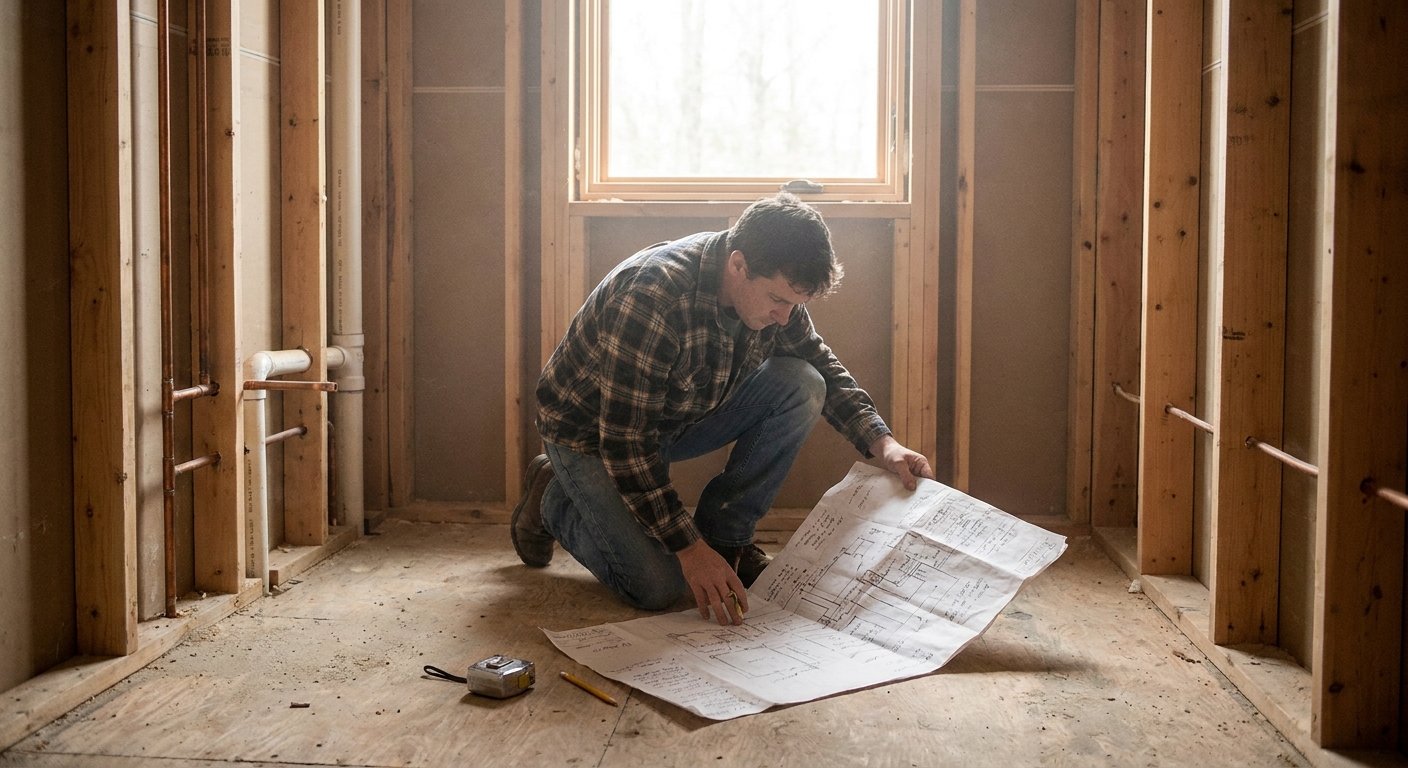
Fixture Spacing Requirements & Building Codes
Getting your bathroom plumbing layout right starts with understanding the rules, not just best practices. The International Residential Code (IRC) sets the minimum legal standards that all U.S. residential bathroom plumbing must meet, and local jurisdictions may layer on stricter requirements. Most jurisdictions in 2026 are enforcing the 2024 IRC and 2024 IPC (some are still on the 2021 editions), and the core fixture spacing dimensions have not changed for 2026.
IRC Minimum Clearance Requirements
Per IRC Section P2705.1 (referenced by Figure R307.1 in the 2024 IRC), here are the non-negotiable minimums:
| Fixture | Side Clearance (from centerline) | Front Clearance | Center-to-Center Spacing |
|---|---|---|---|
| Toilet / Bidet | 15" to wall or obstruction | 21" minimum | 30" between adjacent fixtures |
| Lavatory (Sink) | 15" to wall or obstruction | 21" minimum | 30" center-to-center |
| Shower (interior) | N/A | 24" in front of opening | Minimum 30" × 30" interior (900 sq in) |
| Bathtub | N/A | 21" from tub edge | N/A |
Code vs. Comfort: The IRC sets the floor, not the ceiling. The National Kitchen & Bath Association (NKBA) recommends 18" side clearance for toilets and 30" of front clearance for a more comfortable and functional bathroom. If space allows, always exceed the minimums.
Shower compartments must meet a minimum interior dimension of 30" × 30" with at least 900 square inches of floor area, plus 24 inches of clear space in front of the shower opening. For a broader look at what inspectors check, see our guide on plumbing code compliance.

Find Trusted & Licensed Plumbers in Ohio
Get matched with companies for your specific needs
Rough-In Dimensions for Every Bathroom Fixture
Rough-in plumbing refers to all the supply lines, drain pipes, and venting that are installed behind walls and under floors before any fixtures are set. Getting these dimensions right is critical because errors are expensive to fix once the tile is down. For a deeper dive into the full plumbing rough-in process, including inspection checklists, see our dedicated guide. To brush up on how these numbers appear on blueprints, check out our guide to reading plumbing diagrams.
Toilet Rough-In Dimensions
The standard toilet rough-in places the drain flange center 12 inches from the finished back wall. Older homes may use a 10" rough-in, while some custom configurations use 14". Key measurements include:
- Drain pipe: 3" diameter at floor level; 12.5" from unfinished wall (accounts for ½" drywall finish)
- Water supply line: about 8¼" above finished floor (typical range 5" to 10"); 6" horizontally from the drain centerline
- Side clearance: 15" minimum from centerline to any wall or obstruction (18" recommended)
- Front clearance: 21" minimum (30" recommended)
Sink / Lavatory Rough-In Dimensions
- Drain height: 16" to 20" above finished floor (18" to 20" is most common)
- Supply lines: 2" to 3" above the drain center (roughly 18" to 22" above the floor); hot and cold lines 4" on each side of centerline (about 8" apart)
- Rim height: ~31" standard; 34" for ADA-compliant installations
- Side clearance: 15" minimum from centerline to obstruction
Shower Rough-In Dimensions
- Drain: Centered in the shower pan; 2" drain pipe diameter
- Valve height: 38" to 48" above finished floor (adjust per manufacturer specs)
- Showerhead arm: 72" to 80" above finished floor is the current standard, with 78" to 80" preferred for taller users
Bathtub Rough-In Dimensions
- Drain offset: Per manufacturer specifications, commonly 12" to 16" from back wall for alcove tubs
- Drain pipe: 1½" to 2" diameter
- Faucet/valve height: 20" to 22" above the finished floor; handles 4" on each side of centerline
- Spout height: approximately 4" above the tub rim
Review plumbing fixture height standards for a comprehensive breakdown of code-compliant mounting heights across all fixture types.
Wet Wall Design & Venting Requirements
What Is a Wet Wall?
A wet wall is the primary structural wall that houses your plumbing supply lines, drain pipes, and the main drain stack. It's typically framed with 2×6 studs (rather than 2×4) to provide enough depth to conceal 3" drain pipes and supply runs. Proper wet wall placement is the backbone of an efficient bathroom plumbing design layout.
Best practices for wet wall placement:
- Position it on the back or side wall of the shower/tub zone
- Align the main drain stack parallel to floor joists to avoid costly joist notching
- The toilet, tub, sink, and shower should all ideally share or connect to the same wet wall to minimize pipe runs and labor
- Use waterproofing membranes or panels over framing in shower zones before finishing
Bathroom Plumbing Vent Layout Requirements
Every fixture drain requires a vent to equalize air pressure, prevent siphoning of P-trap seals, and block sewer gases from entering your home. Without proper venting, you'll experience slow drains, gurgling pipes, and foul odors.
Key venting rules under the IPC/IRC:
| Fixture / Drain Size | Minimum Vent Size | Max Distance from Trap to Vent |
|---|---|---|
| 4" drain | 2" vent | Per local code table |
| 3" drain (toilet) | 1½" vent | 6 feet |
| 2" or smaller (sink) | 1¼" vent | 3.5 feet |
- Wet venting allows multiple fixtures (toilet, tub, lavatory) to share a single pipe that acts as both drain and vent, a space-saving option commonly used in bathroom groups.
- Air Admittance Valves (AAVs) are one-way mechanical valves that admit air into the drainage system while blocking sewer gases. Under IPC Section 918 (and IRC Section P3113), AAVs are code-recognized for individual, branch, and circuit vents in IPC-based jurisdictions in 2026. UPC-based jurisdictions (which include California, and much of the West Coast) treat AAVs on a case-by-case basis, typically allowing them only through state amendments, local approval, or hardship situations, and almost always require at least one conventional vent stack that penetrates the roof. Cities like New York, Philadelphia, Portland, and jurisdictions in Washington State have specific rules permitting AAVs with limits. Always confirm approval with your local building department before specifying an AAV.
- AAVs must be listed to ASSE 1050/1051, installed at least 4" above the fixture drain being vented, and located in an accessible, ventilated space.
- Vent pipes from horizontal drains must rise at a 45° angle or greater before running horizontally, and horizontal vent runs must pitch at ¼" per foot.
For homes being expanded, our guide to plumbing for home additions outlines how vent stack sizing and main line upgrades factor into the total project cost.
Fixture Placement, Costs & When to Hire a Plumber
How Fixture Placement Directly Affects Your Budget
Where you place fixtures on your bathroom plumbing diagram isn't just a design decision, it's a financial one. Fixture placement is one of the biggest cost variables in any bathroom remodel. National averages in 2026 vary widely by source, running from about $16,500 for a typical remodel up to $25,000 to $28,000 for a mid-range full remodel, up 4 to 6 percent from 2025. Plumbing itself typically represents 12 to 18 percent of the total budget, or roughly $3,000 to $8,000 on a mid-range project.
Cost to relocate bathroom plumbing (2026 estimates):
| Scope of Relocation | Average Cost Range |
|---|---|
| Modifying existing plumbing (minor changes) | $500 – $1,600 |
| Single fixture move within same wall | $500 – $1,500 |
| Sink or toilet a short distance | $1,000 – $3,000 |
| Shower drain relocation | $1,500 – $5,000 |
| Full plumbing rough-in for new bathroom | $2,000 – $5,000 |
| Full layout reconfiguration (multiple fixtures) | $3,000 – $15,000+ |
| Plumbing on a slab foundation | Add $1,000 – $3,000 |
The toilet is typically the most expensive fixture to relocate because it requires a large-diameter drain pipe with precise slope and venting, while sinks tend to be the most flexible and cheapest to move short distances. If you're also tackling the kitchen, see our guide on kitchen remodel plumbing costs to understand how combined projects can share costs.
Strategies to Minimize Plumbing Relocation Costs
- Keep fixtures on the same wall. Moving a sink 2 feet along the same wall is far cheaper than moving it to the opposite wall.
- Group all fixtures near the wet wall. Consolidating your plumbing layout minimizes total pipe footage and labor.
- Consult a plumber during design. Catching conflicts early prevents costly mid-project changes.
- Plan for new construction from the start. In new builds, new construction plumbing costs are dramatically lower when layouts are optimized before framing begins.
- Consider accessible design upfront. Adding accessible bathroom plumbing features during initial rough-in is far cheaper than retrofitting later.
- For basements, evaluate whether you need a basement bathroom plumbing solution like a sewage ejector before finalizing your layout.
DIY vs. Hiring a Licensed Plumber
| Task | DIY Safe? | Notes |
|---|---|---|
| Replacing a showerhead or faucet aerator | ✅ Yes | Basic tools, no permits needed |
| Fixing a running toilet (flapper, fill valve) | ✅ Yes | Low risk, common repair |
| Unclogging drains (plunger, manual snake) | ✅ Yes | Avoid harsh chemicals |
| Installing a new toilet on existing flange | ⚠️ Maybe | Requires proper wax ring seal and level setting |
| Rough-in for new fixture locations | ❌ No | Requires permits, licensed plumber |
| Relocating drain lines or supply pipes | ❌ No | Structural and code implications |
| Venting a new fixture (including AAV specs) | ❌ No | Code-critical; failed venting causes health hazards |
| Any work on a slab foundation | ❌ No | Requires concrete cutting and licensed work |
DIY errors on major plumbing work can void homeowner's insurance, trigger permit fines, and cause costly water damage. When in doubt, always get a licensed plumber involved, especially for anything that touches the drain stack, supply mains, or requires a permit. If you're planning fixture upgrades as part of the project, coordinate them with your plumber early so pipe sizing and rough-in heights match your chosen models.
Frequently Asked Questions
What is the standard rough-in distance for a toilet in 2026?
The standard toilet rough-in distance is 12 inches from the finished back wall to the center of the drain flange. Some older homes use 10-inch rough-ins, and certain custom configurations use 14-inch rough-ins. Always measure an existing toilet before purchasing a replacement to ensure the new unit matches your rough-in distance. Mismatched rough-ins require drain relocation, which can cost $1,000 or more in 2026.
How much space do I need between a toilet and the wall?
Per IRC Section P2705.1, the toilet centerline must be at least 15 inches from any side wall or obstruction, with a minimum of 21 inches of clear space in front of the toilet. Adjacent fixtures must be at least 30 inches center-to-center apart. For comfortable everyday use, the NKBA recommends at least 18 inches on each side and 30 inches of front clearance.
What is a wet wall in bathroom plumbing?
A wet wall is the main structural wall that conceals supply lines, drain pipes, and the primary drain stack. It is typically built with 2×6 framing to accommodate larger pipe diameters. Efficient bathroom plumbing design positions all major fixtures (toilet, sink, shower, and tub) along or adjacent to the wet wall to minimize pipe runs, simplify venting, and reduce labor costs.
Do I need a permit to move bathroom plumbing?
In virtually every U.S. jurisdiction, yes. Any work that involves relocating drain lines, supply pipes, or venting requires a building permit and inspection. Unpermitted plumbing work can result in fines, mandatory removal of finished work, and legal complications when selling your home. Permit fees for a 2026 bathroom remodel typically run $100 to $1,000 total, or about 2 to 5 percent of your project budget.
How much does it cost to move bathroom plumbing in 2026?
Minor plumbing changes run about $500 to $1,600, while moving a toilet a few feet costs $500 to $3,000. Shower drain relocations range from $1,500 to $5,000, and a full bathroom layout change adds $3,000 to $15,000 in rough plumbing on top of your base remodel budget. Slab foundations add $1,000 to $3,000 for concrete cutting.
How can I save money on a bathroom plumbing remodel?
The most effective way to save money is to keep your existing fixtures in place and avoid moving the drain stack. When changes are necessary, limit moves to the same wall rather than relocating fixtures across the room. Get a plumber involved early in the design phase to identify the most cost-efficient layout. In new construction, optimize your plumbing diagram before framing begins to lock in the lowest possible rough-in costs.