
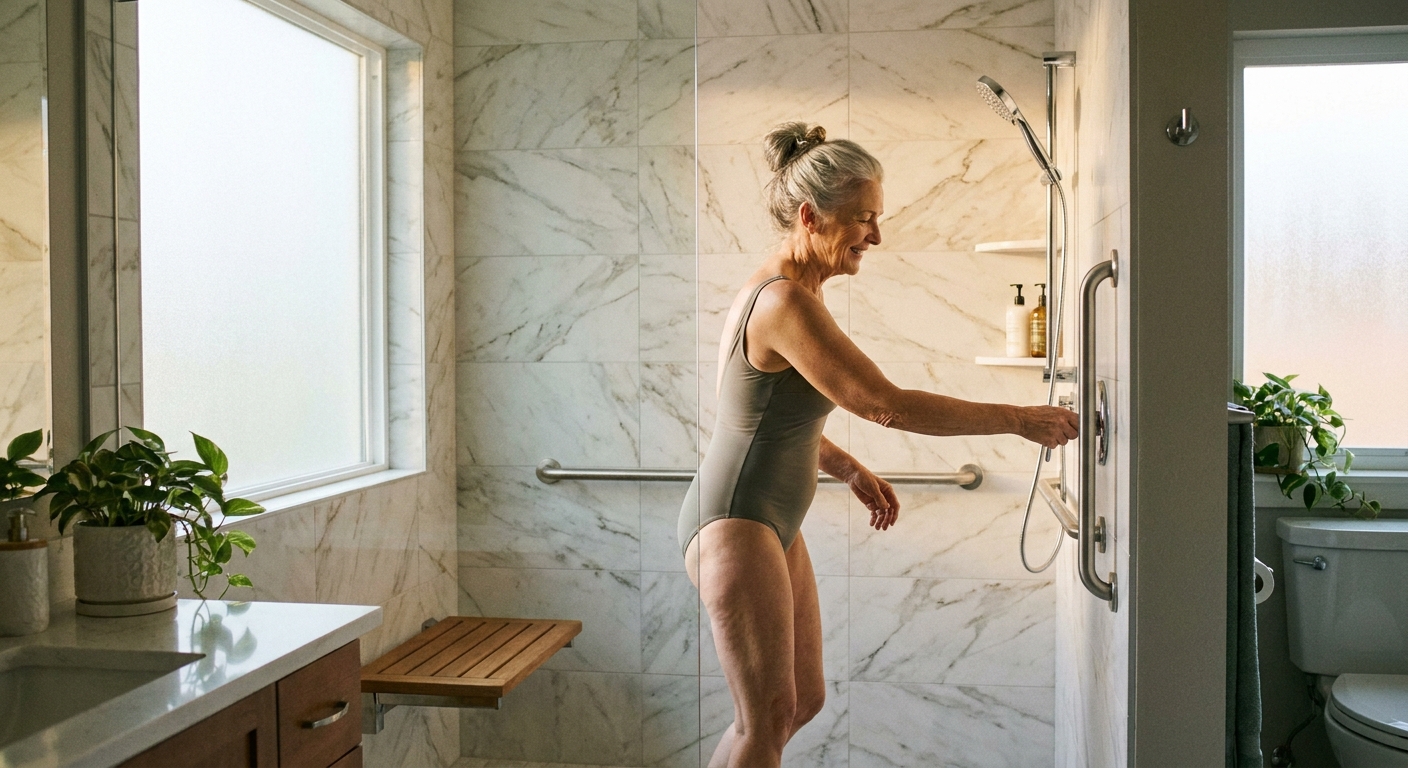
ADA Compliance Standards & Fixture Specifications
Accessible bathroom plumbing design is guided primarily by the 2010 ADA Standards for Accessible Design, which remain the controlling federal benchmark in 2026 for new construction and alterations. While these standards are mandatory for commercial and public facilities, they are widely adopted as the gold standard for residential aging-in-place renovations. Understanding the core specifications helps you prioritize upgrades that are both safe and code-aligned.
Toilet Requirements
The ADA specifies that toilet seat height must be 17 to 19 inches above the finished floor, often called "comfort height." The toilet centerline should be positioned 16 to 18 inches from the side wall, and grab bars must be installed between 33 and 36 inches high. The side wall grab bar must be a minimum of 42 inches long and located no more than 12 inches from the rear wall, while the rear wall grab bar must be at least 36 inches long. Note that many local codes now reference ICC A117.1, which adds an 18-inch minimum vertical grab bar requirement not required by ADA itself. Learn more about plumbing fixture height standards to understand how these requirements interact with standard residential code.
Sink & Vanity Requirements
The maximum sink rim height is 34 inches above the finished floor. Equally important is the knee and toe clearance underneath: a minimum of 27 inches high, 30 inches wide, and 19 inches deep, allowing wheelchair users to roll up to the sink comfortably. Any exposed pipes must be insulated or guarded to prevent contact burns. Operable parts like faucets and flush controls must be usable with one hand, without tight grasping or twisting, and require no more than 5 pounds of force.
Clearance & Maneuvering Space
| Requirement | ADA Standard |
|---|---|
| Turning radius | 60-inch diameter clear circle |
| Doorway clear width | 32 to 36 inches minimum |
| Knee/toe clearance (sink) | 27"H × 30"W × 19"D |
| Toilet compartment (wall-mount) | 60 × 56 inches |
| Toilet compartment (floor-mount) | 60 × 59 inches |
| Toilet seat height | 17 to 19 inches |
| Grab bar height | 33 to 36 inches |
| Side grab bar length | 42 inches minimum |
| Rear grab bar length | 36 inches minimum |
| Grab bar load capacity | 250 lb of force |

Find Trusted & Licensed Plumbers in Ohio
Get matched with companies for your specific needs
Walk-In Showers, Tub Conversions & Plumbing Requirements
For aging homeowners and people with disabilities, replacing a standard bathtub is often the single most impactful change. Walk-in and roll-in shower designs eliminate the dangerous step-over required by traditional tubs, and industry data show they remain the most-requested aging-in-place upgrade in 2026.
Curbless (Roll-In) Shower Essentials
A curbless shower should have zero or a maximum 0.5-inch threshold to eliminate tripping hazards. For plumbing, this means:
- Drain size: A 2-inch drain with a maximum trap-to-vent distance of 5 feet for efficient drainage.
- Floor slope: A precise slope toward the drain (typically 1/4 inch per foot) must be built into the subfloor to direct water without pooling.
- Shower controls: Valves and handheld showerheads should be positioned 38 to 48 inches from the floor to accommodate both seated and standing users.
- Minimum size: 30 × 60 inches for basic wheelchair access, with 60 × 60 inches ideal for full maneuverability.
Tub-to-Shower Conversion Plumbing
Converting a tub to an accessible shower involves removing the existing tub drain and faucet assembly, then installing a new shower drain, supply lines, and mixing valve. Structural checks for floor support and possible doorway widening are often required, especially in older homes.
Pressure-Balancing Valves & Lever Faucets
Two plumbing upgrades that are small in cost but enormous in impact:
Pressure-balancing valves automatically maintain water temperature within ±3.6°F regardless of pressure changes elsewhere in the home, such as when a toilet flushes. Under the 2024 Uniform Plumbing Code and IPC, all shower and tub-shower valves must be balanced-pressure, thermostatic, or combination valves listed to ASSE 1016 / ASME A112.1016 / CSA B125.16, with the high-limit stop adjusted so delivered water does not exceed 120°F. This prevents dangerous scalding bursts, which are a serious risk for users with limited mobility who can't quickly move away from hot water.
Lever-handle faucets require minimal grip strength and can be operated with a closed fist or forearm, ideal for users with arthritis or limited hand dexterity. Both features are recognized under ADA standards for operable parts. When planning plumbing fixture upgrades, always opt for lever-style controls throughout the bathroom.
Accessible Bathroom Remodel Costs in 2026
The cost of an accessible bathroom remodel varies significantly depending on how many modifications are needed, the size of the bathroom, and local labor rates. National 2026 cost data show a wide but predictable range across project scopes, with most homeowners spending between $10,000 and $25,000 for a full accessible remodel.
Cost Breakdown by Scope
| Project Scope | 2026 Cost Range | What's Included |
|---|---|---|
| Basic Safety Package | $2,500 to $5,000 | Grab bars, comfort height toilet, lever faucets, non-slip flooring |
| Walk-In Shower Conversion Only | $4,000 to $12,000 | Curbless or low-threshold shower replacing existing tub |
| Mid-Range Accessible Remodel | $8,000 to $16,000 | Walk-in shower plus core safety features and fixtures |
| Full Accessible Renovation | $15,000 to $25,000 | New layout, roll-in shower, widened doorways, accessible vanity |
| Premium / Custom ADA Remodel | $28,000 to $45,000+ | Custom tile, reconfigured layout, premium fixtures, structural work |
The national average for a typical accessible bathroom remodel in 2026 lands around $15,000 to $20,000, though HomeAdvisor still reports an $8,400 average for smaller-scope accessibility builds. Walk-in tub installation alone averages roughly $15,000 with professional installation.
Individual Cost Estimates
- ADA-compliant fixtures (toilet, sink, shower): $3,000 to $15,000
- Plumbing modifications: $500 to $1,600
- Non-slip flooring & waterproofing: $4,500 to $8,500
- Grab bars & accessories: $300 to $2,000
- Demolition & prep: $1,000 to $3,500
- Contractor labor: $45 to $250/hour
Which Modifications Offer the Best Resale Value?
Not every accessibility upgrade pays off equally at resale. The best modifications blend safety with universal design, features that look attractive and functional to any buyer, not just those with specific needs. According to the 2025 Cost vs. Value Report from Zonda, midrange bathroom remodels now return roughly 80% ROI nationally (the highest since 2007), while universal design bathroom remodels jumped 12 points to 61% ROI, the largest single-year gain in the report. Our companion guide on plumbing for aging in place breaks down which senior-focused upgrades deliver the best safety returns.
Top ROI Modifications
1. Tub-to-Walk-In Shower Conversion. The highest-impact single upgrade in 2026, especially when finished with "invisible accessibility" details like curbless entries, linear drains, and reinforced walls. Zero-threshold entry eliminates tripping hazards, creates a modern aesthetic, and appeals to buyers of all ages. Keep at least one tub elsewhere in the home for family buyers.
2. Grab Bars Integrated into Design. Modern grab bars that double as towel bars or decorative rails avoid the "clinical" look while providing critical support. These are a low-cost, high-impact upgrade, and Zillow and Opendoor data both put walk-in showers, grab bars, and wider doorways together at roughly 61% ROI.
3. Wider Doorways (32 to 36 inches). Improves access for wheelchairs, injury recovery, and families, broadening buyer appeal significantly. Widening doorways is one of the more affordable structural changes and is a signature feature buyers use to identify true universal design.
4. Comfort Height Toilets. Universally preferred by users of all ages and abilities. These are now standard in modern bathroom remodels and add no negative aesthetic impact.
5. Water-Efficient Accessible Fixtures. EPA WaterSense-certified toilets and faucets reduce utility bills while signaling quality craftsmanship to buyers. Pairing accessibility with water efficiency is a smart dual-value investment. See our guide on modern fixture upgrades for top-rated options, or explore touchless plumbing fixtures that pair perfectly with lever-style accessible design.
For a full breakdown of how fixture choices affect inspection outcomes and home value, our fixture height standards guide is an excellent companion resource.
Frequently Asked Questions
What is the ADA-required toilet seat height for accessible bathrooms?
The ADA requires toilet seat height to be between 17 and 19 inches above the finished floor. This range is commonly referred to as "comfort height" and is standard in most accessible and aging-in-place bathroom designs. The toilet's centerline should also be placed 16 to 18 inches from the nearest side wall. While ADA standards are mandatory for public facilities, they remain the widely accepted benchmark for residential upgrades in 2026.
Do I need a permit to convert a tub to a walk-in shower?
In most jurisdictions, yes. A tub-to-shower conversion involves plumbing modifications (new drain, supply lines, ASSE 1016 mixing valve) and possibly structural work, which typically require a building permit. Requirements vary by city and state, so always check with your local building department before starting. Skipping permits can create issues when selling your home or filing an insurance claim.
Are pressure-balancing valves required by code in accessible bathrooms?
Yes. Under the 2024 Uniform Plumbing Code and International Plumbing Code, all shower and tub-shower valves must be pressure-balancing, thermostatic, or combination types listed to ASSE 1016 with a high-limit stop set to a maximum of 120°F. For aging-in-place designs, they are essential because they prevent scalding water temperature spikes that could seriously injure users with limited mobility. Always confirm current local requirements with a licensed plumber.
How wide does a bathroom doorway need to be for wheelchair access?
The ADA minimum clear doorway width is 32 inches when a door opens to 90 degrees, increasing to 36 inches for deeper door configurations. A 36-inch door is generally recommended for comfortable wheelchair passage and is the standard used in most accessible bathroom remodels. Widening a doorway is one of the more affordable structural changes and significantly boosts the home's accessibility and resale appeal.
Does Medicare cover accessible bathroom remodeling in 2026?
Original Medicare (Parts A and B) generally does not cover structural home modifications like walk-in showers, grab bars, ramps, or widened doorways, since these are classified as home modifications rather than durable medical equipment. However, starting January 1, 2026, Medicare now covers home accessibility assessments performed by an occupational therapist when ordered by a physician. Many Medicare Advantage plans offer annual home-safety stipends of $500 to $2,500 for grab bars and minor modifications, and Medicaid HCBS waivers often fund larger renovations for eligible participants. VA benefits also help eligible veterans, so contact your local Area Agency on Aging to explore all options.