
Compare Home Insurance Plans in Ohio
Find your best options in less than 2 minutes



The Matching Problem: What Standard Policies Miss
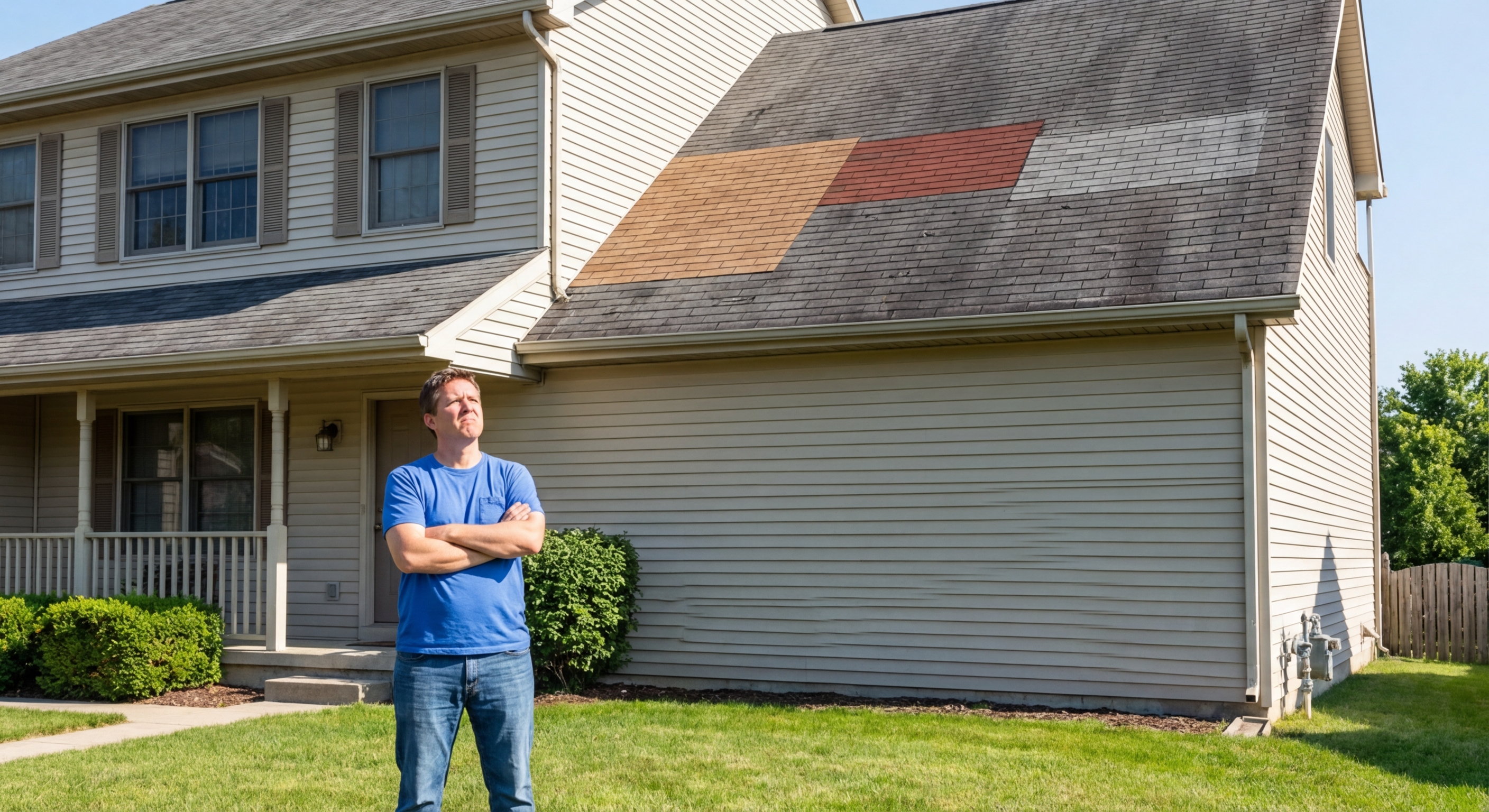
Imagine a hailstorm damages three sections of your roof. Your insurer approves the claim and replaces those sections, but the new shingles are a slightly different shade than your 10-year-old originals. Suddenly your roof looks like a checkerboard. You call your insurer expecting them to pay for a full replacement, and that's when you hit a wall.
This is called the matching problem, and it's one of the most common and most frustrating disputes in homeowners insurance. Standard home insurance policies are built around indemnity: restoring you to your pre-loss condition, nothing more. Homeowners policies usually contain a provision obligating the carrier to repair or replace damaged property with "material of like kind and quality," which insurers often interpret as similar, not necessarily identical. If the replacement materials don't aesthetically match the undamaged areas, that's often considered your problem, not theirs.
Matching exclusion clauses are the specific policy language that allows insurers to replace only the damaged portions without paying to match the undamaged areas. A common version reads: "We will not pay to repair or replace undamaged material due to mismatch between undamaged material and new material used to repair or replace damaged material." These clauses are increasingly common in standard homeowners policies, and they can leave homeowners absorbing thousands of dollars in out-of-pocket costs to achieve a uniform look.
Whether a policy will pay to repair property that is not directly damaged by a covered cause of loss depends on policy language, state statutes and regulations, and common law in the jurisdiction. This makes it critical to understand what you do (and don't) have covered before you ever need to file a claim. Reviewing common home insurance exclusions is a smart place to start.

Compare Home Insurance Plans in Ohio
Find your best options in less than 2 minutes
Real-World Scenarios Where Matching Fails
The matching problem shows up across nearly every major exterior and interior surface of a home. Here are the most common situations where standard policies leave homeowners exposed:
Roof Shingle Mismatches
Wind or hail damages two or three slopes of your roof, but the remaining sections are fine. Your insurer replaces only the damaged slopes, but the manufacturer discontinued your original shingle color two years ago. The closest available match is close, but visibly different. Now your roof tells a story you didn't want to tell.
This scenario is especially common on roofs that are 8 to 15 years old, where slight weathering and fading make even "similar" shingles look like a patch job. Learn more about how roof replacement insurance claims work and what drives full vs. partial coverage decisions.
Siding Color Differences
A falling tree branch damages the north-facing siding panels on your home. Your insurer approves replacement of the affected panels, but the original siding product was discontinued. The closest current match has a slightly different texture and undertone, and it's immediately visible when standing in your driveway.
Without matching coverage, you'd need to pay out of pocket to reside the entire home for a uniform appearance. With it, the insurer covers the cost of replacing all siding to achieve a visually consistent result. Similar mismatch issues frequently arise in hail damage claims after major storms.
Discontinued Flooring and Interior Surfaces
Water damage from a burst pipe soaks 50 square feet of laminate flooring in your living room. Your insurer approves the repair, but the flooring was discontinued by the manufacturer three years ago. The "comparable" replacement is a different plank width and finish. You're now stuck with an obvious seam through your living room, or paying to replace the entire floor yourself.
Here's a side-by-side look at how each scenario plays out with and without matching coverage:

Protect your home with State Farm
Average Rate:
Homeowners who bundle and save with State Farm save an average of $1,000 per year!

You're in Good Hands® with Allstate
Average Rate:
Get comprehensive home coverage with flexible policy options.

Customize your home coverage
Average Rate:
Only pay for the coverage you need with personalized home insurance.

Smart coverage for your home
Average Rate:
Protect what matters most with award-winning home insurance.
How Matching Coverage Endorsements Work
A matching coverage endorsement (sometimes called a matching materials, line-of-sight, or undamaged property endorsement) is an optional add-on to your homeowners insurance policy. Siding and roof matching insurance extends coverage of a standard homeowners policy beyond straight replacement to ensure that shingles or panels used will match, including a full system replacement when uniform undamaged replacement components can't be found. When wind, snow, ice, or debris damages sections of roofing and siding materials, the new materials must match (as closely as possible) the existing, undamaged shingles or siding.
What It Covers
Most matching endorsements apply to:
- Roofing: full slope or full roof replacement when damaged sections can't be matched
- Siding: full wall or full-home residing when affected panels are unavailable
- Flooring: full room replacement when discontinued products create visible seams
Some insurers extend this to soffit, fascia, gutters, and even interior wall materials, depending on the endorsement language.
What It Typically Excludes
| Exclusion | Why It Matters |
|---|---|
| Cosmetic damage only | If function isn't impaired, matching coverage may not apply |
| Wear, fading, or aging | Natural weathering that pre-dates the loss isn't covered |
| Non-covered perils | Must stem from a claim-eligible event (storm, fire, etc.) |
| Wooden shakes or specialty materials | Some policies exclude specific material types |
| Pre-existing mismatches | Materials that didn't match before the loss aren't eligible |
How Much Does It Cost in 2026?
Matching coverage endorsements are among the most cost-effective add-ons available for homeowners insurance. Most homeowners can expect to pay $25 to $75 per year in additional premium, though many insurers price it as a fixed limit option (typically $10,000, $20,000, $30,000, or $40,000) rather than a flat nationwide price. American Family Insurance, for example, offers a "Matching Undamaged Siding and Roof Coverage" endorsement that covers up to $20,000 of the cost to update undamaged siding or roofing when there's a mismatch, and it commonly runs around $25 a year. State Farm's "Matching of Undamaged Roof Surfaces" endorsement is available for roofs 15 years old or younger and reportedly runs about $35 a year. That's modest considering a full roof or siding replacement can easily run $10,000 to $25,000 or more in today's construction market.
Pricing structures vary significantly by insurer and state:
- Percentage-based caps: Florida Statute 626.9744 now allows insurers to limit matching to 1% of your Coverage A limit solely to match repairs made as a result of a covered loss. For a $500,000 dwelling limit, that caps matching repairs at $5,000.
- Reimbursement-style endorsements: Others require the policyholder to incur matching costs first, then get reimbursed.
- Full-scope endorsements: The broadest versions include matching within your base dwelling limit, sometimes up to $40,000.
Some insurers bundle matching coverage within broader endorsement packages (like extended replacement cost), while others offer it as a standalone add-on. With the 2026 national average home insurance rate at roughly $2,543 per year for $300,000 in dwelling coverage per Insurance.com, and Insurify tracking a higher average of $2,868 with a projected rise to $3,057 by year-end (following a 12% jump in 2025), a matching endorsement typically represents a small fraction of your total premium for meaningful protection.
Understanding your replacement cost vs. actual cash value policy type is also key, because matching endorsements pair best with replacement cost coverage. ACV policies already factor in depreciation, which reduces payouts before matching disputes even arise. If you're not sure which you have, our ACV vs RCV guide breaks down real-world payout differences by carrier and material.
Older Homes, Discontinued Materials, and State Matching Laws
Why Older Homes Face Greater Risk
The older your home, the more likely it is that your original building materials have been discontinued, reformulated, or are simply no longer manufactured. A home built in the early 2000s may have vinyl siding or asphalt shingles in colors and profiles that no longer exist. A 1980s home could have unique flooring, trim, or brick that can't be replicated without a full replacement.
Older homes also face additional coverage complications. Roofs over 20 years old often qualify only for actual cash value payouts rather than full replacement cost, and many insurers won't cover roofs over 25 years old at all. Combined with the matching problem, this can create a double hit at claim time. For a deeper dive, review home insurance and old roofs and how carriers now enforce age thresholds. Homes that fall outside standard underwriting may also need to explore hard-to-insure property options.
This is also why pairing matching coverage with structural damage coverage and ordinance or law protection is often recommended for older homes. Together, they fill in the costly gaps that standard policies miss. Reviewing your maintenance requirements is also critical, since neglect-based denials continue to rise in 2026.
What State Laws Say About Matching
Your state plays a major role in determining whether your insurer must pay for matching, even without an endorsement. The NAIC's Unfair Property/Casualty Claims Settlement Practices Model Regulation directs insurers to replace all items in the affected area to achieve a "reasonably uniform appearance," but adoption varies significantly by state.
As of 2026, roughly a dozen states address matching through statutes, regulations, or case law, including Alaska, California, Connecticut, Florida, Iowa, Kentucky, Louisiana, Minnesota, Montana, Nebraska, Ohio, Rhode Island, Tennessee, Utah, Vermont, West Virginia, and Wisconsin. Notable examples include California 10 CCR §2695.9(a)(2), Florida Statute §626.9744, Minnesota Statute §65A.28, and Rhode Island Insurance Regulation 73. Ohio Admin. Code 3901-1-54(I)(1)(b) specifically requires insurers to match existing materials to ensure a "reasonably comparable appearance."
| State Requirement Type | Examples |
|---|---|
| Statutory mandate (written law) | Florida, Iowa, Minnesota, Ohio, Rhode Island, Tennessee, Wisconsin |
| Regulatory guidance | Alaska, California, Kentucky, Louisiana, Nebraska |
| Case law / court precedent | Illinois, Massachusetts, Missouri, Connecticut |
| Policy language only (no state mandate) | Texas, Alabama, and many others |
Recent court decisions have also shifted the landscape in ways that generally help homeowners. In Minnesota, the landmark Cedar Bluff Townhome Condominium Association ruling established that policy language requiring "comparable material and quality" supports a reasonable color-match obligation, meaning insurers can be required to extend repairs into undamaged sections to achieve a proper match. Building on that framework, the July 30, 2025 Minnesota Supreme Court decision in Great Northwest Insurance Co. v. Campbell held that replacement-cost coverage under Minnesota Statute § 65A.10 can require insurers to pay for undamaged components (such as roof decking) if they must be replaced to bring the covered repair up to code.
More recently, on July 27, 2026, the Eighth Circuit issued its opinion in Cannon Falls Area Schools v. Hanover American Insurance Company, vacating summary judgment for the insurer and reviving a hail-damage roof claim. The court rejected the "no leak" standard, holding that a cosmetic-damage exclusion isn't triggered simply because the roof still keeps water out. The real question, the court found, is whether hail damage reduced the roof's present ability to function as a barrier to the elements "to the same extent as before" the storm. That framework makes it harder for insurers to blanket-deny hail claims as merely "cosmetic," which often includes matching disputes.
However, not every 2026 ruling favors homeowners. A California appellate court held that wildfire debris on an otherwise unburned home did not qualify as "direct physical loss" under a homeowners policy, showing that courts still draw a sharp line between undamaged and directly damaged property.
If your state doesn't have a matching mandate, a matching coverage endorsement becomes significantly more important. Even in states with mandates, having it explicitly written into your policy removes any ambiguity during the claims process.
Being underinsured on your home isn't just about coverage limits. It also includes gaps like missing matching coverage that leave you unexpectedly out of pocket when a claim arises. Reviewing your policy alongside our complete Coverage A-F guide is another smart way to identify hidden vulnerabilities, especially for older homes. Pairing that review with a look at accidental damage coverage can uncover additional endorsements worth adding.
Frequently Asked Questions
What is matching coverage in home insurance?
Matching coverage is an optional endorsement that pays to replace undamaged roofing, siding, flooring, or other materials when they can no longer be matched to the new materials installed during a covered claim. Standard policies typically only cover the damaged portion of a surface, which can result in visible cosmetic mismatches. This endorsement closes that gap by covering the full surface replacement needed to achieve a reasonably uniform appearance. It's also called undamaged property coverage, line-of-sight coverage, or a matching materials endorsement.
Does my standard homeowners policy already cover matching?
Most standard homeowners policies do not automatically cover matching of undamaged areas. In fact, many policies now include explicit matching exclusion endorsements that deny it. Whether you're protected depends on your specific policy language and your state's laws. Roughly a dozen states like Florida, Ohio, Minnesota, and Tennessee have statutes or regulations requiring a reasonably uniform appearance, but in states without such mandates, you may have zero protection without a specific endorsement.
How much does a matching coverage endorsement cost in 2026?
Most homeowners can add matching coverage to their policy for approximately $25 to $75 per year in additional premium. American Family, for example, offers a $20,000 matching endorsement for roughly $25 annually, and State Farm's Matching of Undamaged Roof Surfaces endorsement runs about $35 a year for eligible roofs. The exact cost depends on your insurer, your home's age and materials, and your location. Given that a mismatch dispute on a roof or full siding job can easily expose you to $10,000 to $25,000 in uncovered costs, the endorsement represents exceptional value for the premium.
When does matching coverage actually pay out?
Matching coverage only applies after a covered loss (such as storm, hail, wind, fire, or falling object damage) triggers a valid claim. It does not pay for cosmetic wear, fading, or pre-existing mismatches. Once a covered claim is approved and replacement materials cannot reasonably match the undamaged surfaces, the endorsement kicks in to cover the cost of full-surface replacement. The claim must originate from a peril already covered under your base policy.
Is matching coverage worth it for newer homes?
Even newer homes can benefit from matching coverage, since building materials can be discontinued within just a few years of a home's construction. However, the endorsement is most critical for homes 10 years or older, where weathering, fading, and discontinued product lines make exact material matching increasingly unlikely. For newer homes in states with strong matching regulations, the risk is somewhat lower. But for $25 to $75 per year, it's still a worthwhile layer of protection for most homeowners.