
Compare Home Insurance Plans in Ohio
Find your best options in less than 2 minutes



When Home Insurance Covers Your AC Unit
A standard homeowners policy (HO-3 or HO-5) treats your central air conditioner as part of the home's built-in systems, so it gets the same coverage as your roof, siding, or plumbing. If your AC or HVAC system is destroyed by a sudden, accidental event listed as a covered peril, your insurer will generally pay to repair or replace it, minus your deductible.
The most common covered scenarios include:
- Lightning strikes and power surges from a direct strike that fry the compressor, control board, or capacitor
- Hail damage that bends the condenser fins, dents the cabinet, or damages the fan motor
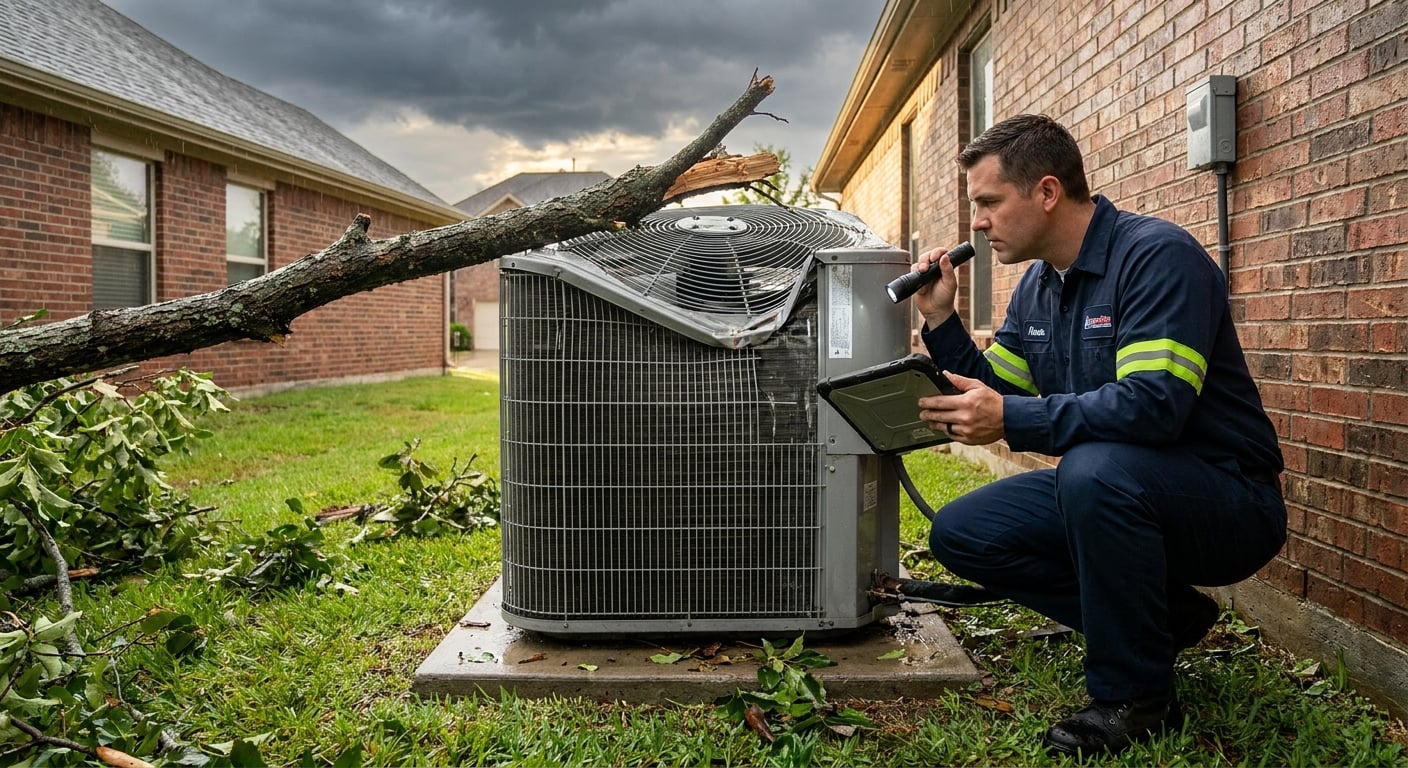
- Falling trees or branches that crush the outdoor condenser during a storm
- Theft of the entire unit or its copper components
- Vandalism such as slashed lines or smashed coils
- Fire and smoke damage from a house fire or nearby structure fire
- Wind damage from tornadoes, hurricanes, or severe straight-line wind events
If you want a deeper look at storm-related coverage, our guides on lightning damage coverage and HVAC coverage rules both apply directly to AC and HVAC equipment.

Compare Home Insurance Plans in Ohio
Find your best options in less than 2 minutes
What's NOT Covered: The Exclusions That Trip Homeowners Up
This is where most AC insurance claims get denied. Standard homeowners policies exclude any damage that's gradual, age-related, or the result of a system simply wearing out. If your 15-year-old condenser quits one July afternoon with no storm in sight, the adjuster will almost certainly call it a maintenance issue.
Common exclusions include:
- Wear and tear (the most common denial reason)
- Mechanical or electrical breakdown not caused by an outside peril
- Age-related failure such as a worn-out compressor on an aging system
- Rust, corrosion, and gradual deterioration
- Lack of maintenance like dirty coils, low refrigerant, or skipped tune-ups
- Manufacturer defects (those are warranty issues)
- Flood or earthquake damage (requires separate policies)
- Pest damage from rodents chewing wiring
For a fuller breakdown of upkeep requirements that protect your coverage, see our full guide on HVAC insurance rules.

Protect your home with State Farm
Average Rate:
Homeowners who bundle and save with State Farm save an average of $1,000 per year!

You're in Good Hands® with Allstate
Average Rate:
Get comprehensive home coverage with flexible policy options.

Customize your home coverage
Average Rate:
Only pay for the coverage you need with personalized home insurance.

Smart coverage for your home
Average Rate:
Protect what matters most with award-winning home insurance.
Dwelling vs. Other Structures: Where Your AC Lives in the Policy
Where your AC unit falls inside the policy structure matters because each coverage section has its own limits and rules.
| AC Type | Coverage Section | Notes |
|---|---|---|
| Central AC outdoor condenser | Dwelling (Coverage A) | Treated as part of the home's built-in systems |
| Indoor air handler / furnace | Dwelling (Coverage A) | Same as above |
| Ductless mini-split (permanently mounted) | Dwelling (Coverage A) | Outdoor + indoor heads usually included |
| AC unit serving detached garage or shed | Other Structures (Coverage B) | Typically 10% of dwelling limit |
| Window or portable AC unit | Personal Property (Coverage C) | Subject to ACV unless you have RCV |
For most homeowners, the outdoor condenser sitting on the concrete pad next to the house is part of the dwelling, not "other structures." That's good news because Coverage A typically carries the highest limit on the policy. However, if you have a detached workshop or guest house with its own mini-split system, that equipment falls under Coverage B, which is usually capped at 10% of the dwelling limit. Window units are personal property, which means a small sub-limit and depreciation can shrink payouts on older models.
Also keep an eye on your deductibles. In 2026, most homeowners carry a flat all-perils deductible of $1,000 to $2,500, but a separate wind, hail, or hurricane deductible of 1% to 5% of dwelling coverage now applies in most storm-prone states. On a $400,000 home, a 2% wind/hail deductible means $8,000 out of pocket before insurance pays a dime toward your damaged condenser.
Equipment Breakdown Coverage: The Endorsement That Fills the Gap
Here's the harsh reality: most AC failures aren't caused by storms. They're caused by burned-out motors, fried circuit boards, and power surges that don't quite qualify as "direct lightning strikes." That's the gap an equipment breakdown endorsement closes.
For roughly $25 to $50 per year in 2026 (with some carriers running as low as $30 for $100,000 in coverage and others closer to $75), this add-on extends your policy to cover sudden mechanical or electrical failures of major systems and appliances, including HVAC, water heaters, electrical panels, and refrigerators. Coverage limits typically range from $50,000 to $100,000 per breakdown with a $250 to $500 deductible separate from your main homeowners deductible.
For a deeper dive into pricing, carriers, and whether it makes sense for your home, read our full guide on equipment breakdown coverage and our overview of home insurance and appliances.
Copper Theft: A Growing 2026 Risk for AC Owners
Copper prices hit historic highs in 2026, with COMEX copper topping out at an intraday $6.71 per pound in May and still trading above $6 per pound through mid-summer. Scrap yards across the U.S. have been paying $4.50 to $5.68 per pound for #1 bare-bright copper, and outdoor AC condensers have become one of the most-targeted sources. Verisk CargoNet reported metal theft surged 77% in 2025, and copper became the No. 1 targeted commodity in the first quarter of 2026. Alpine Intel data on commercial HVAC claims shows theft or vandalism was cited as the cause of loss on 19% of claims in 2025, up from 17% the year before.
The scrap payout is usually small (often $100 to $200 from a stripped condenser), but the homeowner is left with a repair or replacement bill in the thousands once refrigerant, labor, permits, and reinspection are added. The good news: theft and vandalism are named perils on standard homeowners policies, so a stolen or gutted condenser is generally covered up to your dwelling limit minus your deductible. The catch is depreciation. An older unit under an ACV policy may pay out only a fraction of what a new R-454B system actually costs in 2026. To reduce risk and speed up any claim:
- Install a locking cage or anti-theft cover rated for HVAC condensers
- Add motion-activated lighting and a camera with a clear view of the unit
- Anchor the unit to the pad and protect visible wiring with metal conduit
- Store serial numbers, model info, and dated photos so you can prove ownership after a loss
How Depreciation Affects Your Payout
Even with a fully covered claim, you might not get a check for the cost of a brand-new system. The settlement depends on whether your policy pays Actual Cash Value (ACV) or Replacement Cost Value (RCV).
- ACV policies pay replacement cost minus depreciation minus your deductible. A 12-year-old AC at the end of its expected lifespan may have lost 60% to 80% of its original value.
- RCV policies pay the depreciated amount first, then release the held-back "recoverable depreciation" once you actually replace the unit and submit receipts.
Example: A central AC system with a $10,000 replacement cost and $5,000 of accumulated depreciation would pay roughly $5,000 (minus deductible) under ACV. Under RCV, you'd get the same initial payment, then receive the remaining $5,000 after replacing the system and submitting proof.
Our guide on roof replacement coverage walks through the same ACV vs. RCV math for another big-ticket home component.
Home Warranty: The Smart Complement to Insurance
A home warranty isn't insurance. It's a service contract that pays to repair or replace systems and appliances that fail from normal wear and tear, which is exactly where homeowners insurance stops working. In 2026, home warranty plans that cover HVAC typically run $350 to $900 per year (about $30 to $90 per month), plus a service call fee of $75 to $150 per visit.
The smartest setup for most older homes is a homeowners policy with an equipment breakdown endorsement and a basic home warranty. Insurance handles disasters, the endorsement covers sudden mechanical failure, and the warranty picks up the slow-motion breakdowns from aging systems. Learn more about power surge damage coverage if you're also concerned about protecting sensitive HVAC electronics.
Filing an AC Claim: Documentation Checklist
A well-documented claim gets paid faster and at a higher value. Here's exactly what to gather before you call your insurer:
- Photos and video of the damaged or missing unit from multiple angles, plus surrounding damage
- Date and time the loss was discovered, with weather conditions if relevant
- Police report number for theft or vandalism (insurers usually require this)
- Licensed HVAC technician's written report stating cause of damage and repair or replacement recommendation
- Two or three written estimates for repair or replacement
- Proof of ownership including original purchase receipt, model and serial numbers, and warranty card
- Maintenance records showing annual tune-ups and prior service
- Receipts for emergency repairs or temporary measures you took to prevent further damage
File the claim promptly. Most policies require notification within a "reasonable time," and some carriers impose strict deadlines. For broader claim tips, see our power surge claim checklist and how appliance losses are handled in our home insurance appliance coverage guide.
Prevention: Keep Your AC and Your Coverage Healthy
A few small habits dramatically reduce the chances of both a breakdown and a denied claim:
- Schedule annual professional tune-ups in spring and keep the invoices
- Install a whole-house surge protector to prevent lightning-related electrical damage
- Clear debris around the outdoor condenser, keeping at least 24 inches of clearance
- Trim trees and branches within falling distance of the unit
- Bolt down the condenser to its pad with a hurricane strap or anti-theft cage in high-risk areas
- Photograph your system annually so you have a record of its condition before any loss
- Change air filters every 1-3 months to reduce wear on the blower and compressor
- Cover the unit in winter only with a breathable mesh (never plastic, which traps moisture)
Frequently Asked Questions
Does homeowners insurance cover AC unit replacement if it just stops working?
Generally no. If the unit fails because of age, worn-out parts, or a clogged condenser, the standard policy treats that as a maintenance issue and denies the claim. You'd need an equipment breakdown endorsement to cover sudden mechanical or electrical failure, or a home warranty for normal wear-and-tear failures. Document professional maintenance to keep any covered-peril claim on solid ground.
Will my insurance cover a stolen AC condenser in 2026?
Yes, theft is a covered peril on every standard homeowners policy, so a stolen outdoor condenser is generally reimbursable up to your dwelling coverage limit minus your deductible. With copper trading above $6 per pound and metal theft up 77% year over year, insurers are seeing more of these claims than ever, so expect adjusters to ask for a police report, model and serial numbers, and proof of ownership. Older units may pay out only depreciated value unless you carry replacement cost coverage.
Does home insurance cover an AC unit struck by lightning?
Yes. Lightning is a named peril in nearly every homeowners policy, so direct strikes and the resulting power surge damage to your central AC, heat pump, or HVAC controls are typically covered. You'll want a licensed HVAC technician to document that lightning caused the failure, not gradual wear. Adding a surge protection device can prevent future damage and may even qualify for a discount with some insurers.
How much does equipment breakdown coverage cost for HVAC in 2026?
Equipment breakdown endorsements typically run $25 to $50 per year in 2026, with some carriers offering $100,000 in coverage for as little as $30 and others charging up to $75 depending on state and limits. Most policies include a $250 to $500 deductible separate from your main homeowners deductible. Given that a new mid-tier central AC now runs $6,500 to $9,500 installed (and premium systems reach $15,000), the endorsement usually pays for itself with a single covered claim.
Should I file an AC claim or pay out of pocket?
If the repair or replacement is only slightly more than your deductible, paying out of pocket is often smarter because filing a claim can raise your premium for several years. In storm-prone states with a 2% wind/hail deductible on a $400,000 home, that could mean $8,000 out of pocket before any payout. Save claims for major losses where the payout substantially exceeds your deductible and your potential rate increase.