
Compare Car Insurance Rates in Ohio
See if you qualify for a lower rate in less than 2 minutes



Who's Offering OEM Insurance — and How It Works
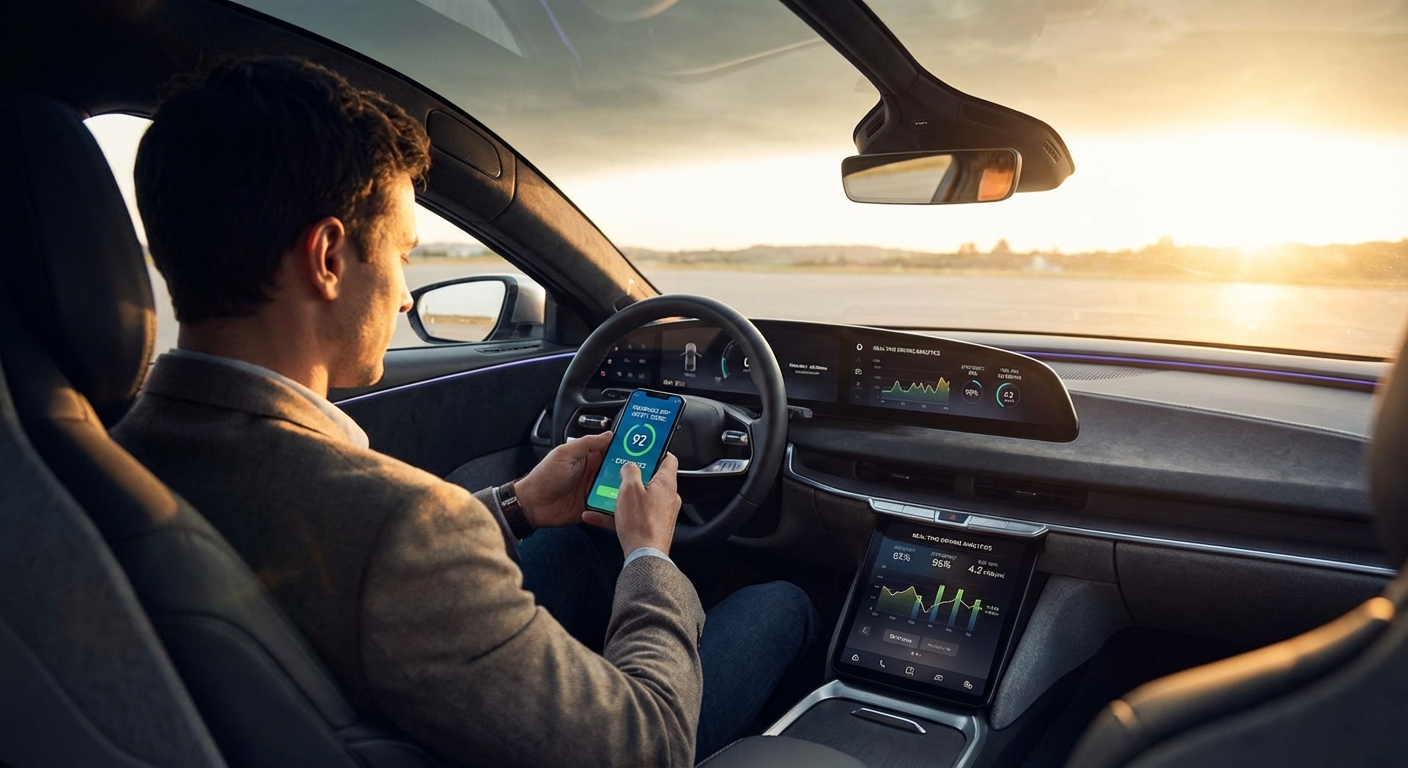
Automakers selling insurance is no longer a futuristic concept — it's happening right now. Tesla, General Motors, Honda, and Rivian have all stepped into the insurance market, using the connected technology already built into their vehicles to assess risk and price premiums. Instead of relying on traditional factors like age, gender, or credit score, these manufacturer-owned programs tap directly into your car's onboard systems to understand how you actually drive.
This approach — often called Real-Time Insurance or telematics-based insurance — marks a fundamental shift in how auto coverage is priced and sold. Rather than buying a policy from a third-party insurer who knows little about your specific vehicle, you're buying from the entity that built it. Learn more about how usage-based insurance programs work and how much they can realistically save you.
The global vehicle insurance market is valued at approximately $1.17 trillion in 2026 and is projected to grow at an 8.6% CAGR through 2033. Within that, OEM and embedded insurance channels are among the fastest-growing segments — driven by connected vehicle adoption, AI-powered underwriting, and automaker-insurer API integrations. The North American embedded auto insurance market alone is estimated at $28 billion in 2026. For consumers, that growth translates to more options — and more pressure on traditional insurers to compete.
The Major OEM Insurance Players in 2026
Here's a look at the automakers currently offering their own insurance programs and what makes each one unique:
Tesla Insurance
Tesla Insurance is the most prominent and mature OEM program on the market. Tesla began underwriting its own policies for the first time in February 2025 — a significant milestone after initially relying on third-party underwriters since its 2019 launch. Tesla reported $1 billion in written premiums in 2025, up from $315 million in 2024, underscoring how quickly the program is scaling.
Tesla prices premiums using a proprietary Safety Score system that tracks hard braking, aggressive turning, unsafe following distance, forward-collision warnings, and Autopilot disengagement events. No additional hardware is required — Tesla uses sensors already embedded in the vehicle. New policyholders start with a default Safety Score of 90, and as your monthly score improves, your premium drops. Tesla also offers an FSD (Full Self-Driving) discount, rewarding drivers who actively use autonomous features with lower premiums.
State availability: Tesla Insurance has expanded to 14 U.S. states as of 2026. The program has grown meaningfully after a multi-year pause and continues to add state coverage. Notably, California presents a unique situation — Tesla does not use the Safety Score for pricing there due to state insurance regulations, and in October 2025, the California Department of Insurance initiated enforcement proceedings against Tesla for alleged claims handling violations, including delayed claim responses and failure to inform consumers of appeal rights. As of May 2026, Tesla's California license remains active, with regulatory proceedings ongoing.
In January 2026, Lemonade launched a competing pay-per-mile Tesla insurance product offering approximately 50% off per-mile rates for miles driven with FSD engaged — using Tesla's Fleet API to detect FSD mode in real time. The program launched in Arizona (January 2026) and Oregon (February 2026), with further expansion planned. By March 2026, fully half of Lemonade's Tesla FSD policyholders were driving autonomously 90–100% of the time. Learn more about how autonomous vehicle insurance will continue to evolve as self-driving adoption grows.
GM Insurance
General Motors offers GM Insurance through its OnStar ecosystem, covering Chevrolet, Buick, GMC, and Cadillac vehicles. GM Insurance expanded to 14 states, including a notable California launch in March 2026. GM Insurance uses OnStar telematics to monitor driving behavior — including acceleration, braking, cornering, speed, seat belt usage, and mileage — and bases rates on actual driving habits. The program prioritizes OEM parts in claims and integrates directly with the vehicle's existing connectivity platform.
Important regulatory update: In January 2026, the FTC finalized a landmark settlement order against GM and OnStar for collecting and selling precise geolocation data and driving behavior information from millions of vehicles without adequately notifying consumers or obtaining affirmative consent. The FTC voted unanimously and described GM's conduct as "an egregious betrayal of consumers' trust." Key terms include a 5-year ban (through 2031) on sharing geolocation or driving data with consumer reporting agencies, and 20-year requirements (through 2046) to obtain affirmative express consent before collecting or sharing vehicle data — with options for consumers to access, delete, or disable precise location tracking. GM discontinued its Smart Driver program in April 2024 and ended third-party telematics relationships ahead of the order. Learn more about how telematics privacy concerns are shaping usage-based insurance.
Honda Insurance Solutions
Honda launched Honda Insurance Solutions in July 2025, a licensed insurance agency available across all 50 states. The platform is powered by VIU by HUB, an omnichannel insurance brokerage, and allows consumers to comparison-shop across multiple carriers entirely online. Coverage includes automobiles, motorcycles, homes, RVs, renters, and pets. One standout feature: Honda does not use driving behavior data to set rates — a deliberate privacy-forward differentiator from Tesla and GM. Honda also offers optional OEM parts coverage, ensuring that accident repairs use genuine Honda and Acura factory parts.
Rivian Insurance
Rivian offers its own Rivian Insurance program, available in all U.S. states and Washington D.C., designed specifically for its electric vehicles. The program integrates with Rivian's connected vehicle platform and its Driver+ ADAS suite — including adaptive cruise control, automatic emergency braking, and lane-keeping assist — to track driving quality and potentially reduce premiums. Rivian also allows multi-vehicle bundling for additional discounts. Average full coverage costs for Rivian models range from roughly $2,800–$3,800 per year based on 2026 market data, reflecting the elevated repair complexity of electric vehicles.

Compare Car Insurance Rates in Ohio
See if you qualify for a lower rate in less than 2 minutes
How Vehicle Data Powers OEM Insurance Pricing
The core advantage OEM insurers have over traditional carriers is data depth. When you buy insurance from your car's manufacturer, they already have access to every sensor, every alert, and every system interaction your vehicle generates. This is also what makes telematics-based OEM programs uniquely powerful compared to third-party devices.
What Data Is Tracked?
| Data Point | Tesla | GM (OnStar) | Rivian |
|---|---|---|---|
| Hard braking events | ✅ | ✅ | ✅ |
| Aggressive turning | ✅ | ✅ | ✅ |
| Following distance | ✅ | ✅ | ✅ |
| Autopilot / ADAS usage | ✅ | ✅ | ✅ |
| Speed & acceleration | ✅ | ✅ | ✅ |
| Seat belt usage | ❌ | ✅ | ❌ |
| Late-night driving | ✅ | ❌ | ❌ |
| Forced system disengagement | ✅ | ❌ | ✅ |
| Mileage tracking | ✅ | ✅ | ✅ |
This granular data allows OEM insurers to build a far more precise picture of your actual risk compared to traditional insurers who estimate risk based on demographic proxies.
Privacy Tradeoffs and Regulatory Scrutiny
The same data richness that enables better pricing also raises serious concerns — and regulators are taking decisive action. In January 2026, the FTC finalized its settlement order against GM and OnStar after a New York Times investigation revealed the company was selling customer driving data — including precise geolocation — to data brokers like LexisNexis and Verisk, which then sold it to insurance companies for rate-setting purposes — without drivers' knowledge or meaningful consent.
The order sets an industry precedent: a 5-year ban on selling geolocation and driving data to consumer reporting agencies, and 20-year requirements to obtain affirmative express consent before any vehicle data is collected, used, or shared — including consumer options to access, delete, and disable location tracking. Separately, California's new ADMT (Automated Decision-Making Technology) regulations took effect in January 2026, adding another layer of state-level data privacy protection for vehicle owners.
Before enrolling in any OEM insurance program, consider these real risks:
- Data monetization: Who owns your driving data and can it be sold to third parties?
- Claims disputes: Could your own vehicle's data be used against you in a claims investigation?
- Regulatory exposure: As California's actions against Tesla demonstrate, enforcement of claims-handling rules is tightening
- Liability in autonomous driving: As automation increases, data may be used to determine fault between driver and software
For more on how this is evolving, see our guide on autonomous vehicle liability and coverage responsibilities. You can also explore how software-defined vehicles are reshaping OTA update liability and cybersecurity risks.

Protect your car with Farmers
Average Rate:
Find coverage options that fit your budget.

The insurance savings you expect.
Average Rate:
Enjoy personalized policies, comprehensive coverage & more.

See how much you could save today!
Average Rate:
Drivers who switch their auto insurance and save with State Farm save $764 on average!

Safe Drivers Save with Allstate®
Average Rate:
Get rewarded with savings for having a clean driving record.
OEM Insurance vs. Traditional Insurance: Costs and Coverage
What Does OEM Insurance Actually Cost?
For EVs in 2026, full coverage insurance through any provider runs higher than average due to expensive repair costs. The national average for EV full coverage is approximately $3,281 per year — roughly 20–49% more than comparable gas vehicles — due to higher repair complexity, proprietary parts, and battery replacement exposure. Here's how Tesla models stack up using the latest 2026 market data:
| Tesla Model | Avg. Annual Full Coverage (Market) |
|---|---|
| Model 3 | ~$2,000–$2,600/year |
| Model Y | ~$2,300–$2,900/year |
| Model S | ~$2,900–$3,800/year |
| Model X | ~$3,200–$4,200+/year |
| Cybertruck | ~$2,800–$4,200/year |
Tesla Insurance's own pricing can be 20–40% below these market averages for safe drivers, thanks to the Safety Score system. However, unsafe drivers may see their premiums climb above market rates. For a full breakdown of EV insurance costs across all brands, see our electric vehicle insurance guide.
OEM Parts Coverage: A Hidden Advantage
One major financial benefit of manufacturer insurance is the guarantee of OEM parts in repairs. Traditional insurers often use cheaper aftermarket components to reduce claim costs — parts that may not fit as precisely or carry the same warranty as factory originals. This is especially important for electric vehicles, where battery systems, sensors, and proprietary components are costly and complex to replace correctly.
This guarantee has become significantly more valuable in 2026. The 25% tariffs on imported auto parts — effective since May 2025 — have pushed auto parts inflation from 4.4% year-over-year in Q2 2025 to 6.6% by July 2025, with repair cost increases averaging $250 or more per collision repair and an additional $50 for electrical and ADAS components. Roughly 40% of U.S. imported car parts come from Mexico and Canada alone, meaning tariff exposure across the repair supply chain is extensive. For a deeper look, see our guides on OEM parts coverage and how auto tariffs are driving up repair costs in 2026.
The Future of OEM Insurance
The automaker insurance market is growing fast, and the competitive pressure on traditional carriers is real. The car insurance industry trends shaping 2026 point clearly toward more embedded, telematics-driven, and manufacturer-linked coverage options for consumers.
Expanding Third-Party Competition
OEM insurance is no longer just manufacturer vs. traditional insurer. Third-party insurtechs are now using OEM vehicle APIs to offer aggressive, behavior-based products. Lemonade's January 2026 FSD insurance launch — offering 50% off per-mile rates for autonomous miles in Arizona and Oregon — is the clearest example yet of how OEM vehicle data is becoming the foundation for next-generation insurance products, even from outside the manufacturer. By March 2026, fully half of Lemonade's Tesla FSD policyholders were driving all their miles on FSD — a sign of how quickly autonomous behavior is shifting among early adopters. Analysts at Jefferies have noted that Tesla Insurance itself — with $1 billion in premiums in 2025 — poses a growing competitive risk to third-party providers like Lemonade.
Deeper Integration With Autonomous Driving
As vehicles reach higher levels of autonomy, self-driving car insurance will evolve significantly. The landmark $242.57M Benavides v. Tesla verdict (upheld February 2026) underscores how liability is increasingly shifting from driver to manufacturer — reshaping how OEM insurers underwrite risk. Meanwhile, the federal SELF DRIVE Act (H.R. 7390), introduced February 2026, is advancing through the House Energy and Commerce Committee, aiming to clarify NHTSA authority and improve crash data transparency — though no comprehensive federal AV insurance mandate has been finalized as of May 2026. Learn about the insurance challenges specific to software-defined vehicles as autonomy and OTA updates become standard features.
Embedded Insurance Expansion
Honda and Rivian represent a newer wave of OEM insurance entrants, and embedded insurance — coverage offered directly at the point of vehicle purchase — is expanding rapidly. Other automakers are following suit: Toyota partners with Toggle/Nationwide, BMW with Wrisk, and Stellantis with Bolttech. Learn more about how embedded car insurance programs at dealerships are changing the way consumers shop for coverage.
What This Means for Consumers
More competition is generally good news for drivers. The rise of OEM insurance programs will pressure traditional carriers to offer better usage-based car insurance discounts and more transparent pricing. Smart shoppers should always compare their manufacturer's insurance offering against traditional options — your vehicle make and model have a significant impact on which insurer will offer you the best rate. Learn how car insurance rates in 2026 are trending and whether switching programs could lower what you pay. For context on how your specific vehicle type affects your premium, see our guide on car insurance by vehicle type.
Frequently Asked Questions
Q: Is Tesla Insurance cheaper than traditional car insurance? Tesla Insurance can be significantly cheaper for safe drivers — potentially 20–60% below market rates — thanks to the monthly Safety Score system. Tesla wrote $1 billion in premiums in 2025, reflecting rapid adoption as drivers discover the potential savings. Third-party competitors like Lemonade now also offer pay-per-mile Tesla policies with up to 50% off for FSD-engaged miles, currently live in Arizona and Oregon as of early 2026 with more states planned. Always compare quotes from multiple insurers before committing, as traditional rates vary widely by ZIP code and driving history.
Q: What data does GM Insurance collect through OnStar? GM Insurance uses the OnStar telematics platform to monitor a wide range of driving behaviors, including acceleration, braking, cornering, speed, seat belt usage, and mileage. In January 2026, the FTC finalized a landmark settlement against GM and OnStar for collecting and selling this data — including precise geolocation — without adequate consumer consent, describing the conduct as "an egregious betrayal of consumers' trust." The order requires GM to obtain affirmative express consent before collecting or sharing vehicle data for 20 years (through 2046) and bans sharing driving data with consumer reporting agencies for 5 years (through 2031). Always review a program's privacy policy before enrolling.
Q: Does Honda Insurance track my driving habits? No — Honda Insurance Solutions, launched in July 2025 through its VIU by HUB partnership, explicitly does not use driving behavior data to set rates. This makes it a strong privacy-forward option for drivers who want the convenience of manufacturer-affiliated coverage without the telematics monitoring required by Tesla or GM programs. The Honda program is also available in all 50 states, making it the most geographically accessible OEM insurance offering available today.
Q: Why does manufacturer insurance guarantee OEM parts in repairs? When you're insured through your vehicle's manufacturer, there is a strong business incentive to use original factory parts — it protects the brand's reputation and ensures vehicles are restored to their original safety specifications. Traditional insurers typically default to cheaper aftermarket parts to reduce claims costs, which can affect fit, function, and even warranty coverage on newer vehicles. This benefit is especially valuable in 2026, as 25% tariffs on imported auto parts have pushed parts inflation to 6.6% year-over-year — making the OEM parts guarantee worth significantly more in real-dollar terms than in prior years.
Q: Should I switch to my car manufacturer's insurance program? It depends on your driving habits, privacy comfort level, and which states the program operates in. If you're a consistently safe driver who values seamless claims handling and guaranteed OEM parts, a manufacturer program could offer significant savings — Tesla Insurance has expanded to 14 states and wrote $1 billion in premiums in 2025. However, be aware of the FTC's landmark January 2026 action against GM/OnStar — a clear signal that regulators are scrutinizing how OEM programs collect and share your driving data. Always compare at least 3–4 quotes, including your OEM option and third-party telematics programs, before deciding.