
Compare Car Insurance Rates in Ohio
See if you qualify for a lower rate in less than 2 minutes



How Lemonade Car Insurance Works
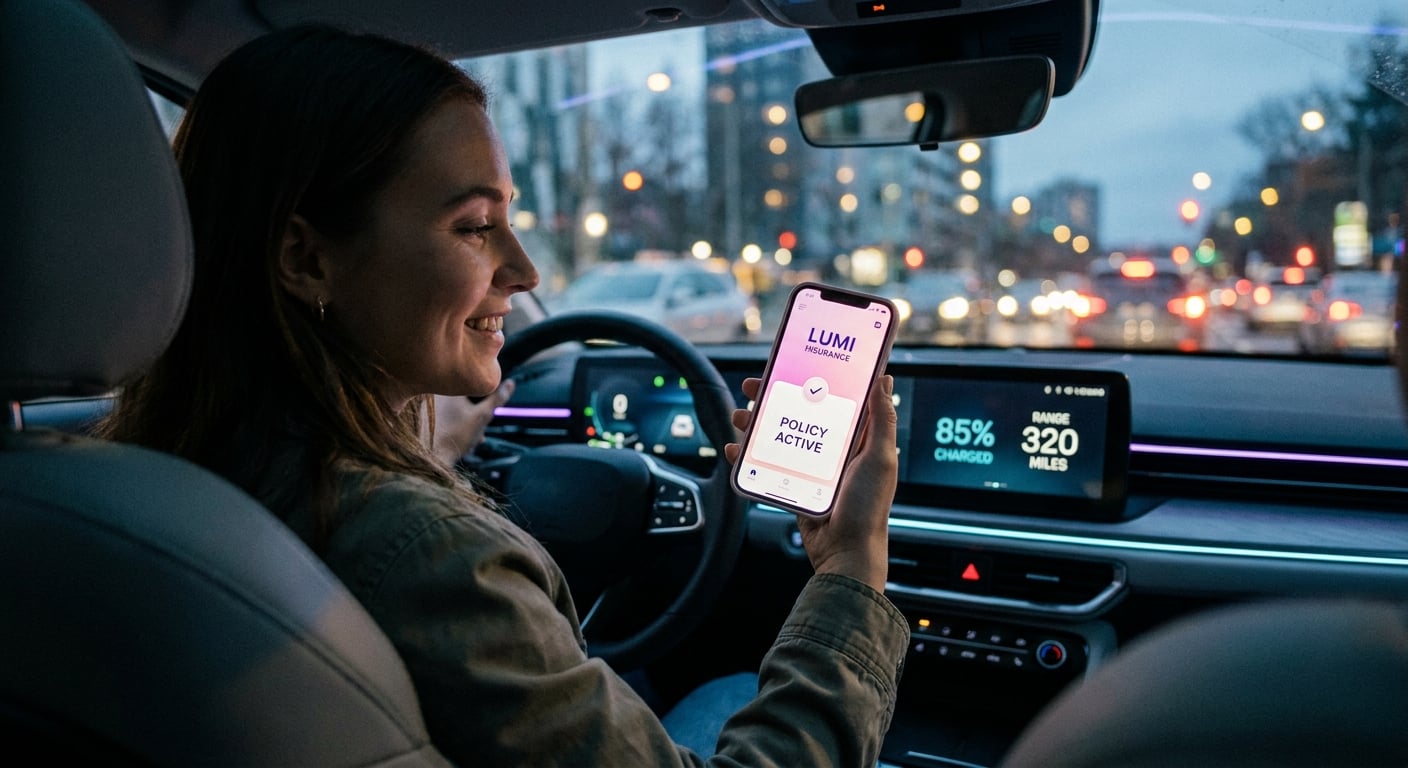
Lemonade Car is built around a fully digital experience. There are no local agent offices, no paperwork, and no phone calls required to start coverage. You download the app, answer a short questionnaire, get a quote, and bind a policy in minutes. After Lemonade absorbed Metromile in 2022, the company rebuilt its auto product around a usage-based model in most active states, meaning you pay a base monthly rate plus a per-mile charge (typically a few cents per mile).
Pricing is shaped by a mix of traditional rating factors (vehicle, location, driving record) and behavioral data gathered through the Lemonade Car app. The app uses your phone's location and motion sensors to track mileage and, in some states, scoring data like hard braking and phone handling. Drivers who keep mileage low and drive carefully unlock the deepest savings. As of Q2 2025, Lemonade Car surpassed $150 million in in-force premiums, with the product available in 10 states covering roughly 50% of the U.S. car insurance market.
What Coverages Are Available
Lemonade offers the standard menu most US drivers need: liability, collision, comprehensive, uninsured/underinsured motorist, medical payments or personal injury protection, and roadside assistance. The app also supports emergency crash assistance, towing, and jump starts directly from your phone.

Compare Car Insurance Rates in Ohio
See if you qualify for a lower rate in less than 2 minutes
Where Lemonade Car Insurance Is Available
One of the biggest limitations of Lemonade Car is geography. As of 2026, Lemonade auto coverage is available in 10 states: Arizona, California, Colorado, Illinois, Indiana, Ohio, Oregon, Tennessee, Texas, and Washington. Indiana was the most recent state to come online, with Lemonade Car launching there in July 2025 as part of the company's ongoing expansion push. If you live anywhere else, Lemonade can sell you renters, homeowners, pet, or life insurance, but you'll need another carrier for your car.
For drivers outside Lemonade's footprint, other pay-per-mile options like Allstate Milewise and Nationwide SmartMiles are worth a look. Drivers in states with updated minimum liability laws should also confirm Lemonade's coverage tiers meet the new requirements before switching.

Protect your car with Farmers
Average Rate:
Find coverage options that fit your budget.

The insurance savings you expect.
Average Rate:
Enjoy personalized policies, comprehensive coverage & more.

See how much you could save today!
Average Rate:
Drivers who switch their auto insurance and save with State Farm save $764 on average!

Safe Drivers Save with Allstate®
Average Rate:
Get rewarded with savings for having a clean driving record.
Lemonade Car Insurance Cost in 2026
Lemonade markets car insurance "starting at $30 per month" for low-mileage drivers, though actual pricing depends on state, vehicle, mileage, and driver profile. Independent 2026 data paints a wider range. Insuranceopedia reports typical Lemonade auto costs around $75 to $100 per month for good-credit drivers, while The Zebra found average 6-month premiums of about $1,159 (roughly $193 per month), nearly identical to the national 6-month average of $1,163.
For context, the 2026 national average for minimum coverage is roughly $912 per year ($76 per month), while full coverage averages about $2,496 per year ($208 per month). In California, average car insurance runs around $168 per month statewide.
| Coverage Type | 2026 National Average | Lemonade's Typical Range |
|---|---|---|
| Minimum liability | ~$76/month | From ~$30-$108/month |
| Full coverage | ~$208/month | ~$75-$195/month depending on mileage |
| Pay-per-mile base + per-mile | N/A | ~$50 base + $0.05-$0.07/mile |
Telematics and the Lemonade Car App
Telematics is central to Lemonade's pricing engine. The Lemonade Car app uses your phone (and, for eligible Teslas, vehicle data via Tesla's Fleet API) to measure how, when, and how much you drive. Lemonade explicitly tells customers that disabling location services or not using the app can affect your price in some states.
For Tesla owners with Full Self-Driving (Supervised), Lemonade's new Autonomous Car program launched in January 2026 and now offers a striking discount. The program cuts per-mile rates by approximately 50% for FSD-engaged driving, reflecting significantly reduced risk during autonomous operation. Lemonade supports intermittent FSD use as well as households with a mix of Teslas and non-FSD vehicles. As of mid-2026, the Autonomous Car product is available in Arizona, Oregon, Colorado, and Indiana. To qualify, your Tesla needs Hardware 4 or higher and current firmware. If you want to understand how telematics scoring affects rates at other carriers too, see our guide on AI in car insurance pricing.
The Giveback Program Explained
The Giveback program is Lemonade's signature differentiator. When you buy a policy, you choose a nonprofit cause from a curated list. Every customer who picks the same cause is grouped into a cohort. Lemonade keeps a flat fee for operations and profit, uses the rest to pay claims in your cohort, and at the end of the year donates any leftover money to your chosen charity.
The model is designed to reduce the classic conflict of interest between insurers and customers. Traditional carriers profit from denied or minimized claims. Lemonade argues that since unused premiums leave the company anyway, the incentive to deny valid claims is much smaller.
Real numbers from Lemonade's published reports:
- 2023 Giveback: $2,008,847 to 58 nonprofits
- 2024 Giveback: $2,112,608 to 43 nonprofits
- 2025 Giveback: $2,104,557 to 45 nonprofit organizations across the US and EU
- Total since 2017: Over $12 million contributed to more than 100 nonprofit organizations
Discounts Available With Lemonade Car
Lemonade keeps its discount list shorter than legacy carriers, but several stack nicely for the right driver profile.
| Discount | Who It's For | Notes |
|---|---|---|
| EV / Hybrid | Electric and hybrid drivers | Includes coverage perks for home and portable chargers |
| Low Mileage | Drivers under 7,500-10,000 miles/year | Built into pay-per-mile pricing |
| Telematics / App | Anyone who enables location services | Instant discount in most states |
| Bundle | Customers with Lemonade renters, home, pet, or life | Stacks with EV and low mileage |
| Planning Ahead | Buyers who sign up before coverage start date | Small but easy to grab |
| Tesla FSD | Eligible Teslas in AZ, OR, CO, IN | 50% off every FSD-engaged mile |
| Safe Driving (state-specific) | Drivers with 3+ years no incidents | Available in states like TN |
For deeper insight on Tesla-specific pricing, see our Tesla car insurance cost guide and our OEM insurance program breakdown.
Claims Process and AI Speed
Lemonade's claims pipeline is its proudest engineering achievement. You file inside the app, and an AI chatbot named AI Jim walks you through reporting, photos, and statements. Telematics data is layered in to reconstruct the accident.
For straightforward claims, Lemonade reports that roughly 40% of claims are handled instantly by AI, with payments issued in seconds if approved. Complex claims escalate to human adjusters. Lemonade's telematics can also gather location and speed data at the moment of impact, which speeds up decision-making for simple incidents.
That said, customer feedback is mixed. Repair shops gave Lemonade a C+ grade on the CRASH Network claims-handling survey, indicating average (not excellent) performance. Customer reviews praise the speed of simple claims but flag delays and communication gaps when claims get complex or disputed. To see how Lemonade compares with other automation-heavy carriers, our AI-powered car insurance claims breakdown goes deeper.
Customer Satisfaction and Complaints
This is where Lemonade's review gets uncomfortable. Independent analysts report a NAIC complaint index of roughly 10.11 for Lemonade's auto insurance, meaning it receives about ten times the volume of complaints expected for an insurer of its size. Bankrate scores its auto product at 2.9 out of 5 and explicitly cites the high complaint volume as a weakness. NerdWallet gives Lemonade 3.5 stars, calling customer complaints its weakest area.
Common themes in negative reviews include slow human support, surprise rate increases at renewal, and frustration when claims or cancellations require back-and-forth. That said, context matters. AutoInsurance.com notes Lemonade's 10.11 index is based on a small volume of complaints, and its limited state footprint means the ratio is easily skewed. Trustpilot ratings remain around 4.3 to 4.4 out of 5.
Pros and Cons of a Fully Digital Insurer
Lemonade vs Root vs Traditional Insurers
Lemonade and Root are the two best-known insurtech disruptors competing on app-driven, telematics-based pricing. Both target a similar customer: tech-comfortable, mobile-first drivers who want to skip the agent model.
For shoppers comparing the broader market, our Progressive review, GEICO review, and Allstate review provide useful benchmarks. Traditional carriers generally beat both Lemonade and Root on complaint ratios and claims satisfaction, while insurtechs often win on price for the right driver profile. Amica ranked #1 in J.D. Power's 2025 New England satisfaction study, as covered in our Amica review.
If you primarily want flexible monthly billing, subscription-based car insurance plans and weekly micro insurance options may offer the same savings without the high complaint risk. App-obsessed drivers should also check our best car insurance mobile apps ranking.
Frequently Asked Questions
Is Lemonade car insurance good for the average driver?
It depends heavily on your state, mileage, and tolerance for digital-only service. Low-mileage drivers in Lemonade's 10 states can get genuinely competitive pricing, especially with EV, bundle, or Tesla FSD discounts. However, the elevated NAIC complaint index of about 10x expected and reports of slow complex-claim resolution mean drivers who want hand-holding may prefer a traditional carrier.
How does the Lemonade Car app track my driving?
The app uses your phone's GPS, motion sensors, and (for eligible vehicles) connected car data to log mileage and driving behavior. In some states this includes events like hard braking, fast acceleration, and phone handling while driving. Lemonade has stated that turning off location services can affect your rate.
Will the Giveback program actually lower my premium?
No. Giveback does not reduce your premium directly. Instead, it routes unclaimed premiums from your cohort's pool to a charity you select. The financial benefit to you is indirect, and the value is in the model's alignment, not a discount on your monthly bill.
How does Lemonade compare to Root for claims handling?
Both are app-first and lean heavily on telematics, so simple claims tend to resolve quickly at either carrier. Lemonade publishes more concrete automation stats (about 40% paid instantly), but its complaint index for auto is higher than Root's. Neither matches the claims satisfaction scores of top traditional insurers like Amica or Erie.
Can I get Lemonade car insurance if I drive a lot of miles?
You can, but it may not save you money. Pay-per-mile pricing favors drivers under roughly 7,500 to 10,000 miles per year. High-mileage commuters often end up paying more with Lemonade than they would with a flat-rate insurer like GEICO or State Farm, so always compare a Lemonade quote against at least two traditional carriers before switching.