
Compare Car Insurance Rates in Ohio
See if you qualify for a lower rate in less than 2 minutes



How a Common Loss Deductible Works
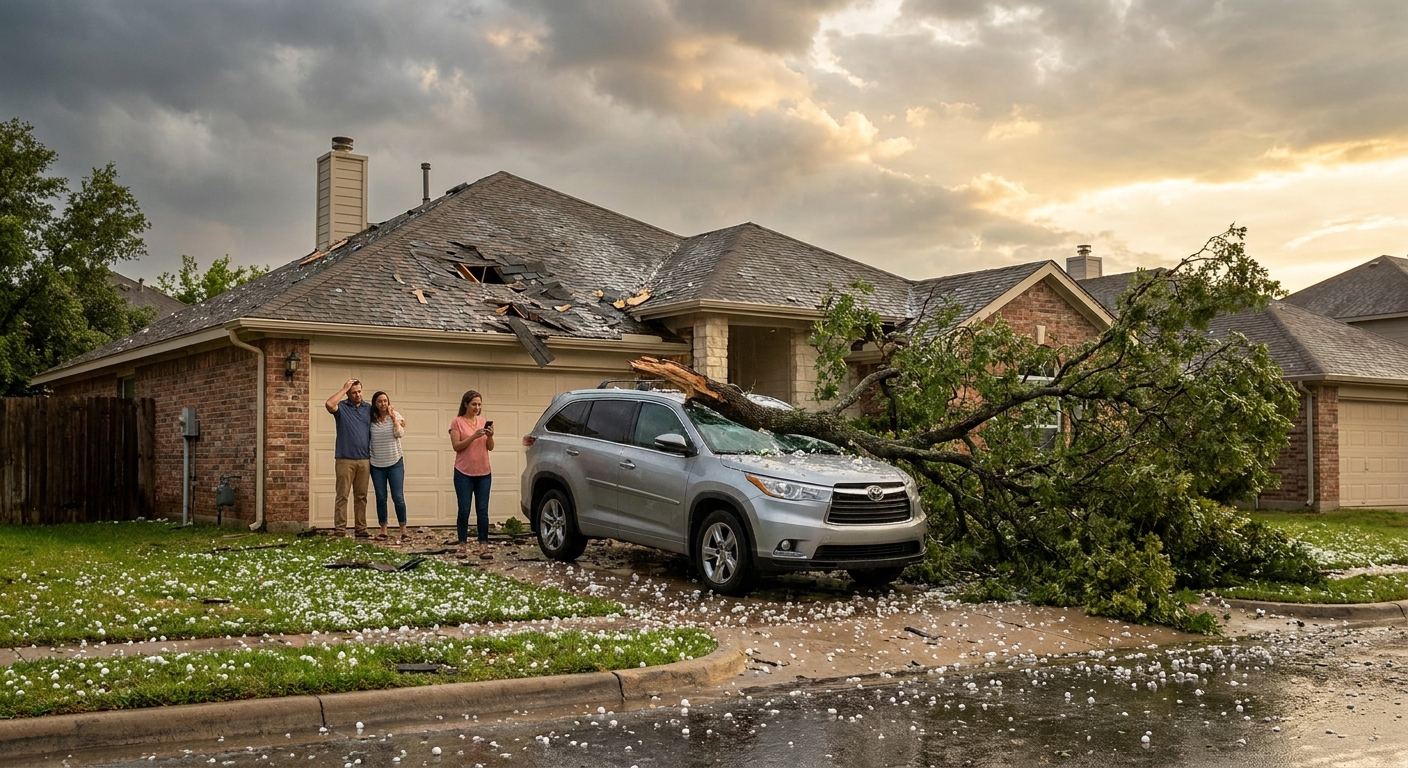
Normally, your auto and home insurance policies each carry their own deductible, the amount you pay out of pocket before your insurer covers the rest. If a hailstorm damages your roof and your parked car in the same storm, you'd typically owe both your homeowners deductible and your auto comprehensive deductible, even though it was a single event.
A common loss deductible changes that completely. When both your home and vehicle suffer damage from the same covered incident, you pay only one deductible (usually the higher of the two) instead of both. The insurer covers the rest across both claims, and you keep more money in your pocket when you need it most.
Separate Deductibles vs. Common Loss Deductible: Dollar-for-Dollar Comparison
| Scenario | Home Deductible | Auto Deductible | Without Common Loss | With Common Loss | You Save |
|---|---|---|---|---|---|
| Moderate deductibles | $1,500 | $500 | $2,000 | $1,500 | $500 |
| Higher deductibles | $2,500 | $1,000 | $3,500 | $2,500 | $1,000 |
| 2% wind/hail on $400K home | $8,000 | $1,000 | $9,000 | $8,000 | $1,000 |
| Lower deductibles | $1,000 | $500 | $1,500 | $1,000 | $500 |
As the table shows, savings range from $500 to $1,000 or more in a single qualifying storm event. That's a meaningful amount when you're already dealing with the stress of major property damage, and it's even more relevant now that the average home insurance deductible rose 22% in 2025 alone. Learn more about rising home insurance deductibles in 2026 and why insurers are pushing more risk onto homeowners.

Compare Car Insurance Rates in Ohio
See if you qualify for a lower rate in less than 2 minutes
Common Scenarios Where It Applies
The common loss deductible is specifically designed for situations where a single natural or accidental event damages both your home and your vehicle simultaneously. Understanding how hail damage claims work on home insurance is key to knowing when this feature applies. The most frequent qualifying events include:
- Hailstorm. The most common trigger by far. Hail dents your car's roof and panels while damaging your home's roof, siding, and windows in the same storm. In 2025, Verisk logged 835,058 homeowner hail claims and 328,606 personal auto hail claims in the U.S., and State Farm alone paid over $5.6 billion in hail claims (up 12% from 2024).
- Tornado or windstorm. High winds collapse a fence onto your car while tearing shingles off your roof in the same event. Severe convective storms drove more than $51 billion in U.S. insured losses in 2025.
- Tree falling. A large tree strikes both your vehicle in the driveway and your house's garage or roof at the same time.
- Garage fire. A fire breaks out in your attached garage, damaging both the structure and the vehicle parked inside.
- Hurricane. Wind-driven debris damages your home's exterior and your parked vehicles in the same storm. Review our guide on car insurance hurricane coverage to understand when your auto policy responds.
Events That Typically Do NOT Qualify
| Situation | Reason Not Covered |
|---|---|
| A car accident + a kitchen fire weeks apart | Two separate, unrelated events |
| Flood damage to car + flood excluded on home policy | One loss is not covered under both policies |
| Pre-existing home damage + new storm car damage | Damage must originate from the same cause |
| One policy lapsed at time of loss | Both policies must be active and in force |

Protect your car with Farmers
Average Rate:
Find coverage options that fit your budget.

The insurance savings you expect.
Average Rate:
Enjoy personalized policies, comprehensive coverage & more.

See how much you could save today!
Average Rate:
Drivers who switch their auto insurance and save with State Farm save $764 on average!

Safe Drivers Save with Allstate®
Average Rate:
Get rewarded with savings for having a clean driving record.
Which Insurers Offer a Common Loss Deductible in 2026?
Not every insurer provides this feature. It's a specialty benefit that typically requires you to have both your home and auto policies bundled with the same carrier. According to 2026 industry reviews, most national carriers don't offer this at all, making it a real differentiator. Here are the confirmed providers:
Auto-Owners Insurance remains the most recognized carrier for this feature in 2026. When the same event damages both your home and car, Auto-Owners reduces the auto deductible by the amount of your homeowners deductible, or waives it entirely if the auto deductible is lower. Effectively, you pay only the higher of the two.
Acuity Insurance offers a similar benefit through its Road and Residence® Package Policy, which combines home, auto, and other personal lines into a single package. Under the program, one covered event that damages both your home and vehicle triggers a single per-event deductible instead of separate ones on each policy. Acuity also reports average bundle savings of around 20% for Road and Residence customers.
Other carriers may offer comparable provisions under different names such as "single loss deductible," "combined deductible," "package deductible," or "single event deductible." Always ask your insurer directly. Bundling home and auto insurance can unlock not just common loss benefits but also significant premium discounts. 2026 industry data from MoneyGeek and Insurify shows real-world bundle savings averaging $542 to $869 per year, or roughly 10% to 20% off combined premiums (State Farm leads at about 25%).
Requirements to Qualify & How to Add It to Your Policy
Qualification Requirements
The common loss deductible is not automatic. You must meet specific conditions before you can use it:
- Same insurer for both policies. Home and auto must be bundled with the same carrier. Policies split across two different companies will not qualify, even if both offer the feature individually.
- One event damages both. The same cause (hail, wind, fire, falling tree) must damage both your home and your vehicle in a single occurrence.
- Both policies must be active. Both must be in force and fully paid up on the date of the loss.
- Both claims must be filed. You typically need to file claims under both your homeowners policy and your auto policy for the same event to trigger the combined deductible.
- Coverage must apply on both sides. If one loss is excluded (for example, flood on a standard homeowners policy), the combined deductible may not apply.
- Percentage-based deductibles may be excluded. In storm-prone areas, homes often carry a percentage-based wind and hail deductible. In 2026, 2% is the new standard in Texas, Colorado, and much of Tornado Alley (roughly $8,000 on a $400,000 home). These may not be eligible for the combined deductible provision, so confirm with your carrier.
How to Add It to Your Policy
Adding a common loss deductible is straightforward once you know what to ask for. Before going through these steps, it helps to understand how car insurance deductibles work so you can make informed decisions about your deductible levels on each policy.
- Confirm your home and auto are bundled with the same insurer. This is the most fundamental requirement.
- Review your current policy documents. Look in the endorsements section for terms like "common loss," "single loss deductible," "combined deductible," or "single event deductible."
- Call your agent or insurer. Ask directly whether your bundled policy already includes the endorsement and, if not, whether you can add it.
- Request a quote for the endorsement. Some carriers include it at no additional cost as part of a bundled package. Others may charge a small premium adjustment.
- Verify the claim procedure. Confirm whether you need to file both claims simultaneously or within a specific time window for the single deductible to apply.
- Get the updated declarations page. Once the endorsement is added, request confirmation in writing and keep it on file.
If you're also exploring other ways to lower your out-of-pocket exposure, look into vanishing deductible programs that reduce your deductible each year you drive safely. That's another smart way to shrink what you owe after a claim.
Frequently Asked Questions
What is a common loss deductible in car insurance?
A common loss deductible is a policy provision that lets you pay only one deductible when a single event (such as a hailstorm, tornado, or fallen tree) damages both your car and your home at the same time. Instead of paying your auto deductible and your homeowners deductible separately, you typically pay only the higher of the two. It's available on bundled home and auto policies with select insurers like Auto-Owners and Acuity, and may be listed in your policy as a "single loss," "combined," or "per event" deductible endorsement.
Which insurance companies offer a common loss deductible in 2026?
Auto-Owners Insurance and Acuity Insurance are the two most widely recognized carriers offering this feature in 2026. Acuity provides it through its Road and Residence® Package Policy, and Auto-Owners reduces or waives your auto deductible when both home and car are damaged by the same event. According to 2026 insurance reviews, most national carriers do not offer an equivalent benefit, so you'll need to confirm directly with your insurer or agent.
How much can I save with a common loss deductible?
Savings depend on your specific deductibles. If your home deductible is $1,500 and your auto comprehensive deductible is $500, a common loss deductible saves you $500 per qualifying event. With higher deductibles like $2,500 home and $1,000 auto, you could save $1,000 in a single storm. The savings add up especially fast in hail-prone regions like Texas, Kansas, Nebraska, Oklahoma, and Colorado, where 2025 saw record hail losses topping $50 billion nationally.
Do I need to bundle home and auto insurance to get a common loss deductible?
Yes, in nearly all cases. The common loss deductible requires both your home and auto policies to be with the same insurer and actively bundled together. If your policies are with separate carriers, you will not be eligible for this benefit, even if both insurers individually offer the feature. On top of that, bundling itself saves an average of $542 to $869 per year in 2026, so keeping both policies under one roof usually pays off.
Does a common loss deductible apply to flood, hurricane, or earthquake damage?
Generally, no. Standard homeowners policies exclude flood and earthquake damage, so those perils typically won't qualify for a combined deductible even if your car is also damaged by the same event. Additionally, percentage-based hurricane and named-storm deductibles common in the 19 coastal states plus D.C. are frequently excluded from common loss deductible provisions. Always review your specific endorsement language or ask your agent to confirm which perils are included.