
Compare Car Insurance Rates in Ohio
See if you qualify for a lower rate in less than 2 minutes



What Does Car Insurance Cover During a Hurricane?
Car insurance can cover hurricane damage, but only if you carry the right type of policy. The coverage that matters here is comprehensive coverage, also called "other than collision." Standard liability-only policies won't pay a dime for storm damage, and collision coverage only applies to accidents involving another vehicle or object.
Comprehensive car insurance is designed for situations beyond your control, and hurricanes fall squarely in that category. Here's a quick breakdown of what's covered and what's not:
One critical rule: you cannot add comprehensive coverage once a storm is already named or imminent. Most insurers freeze policy changes during an active storm watch or warning. If you're in a hurricane-prone state and currently carry liability-only coverage, now is the time to evaluate an upgrade. Learn more about what full coverage includes and whether it makes sense for your situation.
You can also review our glass and windshield coverage guide to understand how comprehensive protects your vehicle across a range of weather events.

Compare Car Insurance Rates in Ohio
See if you qualify for a lower rate in less than 2 minutes
Flood Damage vs. Storm Surge: A Distinction That Matters
Here's where many drivers get confused, and where claim outcomes can diverge significantly.
For auto insurance, comprehensive coverage generally treats flood damage and storm surge damage the same way. Both are classified as water damage caused by the storm event, and both are covered under comprehensive. This is actually different from homeowners insurance, where storm surge typically requires a separate flood policy. It's also worth noting that the National Flood Insurance Program (NFIP) does not cover vehicles at all, so your auto comprehensive policy is the only source of coverage for a flooded car.
However, the severity of damage is where the distinction becomes critical:
| Damage Type | Cause | Coverage | Severity Risk |
|---|---|---|---|
| Rainwater flooding | Heavy precipitation pooling | Comprehensive | Moderate, depends on depth |
| Freshwater flooding | Overflowing rivers/lakes | Comprehensive | High, can total a vehicle |
| Storm surge | Hurricane-driven coastal seawater | Comprehensive | Very High, saltwater accelerates corrosion |
| Wind damage | Hurricane-force gusts | Comprehensive | Moderate to High |
| Flying/falling debris | Trees, signs, objects | Comprehensive | Moderate |
| Collision while evacuating | Driver error | Collision | Varies |
Why storm surge is especially destructive: Saltwater intrusion corrodes electrical components, destroys the engine and transmission, and causes rapid rust and mold growth. Modern cars are especially vulnerable because of extensive onboard electronics, meaning even water levels below the dashboard can total a newer vehicle. A car submerged in saltwater is far more likely to be declared a total loss than one damaged by freshwater flooding.

Protect your car with Farmers
Average Rate:
Find coverage options that fit your budget.

The insurance savings you expect.
Average Rate:
Enjoy personalized policies, comprehensive coverage & more.

See how much you could save today!
Average Rate:
Drivers who switch their auto insurance and save with State Farm save $764 on average!

Safe Drivers Save with Allstate®
Average Rate:
Get rewarded with savings for having a clean driving record.
Hurricane Deductibles & Coverage Costs
How Deductibles Work for Auto Claims
Unlike homeowners insurance, which in 19 coastal states plus Washington, D.C. uses special hurricane deductibles calculated as a percentage of your home's insured value (typically 1% to 5%), car insurance does not use hurricane-specific deductibles. Your vehicle claim is processed using your standard comprehensive deductible, which is a flat dollar amount you selected when you purchased the policy.
Common comprehensive deductible options include $250, $500, $1,000, and $2,000. The higher your deductible, the lower your monthly premium, but the more you'll pay out of pocket when filing a storm damage claim. As of mid-2026, $500 remains the most common deductible, though $1,000 has continued to gain popularity as cost-conscious drivers try to offset rising premiums. That's a trend worth reconsidering if you live in a high-risk coastal area, so review our car insurance claims process guide to understand how your deductible interacts with claim timing.
For drivers in coastal states like Florida, Texas, Louisiana, or the Carolinas, a lower deductible often makes more financial sense given the elevated risk of hurricane-related claims. Coastal-state premiums remain well above the national average in 2026: Florida drivers now pay an average of $3,916/year for full coverage (about $326/month), the highest in the country, up roughly 51% from $2,597 in 2022. Louisiana averages around $3,400/year for full coverage, while Texas lands closer to $2,300 to $2,600/year, still above the U.S. average of about $2,578/year. Understanding the types of car insurance coverage available can help you strike the right balance between deductible level and storm risk.
2025 Recap & the 2026 Hurricane Season So Far
The 2025 Atlantic hurricane season produced 13 named storms and 4 major hurricanes, with no U.S. hurricane landfalls (the first such season in a decade). Even so, vehicle damage remained significant. Per CARFAX, roughly 482,000 flood-damaged vehicles were already on U.S. roads entering 2025, and mid-year storms added another 45,000 flood-damaged vehicles. As of August 2026, the National Insurance Crime Bureau (NICB) and CARFAX now estimate roughly 530,000 flood-damaged vehicles are on U.S. roads, many of which have quietly re-entered the used market with hidden electrical, safety, and mechanical damage. States most impacted continue to be Florida and Texas, followed by Pennsylvania, California, New Jersey, and New York, so a title check is essential before any used-car purchase.
Looking at the current year, NOAA released its official 2026 Atlantic hurricane season forecast on May 21, 2026, and then updated it on August 6, 2026 as the peak of the season approached. The updated August outlook still calls for a below-normal season, with even lower numbers than the May forecast:
| Forecaster | Named Storms | Hurricanes | Major Hurricanes | Outlook |
|---|---|---|---|---|
| NOAA (August 6, 2026 update) | 7 to 13 | 2 to 6 | 0 to 2 | Below-normal (75% probability) |
| NOAA (May 21, 2026) | 8 to 14 | 3 to 6 | 1 to 3 | Below-normal (55% probability) |
| Colorado State University (August 2026 final) | 9 | 4 | 1 | Least active in over a decade |
| AccuWeather (August 19 update) | 8 to 11 | 3 to 4 | 1 to 2 | Below to near-average |
| Historical Average (1991–2020) | 14 | 7 | 3 | Baseline |
The season has played out remarkably quietly through late August 2026. So far, only three named storms have formed: Tropical Storm Arthur (June 17 to 18), Tropical Storm Bertha (July 19 to 23), and Tropical Storm Cristobal (August 12 to 13). No hurricanes and no major hurricanes have formed in the Atlantic basin as of the National Hurricane Center's late-August summary. Both Arthur and Bertha made U.S. landfall as tropical storms along the Gulf Coast, bringing flash flooding but no hurricane-level wind damage, while Cristobal stayed offshore.
Forecasters point to a strengthening super El Niño (which NOAA now gives a 90% probability of reaching strong or very strong status through the August to October peak) plus a persistent plume of Saharan dust as the reasons the tropics have been unusually silent. AccuWeather still projects several direct U.S. impacts before the season ends on November 30.
The key takeaway: regardless of totals, a single major U.S. landfall can cause billions in vehicle damage. Don't let a quiet forecast lull you into dropping coverage.
How to Protect Your Car Before & After a Hurricane
Before the Storm Hits
Preparation is your first line of defense. Here's a pre-hurricane vehicle checklist:
| Action | Timeline | Why It Matters |
|---|---|---|
| Photograph your entire vehicle | 72+ hours before storm | Documents pre-storm condition for claims |
| Fill your gas tank | 48–72 hours before | Avoid shortages during evacuation |
| Park on highest available ground | 24 hours before | Reduces flood damage exposure |
| Move vehicle into a garage | 24 hours before | Best protection from wind and debris |
| Cover with heavy-duty car cover | If garage unavailable | Buffers against flying debris |
| Check tire tread and pressure | 1–2 weeks before season | Critical for safe evacuation driving |
| Disconnect EV charging cable | Before storm arrives | Prevents surge/lightning damage |
If you're evacuating: Leave early to beat traffic, plot your route with gas stations marked, and avoid driving through any flooded roadways, no matter how shallow they appear. Snowbirds heading to coastal Florida or the Gulf should also review our snowbird car insurance guide to make sure their policy is properly aligned before storm season peaks.
After the Storm: Document Before You Drive
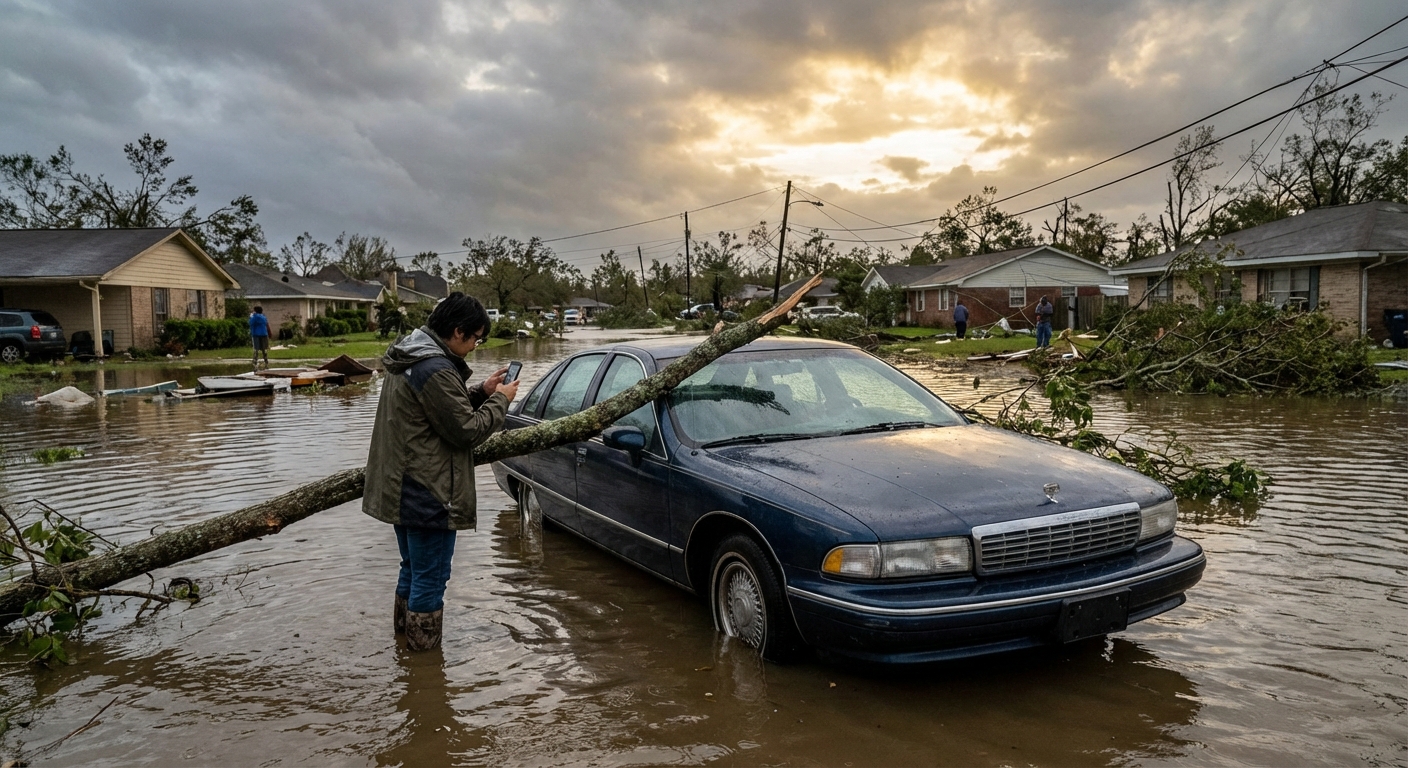
Once it's safe to return to your vehicle, do not start the engine if there is any indication the car has been submerged in water. Starting a flooded engine can cause catastrophic internal damage ("hydrolocking") and virtually guarantees a total loss determination. Instead:
- Photograph all damage from multiple angles: exterior, interior, waterline marks, engine bay
- Note the water level by looking for a visible high-water mark inside the car
- Contact your insurer as soon as possible with your policy number and photos
- Request a tow to a certified repair shop rather than attempting to drive a flood-damaged vehicle
Filing Your Hurricane Car Insurance Claim
Here's what you need to file a successful storm damage claim:
- 📷 Photos and video of all exterior and interior damage
- 📄 Your insurance policy number and insurer's claims contact info
- 🔑 Vehicle title and proof of ownership
- 🔧 Repair estimates from licensed auto body shops
- 🧾 Receipts for towing, emergency repairs, or rental car expenses
- 📋 A written description of when, where, and how the damage occurred
Once filed, your insurer will send an adjuster to evaluate the damage. If repair costs exceed your vehicle's actual cash value (ACV) (what the car is worth on the open market after depreciation), it will be declared a total loss. Most insurers apply a total-loss threshold of 70 to 80% of ACV, though the exact percentage varies by state and carrier. For example, Texas insurers typically use a 70 to 75% threshold and pay ACV plus applicable sales tax and title fees per state law. Learn more about how car insurance claims work to understand the full process from filing to settlement.
It's also worth noting that filing a comprehensive claim for hurricane damage has a much smaller impact on your rates than an at-fault collision. Weather-related rate increases tend to apply broadly to regions impacted by storms, not just to individual claimants, meaning your rates could rise even if you never file a claim, simply due to regional risk pooling. This is a sharp contrast to at-fault accidents, which can raise rates by 40% or more.
When Your Car Is Totaled by a Hurricane
If your vehicle is declared a total loss after hurricane damage, here's what to expect:
- Insurer calculates ACV based on comparable vehicles in your area
- Deductible is subtracted from the ACV payout
- Insurer takes the salvage (or you can keep it for a reduced settlement)
- GAP insurance covers the difference between ACV and your remaining loan balance if applicable
- You can negotiate the ACV if you believe it's undervalued by providing comparable listings as evidence
Understanding windshield and glass damage coverage is also worthwhile, since flying debris during hurricanes frequently cracks or shatters windshields, a common comprehensive claim after any major storm. Florida drivers in particular should also review our guide to the cheapest car insurance in Florida, since coastal states carry the highest hurricane-related claim exposure in the country.
Frequently Asked Questions
Does comprehensive car insurance cover all hurricane damage?
Comprehensive coverage covers the vast majority of hurricane-related vehicle damage, including wind damage, falling trees, flying debris, hail, and flooding. However, it does not cover personal belongings inside the vehicle, mechanical failures caused by deferred maintenance, or damage that occurs while you're at fault in a collision during evacuation. Always review your specific policy's declarations page to confirm your covered perils, and get familiar with car insurance terminology so you can spot gaps before storm season arrives.
Is flood damage from storm surge covered by car insurance?
Yes. For auto insurance purposes, storm surge damage is treated as flood and water damage and is covered under comprehensive coverage. This is different from homeowners insurance, where storm surge typically requires a separate flood policy. Saltwater intrusion from storm surge is far more destructive than freshwater flooding and greatly increases the likelihood of a total loss, which is one reason NICB and CARFAX estimate roughly 530,000 flood-damaged vehicles are on U.S. roads as of August 2026.
Do I need separate flood insurance for my car?
Unlike homeowners, vehicle owners do not need a separate flood insurance policy for their car. Comprehensive auto coverage handles flood damage to your vehicle. The National Flood Insurance Program (NFIP) only covers structures and contents of homes, not vehicles. As long as you carry comprehensive coverage, your car is protected from both freshwater and saltwater flooding events.
Can I add comprehensive coverage right before a hurricane?
No. Most insurance companies suspend policy changes, including adding comprehensive coverage, once a named storm watch or warning is issued that could affect your area. Coverage additions made immediately before a storm may also be subject to insurer review and potential denial. The time to upgrade your coverage is during the off-season, not when a storm is 48 hours away. Reviewing what car insurance actually covers can help you make sure your policy is hurricane-ready before the season begins.
How long do I have to file a car insurance claim after a hurricane?
Filing deadlines vary by state and insurer, but you should always file as quickly as possible after the storm passes. In Florida, policyholders generally have up to one year from the date of loss (measured from the hurricane's landfall date) to file the initial claim and 18 months to file a supplemental claim under Florida Statute 627.70132. Most insurers still recommend filing within 30 days to ensure a smooth process. Delays can complicate documentation, allow damage to worsen, and give insurers grounds to question the claim's validity.