
Compare Car Insurance Rates in Ohio
See if you qualify for a lower rate in less than 2 minutes



What Is Comprehensive Coverage Car Insurance?
Comprehensive coverage, formally referred to in the insurance industry as "other than collision" (OTC) coverage, is an optional type of auto insurance that pays to repair or replace your vehicle when it's damaged by something other than a crash with another car or object. Think of it as protection against the unexpected events you simply can't control: a hailstorm, a deer jumping in front of your car, or a thief breaking in overnight.
Unlike liability insurance (which covers damage you cause to others), comprehensive coverage focuses entirely on protecting your own vehicle from a wide range of non-collision perils. It is not required by law in any U.S. state, but lenders and leasing companies almost always require it (alongside collision coverage) for the duration of an active loan or lease. Learn more about full coverage car insurance and how comprehensive fits into the bigger picture.
What Does Comprehensive Insurance Cover?
Comprehensive car insurance is broad by design. Here's a breakdown of the most common covered events:
| Covered Event | Example Scenario |
|---|---|
| Theft | Your car is stolen from a parking lot or your catalytic converter is taken overnight |
| Vandalism | Someone keys your paint or smashes a window during civil unrest |
| Fire | Your vehicle catches fire due to an electrical fault while parked |
| Weather Damage | Hail dents your roof; a flood submerges your engine; wind blows debris onto your car |
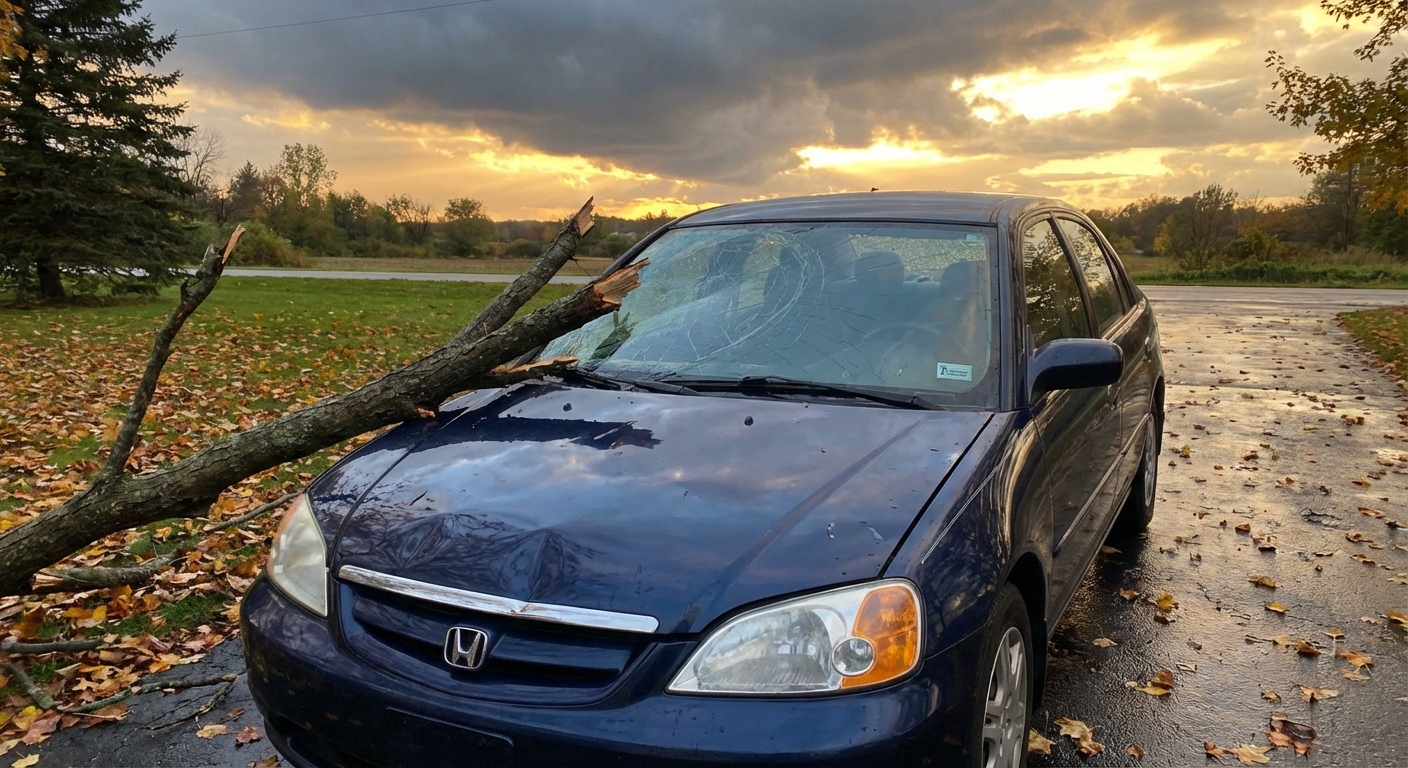
| Falling Objects | A tree branch collapses onto your hood during a storm |
| Animal Strikes | You hit a deer on a rural highway or a rodent chews through your wiring |
| Glass Damage | A rock chips or cracks your windshield; many insurers waive the deductible for glass-only repairs |
It's worth noting that comprehensive pays out based on your vehicle's actual cash value (ACV), the market value of your car at the time of the loss (accounting for depreciation), minus your chosen deductible. For a plain-English breakdown of how each coverage type works, see our complete car insurance coverage breakdown.
What Comprehensive Coverage Does NOT Cover
Understanding the exclusions is just as important as knowing what's covered. Comprehensive insurance will not pay for:
- Collision damage: if you crash into another vehicle, a guardrail, or a pole, you'll need collision coverage. See our types of car insurance coverage guide for a full breakdown.
- Mechanical breakdowns: engine failures, transmission problems, or normal wear and tear are never covered by any type of auto insurance. Learn more in our mechanical breakdown coverage guide.
- Items stolen from inside your car: a laptop, bag, or phone taken from your vehicle would fall under your homeowners or renters insurance policy.
- Aftermarket upgrades: custom rims, spoilers, or audio systems typically require a separate endorsement.
- Medical expenses: comprehensive doesn't cover injuries to you or anyone else; that falls under medical payments (MedPay) or personal injury protection (PIP).

Compare Car Insurance Rates in Ohio
See if you qualify for a lower rate in less than 2 minutes
How Deductibles & Costs Work
Choosing Your Comprehensive Deductible
Your deductible is the amount you pay out of pocket before your insurance kicks in. For comprehensive claims, deductibles typically range from $100 to $1,000, with $500 being the most common choice (though CCC's 2026 Crash Course data shows about 26% of drivers now carry a $1,000 or higher deductible).
Here's how the math works in practice:
| Vehicle Repair Cost | Your Deductible | Insurance Pays |
|---|---|---|
| $1,200 (hail damage) | $500 | $700 |
| $3,500 (theft recovery damage) | $500 | $3,000 |
| $800 (windshield replacement) | $250 | $550 |
| $400 (minor vandalism) | $500 | $0 (below deductible) |
Choosing a higher deductible lowers your monthly premium, but means more out of pocket when you file a claim. A lower deductible costs more monthly but reduces your financial hit at claim time.
How Much Does Comprehensive Coverage Cost in 2026?
Comprehensive coverage by itself is one of the more affordable parts of a full coverage policy. As a standalone component, it is significantly cheaper than collision, and only a fraction of full coverage cost. Nationally, full coverage auto insurance averages roughly $2,237 to $2,926 per year ($186 to $244 per month) as of August 2026, depending on the source (Insurify, NerdWallet, Forbes, and Experian). Insurify's mid-year report projects a year-end 2026 average near $2,242, a 1% year-over-year increase, with 32 states expected to see hikes by December. Louisiana leads the country at roughly $333 per month for full coverage per LendingTree's 2026 state data, followed by New Jersey ($305), Maryland/New York ($304), Nevada ($286), and Connecticut/Florida in the $264 to $265 range.
Factors that affect your comprehensive premium include:
- Where you live: areas with high vehicle theft, frequent hail, or flood risk cost more. Louisiana, New Jersey, Maryland, New York, and Nevada lead the nation for full-coverage cost, while Wyoming ($96/mo), Vermont ($122/mo), Idaho, Iowa, and Hawaii remain among the cheapest.
- Your vehicle's value: newer, more expensive cars cost more to insure.
- Your deductible: higher deductibles = lower premiums.
- Your claims history: prior comprehensive claims can raise your rate by roughly 3 to 10% annually.
- Weather and tariff pressure: severe weather losses and 25% tariffs on imported auto parts are pushing repair costs up 15 to 25%, which insurers are passing through as premium increases. Connecticut is projected to see a +15% jump in 2026 rates, the largest in the country, followed by Kentucky at +8%.
Will Filing a Comprehensive Claim Raise My Rates?
Comprehensive claims are treated as non-fault events, so they generally have a smaller impact on your premiums than at-fault collision claims. For context, at-fault accidents typically raise rates by 45% to 61% on average (per Insure.com and LendingTree data), and that impact usually persists for three to five years. A single comprehensive claim, by comparison, typically raises your rate by around 3 to 10% (roughly $30 to $70 per six-month term, or $60 to $140 per year), and some insurers waive surcharges entirely for first-time small weather-related or glass claims under $1,000.
However, filing multiple claims within 3 to 5 years can trigger more significant rate increases and may cause you to lose claim-free discounts. Larger claims of $2,500 or more also tend to have a greater impact at renewal. Notably, Allstate raised comprehensive coverage rates by 12.1% across all 50 states effective March 2026, citing "broader geographic correlation of severe weather events," a signal that base comp rates are rising even for claim-free drivers.
If your repair cost is close to or below your deductible, it may be worth paying out of pocket to avoid any potential rate impact. Always verify with your agent, since state rules vary (California, for example, limits surcharges under Prop 103). See our full guide on car insurance terminology explained for more context on how claims and surcharges affect pricing.

Protect your car with Farmers
Average Rate:
Find coverage options that fit your budget.

The insurance savings you expect.
Average Rate:
Enjoy personalized policies, comprehensive coverage & more.

See how much you could save today!
Average Rate:
Drivers who switch their auto insurance and save with State Farm save $764 on average!

Safe Drivers Save with Allstate®
Average Rate:
Get rewarded with savings for having a clean driving record.
Who Needs Comprehensive Coverage?
You're Likely Required to Have It
If your car is financed or leased, you almost certainly don't have a choice. Your lender or leasing company will require comprehensive coverage (alongside collision) until the loan is paid off or the lease ends. This protects their financial interest in the vehicle. Dropping required coverage on a financed vehicle can result in your lender placing force-placed insurance on your policy, which averages around $350 per month in 2026 (roughly 3x standard full coverage) and offers less protection. See our full guide to car loan insurance requirements for details.
You Should Strongly Consider It If...
A note on vehicle theft: According to the National Insurance Crime Bureau (NICB), U.S. vehicle thefts fell to 659,880 in 2025, described as a historic low and a 23.2% decline from 850,708 in 2024 (roughly 190,828 fewer stolen vehicles year over year). That works out to roughly one vehicle stolen every 48 seconds in the U.S. NICB credits partnerships between law enforcement, insurers, and auto manufacturers for two consecutive years of significant declines, but warns organized theft networks continue to evolve with key programming and relay attack devices. California led all states in raw theft totals, and Hyundai and Kia models still appeared prominently in the top 10 despite ongoing software patches. The most-stolen vehicles based on the latest NICB data are:
| Rank | Vehicle | Reported Thefts (2025) |
|---|---|---|
| 1 | Hyundai Elantra | 21,732 |
| 2 | Honda Accord | 17,797 |
| 3 | Hyundai Sonata | 17,687 |
| 4 | Chevrolet Silverado 1500 | 16,764 |
| 5 | Honda Civic | 12,725 |
| 6 | Kia Optima | 11,521 |
| 7 | Ford F-150 | 10,102 |
| 8 | Toyota Camry | 9,833 |
| 9 | Honda CR-V | 9,809 |
| 10 | Nissan Altima | 8,445 |
Source: NICB 2025 Vehicle Theft Report (released March 2026).
If you own one of these models, comprehensive coverage is especially valuable. You can also learn more about what happens when your car is stolen, including how insurers calculate your payout and what to do immediately after a theft.
Comprehensive-Only Policies for Stored Vehicles
If you're putting a vehicle in seasonal storage, you can often drop liability and collision coverage and keep comprehensive only. This protects your stored car from theft, fire, storm damage, rodent damage, and flooding, all without paying for coverage you don't need while the car sits idle.
Storage-only comprehensive policies average around $10 to $50 per month with major national insurers in 2026, depending on vehicle value, deductible, and location (the Insurance Information Institute pegs standalone comprehensive at roughly $134 per year on the low end). Just remember: you cannot legally drive the vehicle until you reinstate full coverage. Not all companies offer this option, and state rules vary, so always contact your insurer directly. Learn more in our car insurance when not driving guide. If you live in a hurricane-prone region, check out our guide on hurricane car insurance coverage for additional storm-related protection strategies.
When to Drop Comprehensive Coverage
The 10% Rule: Your Decision-Making Guide
The most widely used guideline for deciding when to drop comprehensive (and collision) coverage is the 10% rule: if your annual comprehensive plus collision premium exceeds 10% of your car's actual cash value, the coverage may no longer be financially worth it.
Example:
- Your car's ACV = $4,000
- 10% of $4,000 = $400
- If comprehensive + collision costs more than $400/year, consider dropping it
Also factor in your deductible. If your car is worth $3,000 and your deductible is $1,000, the insurer would only ever pay a maximum of $2,000 on a total loss, making the math even less favorable. Most financial experts suggest that vehicles valued under $4,000 to $5,000 are prime candidates for dropping comprehensive coverage, though some analysts extend this threshold to $7,500 depending on your local risk factors and financial cushion. With the average U.S. vehicle age at a record 12.8 years in 2025 and CCC projecting 13 years in 2026, this decision is affecting more drivers than ever, and CCC data shows 8% of drivers moved from full to liability-only over the past year.
Use tools like Kelley Blue Book or Edmunds to check your car's current ACV before making this decision. Our guide on when to drop full coverage on older vehicles dives into the cost-benefit analysis further, and our aging vehicle fleet analysis covers how record-old cars are reshaping coverage decisions in 2026.
Frequently Asked Questions
Q: Is comprehensive coverage required by law? Comprehensive coverage is not legally mandated by any U.S. state, unlike liability insurance, which is required in nearly every state. However, it is almost always required by lenders and leasing companies while you're financing or leasing a vehicle. Once your loan is paid off, the decision to keep or drop it is entirely yours. If you're unsure what your lender requires, review your financing agreement or contact your insurer directly.
Q: What's the difference between comprehensive and collision coverage? Comprehensive covers damage from non-collision events like theft, weather, fire, and animal strikes. Collision coverage pays for damage from crashes, whether with another vehicle, an object, or a rollover. Comprehensive is typically the cheaper component of a full coverage policy, and together with liability, both coverages form what is commonly called "full coverage." Learn more in our types of car insurance guide.
Q: Does comprehensive insurance cover a cracked windshield? Yes, windshield and glass damage is covered under comprehensive insurance. In many cases, insurers will waive the deductible entirely for glass-only repairs, since fixing a chip early prevents a costlier replacement later. As of 2026, Florida, Kentucky, and South Carolina legally require insurers to waive the deductible for a covered windshield claim when the customer carries comprehensive coverage, while Arizona requires insurers to offer it as an optional add-on. Learn more in our car insurance glass coverage guide.
Q: Will filing a comprehensive claim raise my insurance rates? Comprehensive claims are considered non-fault events and generally have a smaller impact on your premiums than at-fault collision claims, typically a 3 to 10% increase (roughly $30 to $70 per six-month term) for a single claim. Larger claims of $2,500 or more, or multiple claims within a 3 to 5 year period, can lead to more significant rate hikes and the loss of claim-free discounts. If the repair cost is close to your deductible amount, it may be worth paying out of pocket to avoid any potential rate impact.
Q: Can I have comprehensive coverage without collision coverage? Yes, in most cases you can purchase comprehensive coverage without collision, and this is a popular strategy for vehicles in long-term storage or classic cars that are rarely driven. Storage-only comprehensive policies typically range from about $10 to $50 per month in 2026, depending on the insurer, vehicle value, and location. However, if your vehicle is financed or leased, your lender will typically require both. Always verify with your insurer whether a comprehensive-only policy is available in your state, as not all carriers offer this option.