
Compare Car Insurance Rates in Ohio
See if you qualify for a lower rate in less than 2 minutes



How a Car's Age Affects Your Insurance Decisions
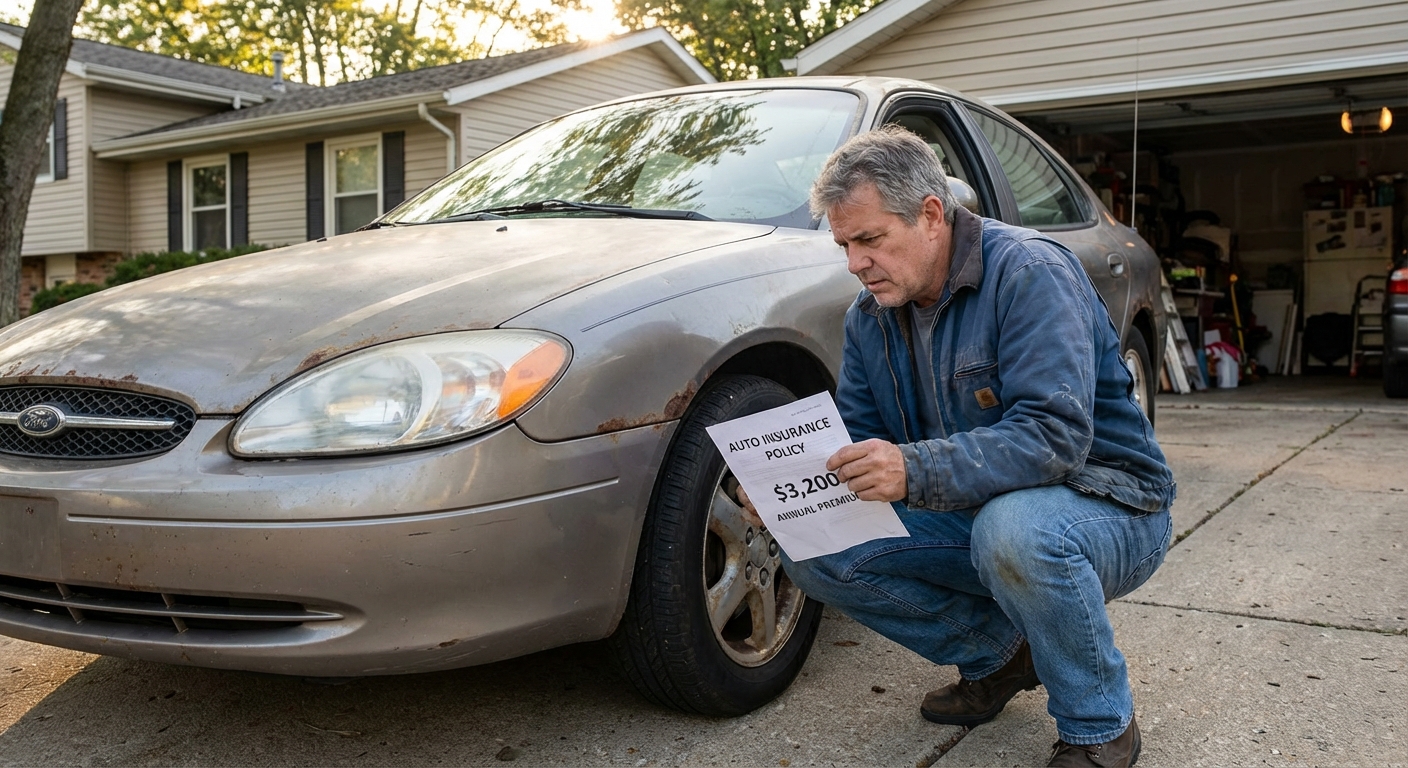
When your car gets older, your insurance strategy should evolve with it. A brand-new vehicle financed through a lender requires full coverage car insurance, but the math changes dramatically once a car depreciates. As a vehicle ages, its market value shrinks, and in many cases the cost of maintaining comprehensive and collision coverage outpaces what the insurer would ever pay out in a claim.
New cars typically lose about 20% of their value in the first year alone, then continue depreciating roughly 8 to 15% per year through year five, per Kelley Blue Book and iSeeCars 2026 data. By the five-year mark, the average car retains only about 55 to 58% of its original value, with iSeeCars' 2026 study pegging average 5-year depreciation at 41.8%. After that, depreciation keeps eating away at the car's worth, which means the gap between what you pay in premiums and what an insurer would actually pay you keeps narrowing. The aging vehicle fleet trend is real. The average vehicle age on U.S. roads hit a record 12.8 years in 2025, per S&P Global Mobility, with CCC Intelligent Solutions and IBISWorld projecting the figure will reach 13.0 years in 2026. Passenger cars alone now average 14.5 years, meaning more drivers than ever face this exact coverage decision.
Here are the primary ways vehicle age influences insurance decisions:
- Depreciation reduces payout potential. A 10-year-old car worth $4,000 can only ever be reimbursed up to $4,000, minus your deductible. If your deductible is $1,000, your maximum net payout is just $3,000.
- Lender requirements drop off. Once your auto loan is paid off, you're free to reduce coverage. Lenders require full coverage on financed cars to protect their investment, but once you own it outright, it's your call.
- Repair costs may exceed value. Older vehicles often cost more to repair than they're worth, making collision and comprehensive payouts almost irrelevant.
- Liability remains mandatory. No matter how old your car is, every state (except New Hampshire) requires you to carry some form of liability insurance to legally drive on public roads.

Compare Car Insurance Rates in Ohio
See if you qualify for a lower rate in less than 2 minutes
The Value Threshold: When to Drop Comprehensive & Collision
The most practical framework for deciding when to drop comprehensive and collision coverage is the 10% rule: if your annual premium for those coverages exceeds 10% of your car's total market value, dropping them is likely the smarter financial move.
As of August 2026, the national average cost of full coverage car insurance ranges from approximately $2,237 to $2,926 per year depending on the data source (Insurify's August 2026 data reports $2,237/year, ValuePenguin $2,496/year, NerdWallet $2,356/year, Insurance.com $2,578/year, and Experian $2,926/year), compared to roughly $646 to $1,178 per year for liability-only or minimum coverage (Insurify $98/month, NerdWallet $54/month, Insurance.com $69/month, LendingTree $68/month). That's a savings gap of $1,300 to $2,200 annually, savings that compound quickly when your car simply isn't worth protecting with full coverage.
The 10% Rule in Practice
| Car Value | Annual Comp/Collision Premium | 10% Threshold Exceeded? | Recommendation |
|---|---|---|---|
| $10,000 | $600 | ❌ No (6%) | Keep coverage |
| $6,000 | $700 | ✅ Yes (11.7%) | Consider dropping |
| $4,000 | $500 | ✅ Yes (12.5%) | Drop coverage |
| $2,500 | $450 | ✅ Yes (18%) | Strongly drop |
| $1,500 | $400 | ✅ Yes (26.7%) | Drop immediately |
The $5,000 to $7,500 Tipping Point
Most financial experts recommend dropping collision coverage when your vehicle's market value falls below $5,000 to $7,500. With elevated premiums and repair costs in 2025 and 2026 (driven in part by the 25% Section 232 tariff on imported auto parts that took effect in May 2025), MoneyGeek and other advisors have moved this threshold up from the traditional $4,000 to $5,000 benchmark. Here's why the math matters:
- A $4,000 car with a $1,000 deductible yields a maximum payout of just $3,000.
- If you're paying $500/year for collision alone, you break even in only 6 years, and that's assuming a total loss scenario.
- A 20-year-old car has typically depreciated 90 to 99% of its original value, making any comp/collision payout minimal.
Always verify your car's actual cash value using tools like Kelley Blue Book, Edmunds, or NADA Guides before making any coverage changes. The number you find there is what an insurer would actually pay, not what you paid for the car. Learn more about how coverage downgrades work and the real risks involved.
When to Keep Comprehensive Coverage
Comprehensive coverage is generally cheaper than collision and covers events like theft, fire, flooding, and animal strikes. Even on an older car, it may still make sense to keep it if:
- You live in an area prone to hail, flooding, or high vehicle theft
- The car is stored outdoors and exposed to weather damage
- Your annual comprehensive premium is under $100

Protect your car with Farmers
Average Rate:
Find coverage options that fit your budget.

The insurance savings you expect.
Average Rate:
Enjoy personalized policies, comprehensive coverage & more.

See how much you could save today!
Average Rate:
Drivers who switch their auto insurance and save with State Farm save $764 on average!

Safe Drivers Save with Allstate®
Average Rate:
Get rewarded with savings for having a clean driving record.
Liability-Only Coverage for Older Cars
If you've decided to drop comp and collision, liability-only car insurance becomes your default coverage. This is the most affordable way to stay legally insured while owning an older, low-value vehicle. Switching from full coverage to liability-only on a low-value car can reduce your premium by 50 to 70%, saving hundreds to over $1,500 per year based on 2026 averages.
What Liability-Only Covers
Liability insurance covers damage and injuries you cause to others, not your own vehicle. It includes two components:
2026 State Minimum Requirements
Every state has its own minimum liability limits. Coverage is typically expressed as three numbers (e.g., 30/60/25):
- First number - Bodily injury per person (in thousands)
- Second number - Bodily injury per accident total (in thousands)
- Third number - Property damage per accident (in thousands)
Multiple states have updated their minimums in 2025 and 2026. California raised its minimums to 30/60/15 effective January 1, 2025 (the first increase since 1967, up from 15/30/5), and those limits will remain in force through at least 2034. Virginia increased to 50/100/25, Utah moved to 30/65/25, and North Carolina implemented a significant jump to 50/100/50 effective July 1, 2025, giving it the highest property damage minimum in the country plus a new mandatory UM/UIM requirement at 50/100. Massachusetts raised its minimum from 20/40/5 to 25/50/30 effective July 1, 2025 under Act H.5111, the state's first increase since 1988 (PIP remains at $8,000). Two states then updated their limits at the start of 2026: New Jersey completed a phased increase to 35/70/25 for standard policies effective January 1, 2026 (up from 25/50/25, with UM/UIM also rising to 35/70 minimum), and Hawaii moved to 40/80/20 the same day (up from 20/40/10). Florida's HB 1181, which would have eliminated PIP and required 25/50 bodily injury minimums by July 1, 2026, died in the House Judiciary Committee on June 16, 2025, and follow-up bills (SB 1256 in 2025 and SB 522 in 2026) also died in committee. As of August 2026, PIP remains required in Florida under its existing $10,000 PIP + $10,000 PDL no-fault framework. Learn more about how much coverage you really need to protect your assets.
| State | Minimum Liability (BI/BI Total/PD) | Recent Change? |
|---|---|---|
| California | 30/60/15 | ✅ Updated Jan 2025 |
| Hawaii | 40/80/20 | ✅ Updated Jan 2026 |
| Massachusetts | 25/50/30 | ✅ Updated Jul 2025 |
| New Jersey | 35/70/25 | ✅ Updated Jan 2026 |
| North Carolina | 50/100/50 | ✅ Updated Jul 2025 |
| Utah | 30/65/25 + PIP | ✅ Updated Jan 2025 |
| Virginia | 50/100/25 | ✅ Updated Jan 2025 |
| Florida | $10K PIP + $10K PDL | ⚠️ HB 1181 died in committee; no repeal in force |
Classic Car vs. Old Car Insurance: Key Differences
Not all older vehicles are created equal. A 1969 Ford Mustang and a 2005 Honda Accord may both be old, but they are insured very differently. Understanding the distinction between a classic car and simply an old car can unlock significant savings and better protection.
What Qualifies as a Classic Car?
Classic car insurance is a specialty product with unique eligibility requirements. While standards vary by insurer, most require:
- Vehicle is at least 20 to 25 years old (some insurers accept as young as 10 years for demonstrable collectibles, and State Farm's Classic+ program accepts vehicles as young as 10 years old)
- The car has collectible, historical, or appreciating value
- The vehicle is not used as a daily driver, limited to pleasure drives, shows, and club events
- Owner has a separate insured daily-use vehicle
- Annual mileage is capped in some plans (American Collectors offers 2,500/5,000/7,500-mile tiers; Grundy, Hagerty, American Family, and J.C. Taylor allow unlimited pleasure-use mileage)
- The vehicle must be stored in a locked garage or secure facility or otherwise off-street
- The vehicle must be in good to excellent condition, and drivers typically must be 25+ years old with a clean record
Classic vs. Standard Insurance Side-by-Side
The biggest financial advantage of classic car insurance is agreed value coverage. You and the insurer agree on the car's worth upfront, and that's exactly what you receive in a total loss, with no depreciation deducted. Standard policies pay actual cash value, which factors in wear and depreciation. Overall, per Hagerty's own data, classic car insurance runs roughly 27% less than standard daily-driver coverage on average, and CNBC Select reports that specialty policies can be 40 to 50% cheaper than standard daily-use coverage because the vehicles are driven fewer miles under strict usage restrictions. Learn more in our comprehensive coverage guide.
2026 Classic Car Insurance Costs
Specialty insurers offer significantly lower premiums than standard carriers for qualifying vehicles. For comparison, full coverage on a standard policy runs $2,237 to $2,926/year nationally, making classic car rates a dramatic bargain for eligible vehicles. Sample 2026 quotes (based primarily on a 1967 Chevy Camaro benchmark used by MoneyGeek, LendingTree, and Garage Lore):
| Insurer | Annual Premium (Est.) | Key Feature |
|---|---|---|
| American Collectors | ~$244 to $468/year | 2,500/5,000/7,500-mile tiers |
| Grundy | ~$305 to $345/year | Unlimited pleasure-use mileage; often $0 deductible |
| Hagerty | ~$284 to $542/year | Agreed value, $750 spare parts coverage |
| American Modern | ~$190 to $278/year | Competitive rates on lower-value vehicles |
| State Farm Classic+ (underwritten by Hagerty) | Varies | Accepts vehicles as young as 10 years |
High Mileage and Pay-Per-Mile Considerations
For non-classic older vehicles with high odometer readings, mileage can affect both your rate and your coverage decision:
- Insurers consider over 15,000 miles/year as high mileage, which typically raises premiums by 25 to 40% compared to low-mileage drivers
- Pay-per-mile insurance (such as Nationwide SmartMiles or Allstate Milewise) charges a base rate plus a fee per mile driven. Nationwide reports SmartMiles customers save an average of 25% vs. standard Nationwide policies, and Insurify data shows the average SmartMiles user saved 33% between March 2023 and April 2024. Low-mileage drivers under 8,000 to 10,000 miles/year can typically save 20 to 40% (with some sources citing up to 49% for the lowest-mileage drivers), translating to $500 to $1,500 per year in reduced premiums
- SmartMiles generally only charges for the first 250 miles per day, so long road trips have limited impact on your bill
- Low annual mileage (under 7,500 miles) can meaningfully reduce your insurance costs, with breakeven typically hitting around 10,000 to 13,000 miles/year
- If your vehicle has over 100,000 miles, factor its overall condition and repair costs into your coverage equation
A high-mileage car with a low market value almost always belongs in the liability-only category. Use the 10% rule alongside your mileage to make the most informed decision. To understand the cost gap between liability and full coverage, see our detailed breakdown, or check out our types of car insurance coverage guide.
Frequently Asked Questions
At what mileage or age should I drop full coverage on my car?
There's no single age or mileage cutoff. The decision is based on your vehicle's current market value and the cost of your comp/collision premiums. Most experts recommend the 10% rule: if your annual comp/collision premium exceeds 10% of your car's value, it's time to consider dropping it. For most vehicles, this threshold hits somewhere between 8 and 12 years old, and you can also cross-check using the "10x rule" (drop coverage if your car is worth less than 10 times your annual comp/collision premium).
Is liability-only insurance legal on any car?
Yes. As long as you meet your state's minimum liability requirements, liability-only coverage is completely legal on any vehicle you own outright. The only exception is if your car is financed. Lenders will contractually require you to carry full coverage until the loan is paid off. Check your specific state's current minimums, as seven states have updated theirs since 2025, including California, Virginia, North Carolina, Utah, Massachusetts (July 2025), New Jersey (January 2026), and Hawaii (January 2026).
Can I get classic car insurance on a 10-year-old vehicle?
It depends on the insurer and the vehicle's characteristics. Some insurers, like State Farm's Classic+ program (underwritten by Hagerty), allow vehicles as young as 10 years old to qualify if they are used on a limited basis. However, most specialty insurers look for cars that are at least 20 to 25 years old with demonstrated collectible value. Review the different types of car insurance coverage before making the switch.
Does high mileage make car insurance more expensive?
Yes, to a degree. Driving over 15,000 miles annually is considered high mileage by most insurers and can incrementally increase your premiums by 25 to 40% versus low-mileage drivers. For older, high-mileage vehicles, the more important financial decision is whether to drop collision coverage based on the car's total value. Pay-per-mile insurance is worth exploring if you drive infrequently, with SmartMiles users saving an average of 25 to 33% and low-mileage drivers under 8,000 to 10,000 miles/year typically seeing 20 to 40% savings.
What happens if I only carry state minimum liability and cause a major accident?
State minimums may not cover all damages in a serious accident. For example, California's minimum of $30,000 per person for bodily injury can be exceeded quickly in a multi-car crash involving medical bills and lost wages, especially given the average new-vehicle transaction price now exceeds $49,000. Any damages beyond your policy limits come out of your personal finances. Experts recommend carrying at least 100/300/100 limits, even when driving an older vehicle. Learn more about what car insurance actually covers to find the right balance.