
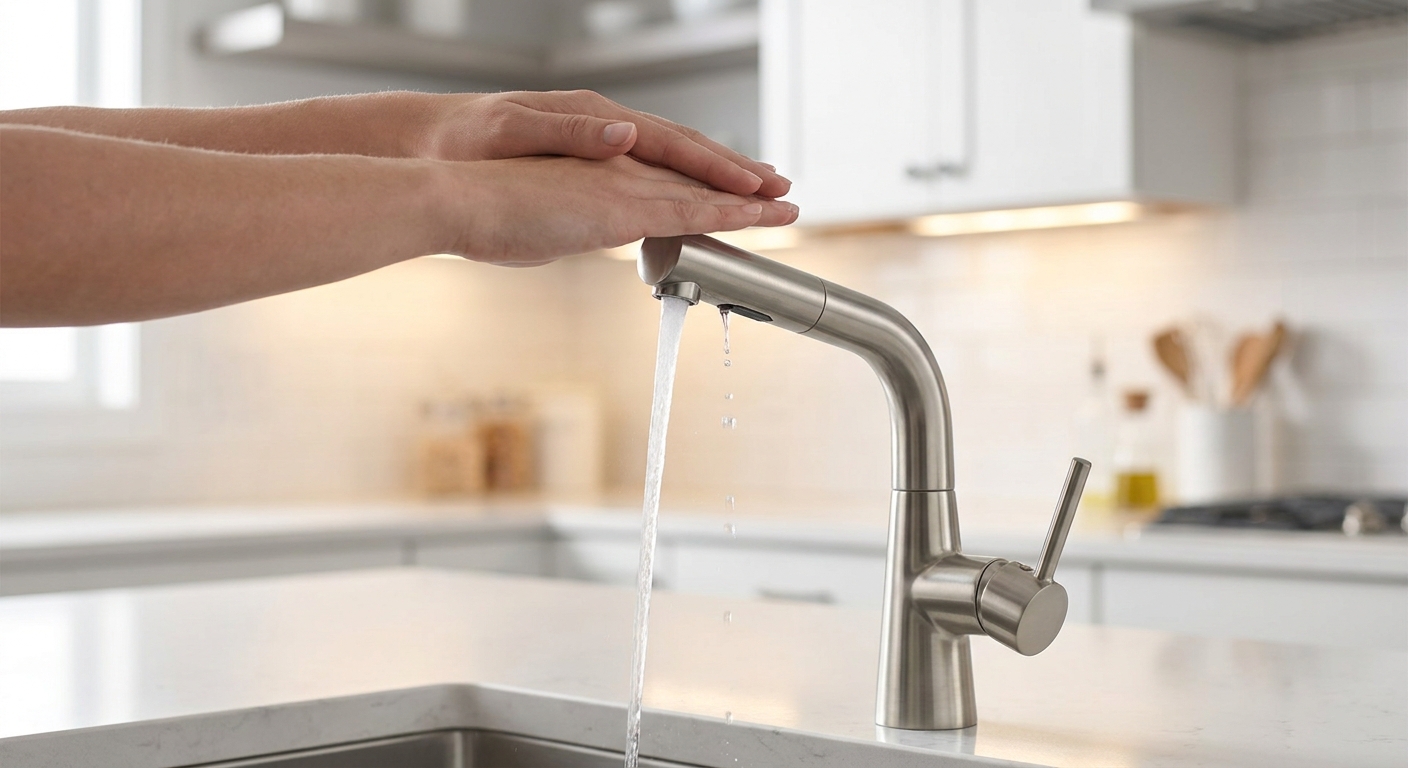
Types of Touchless Plumbing Fixtures
Touchless plumbing fixtures use sensors to detect hand movement or proximity and automatically control water flow, no handle-turning required. Once limited to commercial buildings, these hands-free plumbing fixtures are now a mainstream residential upgrade. Modern bathroom and kitchen models from Moen, Delta, and Kohler now include improved multi-point sensing, better range control, and clearer LED diagnostics that reduce the misfires that plagued earlier generations. Here's a breakdown of the main types.
Touchless Faucets (Kitchen & Bathroom)
Sensor faucets are the most common touchless fixture for homes. They use infrared (IR) or capacitive sensing to detect hands within 4-8 inches of the spout and trigger a solenoid valve to release water. When your hands move away, the valve closes automatically.
- Infrared/Proximity Sensors – The most common type; reliable, affordable, and widely available.
- Capacitive Sensors – More precise than basic IR, with smoother operation and fewer false activations.
- Wave-Activation Sensors – Detect specific hand gestures (like Moen's MotionSense Wave); popular in kitchens where you need manual control.
- Hybrid Touch/Touchless – Combines tap activation with sensor detection (like Delta's Touch2O); great for reducing accidental triggers.
- Voice-Activated/Smart Faucets – Now mainstream in premium kitchens. Systems like U by Moen and Delta VoiceIQ connect to Alexa and Google Assistant, and can dispense anywhere from 1 tablespoon to 15 gallons at a specified temperature via voice commands like "fill 1 cup at 100 degrees."
Automatic Flush Toilets
Sensor-activated toilets use infrared sensors to detect when a user leaves the seat and trigger the flush automatically. Some residential models include dual-flush modes, smart bowl rinsing, and scheduled flushing to keep the bowl fresh. These are particularly useful in households with young children or elderly family members.
Sensor Soap Dispensers
Automatic soap dispensers use a proximity sensor near the nozzle to release a measured amount of soap when hands are placed underneath. These are battery-operated, easy to install, and pair seamlessly with a touchless faucet for a fully hands-free sink experience.

Find Trusted & Licensed Plumbers in Ohio
Get matched with companies for your specific needs
Installation Requirements & Power Sources
Before you commit to a touchless fixture, understanding the installation requirements is key. Most sensor faucets and auto-flush toilets need a power source to operate their solenoid valves and sensors. Learn more about plumbing fixture height standards to ensure your installation meets code.
Power Options
| Power Source | How It Works | Best For |
|---|---|---|
| AA/AAA Batteries | 4-6 batteries power the sensor & solenoid; lasts 2-5 years | Bathroom faucets, soap dispensers |
| AC Adapter / Transformer | Plugs into a standard outlet under the sink | High-use kitchen faucets |
| Hardwired (DC) | Direct electrical connection; most reliable | Permanent residential installs |
| Hybrid (AC + Battery Backup) | AC power with battery fallback so sensors keep working through outages | Whole-home reliability |
| Hydropower (Self-Charging) | Water flow charges a built-in battery (e.g., TOTO EcoPower) | Eco-focused, commercial-grade |
Newer 2026 residential touchless faucets increasingly feature hybrid AC-with-battery-backup designs and energy-harvesting units that use water flow to generate their own electricity, reducing battery replacement needs.
DIY vs. Professional Installation
Most battery-powered touchless faucets are designed for DIY installation and require no electrical work. You simply replace your existing faucet using standard plumbing connections. Hardwired models and automatic toilet flush valves typically require a licensed plumber and possibly an electrician if a new outlet needs to be added under the sink. Professional installation for a standard bathroom faucet typically runs between $130 and $350 depending on location and complexity, with touchless-specific labor often on the higher end due to sensor wiring, calibration, and power setup.
Costs: Products, Installation & Long-Term Savings
Upfront Costs in 2026
Understanding the full cost picture is important before investing in touchless bathroom fixtures or kitchen upgrades. See our faucet replacement cost guide for detailed pricing on all faucet types. The average total bathroom faucet replacement (fixture plus labor) runs $170 to $360, with most homeowners paying around $270, though touchless models specifically land at the higher end of that range.
| Fixture Type | Product Cost | Labor Cost | Total Installed |
|---|---|---|---|
| Basic Touchless Bathroom Faucet | $40 – $200 | $130 – $250 | $170 – $450 |
| Mid-Range Touchless Kitchen Faucet | $280 – $400 | $150 – $300 | $430 – $700 |
| Smart / Voice-Activated Kitchen Faucet | $370 – $650 | $200 – $350 | $570 – $1,000 |
| High-End Designer Touchless Faucet | $800 – $1,600+ | $250 – $400+ | $1,050 – $2,000+ |
| Automatic Flush Toilet Kit | $200 – $600 | $300 – $800 | $500 – $1,400 |
| Sensor Soap Dispenser | $25 – $80 | DIY | $25 – $80 |
Note: Urban areas, emergency installs, or homes requiring sink modifications can push costs 20-40% higher. Smart faucets like the Moen Sleek Smart Faucet run around $650, the Kohler Sensate around $550, and the Delta Trinsic VoiceIQ around $460 at retail in 2026.
Long-Term Savings
WaterSense-labeled bathroom faucets use a maximum of 1.5 gallons per minute, reducing flow by 30% or more from the old 2.2 gpm standard without sacrificing performance. Replacing older faucets and aerators with WaterSense-labeled models can save the average family about 700 gallons per year, or nearly 11,000 gallons over the lifetime of the faucets. When paired with touchless sensors that auto-shut when hands leave the zone, real-world water savings climb to 30-50% because water no longer runs while you lather, brush, or shave.
Many touchless fixtures also meet EPA WaterSense standards. Learn more in our WaterSense certified fixtures guide.
Best Touchless Fixture Brands for 2026
Top Picks
| Brand | Best For | Key Technology | Top Models |
|---|---|---|---|
| Moen | Overall residential / hygiene | MotionSense Wave, U by Moen | Arbor, Brantford, Sleek Smart |
| Delta | Precision touch + voice | Touch2O, VoiceIQ, TempSense LED | Trinsic VoiceIQ, Essa, Keele |
| Kohler | Premium / upscale bathrooms | Sensate, Kinesis sensor | Sensate, Simplice, Crue |
| Bio Bidet | Sensor accuracy on a budget | FLOW motion sensing | FLOW Motion Activated |
| TOTO | Eco-friendly / self-charging | EcoPower hydropower | EcoPower Sensor Faucet |
Moen is the winner if you want a truly hands-free experience where hygiene is your #1 priority, with its Spot Resist finish that hides fingerprints. Delta is stronger for tactile control because its Touch2O technology and TempSense LED give you a fast tap-based response with visible temperature feedback. The Bio Bidet FLOW Motion Activated Kitchen Faucet is rated best overall by The Spruce's testing thanks to accurate, perceptive sensors and easy temperature control, with the Moen Arbor Smart Faucet earning a top spot for voice control. Kohler shines in premium bathroom designs with smart monitoring, and TOTO's EcoPower line is a standout for eco-conscious homeowners who want to skip batteries and outlets entirely.
These smart plumbing systems pair well with touchless fixtures if you're building a fully connected, water-efficient home. Moen's own Flo by Moen ecosystem, for example, integrates smart faucets with whole-home leak monitoring and automatic shutoffs to prevent flooding.
Common Problems, Maintenance & Is It Worth It?
Common Touchless Faucet Problems
Even the best touchless faucets can run into issues. Here are the most frequent complaints and what causes them:
| Problem | Likely Cause | Fix |
|---|---|---|
| Sensor not activating | Dirty sensor lens or dead batteries | Clean with soft cloth; replace batteries |
| False triggers / random flow | Sensor range too wide or reflective sink | Dial range down; clean water spots |
| Weak water pressure | Clogged aerator or partially closed shutoff valve | Clean aerator; open valve fully |
| Faucet leaking when off | Faulty solenoid valve or worn O-ring | Inspect and replace solenoid |
| Clicking sounds / no water | Solenoid valve failure or low battery voltage | Test voltage; professional replacement |
| Temperature inconsistency | Mineral buildup in mixing cartridge (hard water) | Flush cartridge; replace if worn |
False triggers are usually caused by a sensor range set too wide or a reflective sink bouncing the IR beam back, so dial the range down. Weak flow is almost always a clogged aerator or a partially closed supply valve, not the electronics. Understanding when to repair vs. replace can save money. Read our plumbing fixture lifespan guide for more details.
Maintenance Tips
Keeping your sensor faucet running smoothly doesn't take much. A few minutes each month goes a long way:
- Clean the sensor lens regularly using a soft cloth and mild cleaner to remove soap film and mineral haze. Avoid abrasives that could scratch the lens.
- Descale the aerator every 3 to 6 months by unscrewing, soaking in vinegar, rinsing, and reinstalling. Checking for mineral deposits every 3 to 6 months is the recommended interval in most manufacturer guides.
- Replace batteries proactively every 2-5 years depending on use. Most models have a low-battery LED indicator, and some flash specific patterns to signal low voltage or sensor faults.
- Keep reflective and conductive items (steel wool, metal pads) away from the sensor zone to prevent false triggers.
- Inspect connectors annually under the sink to make sure they're fully seated, dry, and free of corrosion.
Are Touchless Fixtures Worth It in 2026?
For most homeowners, yes. Touchless fixtures offer a compelling combination of hygiene, convenience, and long-term savings. They're especially valuable in kitchens (where your hands are frequently messy), in households with children or elderly residents, and for anyone focused on reducing water waste. The upfront cost is higher than traditional faucets, but water savings of 30-50%, reduced handle maintenance, and modern aesthetics make the investment worthwhile over time.
If budget is a concern, start with a mid-range battery-powered touchless kitchen faucet ($280-$400) from Moen or Delta. Both offer excellent reliability without requiring an electrician. For a full bathroom upgrade, pairing a sensor faucet with an automatic soap dispenser and accessible bathroom plumbing features creates a modern, low-maintenance space that also supports aging-in-place design.
Frequently Asked Questions
Q: Can I install a touchless faucet myself, or do I need a plumber? Most battery-powered touchless faucets are designed for DIY installation and come with all the hardware you need. The process is similar to replacing a standard faucet: turn off the water, disconnect the old fixture, and connect the new one. Hardwired models or automatic toilet flush valves typically require a licensed plumber and possibly an electrician if you need a new outlet under the sink.
Q: How long do batteries last in a touchless faucet? Most battery-powered touchless faucets use 4-6 AA batteries and modern models last approximately 2-5 years under normal residential use. High-traffic kitchens may see shorter battery life. Most models include a low-battery LED indicator so you're not caught off guard. Alternatively, choosing an AC-adapter, hardwired, or self-charging hydropower model eliminates battery concerns entirely.
Q: Will a touchless faucet trigger accidentally with a pet or passing motion? It can happen, particularly with older or lower-quality infrared sensors. Modern 2026 faucets from Moen (MotionSense Wave) and Delta (Touch2O) have improved significantly, using multi-point sensing and better range control to minimize false activations. Keeping the sensor area clear of reflective objects and dialing the sensor range down also helps reduce unintended triggers.
Q: How much water can I actually save with a touchless faucet? WaterSense-labeled faucets alone deliver about 30% less water than the old 2.2 gpm federal standard by capping flow at 1.5 gpm. Add touchless auto-shutoff and real-world savings climb to 30-50% because water no longer runs while you lather, brush, or shave. Visit our guide on water conservation plumbing to explore more ways to cut your water bill.
Q: Do touchless faucets work during a power outage? Battery-powered models continue to work during a power outage as long as the batteries are charged, making them more resilient than AC-adapter or hardwired faucets. TOTO's EcoPower line is self-charging via water flow, so it operates independently of external power. If you live in an area with frequent outages, a battery-powered, hybrid, or hydropower model is the safest choice for uninterrupted use.
Q: Are voice-activated faucets worth the extra cost in 2026? Voice-activated faucets like U by Moen and Delta VoiceIQ let you dispense measured amounts anywhere from 1 tablespoon to 15 gallons at specified temperatures, and integrate with Alexa and Google Assistant. They typically run $370-$650 for the faucet itself, adding $200-$500 over standard touchless models. For most homeowners, a mid-range motion-activated faucet delivers 90% of the convenience at a much lower price, but heavy home cooks and smart-home users often find the extra features genuinely useful.