
Why Is My Shower Pressure So Low?
Before spending money on equipment, it's worth diagnosing why your shower pressure is lacking. The fix for a clogged showerhead costs almost nothing. The fix for corroded pipes is a completely different story.
The Most Common Culprits
| Cause | Affects | DIY Fix? |
|---|---|---|
| Mineral buildup in showerhead | Shower only | ✅ Yes |
| Flow restrictor in showerhead | Shower only | ✅ Yes |
| Partially closed valve | Shower or whole house | ✅ Yes |
| Faulty pressure regulator | Whole house | ⚠️ Sometimes |
| Leaking or corroded pipes | Whole house | ❌ Call a plumber |
| Failing mixing valve | Shower only | ❌ Call a plumber |
| Municipal supply issue | Whole house | ❌ Contact utility |
| Water heater sediment buildup | Hot water only | ⚠️ Sometimes |
The single most common cause is mineral deposits. Hard water leaves behind limescale that clogs the tiny nozzles in your showerhead over time, choking flow down to a trickle. If the problem is isolated to your shower and nowhere else in the house, start here before doing anything else.
A quick diagnostic tip: turn on several faucets throughout your home. If all of them have weak pressure, the issue is systemic (a faulty pressure regulator, a leaking pipe, or a supply problem). If it's just the shower, the showerhead itself is almost always the first place to look. For a deeper dive into whole-house issues, our guide on water pressure problems walks through every diagnostic step.

Find Trusted & Licensed Plumbers in Ohio
Get matched with companies for your specific needs
Simple Fixes First: DIY Solutions That Cost Almost Nothing
Don't invest in a booster pump until you've ruled out these straightforward fixes. Many homeowners spend hundreds of dollars on equipment when a $0 cleaning would have solved the problem.
1. Clean or Replace the Showerhead
Unscrew the showerhead and soak it in white vinegar overnight. The acid dissolves limescale deposits blocking the nozzles. Rinse thoroughly and reinstall. If it's heavily corroded or several years old, replacing it entirely costs as little as $20 to $40 and often delivers a dramatic improvement. Our low water pressure guide covers additional troubleshooting steps before you reach for your wallet.
2. Understand the Flow Restrictor Rules (Updated for 2026)
Federal law under the Energy Policy and Conservation Act still limits residential showerheads to a maximum of 2.5 gallons per minute (GPM) measured at 80 PSI. The big story in 2026 is the SHOWER Act (H.R. 4593), which passed the House on January 13, 2026, by a vote of 226 to 197. It has been referred to the Senate Committee on Energy and Natural Resources but has not yet become law as of mid-2026, so the final federal rules are still in a transitional state.
If enacted, the SHOWER Act would allow each individual nozzle in a multi-nozzle system to flow at up to 2.5 GPM, rather than capping the combined output at 2.5 GPM. That means a properly built dual-head system could legally deliver more total water than under the stricter interpretation. Until the Senate acts, manufacturers are hedging their designs.
Some states go further than the federal rule. California, Hawaii, and Washington limit showerheads to 1.8 GPM, while Colorado and several municipalities enforce a 2.0 GPM cap. EPA WaterSense-certified models are voluntarily capped at 2.0 GPM regardless of location.
| Jurisdiction | Max Flow Rate |
|---|---|
| Federal (EPCA) | 2.5 GPM |
| California, Hawaii, Washington | 1.8 GPM |
| Colorado, New York, WaterSense-certified | 2.0 GPM |
To remove a restrictor on an older head, unscrew the showerhead, look for a small rubber or plastic disc just inside the fitting, and pull it out with needle-nose pliers. Reinstall and test.
3. Check for Partially Closed Valves
After any plumbing work, valves are sometimes left partially closed. Check the main shutoff valve where your water supply enters the house, and any inline valves near the shower. They should be fully open (handle parallel to the pipe for ball valves).
Shower Pressure Booster Pumps: Types, Costs & Installation
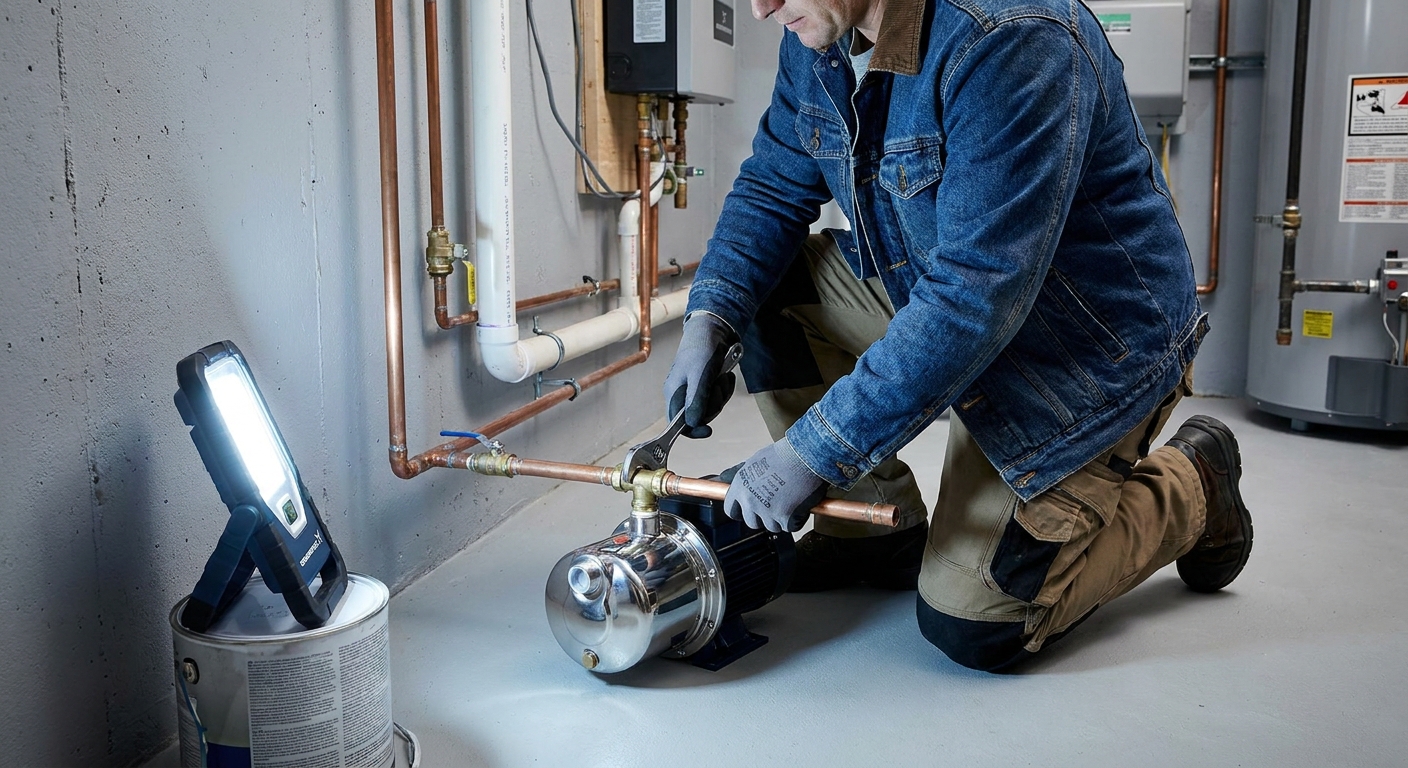
If simple fixes haven't solved the problem, or if your home has genuinely low incoming water pressure, a booster pump is the next logical step.
How Booster Pumps Work
A booster pump uses a motor-driven impeller (rotating blades that spin at high speed) to accelerate water passing through the pump. That velocity converts into pressure, pushing water through your pipes with more force. Most residential pumps activate automatically via a flow or pressure sensor the moment you open a faucet or showerhead. Modern smart units use variable-frequency drives (VFD) to maintain constant pressure even when multiple fixtures run at once. Popular 2026 smart pumps like the Grundfos SCALA2, Aquastrong Smart 45, and AIDPATH Whole House use permanent magnet motors that can cut power consumption by up to 50% versus fixed-speed models.
Booster Pump Cost Breakdown (2026)
| Pump Type | Equipment Cost | Labor Cost | Total Installed |
|---|---|---|---|
| Point-of-use shower pump | $120–$450 | $150–$700 | $550–$1,200 |
| Whole-house (single-speed) | $300–$800 | $300–$600 | $800–$1,500 |
| Whole-house (variable speed) | $800–$2,000 | $500–$800 | $1,300–$2,800 |
| Multi-stage (large homes) | $1,200–$6,000 | $700–$1,200 | $2,000–$3,500+ |
The national average for a straightforward residential booster pump installation in mid-2026 lands around $1,000 to $2,000 installed, according to major cost aggregators, with basic residential systems as low as $717 to $1,094 and complex variable-speed setups reaching $3,000 or more. Plumber labor typically runs $45 to $150 per hour (up to $200/hour in high-cost metros), with most residential installs taking 1 to 3 hours. Additional costs include a pressure expansion tank ($150 to $300), check valves ($14 to $30), and pressure regulators.
Monthly Operating Cost
Booster pumps are surprisingly cheap to run because they only operate when water is flowing. A typical inline shower pump draws 120 to 200 watts. Newer variable-speed models can run on as little as 50 to 85 watts while still producing 17 to 26 PSI of boost. At average U.S. electricity rates in 2026, expect to pay:
- Small point-of-use pumps: $2 to $5 per month
- Standard whole-house boosters: $5 to $20 per month
- Variable-speed whole-house systems: $8 to $25 per month
Installation Requirements
- Electrical access: Most booster pumps require a dedicated 120V or 240V outlet nearby. Budget for an electrician if one isn't already available.
- Pipe compatibility: Confirm the pump's inlet/outlet sizing matches your existing pipe diameter (typically ¾" or 1").
- Permits: Some municipalities require a permit for whole-house pump installations. Check with your local building department.
- Professional vs. DIY: Point-of-use shower pumps can be a DIY project for confident homeowners, with kits typically running $480 to $1,150. Whole-house systems should always be installed by a licensed plumber. Our preventive plumbing maintenance guide covers what to inspect annually to protect your investment.
Pressure Regulators, High-Pressure Heads & When to Call a Plumber
Adjusting Your Pressure Regulator
Every home connected to a municipal supply has a pressure reducing valve (PRV), a brass, bell-shaped device typically located where the main water line enters the house. It's designed to drop incoming street pressure (which can exceed 100 PSI) to a safe household range. Under current plumbing codes (IPC, IRC, UPC), residential pressure is capped at 80 PSI, and a PRV is required whenever static pressure exceeds that limit. EPA WaterSense guidance recommends an operating range of 45 to 60 PSI, with 50 to 60 PSI considered the sweet spot for most homes.
Over time, regulators can fail or drift out of adjustment. Here's how to check and adjust yours:
- Test your current pressure using an inexpensive pressure gauge ($10 to $20) attached to an outdoor hose bib.
- If pressure reads below 40 PSI and the regulator may be the cause, locate the PRV and loosen the locknut.
- Turn the adjustment screw clockwise to increase pressure, counterclockwise to decrease. Make small, incremental turns.
- Retest after each adjustment. Tighten the locknut when you reach your target.
- If adjustments don't hold or pressure swings wildly, the regulator itself is likely failing. Replacement costs $200 to $700 installed in 2026, with a national average around $400 to $475. Homewyse's May 2026 estimator puts the average closer to $549 to $656 per valve.
Regulators typically last 4 to 7 years before needing replacement. If yours is older and causing house-wide pressure drops, replacing it may solve your problem entirely, without any pump at all. See our pressure reducing valve installation guide for a deeper look at brands, code requirements, and expansion tank pairing.
Do High-Pressure Shower Heads Actually Work?
Short answer: yes, but with important limitations.
High-pressure showerheads work by using smaller nozzle openings, channeling spray patterns, and colliding water streams to create a more forceful perceived spray from the same volume of water. They don't increase your actual line pressure, but they can make a shower feel significantly stronger.
These showerheads are most effective when your incoming flow rate is at least 1.5 GPM. If your pressure is so low that water barely dribbles out, a specialty showerhead won't save you. But for homes with moderately low pressure (30 to 45 PSI), a quality high-pressure showerhead ($25 to $80) can transform the experience without any plumbing work at all. If you're already thinking about upgrading, our plumbing fixture upgrade guide walks through modern options that add resale value.
When to Call a Plumber Instead of Using a Booster Pump
A booster pump is the right tool for homes where incoming pressure is genuinely inadequate. It is not the right tool when:
- You have a hidden pipe leak diverting water away from fixtures
- Your pipes are corroded and restricting flow internally
- The pressure varies wildly between fixtures (sign of a blockage or failing valve)
- Your mixing valve is worn and needs replacement
- Municipal supply pressure is adequate but something inside your home is restricting it
- You're on a private well and the pump itself may be failing (see our well pump repair guide)
In all of these cases, adding a pump will mask the symptom without fixing the underlying failure, and can even accelerate pipe damage by forcing more water through compromised lines. If banging noises accompany your pressure issues, review our water hammer guide before adding any pump. A licensed plumber can pressure-test your system, identify leaks, and give you a clear picture of whether a pump or a repair is the right investment.
Frequently Asked Questions
What PSI is considered low shower water pressure?
Most plumbers and the EPA consider anything below 40 PSI to be low water pressure, while the ideal residential range is 45 to 60 PSI. If your pressure gauge reads below 40 PSI at a hose bib, that's a strong indicator that your home has a failing pressure regulator, a supply issue, or a plumbing obstruction worth investigating. Anything above 80 PSI is actually too high and violates plumbing code because it risks damaging pipes and appliances.
Can I install a shower booster pump myself?
Point-of-use shower pumps are designed for DIY installation and typically include all the fittings and instructions needed, with kits running $480 to $1,150. However, whole-house booster pumps involve main water line connections, electrical requirements, and sometimes permits, all of which generally require a licensed plumber and electrician. Attempting a whole-house installation without experience can lead to leaks, code violations, or pump damage.
How much does a shower pressure booster pump cost to run monthly?
Most residential booster pumps are highly energy-efficient, especially variable-speed models with permanent magnet motors that can cut power use by up to 50%. A typical point-of-use shower pump draws 120 to 200 watts (some smart models as low as 50 to 85 watts) and runs only while water is flowing. At average 2026 U.S. electricity rates, this adds just $2 to $8 per month for a point-of-use unit, or $5 to $20 per month for a whole-house system.
Will a booster pump work if my municipal water pressure is very low?
Yes, a booster pump can increase pressure even when the incoming municipal supply is weak. That's exactly what it's designed for. However, if the supply pressure is extremely low (under 20 PSI), a pump alone may struggle to meet demand during peak hours. In that case, a system with a hydropneumatic storage tank allows the pump to pre-pressurize a reserve of water for consistent delivery throughout the day.
How long do shower booster pumps last?
Quality residential booster pumps typically last 8 to 15 years with proper installation and regular maintenance. Key factors that affect lifespan include water quality (hard water accelerates wear), how frequently the pump cycles on and off, and whether the system includes a pressure tank to reduce cycling. Annual inspection of seals, connections, and pressure settings helps catch issues early and extends the life of the unit.