
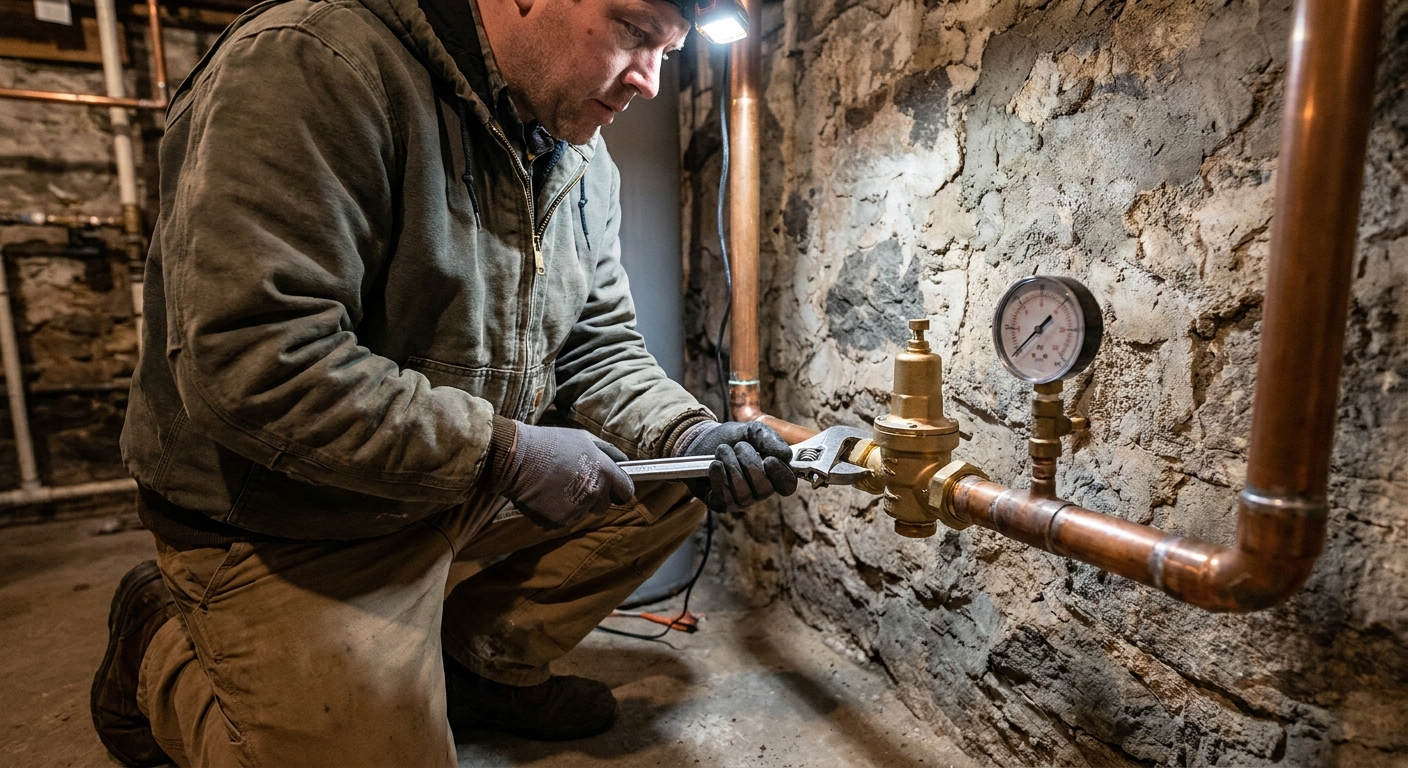
How a Water Pressure Reducing Valve Works
A water pressure reducing valve (PRV), also called a pressure regulator valve, is a mechanical device installed on your home's main water supply line that automatically reduces high incoming municipal water pressure to a safe, consistent level for your household plumbing, fixtures, and appliances.
Municipal water systems commonly deliver water at 100 to 150 PSI, which is far too high for most residential plumbing. Without a PRV, that excessive force is transferred directly to every pipe, seal, joint, and appliance in your home. A PRV uses a spring-loaded diaphragm to continuously sense and regulate downstream pressure. When water enters the inlet side, the diaphragm restricts flow through a narrow internal gap, reducing pressure. If downstream pressure rises, the diaphragm compresses further. If it drops, the valve opens wider, all automatically. The typical target outlet pressure for a home is 50 to 70 PSI, with most plumbers recommending 50 to 60 PSI as the sweet spot. Watts engineering data shows that reducing pressure from 100 PSI to 50 PSI cuts total water flow by roughly one-third, and Zurn Wilkins estimates this saves the average home between 30,000 and 40,000 gallons of water per year.
The valve is typically brass-bodied, installed just after your main shutoff valve, and features an adjustable screw that lets a plumber fine-tune the outlet pressure. Top brands in 2026 include Watts, Apollo, Zurn Wilkins, Cash Acme, and Taco, all of which offer lead-free, NSF/ANSI-certified models for potable water use. Watts holds roughly 18% of the global PRV market and Apollo about 14%. Plumbers most often recommend the Watts 25AUB series, Wilkins NR3XL and 70XL, Apollo 36HLF (for high-capacity homes), and the Cash Acme EB45 series for easy press-fit installations. Learn more about locating and operating your main water shut off valve before you attempt any work near the PRV.

Find Trusted & Licensed Plumbers in Ohio
Get matched with companies for your specific needs
Signs of High Water Pressure & When to Install a PRV
You should install a PRV if your municipal supply consistently exceeds 80 PSI, the threshold set by the 2024 International Plumbing Code (Section 604.8). Many homeowners don't realize they have a pressure problem until damage has already been done. Here are the most common warning signs.
Warning Signs of High Water Pressure
| Symptom | What's Happening |
|---|---|
| Banging or knocking pipes | Water hammer, pressure surges slam pipes when flow stops abruptly |
| Leaking faucets or showerheads | High pressure wears down seals and washers prematurely |
| Constantly running toilet | Excess pressure prevents proper fill valve operation |
| Appliance failures | Washing machines, dishwashers, and water heaters fail due to seal wear |
| Water spitting from faucets | Aeration caused by pressure spikes inside supply lines |
| Higher water bills | Undetected micro-leaks caused by stress on joints and fittings |
| Water stains or mold on walls | Slow leaks at pipe joints from chronic over-pressure |
| Dripping T&P valve on water heater | Pressure climbing above the heater's safety threshold |
If you're experiencing several of these issues, learn more about diagnosing water pressure problems to pinpoint whether a PRV or another fix is the right solution. Persistent banging pipes may also indicate a water hammer issue that requires additional arrestors alongside a PRV.
Code Requirements for PRV Installation
Under the 2024 International Plumbing Code (IPC) Section 604.8, a PRV is required when municipal water pressure exceeds 80 PSI static. The valve must conform to ASSE 1003 or CSA B356 and include an inlet strainer. The Uniform Plumbing Code (UPC), followed in most Western states, has similar provisions. A few jurisdictions (notably New York City) use a slightly higher 85 PSI threshold, so always check with your local Authority Having Jurisdiction (AHJ). Key code points include:
- The PRV must be installed on the main cold water supply line, downstream of the water meter or main shutoff valve
- The valve must reduce building distribution piping pressure to no more than 80 PSI static
- A pressure gauge port (0 to 150 PSI range) must be within 24 inches downstream of the PRV
- A thermal expansion tank is required in closed systems (more on this below)
- The valve must be installed in an accessible location with adequate clearance for maintenance
- 2026 state amendments (such as Georgia's) reinforce that expansion tanks must be sized so system pressure never exceeds the PRV's set limit
Water Pressure Reducing Valve Installation Costs
The total cost to install a water pressure reducing valve in 2026 typically ranges from $300 to $700 for most residential jobs, with a national average around $400 to $500 including parts and labor. Homewyse's May 2026 data pegs the national average at $549 to $656 per valve, HomeGuide reports an average of $475 with most homeowners paying $300 to $650, and Angi's 2026 data places the average at $400 with a typical range of $200 to $700. CountBricks tracks recent residential PRV installs at $345 to $780, with a national median around $515.
2026 Cost Breakdown
| Cost Component | Typical Range |
|---|---|
| PRV valve (¾-inch residential) | $75 to $200 |
| PRV valve (1-inch residential) | $100 to $250 |
| Higher-end/specialty valve (integral strainer, bypass) | $150 to $300+ |
| Labor (2 to 3 hours at $75 to $150/hr) | $225 to $450 |
| Fittings, connectors, and supplies | $50 to $150 |
| Total (¾-inch, standard install) | $300 to $500 |
| Total (1-inch or complex install) | $500 to $800 |
Factors That Affect Your Final Price
- Accessibility: Hard-to-reach valves behind walls or requiring excavation can add $100 to $300
- Geographic location: Labor rates vary significantly. Metro areas like Los Angeles, New York, and San Francisco often run $700 to $1,100 or higher (a Queens, NY average sits around $675, and Bay Area quotes can start near $950)
- Valve type: Basic spring-loaded PRVs are the most affordable. Pilot-operated, backflow-protected, or premium Zurn/Watts/Apollo models can cost $150 to $300+ for the unit alone
- Additional work: If your plumber also installs a thermal expansion tank or replaces old pipe sections, expect to add $150 to $450
- Permits and inspection fees: Add $50 to $200 depending on jurisdiction
Compared to other low water pressure fixes, a PRV installation is one of the highest-ROI plumbing upgrades you can make. It can extend the life of your water heater, dishwasher, and pipes by years, and Watts data suggests it can cut domestic water heating costs by as much as 30%.
PRV Adjustments, Maintenance, Lifespan & Failure
How to Adjust Your Water Pressure Regulator
Adjusting a PRV is straightforward but requires a pressure gauge to verify results. Follow these steps:
- Locate the PRV: it's the bell-shaped brass valve on your main supply line near the point of entry
- Attach a pressure gauge to a nearby hose bib or fixture to read current downstream PSI
- Loosen the locknut on top of the PRV with a wrench
- Turn the adjustment screw, clockwise to increase pressure, counterclockwise to decrease it (make small ¼-turn increments)
- Open a nearby faucet briefly between adjustments to let the pressure stabilize
- Re-check the gauge, targeting 50 to 60 PSI for most homes
- Tighten the locknut once your target pressure is achieved and test all fixtures for leaks
PRV Lifespan and Maintenance
A well-maintained PRV can last anywhere from 7 to 25 years, depending on water quality, usage patterns, and maintenance habits. Here are the key upkeep steps:
Regular preventive plumbing maintenance that includes an annual pressure check is the single best way to extend PRV lifespan.
Symptoms of PRV Failure
If your PRV is failing, you'll typically notice one or more of these signs:
- Fluctuating, unstable pressure throughout the day, often the earliest warning that the diaphragm or spring is deteriorating
- Pressure too high (over 80 PSI) even though the PRV is installed, indicating debris blocking the diaphragm or a worn spring
- Pressure too low (under 40 PSI) even at maximum adjustment, meaning the diaphragm may have failed
- Loud water hammer or chattering from the valve itself when fixtures shut off
- Visible leaks at the valve body, showing that seals or O-rings have degraded
- Dripping T&P valve on your water heater, a sign that pressure is climbing beyond safe limits
- No response to adjustment, meaning the internal mechanism has seized or corroded
If adjustment doesn't restore pressure to a safe range (40 to 70 PSI), it's time to replace the valve.
PRVs and Thermal Expansion Tanks: A Critical Pairing
When a PRV (or backflow preventer) is installed, your home's plumbing becomes a closed system, meaning water can no longer expand back into the municipal supply. This creates a dangerous situation. As your water heater heats water, it expands (a 50-gallon heater rising to 110°F generates roughly 0.9 gallons of expansion). Without anywhere to go, this thermal expansion causes pressure spikes that can damage your water heater, pipes, and the PRV itself.
The solution is a thermal expansion tank, a small pressurized tank installed on the cold-water supply line to the water heater that absorbs the expansion. Under IRC P2903.4 and current IPC/UPC provisions, expansion tanks are required on virtually all closed-loop residential systems. In 2026, expect to pay $150 to $450 installed (national average around $325) as a standalone job, or $80 to $250 if bundled with a water heater replacement. Make sure your plumber sizes and pre-charges the tank to match your PRV's outlet pressure. Read our full guide to water heater thermal expansion to understand why this pairing is non-negotiable.
Smart Add-Ons: Leak Detection and Shutoff Valves
In 2026, more homeowners are pairing their mechanical PRV with a smart leak-detection shutoff valve. Current top picks include the Phyn Plus 2nd Gen (about $580 list, rated best overall for whole-home ultrasonic detection), the Flo by Moen Smart Water Shutoff (around $400 to $500 depending on retailer, the most-reviewed premium choice), and the Frizzlife LP365 at roughly $330, a strong value pick. These devices continuously monitor flow, pressure, and temperature, and can automatically shut off the main water line when they detect a leak or dangerous pressure spike. Expect $400 to $800 installed, and check with your homeowners insurance carrier for potential discounts of 5 to 10% on your policy.
DIY vs. Professional Installation
| Factor | DIY | Professional |
|---|---|---|
| Cost | $80 to $200 (parts only) | $300 to $800 (parts + labor) |
| Skill required | Intermediate-Advanced | Licensed plumber |
| Code compliance risk | High | Low |
| Warranty implications | May void appliance warranties | Maintains warranties |
| Thermal expansion tank | Difficult to size correctly | Properly sized and charged |
| Recommended? | Generally not | Yes |
While a mechanically inclined homeowner can technically install a PRV, professional installation is strongly recommended. Incorrect sizing, improper sealing, or failure to pair with an expansion tank can result in code violations, voided warranties, or even burst pipes. The cost savings rarely justify the risk. If you do go pro, check whether your project needs a plumbing permit before work begins.
Frequently Asked Questions
What PSI should I set my water pressure reducing valve to?
Most plumbers and plumbing codes recommend setting your PRV to between 50 and 60 PSI for residential use. This range is comfortable for everyday use, strong enough for good shower pressure and appliance performance, while staying well below the 80 PSI threshold where damage begins. Homes on upper floors or with long pipe runs may need settings closer to 65 to 70 PSI to account for pressure drop.
How do I know if my home already has a PRV installed?
Look for a bell-shaped brass valve on your main water supply line, usually located just inside where the water line enters your home, often in the basement, crawl space, utility room, or near the water meter. It will have an adjustable bolt or screw on top and may have a pressure gauge attached. If you can't locate one, a licensed plumber can quickly confirm its presence or absence during an inspection.
Can high water pressure damage my water heater?
Yes, significantly. Chronic high pressure accelerates wear on the water heater's internal components, causes the temperature and pressure (T&P) relief valve to discharge more frequently, and can shorten the unit's lifespan by several years. In a closed system without an expansion tank, thermal expansion also sends repeated pressure spikes back through the water heater, further stressing the tank. A properly installed PRV and expansion tank together protect your water heater investment.
How long does it take to install a water pressure reducing valve?
For a straightforward installation on an accessible main line, a licensed plumber can typically complete the job in 2 to 3 hours in 2026, which matches national labor estimates. More complex jobs, such as those involving hard-to-reach pipes, older plumbing systems, or simultaneous expansion tank installation, may take 3 to 5 hours. Always make sure the job includes pressure testing both before and after installation to confirm correct setup.
Will a PRV reduce my water bill?
It can, indirectly. High water pressure causes micro-leaks at joints and fittings that go undetected for months and increases water usage through every fixture in the house. By regulating pressure to a safe range, a PRV reduces unnecessary water consumption. Watts and Zurn engineering data show that reducing pressure from 100 PSI to 50 PSI cuts total water use by roughly one-third, saving the average home 30,000 to 40,000 gallons per year, which translates directly to lower water and sewer bills.