
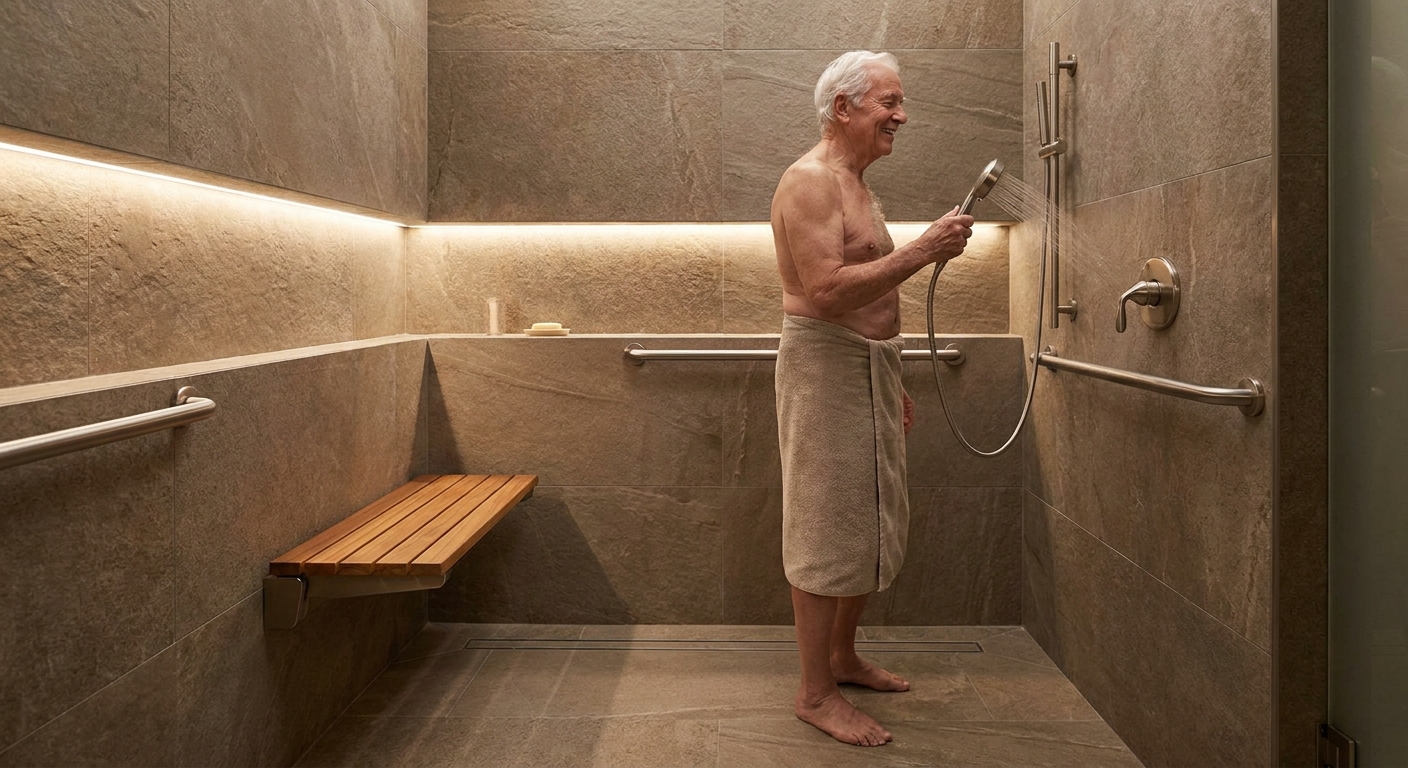
Safety Upgrades That Go Beyond Standard ADA Compliance
Most homeowners assume that meeting ADA guidelines is the finish line for aging in place plumbing. In reality, ADA standards are a commercial baseline — your home deserves a more personalized level of protection. The real goal is eliminating burn risks, fall hazards, and accessibility barriers before a health event forces a reactive (and expensive) renovation.
Anti-Scald Devices & Pressure-Balanced Shower Systems
Scalding is a serious threat for older adults. Thinner skin, slower reflexes, and reduced sensitivity to temperature changes make seniors significantly more vulnerable to burns from hot water. Two device types work in concert to protect them:
Pressure-Balanced Shower Valves automatically maintain a stable temperature when pressure drops elsewhere in the system — like when a toilet flushes mid-shower. A sudden burst of scalding hot (or ice-cold) water can cause a panic reaction leading to falls. These valves are a non-negotiable upgrade.
Thermostatic Mixing Valves (TMVs) installed at the water heater blend hot and cold supply water to a safe maximum delivery temperature — typically 120°F — throughout the entire home. This provides whole-house scald protection without lowering the heater's tank temperature (which needs to stay at 140°F to prevent Legionella bacteria growth).
Point-of-use anti-scald devices can be added to individual faucets and showerheads as a targeted, lower-cost solution.
| Device | Protection Level | Typical Installed Cost |
|---|---|---|
| Pressure-balanced shower valve | Per-shower | $350 – $1,100 |
| Thermostatic mixing valve (whole house) | Whole home | $300 – $800 |
| Point-of-use anti-scald device | Per fixture | $100 – $250 |
Lever-Handle & Touchless Faucets: Accessibility at the Tap
Standard round knob faucets require a pinch-and-twist grip — the exact motion that taxes arthritic finger and wrist joints the most. For seniors with arthritis, Parkinson's disease, post-stroke weakness, or tremors, this daily struggle is both painful and hazardous.
Lever-handle faucets can be operated with an open palm, wrist, or even an elbow. ADA-compliant lever faucets are designed to require less than 5 lbs of force and work with one hand. A single-handle lever design is ideal, allowing simultaneous temperature and flow control without removing a hand from a grab bar or walker.
Touchless sensor faucets eliminate the need to grip or twist entirely. They're particularly valuable for seniors with severe dexterity limitations. Key features to prioritize include adjustable sensor sensitivity, a manual override lever, and a built-in temperature limiter set to a safe default.
Lever faucets cost $160–$500 installed per fixture. Touchless sensor faucets run $250–$750 installed. Learn more about modern fixture upgrade options and how they add long-term home value.

Find Trusted & Licensed Plumbers in Ohio
Get matched with companies for your specific needs
Accessible Sinks, Showers & Toilet Upgrades
Sink Height, Knee Clearance & Plumbing Rough-In
An accessible sink isn't just about height — it's about the full envelope of usable space. For seniors who may need to sit while grooming or who use a walker or wheelchair, the under-sink area is just as important as the basin itself.
- Counter/rim height: 32–34 inches maximum above finished floor
- Knee clearance height: 27 inches minimum from floor to underside of sink at the front
- Knee clearance width: 30 inches minimum
- Toe clearance: 9 inches high, 17–25 inches deep
Exposed hot water and drain pipes under open-access sinks must be insulated or enclosed to protect legs from burns and pressure injuries — a detail many plumbers overlook.
For a deeper look at exact measurements and code requirements, see our guide on plumbing fixture height standards.
Walk-In & Curbless Shower Plumbing Requirements
A curbless (zero-threshold) shower is the single most impactful plumbing upgrade for aging in place. Eliminating the step-over curb removes the #1 fall hazard in the bathroom. Here are the key requirements:
Minimum shower dimensions:
- Transfer-type shower (with seat): 36" × 36" inside clear
- Roll-in shower (walker/wheelchair access): 60" × 30" minimum; 60" × 36" recommended
Threshold: Completely flush is ideal. Any change in level must not exceed ½ inch (beveled at 1:2 slope maximum).
Floor slope: ¼ inch per foot toward the drain. A linear trench drain at the entry wall is the best solution for curbless designs — it keeps the floor level at the opening while effectively containing water.
Grab Bar Blocking During Rough-In: This is a critical planning step. Before walls are closed, install solid 2×8 or 2×10 blocking between studs from approximately 30 to 48 inches above the subfloor. This continuous band allows grab bars to be mounted at any position later — without the expense of opening finished walls. Also add blocking at the 17–19 inch height range for a future fold-down seat.
Controls and showerhead placement: Mount the pressure-balanced or thermostatic valve near the entry so users can turn on water without stepping into a cold spray. Handheld showerheads on a 59"+ hose with a slide bar (bottom at ~36", top at ~72–78") allow seated and standing use.
| Upgrade | Typical Cost Range |
|---|---|
| Curbless shower conversion (tile, drain, labor) | $4,000 – $15,000 |
| Pressure-balanced valve replacement | $350 – $1,100 |
| Thermostatic shower valve | $500 – $1,500 |
| Handheld showerhead + slide bar | $180 – $600 |
| Grab bar blocking (during rough-in) | $150 – $400 |
For full layout planning, our bathroom plumbing layout guide covers rough-in dimensions and wet wall design in detail. You may also want to reference our comprehensive accessible bathroom plumbing guide for ADA compliance specifics.
Comfort Height Toilets & Bidet Options
A comfort-height toilet sits at 17–19 inches from floor to seat — comparable to a standard chair — versus the 15 inches of a traditional toilet. This seemingly small difference significantly reduces the knee and hip strain involved in sitting and standing, lowering fall risk in the process.
For maximum independence, pair a comfort-height toilet with an electric bidet seat. Bidets eliminate the painful reaching and twisting involved in wiping, which is often the first toileting task that requires caregiver assistance. A bidet seat with warm water, heated seat, adjustable spray pressure, and a warm-air dryer can meaningfully extend a senior's ability to live independently.
Cost ranges:
- Comfort-height toilet (installed): $400 – $1,000
- Electric bidet seat (mid-range): $250 – $600
- GFCI outlet installation (if needed): $150 – $400
Easy-Access Shut-Off Valves & Future-Proofing Your Plumbing
Strategic Shut-Off Valve Placement
In an emergency — a running toilet, a burst supply line, a slow leak discovered at night — the ability to quickly shut off the water supply is critical. For seniors and their caregivers, standard shut-off valves tucked behind toilets, crammed under sinks, or in hard-to-reach crawlspaces are more than an inconvenience; they're a safety gap.
Best practices for aging in place shut-off valves:
- Replace old gate-style shut-off valves with quarter-turn ball valves — one 90° turn fully closes flow versus multiple turns for a gate valve
- Position individual fixture shut-offs at accessible heights (18–36 inches off the floor where possible)
- Label the main shut-off valve clearly for caregivers and emergency responders
- Consider a smart whole-house shut-off that can be triggered remotely via smartphone app or automatically via leak sensors
Individual shut-off valve replacement runs $50–$200 per valve installed. A smart whole-house shut-off system runs $450–$1,400 installed.
For more on fixture planning and rough-in coordination, see our bathroom plumbing layout planning guide.
Prioritization Guide: Where to Start
Not every upgrade can happen at once. Here's how to phase your aging in place plumbing investments for maximum impact per dollar spent:
| Priority | Upgrade | Estimated Cost | Key Benefit |
|---|---|---|---|
| 🥇 High | Pressure-balanced shower valve | $350 – $1,100 | Prevents scald burns & fall-inducing temperature shocks |
| 🥇 High | Anti-scald / thermostatic mixing valve | $300 – $800 | Whole-home scald protection |
| 🥇 High | Grab bar blocking (during any remodel) | $150 – $400 | Enables future bar installation without wall demo |
| 🥈 Medium | Curbless shower conversion | $4,000 – $15,000 | Eliminates #1 bathroom fall hazard |
| 🥈 Medium | Comfort-height toilet + bidet seat | $650 – $1,600 | Reduces fall risk, supports toileting independence |
| 🥈 Medium | Lever-handle faucets throughout | $160 – $500 each | Eliminates grip strain at every sink |
| 🥉 Lower | Accessible sink with knee clearance | $1,500 – $4,000 | Supports seated use now or in the future |
| 🥉 Lower | Touchless sensor faucets | $250 – $750 each | Maximum dexterity assistance |
| 🥉 Lower | Smart shut-off valve system | $450 – $1,400 | Remote water control and leak protection |
A focused aging-in-place plumbing remodel covering the high-priority items typically runs $5,000–$18,000. A full bathroom renovation with all accessibility upgrades ranges from $16,500 to $45,000 depending on scope and market.
Learn more about touchless fixture options and installation requirements to determine what makes sense for your specific needs.
Frequently Asked Questions
What is the most important plumbing upgrade for aging in place?
A pressure-balanced or thermostatic shower valve is arguably the single most critical upgrade. It prevents sudden temperature spikes when water pressure changes elsewhere in the home — a common cause of burn injuries and panic-induced falls in the shower. It's relatively affordable at $350–$1,100 installed and provides immediate, measurable safety improvement.
Do I need a permit to install a curbless shower for aging in place?
Yes, in most jurisdictions a curbless shower conversion requires a plumbing permit because it involves modifying the drain system and potentially altering the subfloor structure to achieve a flush entry. Always check with your local building department before starting work. Using a licensed plumber ensures the rough-in and waterproofing meet code, which also protects your homeowner's insurance coverage.
Can I add grab bars to existing tile walls without blocking?
You can, but it's expensive and risky if done incorrectly. Grab bars must be anchored into wall studs or solid blocking — not just drywall or tile backer. Retrofit options include specialty toggle-bolt systems rated for grab bar loads, but the safest and most cost-effective approach is always installing solid 2×8 blocking during construction or any remodel that opens the walls.
Is a bidet seat covered by Medicare or insurance for seniors?
Bidet seats are generally not covered by Medicare or standard health insurance as they are classified as comfort items rather than durable medical equipment (DME). However, some long-term care insurance policies or Medicaid home modification programs may provide partial reimbursement if the device is prescribed or documented as medically necessary. Always check with your specific plan administrator and ask your physician for written documentation of need.
How much does a full aging-in-place bathroom plumbing remodel cost in 2026?
A focused plumbing-specific aging-in-place remodel covering key safety upgrades (shower valve, lever faucets, comfort toilet, anti-scald devices, and accessible shut-offs) typically runs $5,000–$18,000. A full bathroom renovation incorporating curbless shower conversion, accessible sink, new fixtures, and finish work ranges from $16,500 to $45,000 for most U.S. homes in 2026. Moving plumbing adds approximately $500–$1,500 per fixture relocated.