
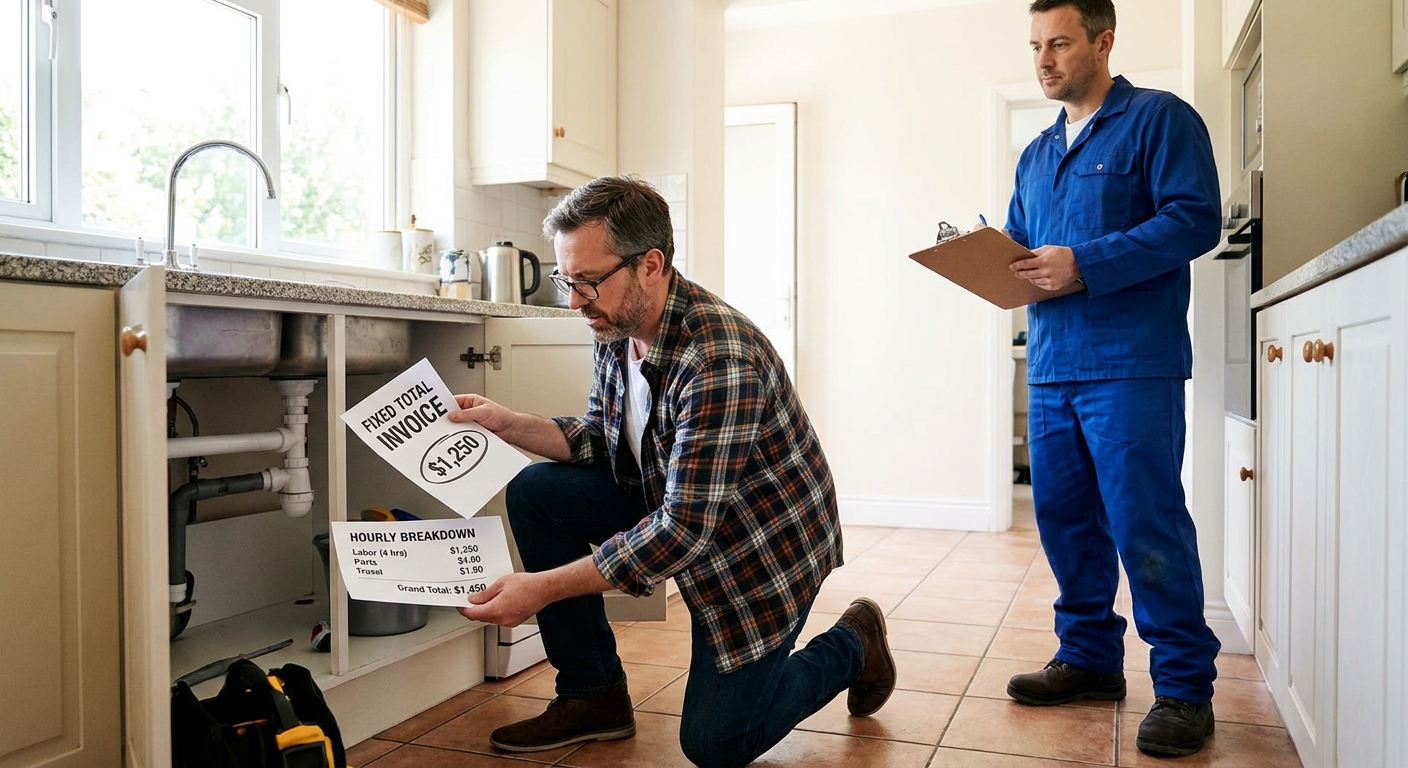
How Each Plumbing Pricing Model Works
When you call a plumber, the cost conversation usually goes one of two ways: a fixed quote for the job before work begins, or an hourly rate that runs until the job is done. These are the two dominant pricing structures in the residential plumbing world, and understanding them can mean the difference between a fair bill and a budget-busting surprise.
Flat Rate Plumbing Explained
With flat rate pricing (also called "upfront pricing" or "price book pricing"), the plumber assesses your problem and then presents a single fixed price before touching a single pipe. That price covers labor, standard materials, and overhead — all bundled into one number.
Plumbers build these prices using a flat rate price book: a standardized catalog of common jobs with pre-calculated prices. Each line item is built from:
- Average labor hours for that specific task
- Typical materials and parts required
- Company overhead (trucks, insurance, training, call centers)
- A built-in profit margin
The formula looks something like this:
Flat Rate Price = (Labor Hours × Loaded Labor Rate) + (Materials × Markup) + Overhead + Profit
Modern plumbing companies manage these price books digitally, often syncing with supplier catalogs to keep material costs current and offering tiered "good-better-best" options for things like water heater replacement.
Hourly Rate Plumbing Explained
With hourly pricing, you pay a set rate per hour for the plumber's time, plus the cost of materials on top. The meter starts when the plumber begins work (and sometimes when they leave the shop).
In 2025, typical plumber hourly rates in the US break down like this:
| Rate Type | Typical Range |
|---|---|
| Standard hourly rate | $75 – $150/hr |
| Master plumber rate | $100 – $200/hr |
| Emergency / after-hours | $150 – $350/hr |
| Service call / trip fee | $50 – $150 (separate) |
Materials are billed on top of labor, either at cost or with a markup. Some companies also charge a minimum of 1–2 hours regardless of how fast the job goes.

Find Trusted & Licensed Plumbers in Ohio
Get matched with companies for your specific needs
Pros and Cons for Homeowners
Both pricing models have genuine advantages depending on your situation. Here's how they stack up from a homeowner's perspective:
Hourly Rate: Pros & Cons
Understanding these trade-offs is the first step. The real question is: which model costs more for your specific job?
When Flat Rate Costs More (and When It Doesn't)
The short answer: flat rate is designed for certainty, not the lowest possible price. Whether it saves or costs you money depends heavily on the job type.
Flat Rate Is Usually More Expensive When...
- The job is simple and predictable — a faucet swap with accessible shutoffs, or a basic fill valve replacement
- You're using a solo plumber with low overhead in a lower cost-of-living area
- The scope is already crystal clear — no unknowns, no risk of hidden complications
Example: Faucet Installation (Simple Job)
| Pricing Model | Breakdown | Total |
|---|---|---|
| Hourly | 1 hr @ $90 + $75 trip fee | $165 |
| Flat Rate | Standard book price | $250 |
In this case, flat rate costs roughly $85 more for the same outcome.
Flat Rate Saves You Money When...
- The job is complex or uncertain — leaks inside walls, slab issues, old galvanized pipe
- You're calling during a weekend or emergency — when hourly rates can hit $250–$350/hr
- The plumber is fast and efficient — they complete a 3-hour "book job" in 90 minutes, but you still pay the same flat price
Example: Emergency Main Sewer Clog (Complex Job)
| Pricing Model | Breakdown | Total |
|---|---|---|
| Hourly (emergency) | 3.5 hrs @ $250 + $150 trip fee | $1,025 |
| Flat Rate | Emergency main line clear | $650 |
Here, flat rate saves you approximately $375 while eliminating the risk of the bill climbing higher.
Quick Reference: Which Model Tends to Win
| Job Type | Likely Cheaper Option |
|---|---|
| Simple faucet or fixture replacement | Hourly |
| Toilet repair or install | Hourly (if straightforward) |
| Basic drain snaking (accessible) | Either — compare quotes |
| Leak inside a wall (unknown source) | Flat rate (caps risk) |
| Main sewer line clog (daytime) | Similar — flat rate safer if old pipes |
| Emergency call (nights/weekends) | Flat rate |
| Full repipe or major renovation | Flat rate (scope control) |
Learn more about typical plumbing service costs to benchmark any quote you receive.
How to Compare Quotes and Avoid Surprises
Getting a fair deal comes down to making sure both quotes describe the exact same job. Here's how to approach it.
Questions to Ask Every Plumber Before Hiring
Before any work begins, ask these questions — for both flat rate and hourly plumbers:
- "Is this flat rate or hourly — and what exactly does the price include?"
- "Is there a separate service call or diagnostic fee? Is it waived if I approve the work?"
- "What conditions could increase the price, and how would that be handled?"
- "What's your warranty on labor and parts?"
- "Are permits, disposal, or equipment fees included or extra?"
- "Can I get this in writing before you start?"
For hourly specifically, also ask: "What's your realistic time estimate, and what's the worst-case range?"
For flat rate specifically, also ask: "If you discover something unexpected, will you stop and re-quote before continuing?"
How to Compare an Hourly Quote vs. a Flat Rate Quote
When comparing plumbing quotes from different companies, normalize them to the same scope:
Step 1: Write out exactly what the job entails and give the same description to every plumber.
Step 2: For the hourly quote, calculate a realistic cost range:
(Estimated hours × hourly rate) + service call fee + estimated parts = Total Range
Step 3: For the flat rate quote, ask what's included and excluded. A flat rate that excludes parts, permits, or haul-away isn't truly comparable to an all-in flat price.
Step 4: Factor in risk and complexity. If the job has unknowns, the hourly "low estimate" may not hold.
Red Flags to Watch For
With flat rate pricing:
- Refuses to explain what's included in the price
- Pressures you to "sign now" to lock in the rate
- Price mysteriously increases mid-job without a new authorization
- Won't provide anything in writing
With hourly pricing:
- Can't give even a rough time estimate for a common job
- Doesn't mention minimums, trip fees, or billing increments upfront
- Bill shows vague "8 hours labor" with no time breakdown
- Hourly rate seems unusually low (may signal no license or insurance)
When in doubt, get at least 2–3 written plumbing estimates before hiring. For emergencies, check in advance what an emergency plumber costs so you're never caught off guard.
Frequently Asked Questions
Is flat rate plumbing more expensive than hourly?
It depends on the job. For simple, fast repairs — like replacing a faucet or fixing a running toilet — hourly pricing can be cheaper, especially with a lower-overhead independent plumber. But for complex jobs, emergencies, or anything with uncertain scope, a flat rate often saves you money by capping the total cost. The key is to compare the full picture: hourly rate + trip fee + estimated time + materials versus the all-in flat rate quote.
How do plumbers calculate flat rate prices?
Plumbers use a price book that assigns a fixed price to each type of job. Behind that price is a formula: average labor hours for that task multiplied by a "loaded" labor rate (which includes wages, insurance, and overhead), plus materials with a markup, plus a profit margin. Prices are built on historical data from many similar jobs, so faster or slower individual jobs average out across the board. In 2025, most plumbers manage these digitally and update them regularly as material costs change.
What should be included in a flat rate plumbing price?
A genuine flat rate price should include all labor for the defined task, standard materials and parts, the service call or diagnostic fee, and any applicable warranty on the work. It should also clearly state what is not included — such as drywall repair, permits, haul-away fees, or work on related issues discovered during the job. Always ask for a written breakdown and confirm what triggers a change to the quoted price.
When should I choose a plumber who charges hourly?
Hourly pricing tends to work in your favor when the job is clearly defined and straightforward — think a basic drain snake, a visible pipe repair, or a simple fixture swap. It also makes sense when you're working with a trusted, efficient independent plumber who has low overhead and a transparent billing style. Just make sure to get a realistic time estimate and ask about minimums, trip fees, and parts markups before agreeing to hourly work.
How do I compare quotes from plumbers using different pricing models?
Start by standardizing the job description — give every plumber the exact same written scope before requesting a quote. For the hourly company, calculate a realistic cost range using (estimated hours × rate) + trip fee + parts. For the flat rate company, confirm what's truly included in the price. Once both quotes reflect the same scope, compare them not just on price but on warranty, reputation, and what happens if complications arise. You can learn more about how to compare plumbing estimates to make the best decision.