
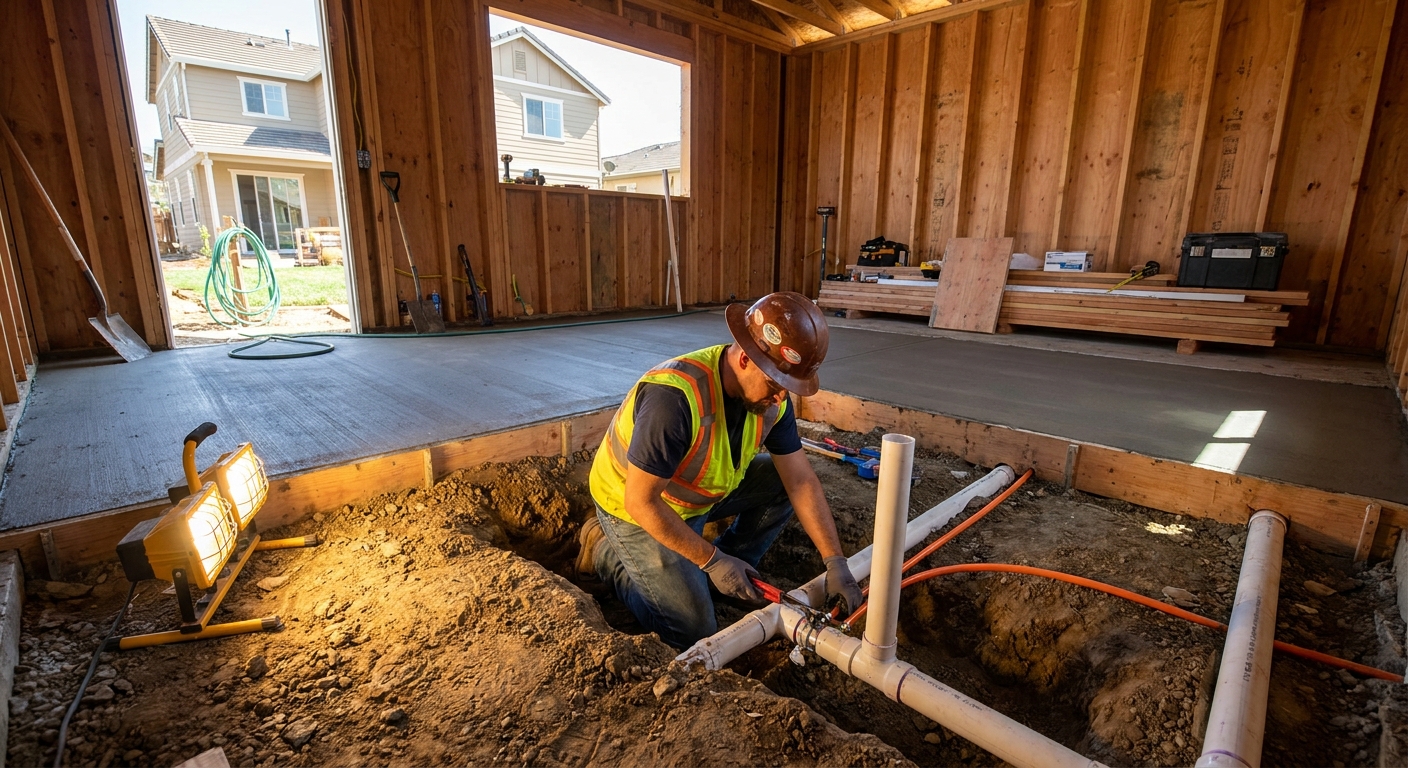
Shared vs. Separate Plumbing: What the Code Actually Requires
One of the most common questions homeowners ask is: does my ADU need its own plumbing, or can it share with the main house? The answer depends on your jurisdiction, ADU type, and local utility policies — but here's the general framework used across U.S. codes in 2026.
Full ADUs vs. Junior ADUs (JADUs)
A full ADU must function as a completely self-contained dwelling. That means it needs its own independent kitchen plumbing (hot/cold supply, drain, vent) and a fully equipped bathroom — even if those lines ultimately tie back into the main home's water and sewer services.
A Junior ADU (JADU), typically 500 sq ft or less and carved out of existing living space, may be permitted to share bathroom facilities with the primary dwelling in some states, particularly California. However, that exception doesn't eliminate code requirements — the plumbing must still meet all applicable fixture, venting, and drainage standards.
Can an ADU Share Plumbing with the Main House?
Yes — in most cases, an ADU can connect to the same water supply and sewer lateral as the main house, but "shared" doesn't mean unregulated. Even on a shared system, the ADU requires:
- Its own branch supply lines with a dedicated shutoff valve
- Properly sized drain lines with correct slope (typically ¼" per foot)
- Independent venting for each fixture group
- Approved backflow prevention where required
- Code-compliant water heater serving the unit

Find Trusted & Licensed Plumbers in Ohio
Get matched with companies for your specific needs
Water Meters, Sewer Connections & Fixture Requirements
Water Meter Requirements by Jurisdiction
Water meter requirements for ADUs vary widely. Most jurisdictions fall into one of three categories:
| Approach | Examples | What It Means |
|---|---|---|
| Shared meter allowed | Arizona, Phoenix, many rural areas | ADU connects to the main home's existing water service |
| Submeter required | California (CALGreen §4.303.2) | ADU shares a master meter but gets its own tracking submeter |
| Separate meter available (optional) | Mesa AZ, Portland OR | Owners can request a dedicated meter for billing purposes |
In California, CALGreen rules require submeters for dwelling units served by a single master meter when there are two or more units on the property. Some water districts go further and require a full separate meter — especially when the added fixture load would require upsizing the service line. Always confirm with your local water district before assuming you can share.
Sewer Connection Options
Your sewer connection strategy significantly affects cost and timeline. There are three common approaches:
- Connect to existing house lateral — The ADU ties into the home's existing sewer line at a point outside the main structure. This is cost-effective but requires confirming the existing pipe is properly sized and in good condition.
- Separate sewer lateral to the street — Some jurisdictions (like LA County) require the ADU to have its own independent connection to the public sewer main. This involves trenching, permits, and often a tap fee from the utility.
- Shared connection with cleanout — Some cities allow a shared line with a dedicated cleanout at the junction, simplifying future maintenance.
A 2025 Massachusetts court ruling affirmed that municipalities generally cannot mandate separate sewer connections for detached ADUs unless state law specifically requires it — a precedent that may influence other states going forward.
Minimum Fixture Requirements for ADUs
Regardless of jurisdiction, a full ADU must include these plumbing fixtures at minimum:
| Area | Required Fixtures |
|---|---|
| Bathroom | Toilet, lavatory sink, shower or bathtub |
| Kitchen | Kitchen sink with hot/cold supply |
| Water Heating | Dedicated water heater (tank or tankless) |
| Exterior | At least one hose bibb with backflow protection |
Most codes also require the bathroom to be at least 30 sq ft and the kitchen area at least 50 sq ft. These dimensions affect your plumbing rough-in layout significantly. For guidance on optimal fixture placement, see our bathroom plumbing layout planning guide.
ADU Plumbing Costs: What to Budget in 2026
ADU plumbing is one of the largest line items in any build. In Los Angeles, combined plumbing and electrical costs alone can represent roughly 23% of a total ADU budget. Here's a realistic breakdown for 2026:
Cost Breakdown by Component
| Plumbing Component | Typical Cost Range | Notes |
|---|---|---|
| Sewer connection & trenching | $3,000 – $10,000 | Up to $30,000+ for long runs or upgrades |
| Water supply line to ADU | $2,000 – $5,000 | More if upsizing or separate meter required |
| Interior rough-in (bath, kitchen, laundry) | $7,500 – $20,000 | $20K–$30K in high-cost markets |
| Fixture installation & final connections | $3,000 – $8,000 | Varies by fixture count and grade |
| Backflow prevention devices | $300 – $2,500 | Depends on type and hazard level |
| Water heater (tankless) | $1,000 – $3,500 installed | Gas or electric |
Total realistic range: $15,000–$30,000 for a straightforward 1-bath ADU on a flat lot; $30,000–$50,000+ for complex sites, longer utility runs, or multiple bathrooms. In Colorado Springs, plumbing alone for a typical ADU runs $12,000–$28,000.
Permit Costs
ADU plumbing always requires permits. Expect to pay for:
- A building permit (often covers all trades)
- A separate plumbing permit in many jurisdictions ($50–$500+)
- Inspection fees for rough-in and final sign-off
Skipping permits is never worth the risk — unpermitted plumbing can result in forced tear-outs, fines, and complications when selling. Learn more about when plumbing permits are required and what they cost.
Garage Conversions vs. New Construction: Key Differences
Garage Conversion Plumbing Challenges
Converting a garage into an ADU is often the most affordable path — but the plumbing is where costs can spike unexpectedly. Unlike new construction, where you design the slab and plumbing together, a garage conversion means working around an existing slab with no pre-planned drain locations.
Your Three Options for Under-Slab Plumbing
A third option — macerating/upflush systems — avoids cutting the slab entirely by grinding waste and pumping it through small-diameter pipes. While useful in some situations, not all jurisdictions allow macerators as a primary plumbing solution. For below-grade situations, our guide on basement bathroom plumbing options below the sewer line covers these systems in depth.
Additional Garage Conversion Considerations
- Sewer elevation: The existing garage floor may be lower than the home's sewer lateral, requiring a sewage ejector pump (add ~$2,500–$5,000)
- Moisture under slab: Garages rarely have vapor barriers; cutting the slab can expose moisture problems that need remediation before plumbing is installed
- Utility distance: Garages are often on the far side of the lot from where water and sewer lines enter the home, increasing trench length and cost
- Old pipe condition: If the existing house lateral is clay or cast iron, the added fixture load may require full replacement
New Construction ADU Advantages
In a ground-up ADU build, you control where the slab goes, where drain penetrations land, and how close the unit sits to existing utilities. This makes it much easier to cluster wet rooms (bathroom near kitchen), achieve proper sewer slope, and avoid expensive work-arounds. See our new construction plumbing guide for a full breakdown of the rough-in process and phases.
Backflow Prevention for ADUs
Backflow prevention protects the public water supply from contamination. For ADUs in 2026, this is non-negotiable in most jurisdictions. Key requirements include:
- Vacuum breaker or RPZ assembly on all irrigation connections
- Air gaps at dishwashers and certain drain discharge points
- Double check valve (DCV) or RPZ where the ADU water supply branches from the main home's line, depending on hazard level
- Annual testing by a certified tester, with results filed with the water authority in many cities
The type of device required depends on the "hazard level" of the cross-connection. High-hazard situations (fire sprinklers with chemical additives, boilers, irrigation) require a Reduced Pressure Zone (RPZ) assembly. Lower-risk residential supply connections may only require a DCV. Always confirm device type with your local building department and water purveyor — the requirements are site-specific. For more on outdoor plumbing and backflow rules, check out our outdoor plumbing installation guide.
Frequently Asked Questions About ADU Plumbing
Can an ADU share plumbing with the main house?
Yes, in most jurisdictions an ADU can share the main home's water supply and sewer lateral. However, even on a shared system, the ADU must have its own dedicated branch lines, shutoff valve, properly vented fixtures, and code-compliant water heater. Some jurisdictions — like LA County — require a fully separate sewer connection, so always verify local rules before designing your utility layout.
Do I need a separate water meter for my ADU?
Not always. Many cities allow a shared meter, but some — particularly in California — require at minimum a submeter under CALGreen rules when two or more units share a single master meter. Some water districts and a handful of cities go further and require a fully separate meter. Check with your local water utility before finalizing your plans, as meter installation can add $1,500–$5,000 to your project.
What are the minimum plumbing fixtures required in an ADU?
A full ADU must include a toilet, lavatory sink, shower or bathtub, and a kitchen sink with hot and cold water. A dedicated water heater serving only the ADU is also required. In most jurisdictions the bathroom must be at least 30 sq ft and the kitchen at least 50 sq ft. Junior ADUs (JADUs) may be permitted to share bathroom facilities with the primary residence in some states.
How much does it cost to plumb a new ADU?
Total plumbing costs for a typical 1-bathroom ADU range from $15,000 to $30,000 on a straightforward site, and $30,000–$50,000+ for complex projects with longer utility runs, multiple bathrooms, or required system upgrades. In high-cost markets like Los Angeles, plumbing and electrical together can represent nearly a quarter of the entire ADU build budget. Garage conversions often land on the higher end due to slab cutting and trench complexity.
What permits are required for ADU plumbing?
At minimum, you'll need a building permit and a plumbing permit. Many jurisdictions also require separate inspections for rough-in plumbing (before walls are closed) and a final inspection after all fixtures are installed. In some cities, a separate permit is required for sewer lateral work or water service connections. Skipping permits can result in forced demolition of completed work, fines, and complications when refinancing or selling your home.