
Gravity vs. Pump: How to Tell Which You Need
The single most important question for any basement bathroom is whether waste can flow downhill by gravity all the way to the main sewer line — or whether it must be pumped upward. The answer depends on one physical fact: your drain pipes must always slope downward at a minimum of ¼ inch per foot from every fixture to the tie-in point on the main drain.
You can use gravity drainage if:
- The main sewer line exits the foundation below the basement floor level
- There is enough vertical drop over the horizontal distance to maintain the required slope
- For every 10 feet of pipe run, you need approximately 2.5 inches of drop
You need a pump system if:
- The main sewer line runs through the ceiling of the basement or higher than the slab
- The sewer is only slightly below slab level but too shallow to maintain slope over the full pipe run
- You want to avoid major concrete excavation on an already-finished floor
To confirm which situation you're in, locate where the building drain exits the foundation and measure its height relative to your basement slab. If you're on a municipal system, your city's public works department can provide the sewer depth at your property line. When gravity works, a standard trench-and-drain installation is straightforward. When it doesn't, you have several pump-based options outlined below.
Basement Bathroom Plumbing Options: Ejector, Grinder & Up-Flush Systems
When gravity drainage isn't possible, three main pump-based systems can solve the problem. Each has different cost profiles, installation requirements, and ideal use cases.
Sewage Ejector Pump System (Below-Floor)
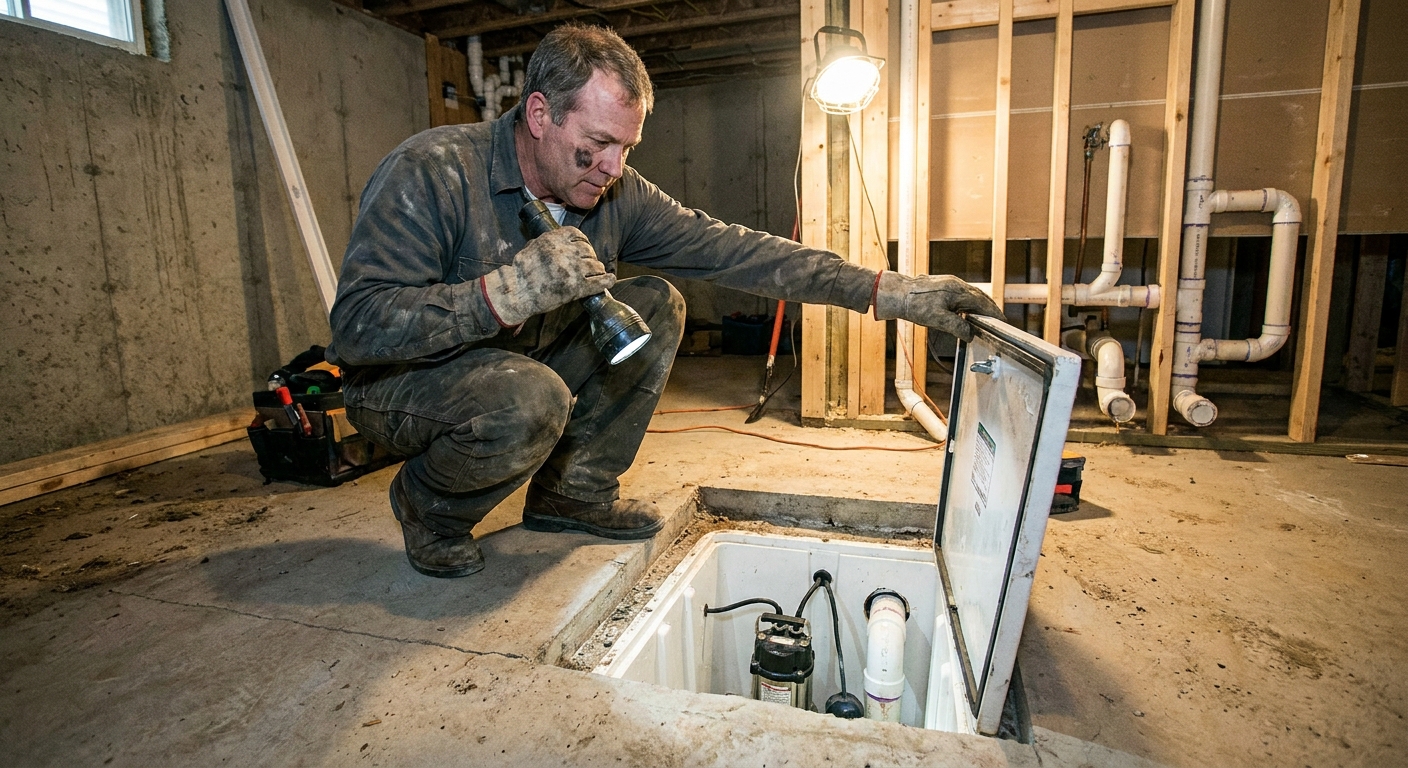
A sewage ejector system is the most conventional solution for a below-grade bathroom. A sealed basin (or crock) is cut into the concrete slab, and all basement fixtures — toilet, shower, and sink — drain by gravity into this pit. When waste reaches the activation level, a float switch triggers the pump, which pushes everything upward through a discharge pipe to the main sewer line above.
- Best for: Full bathrooms (toilet + shower + sink) with a long-term, permanent installation
- Appearance: Uses standard toilets and fixtures; the basin is hidden below the floor
- Pipe size: Requires a 2" or larger discharge line; solids pass without grinding
- Lifespan: 7–15+ years with proper maintenance
A grinder pump (sewage ejector with a macerating impeller) is a step up — it chops solids into slurry and can push waste through smaller 1¼"–1½" pipes over longer distances. This is the better choice when the run to the main sewer is long or involves multiple elevation changes.
Up-Flush / Macerating Toilet Systems (Above-Floor)
Macerating or up-flush systems are self-contained units that sit directly on the finished floor. When flushed, an electric macerator grinds waste into slurry and pumps it through a small-diameter pipe (often ¾"–1") up to the main sewer. Most popular systems, like those from Saniflo, can also accept auxiliary connections from a sink and sometimes a shower drain.
- Best for: Half-baths, small full baths, or finished basements where you don't want to break concrete
- Appearance: A compact unit sits behind or under the toilet; can be concealed in cabinetry
- Pipe size: ¾"–1" discharge snakes easily through walls and ceilings
- Lifespan: 7–15 years depending on brand and usage habits
System-by-System Comparison

Find Trusted & Licensed Plumbers in Ohio
Get matched with companies for your specific needs
Basement Bathroom Plumbing Costs: What to Budget in 2026
Costs vary widely depending on whether you already have rough-in plumbing, how far you are from the main sewer stack, and which system you choose.
| System | Plumbing System Cost | Total Project (Full Bath) |
|---|---|---|
| Gravity drain (existing rough-in) | $2,000 – $7,000 | $12,000 – $20,000 |
| Gravity drain (no rough-in, trenching) | $8,000 – $15,000 | $20,000 – $30,000+ |
| Sewage ejector pump system | $10,000 – $20,000 | $20,000 – $35,000+ |
| Macerating / up-flush toilet system | $3,000 – $8,000+ | $12,000 – $22,000 |
Key cost drivers to know:
- Slab cutting and concrete work: $800–$1,500 to cut; $600–$900 to patch
- Ejector pump unit + installation: $1,500–$3,500 (pump alone); $3,000–$8,000 as part of a full bath scope
- Macerating toilet equipment: $800–$2,500 depending on brand and number of fixtures supported
- Plumbing labor: Often 50–60% of total project cost; $2,000–$10,000+ depending on complexity
The biggest variable is whether your basement already has plumbing rough-ins (stubbed-out pipes under the slab). If you do, costs drop dramatically. If starting from scratch, budget for slab trenching as a significant line item.
Installation, Noise, Maintenance & Permits
Installation Best Practices
Whether you choose a below-floor ejector or an above-floor macerating unit, a few fundamentals apply to every basement bathroom:
For basement showers:
- Use a 2" P-trap and drain line (code minimum in most jurisdictions)
- Set the drain body level in both directions — an off-level drain leads to pooling
- Match your drain type to your waterproofing system (liner drain vs. bonding flange drain)
- Protect weep holes in liner-style pans; blocked weep holes are a leading cause of shower leaks
- Slope the shower pan ¼" per foot from every corner toward the drain
- Perform a 24-hour flood test before tiling
For basement toilets:
- The closet flange should sit on top of the finished floor, not below it
- Standard rough-in is 12" from the finished wall to the flange center — confirm your toilet specs
- Every toilet requires a vent connection within the code-allowed distance; never skip venting
- Install a backwater valve if your fixtures are below the next upstream sewer manhole — many jurisdictions require it
Noise Considerations
Both ejector pumps and macerating toilets produce noise during operation — typically 50–75 dB near the unit, roughly in the range of a conversation to a vacuum cleaner. Cycles are brief (10–60 seconds), but the noise can carry through the house if not addressed.
Ways to reduce pump noise:
- Use a sealed, gasketed pit lid on ejector systems — loose or poorly sealed lids amplify sound significantly
- Install cushioned pipe clamps on all discharge lines; rigid metal-on-wood contact transmits vibration into framing
- Add a quiet check valve (spring-assisted) on the ejector discharge to prevent the loud thud when flow stops
- Wrap accessible discharge piping with acoustic pipe insulation
- Place macerating units on a vibration-damping rubber pad
- For new construction, use insulated stud cavities and resilient channels in drywall around the pump area
If you hear new grinding, rattling, or banging, treat it as a warning sign — these sounds often precede pump failure or a blockage that can lead to a sewage backup.
Maintenance Schedule
| Task | Ejector Pump | Macerating Toilet |
|---|---|---|
| Test operation | Every 3–6 months | Every 3–6 months |
| Inspect / clean basin or unit | Every 3–4 months (heavy use) | Every 6–12 months (descaling) |
| Check vent & discharge piping | Annually | Annually |
| Professional service | Every 1–2 years | Every 3–5 years |
| Expected lifespan | 7–15+ years | 7–15 years |
Common warning signs to watch for:
- Pump doesn't activate: Stuck float switch, tripped breaker, or motor failure
- Frequent short cycling: Failing check valve letting water flow back into the pit
- Foul odors: Dirty pit, blocked vent, or dried-out trap seals in rarely used fixtures
- Backup into basement: Stop all fixture use immediately and call a plumber
Permit Requirements
Adding a basement bathroom almost always requires permits — skipping them can lead to fines, forced teardowns, and problems when selling your home. Most jurisdictions require:
- Building permit — for new walls, structural changes, or converting unfinished space
- Plumbing permit — always required when adding new fixtures or drain/waste/vent lines; must typically be pulled by a licensed master plumber
- Electrical permit — for new circuits to power the pump, exhaust fan, or GFCI outlets
- Mechanical permit — if you're adding or modifying exhaust ventilation
Inspection sequence for basement plumbing:
- Underground/groundwork inspection (before concrete is poured over new drains)
- Rough-in plumbing inspection (before insulation and drywall)
- Rough electrical and framing inspection
- Final plumbing, electrical, and building inspections
Always call your local building department before starting work to confirm which permits are required, who can pull them in your state, and which code edition is currently enforced.
Decision Tree: Choosing the Right Basement Plumbing System
Use this quick guide to find your best option:
Step 1 — Can you drain to the sewer by gravity?
- ✅ Yes → Use standard gravity drain with slab trenching (most affordable long-term)
- ❌ No → Continue to Step 2
Step 2 — Are you willing to break the concrete slab?
- ✅ Yes → Install a below-floor sewage ejector pump system (best for full baths, most durable)
- ❌ No → Continue to Step 3
Step 3 — How many fixtures will the bathroom have?
- Full bath (toilet + shower + sink) → Above-floor sewage/grinder pump system with a small platform, or a macerating system rated for multiple fixtures
- Half-bath or ¾ bath (toilet + sink, maybe shower) → Up-flush / macerating toilet system (fastest install, lowest disruption)
Step 4 — How far is the run to the main sewer stack?
- Short run (under 15 ft, modest vertical lift) → Standard sewage ejector or entry-level macerating unit
- Long run or significant lift → Grinder pump or high-capacity macerating system rated for the distance
Frequently Asked Questions
Can I install a basement bathroom myself to save money?
Some macerating/up-flush toilet systems are marketed as DIY-friendly for skilled homeowners, and a capable DIYer can handle much of the rough carpentry and finish work. However, the plumbing rough-in — especially anything involving slab cutting, ejector pit installation, or tying into the main drain/vent stack — should be handled by a licensed plumber in most states. Unpermitted plumbing work can void your homeowner's insurance, cause problems at resale, and create costly safety hazards if done incorrectly.
How long does a sewage ejector pump last?
With normal use and proper maintenance, a quality sewage ejector pump typically lasts 7 to 15 years or more. Lifespan is heavily influenced by what gets flushed — wipes, feminine products, and other non-flushable items are the single biggest cause of premature pump failure. Testing the pump every 3–6 months and inspecting the pit a few times per year will help you catch issues early and extend the pump's life.
Do macerating toilets smell worse than regular toilets?
A properly installed and vented macerating toilet should not smell any worse than a standard toilet. Odor problems usually stem from a blocked or improperly connected vent line, a poorly sealed unit, or infrequent use that allows traps to dry out. Running the system regularly, using manufacturer-approved descaling cleaner every 6–12 months, and ensuring the vent pipe is clear and properly connected will keep odors under control.
Does a basement bathroom add value to my home?
Yes — adding a full or half bathroom to a basement is one of the higher-return home improvement projects. In many markets, an additional bathroom can recoup a significant portion of its cost at resale and makes the home more attractive to buyers, especially if the basement is also finished living space. The value added is highest when the work is permitted and completed to code, since buyers' home inspectors will flag unpermitted additions.
What is the difference between a sewage ejector pump and a grinder pump?
A standard sewage ejector pump uses an impeller to move waste and water upward but does not grind solids — it relies on solids being small enough to pass through. A grinder pump adds a macerating blade that chops waste into fine slurry before pumping, allowing it to push through smaller-diameter pipes over longer distances. Grinder pumps cost more and are better suited for long runs or complex layouts, while ejector pumps are sufficient for most standard basement bathroom applications with a reasonable run to the main stack.