
Compare Home Insurance Plans in Ohio
Find your best options in less than 2 minutes



The 15- and 20-Year Thresholds: What Most Insurers Use
Roof age is now one of the primary underwriting variables home insurers use, right alongside your location and claims history. In 2026, most major carriers apply two critical age checkpoints to determine what kind of coverage you can get (or keep):
| Roof Age | Typical Insurer Response |
|---|---|
| 0–10 years | Full Replacement Cost Value (RCV); often qualifies for premium discounts |
| 10–15 years | Still broadly insurable; some carriers begin shifting wind/hail to ACV |
| 15–20 years | Inspections required; coverage may downgrade to ACV; non-renewal risk increases |
| 20+ years | Roughly 70% of major carriers restrict to ACV only or deny new coverage entirely |
The "15-year rule" is becoming increasingly common. Roof insurance policy changes in 2026 center around stricter age-based thresholds, with most carriers now enforcing a 15-year rule that triggers coverage reductions, switches from replacement cost value to actual cash value, or outright non-renewals. State Farm, Allstate, and Farmers have all tightened their standards. For asphalt shingle roofs specifically, the 20-year mark is often a hard line, and many carriers simply won't write a new policy on a roof that old.
The 20-year threshold is not a federal law. It's an industry standard. Different carriers set their own limits, and those limits can vary by state, material type, and even your home's proximity to the coast or a hail corridor. Learn more about how home insurance underwriting actually works behind the scenes.

Compare Home Insurance Plans in Ohio
Find your best options in less than 2 minutes
The March 2026 FHFA Rule: Why It Matters for Older Roofs
On March 18, 2026, Fannie Mae and Freddie Mac announced they are rolling back certain property insurance requirements for condominiums and single-family homes in response to "skyrocketing" insurance prices. Fannie and Freddie will now accept actual cash value coverage on roofs. The rest of the home still has to be insured at full replacement cost, but the roof itself can now be written as ACV and still satisfy federal mortgage requirements.
Fannie's change is documented in Lender Letter LL-2026-03, and Freddie's in Bulletin 2026-C. This is a big deal for two reasons:
- Premiums may drop for older-roof homes, since ACV coverage is cheaper for insurers to price.
- Payouts will drop even more. The FHFA changed the rules in March 2026: insurers can now pay only the depreciated value of your roof after a storm. On a $10,000 claim, that could mean a $2,000 payout.
The rule applies to new mortgages and renewals sold to or guaranteed by the GSEs, covering roughly 60 to 70% of conventional mortgages. Existing borrowers can voluntarily request ACV roof coverage at renewal if the lender and insurer agree. Read our full breakdown of the ACV vs. RCV coverage tradeoff before making that call.

Protect your home with State Farm
Average Rate:
Homeowners who bundle and save with State Farm save an average of $1,000 per year!

You're in Good Hands® with Allstate
Average Rate:
Get comprehensive home coverage with flexible policy options.

Customize your home coverage
Average Rate:
Only pay for the coverage you need with personalized home insurance.

Smart coverage for your home
Average Rate:
Protect what matters most with award-winning home insurance.
Roof Material Matters: Not All Roofs Age the Same
Insurers don't treat a 20-year-old tile roof the same as a 20-year-old asphalt shingle roof. The material determines both the roof's expected lifespan and the insurer's risk tolerance.
Asphalt Shingles
Asphalt shingles are the most common roofing material in the U.S. and the most scrutinized by insurers. Standard 3-tab shingles last 15 to 25 years, while architectural (dimensional) shingles can reach 25 to 30 years under good conditions. For insurance purposes, the clock typically runs out around 15 to 20 years, depending on your state and carrier.
- 3-tab asphalt shingles are most frequently restricted at 15–20 years, while architectural shingles are often tolerated a bit longer, commonly 20–25 years.
- Heavy scrutiny begins at 10 to 15 years in high-risk markets (hurricane zones, hail belts)
- Most carriers move to ACV-only or non-renewal at 20 years
- Class 4 impact-resistant shingles may earn discounts and slightly extend insurer tolerance
Metal Roofs
Metal roofing is a favorite among insurers because it's durable, fire-resistant, and built to last 40 to 70 years. Metal roofs are often accepted for 30+ years, with fewer age-based restrictions.
- Often insurable at full RCV well past the 30-year mark
- May qualify for 5 to 20% premium discounts compared to asphalt
- Strict age cutoffs are far less common; condition-based inspections take priority
Clay & Concrete Tile
Tile roofs can physically last 50 to 100+ years, but the underlayment typically needs replacement around the 20 to 30 year mark. Insurers understand this distinction:
- Tile and slate roofs are often treated more favorably and may remain insurable much longer, sometimes 40+ years, depending on condition and carrier rules.
- High replacement costs in coastal markets can still push premiums up even for durable tiles
Flat Roofs
Flat roofs are considered high risk. Many carriers limit coverage to flat roofs under 10 to 15 years, and older flat roofs frequently face ACV-only coverage, higher deductibles, or outright non-renewal.
RCV vs. ACV: The Coverage Type That Determines Your Payout
Understanding the difference between Replacement Cost Value (RCV) and Actual Cash Value (ACV) is essential, especially as your roof ages. The gap between the two can mean tens of thousands of dollars out of your pocket after a storm.
How RCV Works
RCV pays the full cost to replace your roof with new materials of similar quality at today's prices, minus your deductible. No depreciation is deducted. It's the gold standard for roof coverage.
How ACV Works
Actual Cash Value (ACV) is RCV minus depreciation. Depreciation reflects the loss in value due to age, prior wear, and sometimes obsolescence. Most insurers use straight-line depreciation, dividing the roof's age by its expected useful life. On an older asphalt roof, depreciation often runs 60 to 80 percent of replacement cost, so the gap between the two settlement types is frequently a five-figure out-of-pocket bill. Read more about actual cash value home insurance to understand how depreciation schedules work.
Real-Dollar Example
On a $25,000 roof replacement with a $1,000 deductible, RCV pays $24,000 while ACV pays just $9,000 after 60% depreciation, a $15,000 difference (Travelers Insurance, 2025).
| Coverage Type | How It Pays | Insurer Pays | You Pay Out of Pocket |
|---|---|---|---|
| RCV | Full cost, no depreciation | $24,000 | $1,000 |
| ACV (60% depreciation) | Depreciated value only | $9,000 | $16,000 |
The switch from RCV to ACV doesn't happen the day your roof turns 20. Many carriers begin restricting RCV at 10 years for wind/hail perils and then default all roof coverage to ACV around 15 to 20 years. If your policy covers roof replacement claims, know that RCV and ACV can yield wildly different outcomes for the same storm event.
Florida's 15-Year Rule and State-Specific Regulations
Florida has gone further than most states in codifying roof age rules into law under Florida Statute 627.7011, and HB 815 takes effect July 1, 2026 with meaningful updates. Here's how the rule works in practice:
Under 15 Years
Under 627.7011(5)(b), an insurer may not refuse to issue or refuse to renew a homeowner's policy on a residential structure with a roof that is less than 15 years old solely because of the age of the roof. This protection applies regardless of material type.
15 Years or Older
For a roof that is at least 15 years old, an insurer must allow a homeowner to have a roof inspection performed by an authorized inspector at the homeowner's expense before requiring roof replacement. If an authorized inspector finds that the roof has 5 years or more of useful life remaining, the insurer may not refuse to issue or renew the policy solely because of roof age.
- 5+ years of remaining useful life: The insurer must allow coverage to continue and cannot refuse to renew solely because of age
- Less than 5 years remaining: The insurer may non-renew or require roof replacement
HB 815 Updates (Effective July 1, 2026)
HB 815 adds a key wrinkle: insurers must now differentiate between low-slope roofs (pitch of 2 inches or less) and steep-slope roofs (pitch of more than 2 inches). For a low-slope roof, if an authorized inspector determines it can be restored by applying a roof coating system that will give the roof 5 or more years of useful life, the insurer cannot refuse to issue or renew solely because of age.
Other States Worth Knowing
Florida's law is the most consumer-protective in the nation, but it's the exception, not the rule. In most states, insurers set their own age limits:
- In states with high hail or hurricane exposure such as Florida, Texas, Oklahoma, Colorado, and a growing list of others, many carriers won't write new policies for roofs older than 15 or 20 years.
- Virginia (2026) now requires insurers to accept homeowner-supplied age documentation before non-renewing on a roof older than 15 years
- California wildfire zones have separate roof material requirements focused on fire rating rather than age
- Coastal Gulf and Southeast states often mirror Florida's scrutiny with their own carrier-level rules
If you live in an older home, roof age is just one of the factors that can make securing standard coverage difficult, but it's often the most urgent one to address.
How Insurers Verify Roof Age in 2026
You don't just fill out a form and trust the insurer takes your word for it. Insurers increasingly rely on technology, including aerial imagery, AI analysis, drones, and satellite imaging, to assess roof condition without physical inspections. This capability enables more granular, property-specific risk pricing and faster identification of roofs that fail underwriting criteria.
AI-Powered Aerial and Satellite Imagery
This is now a standard, automated underwriting tool. CAPE Roof Age derives an accurate and objective age value using historical high-resolution aerial imagery and AI-based change detection. The CAPE model analyzes past and present imagery to identify the point in time when a roof was completely replaced. Insurers and their data vendors (ZestyAI, Nearmap, Cape Analytics) use 20+ years of high-resolution imagery combined with AI to identify:
- Granule loss, curling, and discoloration on shingles
- The exact year the roof visually changed color or material (indicating a re-roof)
- Construction activity (dumpsters, scaffolding) that confirms permitted work
- Mismatched sections indicating partial prior replacements
Learn more about how AI is reshaping home insurance underwriting.
Building Permit Records
The most direct insurance use case for roofing permit data is deriving a "roof last replaced" date. Insurers pull this data through third-party property vendors to confirm or contradict the age you reported. Roofs replaced without permits can create verification problems, as insurers may default to treating the roof as older than it actually is.
Physical Inspections
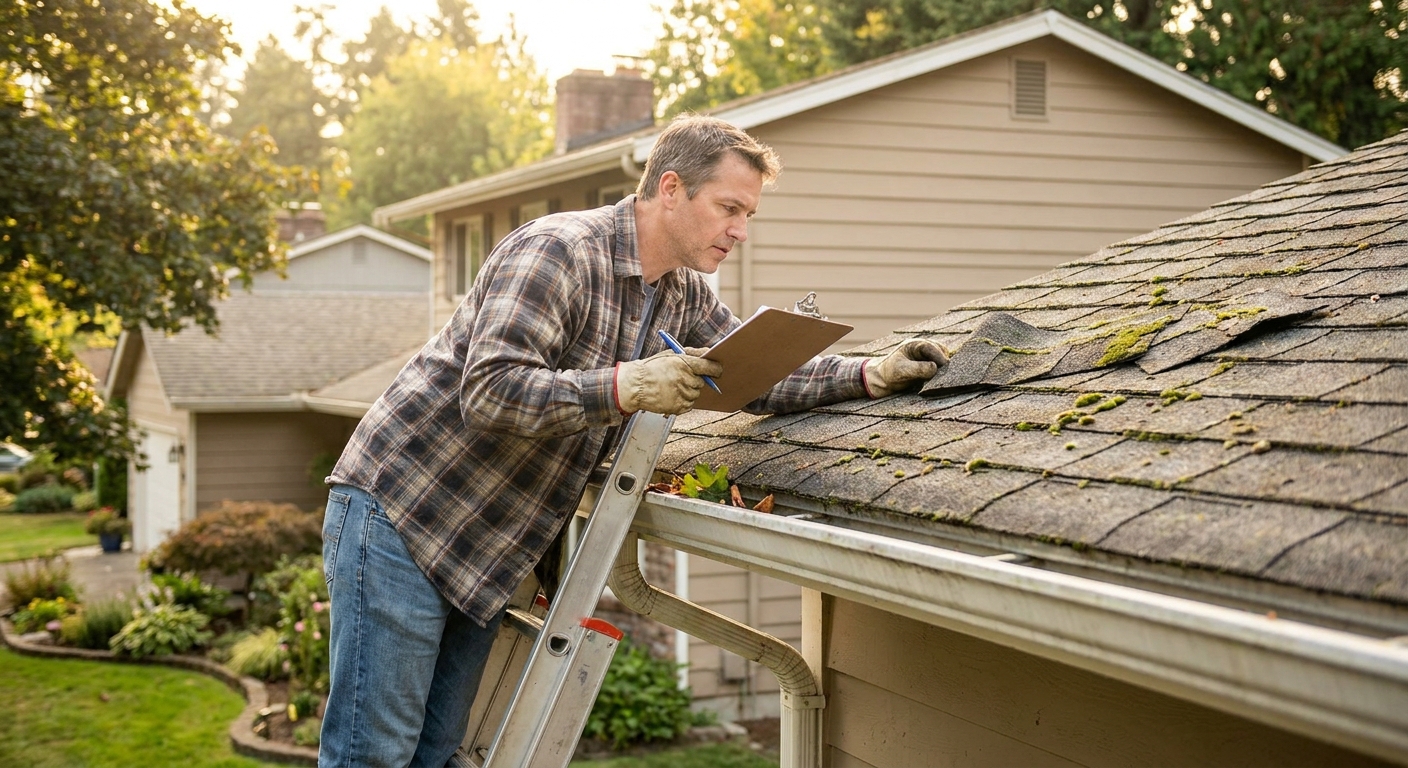
At 10 to 15+ years, physical inspections become standard. Company-hired inspectors, independent services, or drones are used, and the inspection typically produces an estimated remaining useful life that directly influences:
- Whether coverage stays at RCV or drops to ACV
- Whether the insurer issues a non-renewal
- The size of wind/hail deductibles on the renewed policy
You can read our full guide on what home insurance inspections check to prepare for one.
Options for Homeowners With Older Roofs
If your roof is approaching or past your insurer's age threshold, you have more options than you may realize. The key is acting early, ideally 60 to 90 days before your renewal date.
1. Get a Roof Certification Letter
A certification or "certified life letter" is a written statement from a licensed roofer or inspector documenting your roof's current condition and estimated remaining useful life. It often includes photos and a clear statement that the roof is watertight and serviceable. In Florida and Virginia, a certification of 5+ years of useful life can legally prevent non-renewal on age alone.
2. Make Targeted Repairs
Sometimes the issue is a few visible problem areas rather than full roof failure. Strategic repairs that often satisfy insurers include:
- Replacing missing, curled, or broken shingles
- Fixing damaged flashing at chimneys, vents, and valleys
- Cleaning heavy moss or debris that creates the appearance of neglect
- Replacing cracked pipe boots and roof penetrations
Always get a paid invoice for repairs and ask your contractor to update the certification letter to reflect the work done.
3. Shop Independent Agents and Surplus Carriers
Not every insurer uses the same age threshold. An independent insurance agent can shop multiple carriers, including non-admitted surplus lines insurers, who may accept older roofs with different conditions. If you've been denied home insurance or received a non-renewal notice, surplus lines are often your best next stop.
4. Consider State FAIR Plans as a Last Resort
If standard carriers and surplus markets both decline, your state's FAIR Plan (insurer of last resort) provides basic property coverage. Coverage is typically bare-bones, often just fire and named perils, and premiums can be high. It's not an ideal solution, but it keeps your mortgage lender satisfied while you work toward a roof replacement. Homeowners in this situation may face broader hard-to-insure home challenges beyond just the roof.
5. Plan a Proactive Replacement
If your roof is 15 to 18 years old and made of asphalt shingles, replacing it on your own timeline puts you in control. You can shop for materials that qualify for premium discounts (like Class 4 impact-resistant shingles) and time the project to align with policy renewal for maximum benefit. If your roof is damaged by hail, review your hail damage home insurance options carefully before filing. A successful claim on an older roof can accelerate non-renewal.
Frequently Asked Questions
How old can a roof be for home insurance?
Most standard home insurance carriers will insure asphalt shingle roofs up to 15 to 20 years old, after which coverage restrictions or non-renewals become common. Metal and tile roofs are often insurable much longer, up to 30 to 50 years, because of their superior durability. The specific age limit varies by carrier, state, and roof condition. Getting a professional inspection before your policy renewal can help establish that your older roof still has usable life remaining.
What is the 15-year roof insurance rule?
The "15-year rule" refers to the growing industry practice of treating 15-year-old roofs, especially asphalt shingles, as a risk threshold where coverage restrictions begin. Florida has codified this into law under Statute 627.7011, requiring insurers to allow inspections at 15 years and base non-renewal decisions on remaining useful life rather than age alone. Florida's HB 815, effective July 1, 2026, further requires insurers to differentiate between low-slope and steep-slope roofs and accept coating restoration for low-slope roofs when it adds 5+ years of useful life.
Will insurance cover a 20-year-old roof?
It depends on the material and the insurer. A 20-year-old asphalt shingle roof is near or past the coverage threshold for many major carriers, who may offer only ACV coverage or decline new policies entirely. A 20-year-old metal or tile roof, by contrast, may still qualify for full replacement cost coverage if it passes inspection. Shopping through an independent agent is the best strategy, since different carriers apply different age limits.
What did the March 2026 FHFA rule change for roof insurance?
On March 18, 2026, the FHFA directed Fannie Mae and Freddie Mac to accept ACV roof coverage on backed mortgages instead of requiring full replacement cost, documented in Lender Letter LL-2026-03 and Bulletin 2026-C. The rest of the dwelling still needs replacement cost coverage, but the roof portion can now be written as ACV. This may lower premiums for owners of older-roof homes, but it also significantly reduces claim payouts because depreciation is subtracted from any storm payout.
How do I avoid losing home insurance because of my roof?
The most effective steps: get a professional roof inspection at least 90 days before your renewal date, make any visible repairs and document them with invoices, and ask your insurer directly what their age threshold and coverage conditions are. If you receive a non-renewal notice, a roof certification letter from a licensed contractor can sometimes reverse the decision. If your roof is 15 to 18 years old, planning a proactive replacement on your timeline gives you the most leverage.