
Compare Home Insurance Plans in Ohio
Find your best options in less than 2 minutes



Why Insurers Flag Knob and Tube Wiring
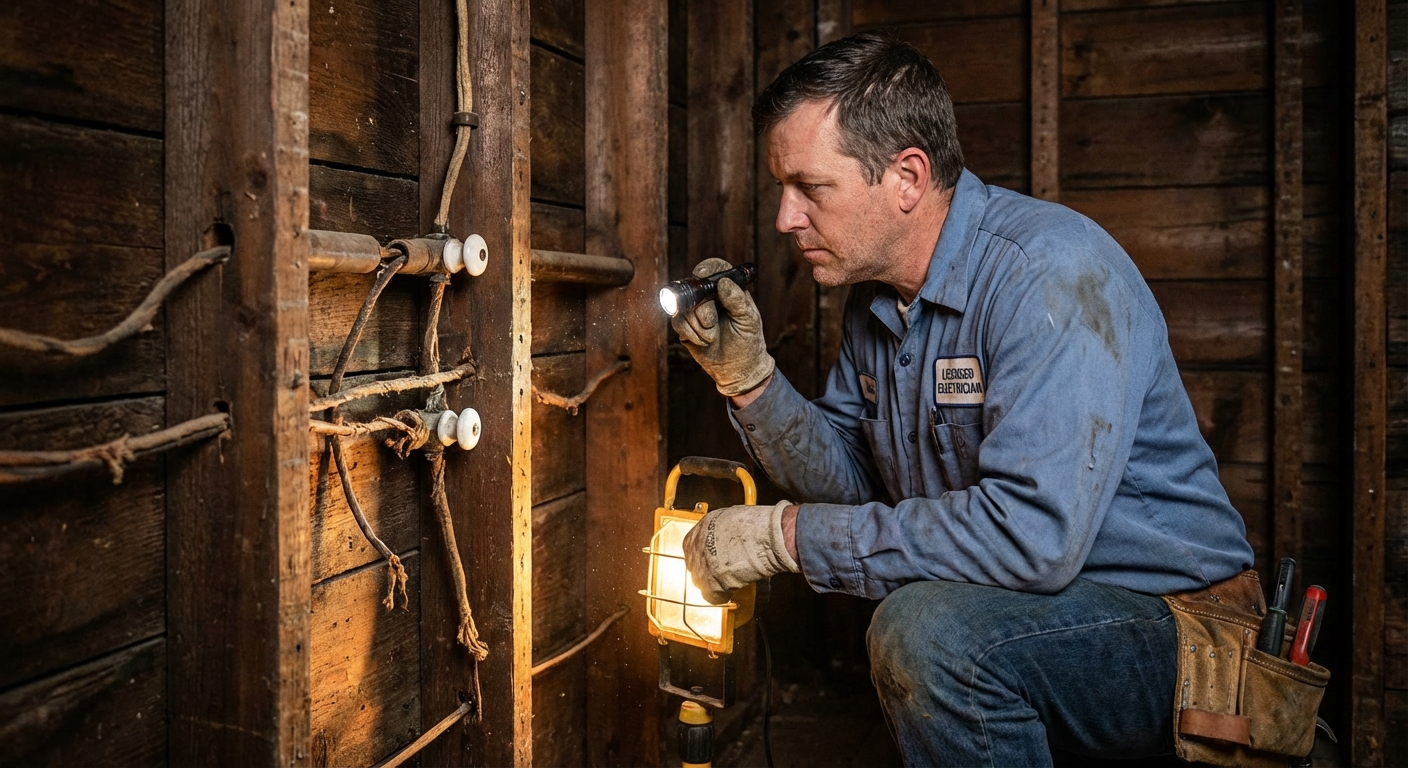
Knob and tube (K&T) wiring was standard construction practice from the 1880s through the 1940s. It uses ceramic knobs to anchor wire runs and ceramic tubes to protect wires passing through framing. The system was perfectly adequate for its era but is dangerously mismatched with the electrical demands of a modern home.
Here's why insurance underwriters treat K&T as a serious red flag:
| Risk Factor | Why It's a Problem |
|---|---|
| No grounding | Stray electrical current has nowhere to safely dissipate, increasing shock and short-circuit risk |
| Overloading | Designed for low-wattage loads; modern appliances can overheat the wiring and cause fires |
| Deteriorating insulation | Cloth, rubber, or asphalt insulation breaks down over decades, exposing bare copper wire |
| Heat trapping | Attic or wall insulation installed over K&T can trap heat and violate current building codes |
| Improper modifications | Splices or connections to modern wiring made over the years add stress and create hazards |
Because insurance companies price policies based on risk, a home with K&T wiring represents a significantly elevated chance of an electrical fire claim, and most carriers simply aren't willing to take that on. Homes built before 1980 face roughly three times the electrical fire risk of newer homes, which is why K&T alone can add $300 to $800 a year to a premium in states where coverage is still available. Understanding older home insurance challenges helps explain how these risk factors are weighted when you apply for a policy, particularly as carriers rely more on AI, satellite imagery, and drone inspections in 2026.

Compare Home Insurance Plans in Ohio
Find your best options in less than 2 minutes
Which Companies Still Offer Coverage and What They Require
Finding a standard homeowners insurance policy for a K&T home is difficult but not always impossible. A shrinking pool of carriers may still consider these homes on a case-by-case basis, typically under strict conditions.
Insurers that have historically written K&T homes in some states:
- State Farm
- Allstate
- Farm Bureau
- Foremost
- USAA (for eligible military members)
- Auto-Owners Insurance
- Encompass Insurance
- Liberty Mutual (including Safeco for historic homes)
Keep in mind that policies and underwriting guidelines change frequently. A company that covered K&T homes in your state last year may no longer do so in late 2026. Availability is heavily dependent on your state, the condition of your wiring, and recent claims history. In Florida, no standard carrier will now write a home with active K&T, and a complete copper rewire is typically required to place coverage at all. In California's Bay Area, agents report that disclosing K&T on an application often results in an automatic decline.
What Insurers Typically Require
Even when coverage is available, you can expect a list of conditions. Common approaches include a licensed electrician's inspection documenting the wiring's condition, a requirement that active K&T be replaced in some or all of the home before coverage is issued, or simply a higher premium to reflect the risk. Many carriers give you a defined window (often 30, 60, or 90 days) to complete the upgrade.
An HO-8 modified policy form is specifically designed for older homes and often caps your payout at actual cash value (ACV) rather than full replacement cost, meaning depreciation will reduce any claim payout significantly. Learn more about hard-to-insure home options and how the U.S. excess and surplus (E&S) market, which crossed $105.31 billion in direct premiums written in 2025, fits into the picture for older homes that standard carriers reject.

Protect your home with State Farm
Average Rate:
Homeowners who bundle and save with State Farm save an average of $1,000 per year!

You're in Good Hands® with Allstate
Average Rate:
Get comprehensive home coverage with flexible policy options.

Customize your home coverage
Average Rate:
Only pay for the coverage you need with personalized home insurance.

Smart coverage for your home
Average Rate:
Protect what matters most with award-winning home insurance.
The Cost Question: Rewire or Pay Higher Premiums?
This is the most important financial decision K&T homeowners face, and the late 2026 numbers often make the answer clear.
What Rewiring Costs in 2026
Full rewiring is not cheap, but it is a permanent solution. Based on the latest 2026 industry data, whole-home K&T replacement projects typically run $12,000 to $36,600, with a national average around $24,300 for a mid-sized home. Per-square-foot costs generally fall between $10 and $20 for full K&T removal and replacement, higher than a standard rewire because the old system has to come out as the new one goes in. Smaller, easier-access projects can start closer to $6,000, while larger homes in expensive labor markets can push past $40,000.
| Home Size (sq ft) | Estimated 2026 Rewiring Cost |
|---|---|
| 1,000 sq ft | $6,000 – $12,000 |
| 1,300 sq ft | $13,000 – $26,000 |
| 1,600 sq ft | $16,000 – $32,000 |
| 2,000 sq ft | $20,000 – $40,000 |
| 2,500 sq ft | $25,000 – $50,000 |
| 3,000 sq ft | $30,000 – $60,000 |
Costs include labor (often $50 to $130/hr, or $100 to $350+ per outlet, switch, or fixture), materials, permits ($200 to $500), an electrical panel upgrade if needed ($600 to $4,000 for a modern 100-amp or 200-amp service), inspections, and drywall repair and repainting afterward. Regional pricing varies widely, with 2026 estimates well below average in parts of the South and often 40% or more above average in California and the Northeast.
Rewiring vs. Paying the K&T Premium Surcharge
Homeowners who find a carrier willing to insure a K&T home often see premiums 15 to 30% higher than comparable modern-wired homes, and 50 to 100% higher when the only options are specialty or surplus lines markets. Insurify now projects the national average home insurance premium will hit $3,057 by the end of 2026, a 4% jump on top of 2025's 12% surge. On a $3,000 policy, a 15 to 30% surcharge adds roughly $450 to $900 a year, while specialty pricing can add $1,500 to $3,000 or more every year, indefinitely.
At that rate, the cost of rewiring often pays for itself in 8 to 20 years through insurance savings alone, and that's before counting increased home value, improved safety, and easier access to standard carriers. Industry data suggests removing active K&T can drop annual insurance costs by $300 to $800 per year on its own, and can also unlock a mortgage refinance or a home sale that a K&T disclosure would otherwise complicate.
Exploring high-risk home coverage options can also help offset costs while you work through the upgrade process, especially as national premiums have climbed more than 60% since 2020.
If You're Denied: Alternatives to Standard Coverage
Being denied homeowners insurance because of K&T wiring doesn't mean you're out of options. Several alternative paths exist, though each comes with trade-offs.
State FAIR Plans
Most states offer a FAIR Plan (Fair Access to Insurance Requirements), a last-resort program for homeowners who cannot obtain coverage in the private market. FAIR Plans provide basic coverage for fire and certain named perils, but they do not typically include liability protection, theft, or water damage coverage.
The California FAIR Plan has grown to 696,562 policies as of June 2026, up 8% since September 2025 and 157% since September 2022, with an approved 29.1% average rate increase taking effect for new and renewal policies on or after October 15, 2026. Total FAIR Plan written premium reached $2.04 billion as of June 2026. The 29.1% increase is an average, so results vary: reports suggest roughly half of homeowners will see increases of 30 to 50%, while about a quarter may actually see reductions of up to 80%, largely tied to wildfire risk and property hardening. Encouragingly, quarterly policy growth slowed to just 1.9% in Q2 2026, the third consecutive quarter of slowing growth and an early sign the private market may be stabilizing. In Massachusetts, homeowners can turn to MPIUA (the Massachusetts Property Insurance Underwriting Association) as an equivalent safety net.
To qualify, you generally need to provide proof that you were denied coverage by private insurers. Review what a hard-to-insure home qualifies for and what significant coverage gaps FAIR Plans carry before committing to one as your only option.
Excess & Surplus (E&S) Lines Insurers
If you don't qualify for a standard carrier and need more robust coverage than a FAIR Plan provides, excess and surplus (E&S) lines insurers specialize in high-risk properties. These are non-admitted carriers that operate outside standard state insurance regulations, which gives them more flexibility to underwrite unusual risks but also means fewer consumer protections. The U.S. E&S market crossed $105.31 billion in direct premiums written in 2025 (its first time above $100 billion), up 7.8% year over year. Growth has moderated to single digits for the first time since 2018, but E&S homeowners premiums specifically surged 29.5% to $4.14 billion as admitted carriers keep retreating from wildfire, coastal, and older-home risks.
E&S policies for K&T homes will still run significantly higher than standard premiums, and an electrical inspection will almost certainly be required. Learn more about high-risk home insurance and whether the E&S route is the right fit for your situation.
State-by-State Differences
Where you live matters significantly. In 2026, California is among the strictest states. K&T wiring is effectively uninsurable in the private market there, especially as major carriers have already pulled back from high-risk coverage over the past several years. Florida is even stricter. Not a single standard carrier will now write a home with active K&T, and Citizens Property Insurance requires a complete copper rewire before it will consider coverage. In New Jersey and other states, coverage is difficult but possible on a case-by-case basis through regional or specialty carriers, usually with a 30 to 60-day replacement timeline.
No state offers broad, easy access to K&T coverage anymore. The nationwide trend since 2022 has been toward fewer carriers accepting this risk at any price point.
If your insurer has dropped you rather than denied a new application, look at the broader landscape of older home insurance challenges to understand your rights and the typical 60 to 120-day non-renewal timeline. Non-renewals continue to run high in 2026 as admitted carriers restrict capacity in high-hazard states, so acting quickly matters.
For more context on the challenges facing owners of aging properties, our guide on hard-to-insure homes covers the full range of issues insurers flag, from wiring to plumbing to roof age.
Frequently Asked Questions
Can you get homeowners insurance with knob and tube wiring?
Yes, but it's increasingly difficult in late 2026. A small number of insurers, including some regional carriers, specialty companies, and E&S lines underwriters, will consider covering homes with K&T wiring. Most require a licensed electrician's inspection, charge significantly higher premiums, and may require you to commit to an upgrade timeline of 30 to 90 days. Availability varies widely by state, with California and Florida being the most restrictive.
Will insurance companies automatically deny a home with knob and tube wiring?
Not universally, but many will. Major national carriers often decline K&T homes during underwriting or require the wiring to be replaced before issuing a policy. In Florida, no standard carrier will write these homes, and in California's Bay Area, agents report near-automatic declines. Your best strategy is to work with an independent agent who can shop your application across multiple carriers, including regional and specialty markets that captive agents may not access.
How much more will I pay for home insurance with knob and tube wiring?
Expect to pay 15 to 30% more than you would for a comparable home with modern wiring in many cases, according to 2026 industry sources. If you're forced into a specialty or surplus lines market, premiums can reach 50 to 100% higher, and in extreme cases two to three times a normal policy's cost. With the U.S. average home premium projected at $3,057 by year-end 2026, a surcharge can easily add $450 to $900 per year, or more in high-risk states.
Is it worth replacing knob and tube wiring just for insurance purposes?
In most cases, yes, especially if you plan to stay in the home long-term. The premium savings from switching to modern wiring often pay back the rewiring cost within 8 to 20 years. Beyond insurance savings, you'll benefit from increased home value, better safety, and easier access to financing since many mortgage lenders flag K&T wiring too. Reviewing older home insurance challenges can help you plan the timing so rewiring lines up with a renewal window.
What happens if I don't disclose knob and tube wiring to my insurance company?
Non-disclosure is considered misrepresentation on your insurance application and can have serious consequences. If your insurer discovers the wiring during a claim or inspection, they may deny the claim entirely and cancel your policy. In some cases, it could be treated as insurance fraud. Always disclose your home's electrical system honestly. The short-term savings are not worth the long-term risk of having no coverage when you need it most.