
Compare Home Insurance Plans in Ohio
Find your best options in less than 2 minutes



How Home Insurance Classifies Your EV Charger
The single biggest factor in whether your homeowners policy responds to an EV charger claim is how the charger is attached to your home. Insurers draw a sharp line between fixtures and accessories, and that line decides which policy pays.
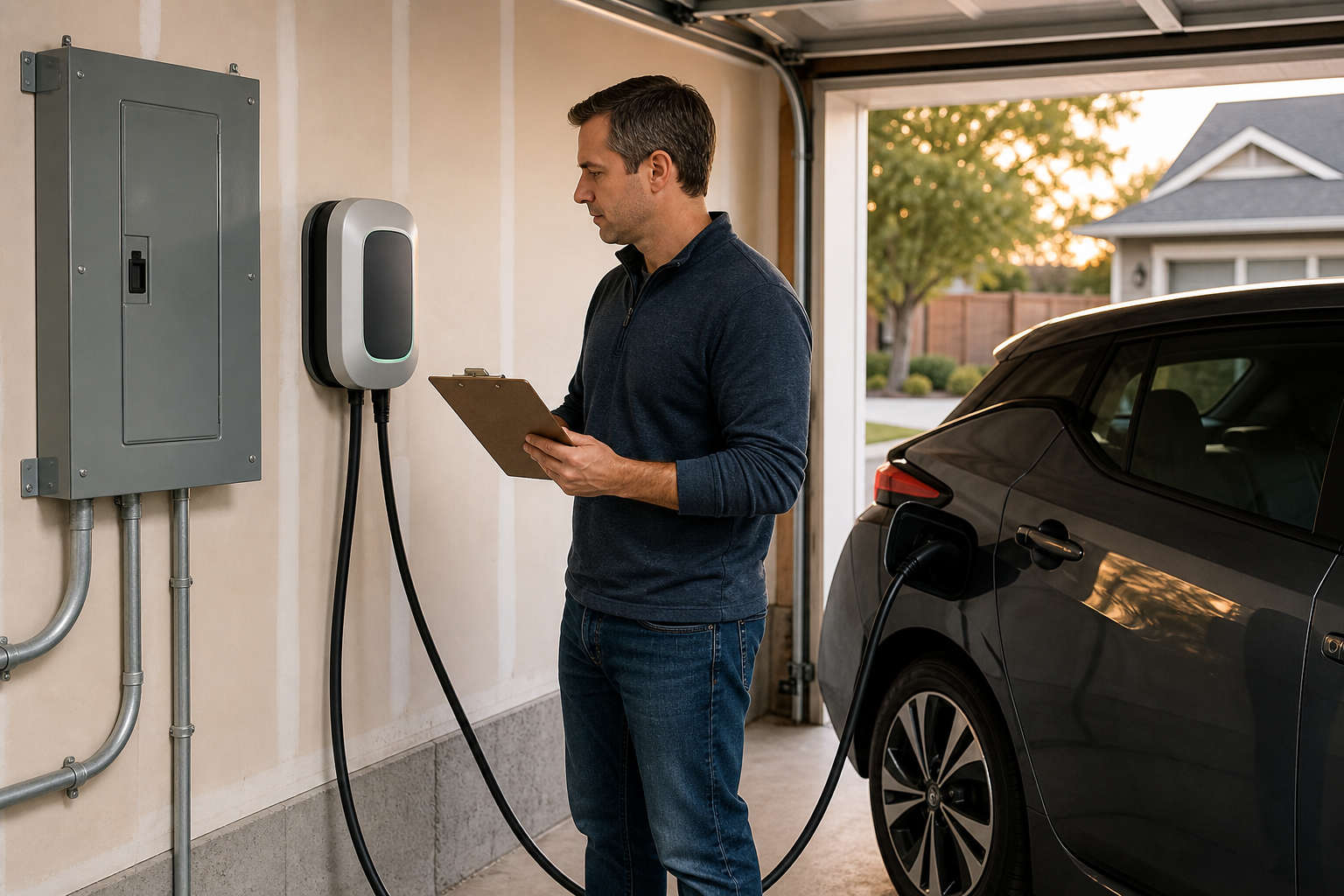
A hardwired Level 2 unit is usually covered by homeowners insurance as part of your dwelling, while a portable charger or its cable falls under comprehensive auto insurance. Think of a wall-mounted Tesla Wall Connector the same way you would think of a furnace, water heater, or built-in dishwasher: it is a fixture wired directly into your electrical panel, so it lives inside Coverage A (dwelling).
A Level 1 cord set that plugs into a standard 120-volt outlet is a different story. A standard homeowners policy excludes coverage for car equipment, accessories, and parts, and only comprehensive auto insurance will cover portable chargers, not homeowners insurance, because they are not an extension of the home but of the car and can be used anywhere.

Compare Home Insurance Plans in Ohio
Find your best options in less than 2 minutes
What Standard Policies Do and Do Not Pay For
Installation costs are on you
Before you file a claim expecting reimbursement for the electrician's invoice, know this: in most cases, homeowners insurance does not reimburse the cost of installing an EV charger because the project is voluntary and planned. That includes the charger unit, labor, permits, wiring, and any panel upgrade. Insurance responds to sudden losses, not scheduled improvements.
Damage from covered perils is generally paid
Once the charger is installed and something goes wrong, the picture improves. If a covered fire, lightning strike, windstorm, or another insured event damages the charger and the surrounding structure, the policy may help pay for repairs, subject to its deductible, exclusions, and coverage limits.
If you have a Level 2 charger installed at home, your homeowners insurance may help in these situations: damage to the charger itself (e.g., fire, lightning), and liability coverage for injuries that occur on your property (e.g., someone trips over your charging cable).
For a deeper dive on surge and lightning claims, see our guide on does home insurance cover power surge damage and the detailed lightning damage coverage explainer.
Theft of a portable charger is tricky
If your removable Level 1 charger has been stolen, an actual cash value replacement would typically be covered by your comprehensive auto policy, not your home policy. If the charger was inside a locked garage when it was taken, some homeowners policies may treat it as personal property, but many still exclude it as a vehicle accessory. Ask your agent to confirm in writing before you assume it is covered.

Protect your home with State Farm
Average Rate:
Homeowners who bundle and save with State Farm save an average of $1,000 per year!

You're in Good Hands® with Allstate
Average Rate:
Get comprehensive home coverage with flexible policy options.

Customize your home coverage
Average Rate:
Only pay for the coverage you need with personalized home insurance.

Smart coverage for your home
Average Rate:
Protect what matters most with award-winning home insurance.
Liability if Your Charger Causes a Fire
This is where a homeowners policy earns its keep. If a malfunctioning charger ignites a garage fire that spreads to your neighbor's fence, damages a visitor's car, or worse, injures someone, your liability coverage (typically $100,000 to $500,000) is what stands between you and a lawsuit.
A wall-mounted or hardwired unit could be part of a homeowners policy, and standard personal liability follows the same rules whether the incident involves a stove, a fireplace, or an EV charger.
Real-world claim examples
- Charger-caused garage fire: Wiring inside a wall-mounted charger overheats, ignites a stud bay, and destroys $40,000 of drywall, storage, and one vehicle. Dwelling and personal property coverage respond; the vehicle goes on the auto policy.
- Lightning surge: A nearby strike sends a surge through the panel and fries the charger's control board. Coverage A pays to replace the unit, subject to your deductible.
- Theft from an open driveway: A portable Level 1 cable is stolen off the driveway. Homeowners insurance likely denies it. Comprehensive auto may pay, minus deductible.
- Neighbor's car damaged: A short in your Wall Connector damages a visiting neighbor's EV during a courtesy top-off. Your liability coverage typically responds.
Should You Tell Your Insurer After Installing a Level 2 Charger?
Yes, in almost every case. Be sure to inform your insurer that you've installed an EV charger, especially if it required electrical work. It may be considered a "permanent fixture" and could affect your dwelling coverage limits.
It is wise to contact the insurer before or promptly after a permanent installation, especially when the project adds a 240-volt circuit, subpanel, upgraded service panel, or structural work.
Will your premium go up?
Usually not by much. For most households, installing a home charger rarely changes your premium on its own, though it can change how a claim is handled. Renewal barely moves. Any small bump you do see is typically tied to a higher dwelling replacement value (because you added a fixture and possibly a subpanel), not to the EV itself.
Panel Upgrades, Permits, and Code Compliance
A Level 2 charger draws 30 to 60 amps on a dedicated 240-volt circuit. Many homes with 100-amp service need a service upgrade to 200 amps before they can safely add one. This upgrade matters to your insurer for two reasons:
- It changes your rebuild cost. A new subpanel, service upgrade, and dedicated circuit can add $2,000 to $6,000 in replacement value. Your Coverage A limit should reflect that.
- It affects claim outcomes. Unpermitted or DIY electrical work is one of the fastest ways to get an EV charger claim denied.
If your project also involves broader electrical work, our overview of common home insurance exclusions explains why unpermitted upgrades so often trigger denials.
Common Exclusions and Specialized Endorsements
What is typically excluded
Even with a hardwired charger classified as a fixture, several situations will not be paid:
| Exclusion | Why It Applies |
|---|---|
| Faulty workmanship / installation | Insurers reject claims tied to poor or unlicensed work |
| Wear and tear | Gradual deterioration is a maintenance issue |
| Manufacturer defects | Handled under warranty, not insurance |
| Mechanical breakdown | Excluded unless you add an equipment breakdown endorsement |
| Use of non-OEM equipment | Some carriers exclude damage from off-brand accessories |
| Portable / plug-in cord sets | Treated as vehicle accessories on many policies |
Damage to a fixed (hard-wired) EV charger, including its cable if it's a tethered unit, is generally covered under the buildings section of a home insurance policy, provided the charger is affixed to the building, and the cause of damage isn't excluded (e.g., wear and tear, faulty workmanship, or defect).
Endorsements worth asking about
Some insurers may have a specific endorsement that you may add to your home, renters, condo or auto policy to help clarify electric vehicle supply equipment (EVSE) protection for theft and damage. State Farm, Allstate, Lemonade, and Liberty Mutual all offer variations. Homeowners insurance (or a separate endorsement) commonly covers damage to installed home chargers from covered perils; some auto insurers now offer EV-specific endorsements for chargers and charging-related services.
An equipment breakdown endorsement (typically $25 to $50 per year) is especially useful because it covers electrical and mechanical failures that the base policy excludes. This can be a lifesaver for a $700 to $1,500 Wall Connector that dies from an internal short.
For a broader look at how policies handle major home upgrades, see our guide on solar panels and home insurance coverage and the companion solar panel coverage and costs breakdown. Many of the same principles (notify insurer, increase dwelling limit, document installer credentials) apply directly to EV chargers.
If you ever need to file a claim, our power surge insurance claim checklist walks through exactly what adjusters want to see.
Frequently Asked Questions
Does homeowners insurance cover the cost of installing an EV charger?
No. Installation is treated as a voluntary home improvement, not a covered loss, so you pay for the charger, labor, permits, and any panel upgrade out of pocket. Once the charger is installed, though, damage to it from covered perils like fire or lightning is generally paid under your dwelling coverage.
Is a Tesla Wall Connector covered under my home insurance?
Yes, in most cases. A Tesla Wall Connector that is professionally hardwired and mounted to your home is treated as a fixture, similar to a water heater or furnace, and falls under Coverage A (dwelling). Damage from fire, lightning, vandalism, or theft is typically covered, subject to your deductible and any exclusions for faulty installation.
Will my premium go up after I install a Level 2 charger?
Usually the impact is minimal or zero. Most insurers do not surcharge for the charger itself, but if the installation raises your home's replacement cost (through a new subpanel or service upgrade), your dwelling limit should be adjusted and that can nudge the premium up slightly. The peace of mind of proper coverage far outweighs a small increase.
What happens if my EV charger causes a fire that damages my neighbor's property?
Your personal liability coverage (typically $100,000 to $500,000 on a standard homeowners policy) responds to bodily injury and property damage claims from third parties. Given the fire potential of 240-volt equipment, many EV owners raise liability limits to $500,000 or add a $1 million umbrella policy for $150 to $300 per year.
Are portable EV chargers covered if they are stolen from my car or garage?
It depends where they were stolen from. A portable Level 1 charger stolen from your vehicle is typically covered under comprehensive auto insurance, not homeowners. If it was stolen from inside a locked garage, your home policy's personal property coverage may respond, but some carriers still exclude portable chargers as vehicle accessories, so confirm with your agent.