
Compare Car Insurance Rates in Ohio
See if you qualify for a lower rate in less than 2 minutes



Step 1: What to Do at the Accident Scene
The moments right after an accident set the tone for your entire claim. Acting quickly and systematically protects both your safety and your legal rights.
Prioritize Safety First
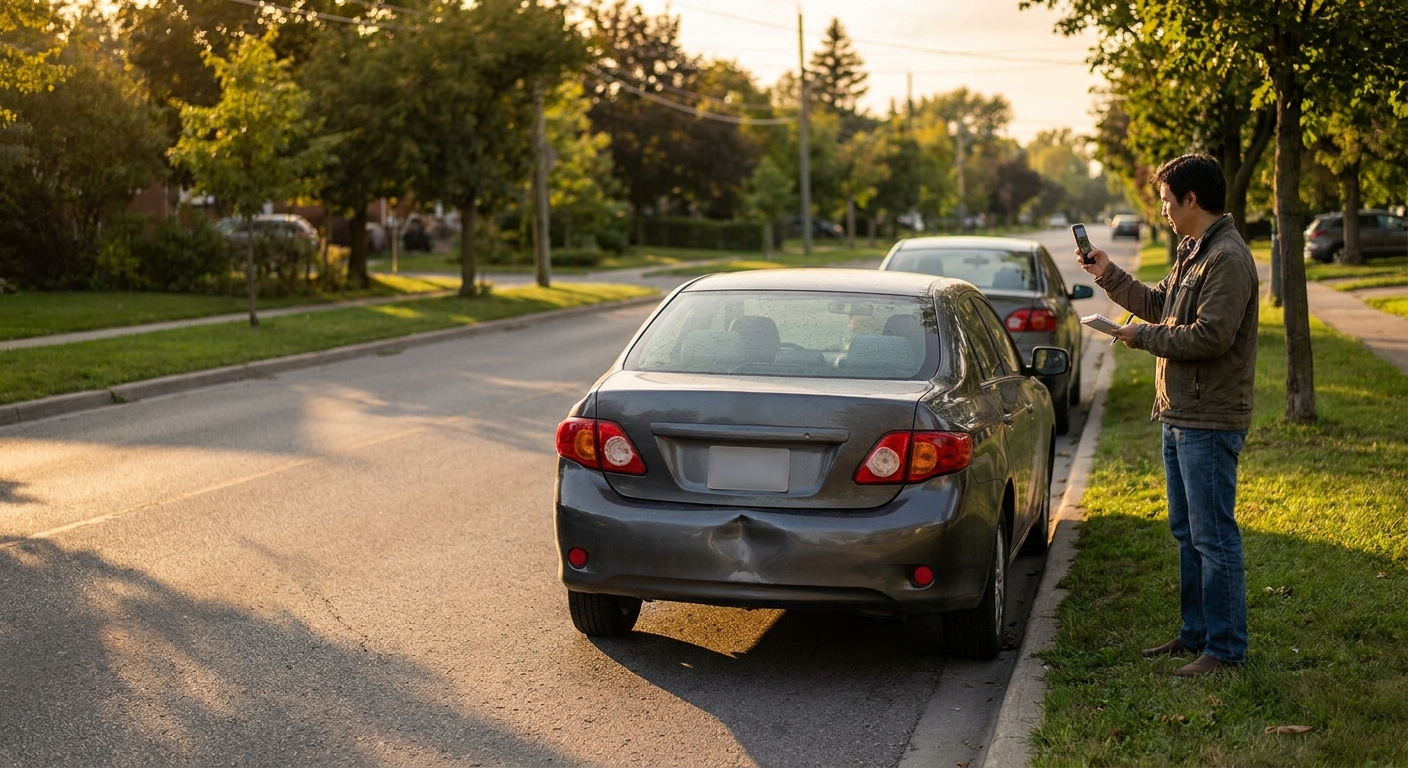
Move vehicles out of traffic if it's safe to do so, turn on your hazard lights, and call 911 if anyone is injured. Even if injuries seem minor, a police report creates an official record that your insurer will rely on. Do not admit fault. Even a casual "I'm sorry" can be used against you during the claims process.
Information to Gather at the Scene
Thorough documentation is your best asset. Use your smartphone to collect everything below:
| Category | What to Collect |
|---|---|
| Other Driver | Full name, phone, address, driver's license number, insurance company, policy number |
| Vehicle Details | Year, make, model, license plate, VIN (from registration) |
| Accident Facts | Date, time, exact location, direction of travel, weather/road conditions |
| Photos & Video | All vehicle damage, license plates, skid marks, traffic signs, road conditions |
| Witnesses | Names and phone numbers of anyone who saw the crash |
| Police Info | Officer name, badge number, department, and incident report number |

Compare Car Insurance Rates in Ohio
See if you qualify for a lower rate in less than 2 minutes
Step 2: Filing Your Car Insurance Claim
Once you're safe, contact your insurance company as soon as possible. Most policies require prompt notice, typically within 24 to 72 hours. Delays can give the insurer grounds to reduce or deny your claim. For a detailed walkthrough, see our step-by-step guide to filing a car insurance claim.
How to File: Your Options
Most major insurers offer three convenient filing methods, and digital-first filing is now the norm. In 2026, leading US and UK carriers report straight-through processing rates of 60% or more for motor claims under a defined severity threshold, meaning many simple claims are resolved without human touch:
Whichever method you choose, have the following ready:
- Your policy number
- Date, time, and location of the accident
- The other driver's information and insurance details
- Your photos, videos, and police report number
- Names and contact info of any witnesses
At-Fault vs. Not-at-Fault Claims
If you were at fault: You'll file under your own collision coverage. Your insurer pays for the other party's damages via your liability coverage and your own vehicle repairs (minus your deductible) through collision.
If you were not at fault: You have two options. File with the at-fault driver's insurance (third-party claim), or use your own collision coverage and let your insurer pursue reimbursement through subrogation. Using your own coverage is often faster, though you'll initially pay your deductible. Learn more about car insurance claim reimbursement and how subrogation can return your deductible.
Claim Types at a Glance
| Claim Type | When It Applies | Uses Your Deductible? |
|---|---|---|
| Collision | Your car hits another vehicle or object | Yes |
| Comprehensive | Theft, weather, vandalism, animal damage | Yes |
| Liability | You caused damage to others | No (paid to others) |
| UM/UIM | Other driver is uninsured or underinsured | Varies by state |
For a deeper look at what each coverage protects, see our guide on what car insurance actually covers and the difference between first-party and third-party coverage.

Protect your car with Farmers
Average Rate:
Find coverage options that fit your budget.

The insurance savings you expect.
Average Rate:
Enjoy personalized policies, comprehensive coverage & more.

See how much you could save today!
Average Rate:
Drivers who switch their auto insurance and save with State Farm save $764 on average!

Safe Drivers Save with Allstate®
Average Rate:
Get rewarded with savings for having a clean driving record.
Step 3: What Happens After You File
Once your claim is submitted, the insurer springs into action. AI-driven triage now classifies incoming claims by severity, complexity, and cost within minutes of first notice of loss. Here's the typical timeline from filing to settlement.
The Claims Timeline (2026)
| Stage | Typical Timeframe |
|---|---|
| Claim acknowledged | Minutes to 3 days |
| Adjuster assigned & contacts you | 1 to 3 business days |
| Investigation & fault determination | 1 to 4 weeks |
| Vehicle inspection & estimate | Same day (AI photo) to 2 weeks |
| Repair authorization | Shortly after estimate approval |
| Payment issued | 1 to 2 weeks after settlement agreement |
| Simple claims total | ~14 days (as fast as 24-48 hours with AI) |
| Complex/injury claims total | 3 to 6+ months |
The average auto insurance claim processing time in the U.S. is 14 days in 2026, down from 18 days in 2020. Industry data shows about 22% of claims resolving in under a week. Digital-first carriers close personal auto claims in roughly 15 days, while AI-assisted workflows compress average processing from about 14 days to under 5 days, with same-day settlement now possible for clear-cut damage.
The Adjuster's Role
An insurance adjuster is assigned to manage your claim from start to finish. Their responsibilities include confirming your coverage, investigating the accident, evaluating your vehicle damage, determining fault, and ultimately making a settlement offer. For a deeper look, read our guide on working with a car insurance claim adjuster.
Remember: The adjuster works for the insurance company, not for you. Their goal is to resolve the claim within policy terms while managing the insurer's costs. You have every right to question their findings, provide additional evidence, and negotiate. Under your policy, you also have a duty to mitigate damages by taking reasonable steps to prevent further loss.
The Inspection and Repair Estimate Process
Your vehicle will be inspected one of three ways:
- Virtual/photo inspection with AI (now the fastest-growing method). You upload guided photos via the insurer's app; computer vision generates a line-level estimate in seconds to minutes. Photo estimating accounted for about 26.4% of repairable claim inspections in 2025, per CCC's Crash Course 2026 report.
- Preferred shop inspection. You drop your car at a Direct Repair Program (DRP) shop where the insurer has pre-set rates.
- In-person field inspection. An adjuster meets you at your home, workplace, body shop, or tow yard, still common for complex or structural damage.
Learn more about how photo estimating is changing claims and how AI-powered claims automation is reshaping settlements.
The estimate will cover labor, parts (OEM vs. aftermarket), paint, and safety system recalibration. Total loss frequency reached a record 23.1% of all claims in 2025, while the average repair cost climbed to $4,818. ADAS calibration is now required on about 65% of collision repairs, though it appears on only around 35.6% of initial estimates. If hidden damage is discovered once repairs begin, the shop files a supplemental claim. Learn how to file a supplemental car insurance claim to make sure you're covered for everything.
To understand how insurers evaluate your vehicle in detail, check out how insurance companies assess car damage after an accident.
Step 4: Settlement, Payment & Dispute Resolution
Once the estimate is approved and repairs are authorized, the final stage begins: getting paid.
How Payment Works
For standard repairs, the insurer typically pays the shop directly. You pay your deductible directly to the shop when you pick up your vehicle. If your car is deemed a total loss (repair costs exceed the vehicle's actual cash value), the insurer offers you a cash payout based on your car's ACV. Nearly 1 in 4 crashed vehicles is now declared a total loss, and total loss frequency reached a record 23.1% of all claims in 2025, driven by rising vehicle prices and expensive ADAS repairs. For a complete breakdown, see what happens when your car is totaled.
What to Do If You Disagree With the Settlement
The first offer is rarely the best offer. If you believe the settlement is too low:
- Request a written explanation citing the specific policy language used
- Gather evidence including independent repair estimates, comparable vehicle listings, and medical documentation
- Submit a written counter-offer with your documented damages and a specific dollar amount
- Escalate internally by requesting a supervisor review or invoking the appraisal clause for vehicle valuation disputes
- File a state complaint. Your state's Department of Insurance can intervene if the insurer acts in bad faith
- Consult an attorney, especially for injury claims. Most personal injury attorneys offer free consultations on contingency
For a full walkthrough on negotiating, visit our guide on car insurance claim settlements, our resource on how to dispute a settlement, and our full dispute resolution guide. If your claim is denied outright, learn why claims get denied and how to fight back.
Will Filing a Claim Raise Your Premium?
Not always, but it often does. Auto insurance premiums increase by an average of 45.0% nationwide after an at-fault accident causing at least $2,000 in property damage. By percentage, rates after an at-fault accident rise the most in California, surging 70.7%. On top of that, ValuePenguin's 2026 analysis shows an at-fault accident raises car insurance rates by 49% on average, adding roughly $102 per month to a full coverage policy, and the surcharge typically sticks for three to five years. Here's a quick breakdown:
For small accidents close to your deductible, run the numbers before filing. If repairs are $1,400 and your deductible is $1,000, a potential 3-year rate increase may cost more than the $400 you'd receive. In fact, a growing share of drivers now report avoiding a claim entirely due to fear of premium increases. Always weigh the short-term payout against long-term premium impact. To dig deeper, see how car insurance premiums are calculated.
Frequently Asked Questions
How long does the car insurance claim process take in 2026?
Simple property damage claims with clear fault now average about 14 days, and AI-assisted claims can settle in as little as 24 to 48 hours for straightforward damage. More complex claims involving injuries, disputed fault, or total loss can take 3 to 6 months or longer. The timeline depends on how quickly fault is established, how fast your vehicle is inspected, and whether you and the insurer agree on the settlement amount.
What information should I gather after a car accident?
At a minimum, collect the other driver's name, phone number, license plate, insurance company, and policy number. Also photograph all vehicle damage from multiple angles, capture license plates, document road conditions, and get the police incident number. Witness contact information is especially valuable if fault may be disputed, and detailed photos help AI estimating tools generate a faster, more accurate repair estimate.
Can I choose my own repair shop for an insurance claim?
In most states, yes, you have the right to select any licensed repair shop. Your insurer may recommend a preferred Direct Repair Program (DRP) shop, which can speed up the process. If you choose your own shop and they charge more than the insurer's approved rate, you may need to negotiate the difference or pay it out of pocket. Learn more in our guide on car insurance terminology.
What happens if the at-fault driver doesn't have insurance?
If the other driver is uninsured or underinsured, you can file under your own Uninsured/Underinsured Motorist (UM/UIM) coverage if you carry it. This coverage pays for your vehicle damage and medical expenses when the responsible party can't. Without it, your only recourse may be suing the driver directly, which is often not financially worthwhile. Nationally, 15.4% of drivers carry no insurance at all, and adding underinsured motorists pushes the total to 33.4%, making UM/UIM coverage more important than ever. Read our hit and run insurance claims guide for related scenarios.
Does filing a car insurance claim affect my rates even if I wasn't at fault?
It depends on your insurer and your state. Many insurers do not surcharge not-at-fault claims, especially if your insurer recovers their costs through subrogation from the at-fault driver's insurer. However, some carriers and states do allow rate adjustments based on claim frequency, regardless of fault. Always ask your insurer directly before filing a borderline claim.