
Compare Car Insurance Rates in Ohio
See if you qualify for a lower rate in less than 2 minutes



The Internal Appeals Process: Your First Line of Defense
When your insurer denies a claim or offers a settlement that feels unfair, your first move is always to work within the company's own system before escalating elsewhere. Most insurance carriers maintain a formal internal appeal process, and using it correctly can resolve many disputes without ever involving outside parties.
Step 1: Review the Denial Letter Carefully
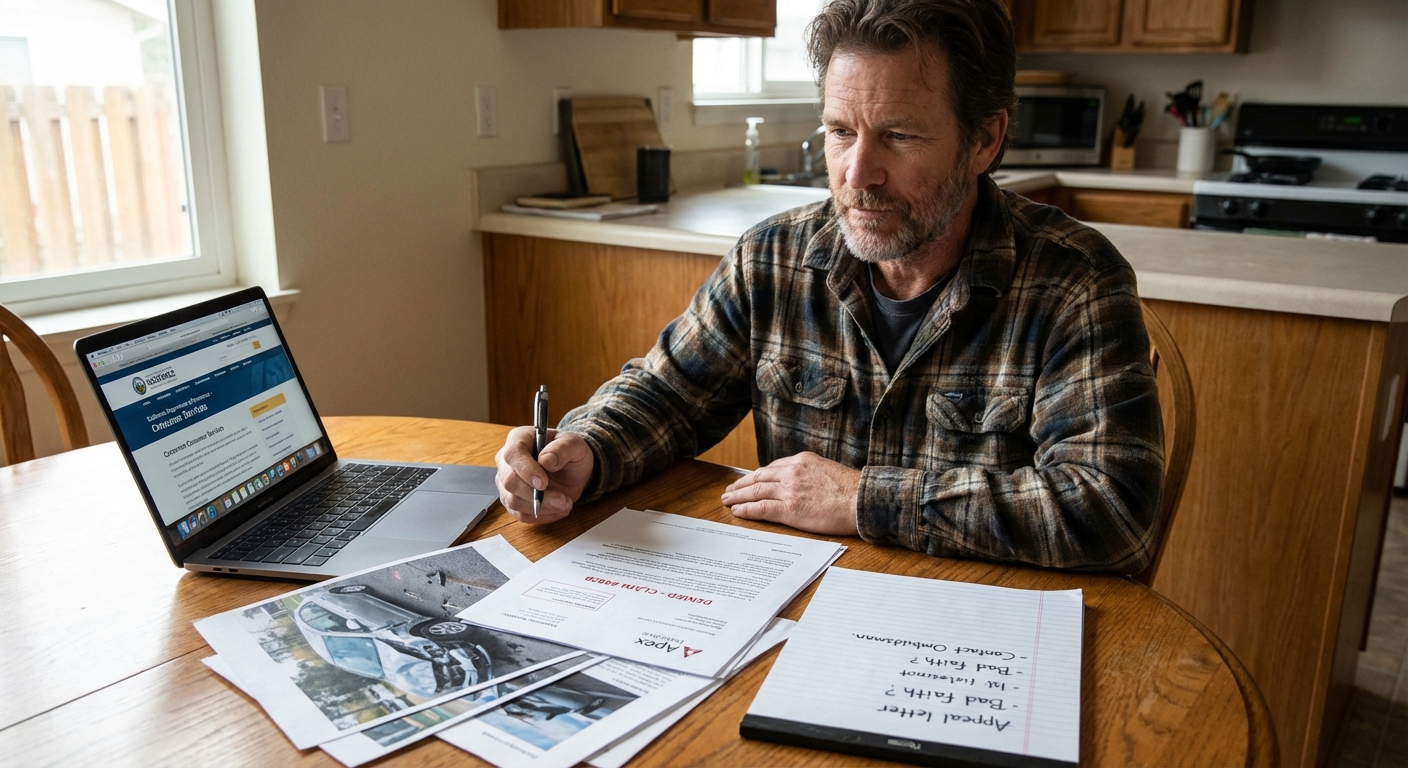
Your denial letter is your roadmap. It must state the exact reason for denial, whether it's a policy exclusion, missing documentation, or a coverage dispute. Note the appeal deadline listed in the letter, which is typically 30 to 60 days for auto insurance policies. Under existing standards for prompt, fair, and equitable settlements, insurers are expected to resolve claims within 30 days, so hold them to that timeline. In states with 2025-2026 AI transparency rules (Illinois, Michigan, Florida), you can also formally request clarification if the decision relied on artificial intelligence models.
Step 2: Build Your Case
Gather every piece of supporting evidence you can find:
- Your full insurance policy with relevant sections highlighted
- Photos of vehicle damage, the accident scene, or injuries
- Police or accident reports
- Repair estimates from at least two licensed shops
- Witness statements or contact information
- All prior communications with your adjuster
Step 3: Submit a Formal Written Appeal
Write a clear appeal letter addressed to the insurer's appeals department (check your denial notice for the address). Your letter should:
- Reference your policy number, claim number, and date of denial
- Quote the exact denial reason and explain why it is incorrect
- Cite the specific policy language that supports your position
- List all attached supporting documents
Step 4: Escalate to a Supervisor or Claims Manager
If the initial adjuster doesn't budge, explicitly request a second-level internal review by a supervisor or claims manager. This is a standard option at most insurers and brings fresh eyes to your claim. Internal review timelines typically run 30 to 90 days, so follow up proactively to keep your appeal moving. Learn more about what a car insurance claim adjuster does and how each type of adjuster operates within the process.

Compare Car Insurance Rates in Ohio
See if you qualify for a lower rate in less than 2 minutes
Escalating Outside the Company: Regulators & Dispute Tools
If internal appeals fail, several powerful external options can pressure your insurer into a fair resolution.
File a Complaint With Your State Insurance Department
Every state has a Department of Insurance (DOI) or Insurance Commissioner that regulates insurer conduct. Filing a formal complaint is free, requires no attorney, and puts your insurer on record with a government regulator. According to industry analysis, the DOI complaint pathway resolves roughly 40% to 60% of insurance disputes before bad-faith litigation becomes necessary, when filed correctly with the right evidence at the right stage. In 2025, state regulators recovered significant sums for consumers, including Missouri's $129 million total, Maryland's $70 million-plus (with a rapid-response program targeting auto and homeowners' claims), Colorado's $17.6 million (with $3.88 million recovered on auto complaints alone), Kansas's $56.7 million (with 1,091 auto complaints), and Pennsylvania's $133 million overall. Florida regulators moved in July 2026 toward finalizing a plan that would expand the state's mediation program to include auto claims disputes.
How to file:
- Visit your state DOI website or the NAIC consumer page to locate your state's portal
- Gather policy documents, denial letters, photos, and all correspondence
- Submit online, by mail, or by phone (most states accept all three methods)
- You'll typically receive an acknowledgment within 2 weeks, and your insurer must respond within 25 to 30 days depending on your state
| State Example | Insurer Response Deadline | Notes |
|---|---|---|
| California | 28 calendar days | Complaint required before access to state's Automobile Claims Mediation Program |
| Ohio | ~30 days | Analyst assigned; full investigation may take longer |
| Texas | 25 days | Insurer must respond to DOI; written reasons required when declining or canceling policies |
| Florida | ~30 days | 2026 rulemaking expanding mediation to auto claim disputes near final approval |
| Michigan | ~30 days | DIFS strengthened oversight in 2025; penalties include fines or license revocation |
Invoke the Appraisal Clause for Value Disputes
If you and your insurer agree a claim is covered but disagree on the dollar amount, the appraisal clause in your policy is one of the most effective tools available. Be aware that a growing trend shows insurers using employee adjusters as appraisers and rejecting most consumer-proposed umpires, creating deliberate delays. Know your rights before invoking it. Learn more about how the appraisal clause works in detail, including Texas SB 458 (Chapter 1813 of the Texas Insurance Code, applying to personal auto and residential property policies issued, delivered, or renewed on or after January 1, 2026, with either party able to unilaterally demand appraisal), Washington SB 5721 (requiring appraisal in every auto policy with first-party physical damage coverage and using a $500 cost-shifting trigger that reimburses the insured's appraisal costs if the appraised loss exceeds the insurer's prior adjustment), and Illinois HB 4160 (signed August 7, 2026 as Public Act 104-0767, effective July 1, 2027).
Here's how it works:
| Step | What Happens |
|---|---|
| 1. Written Demand | Either party sends a written request to invoke the appraisal clause. Under Texas SB 458, either party can demand appraisal unilaterally without mutual consent |
| 2. Each Side Hires an Appraiser | You hire one; the insurer hires one. Each party typically pays their own appraiser |
| 3. Appraisers Negotiate | Both appraisers assess the loss and attempt to agree on a value, typically within a 75-day window under TDI rules |
| 4. Umpire (If Needed) | If appraisers disagree, a neutral umpire is selected. Costs are typically split, and any two of the three must agree for a binding outcome |
Note: The appraisal clause only resolves disputes about the amount of loss, not whether your claim is covered. Experts generally recommend invoking it only when the dollar gap is significant, since appraiser fees ($300 to $900 each in 2026) and umpire costs can eat into smaller disputes. Under Texas SB 458, the appraisal award is binding except in cases of fraud, accident, material mistake, or an award made without authority.
Mediation vs. Arbitration: Know the Difference
For disputes that go beyond dollar amounts, car insurance arbitration and mediation offer two distinct paths. The American Arbitration Association (AAA) updated its Consumer Arbitration Rules effective May 1, 2025, and those rules continue to govern most consumer auto insurance disputes that reach AAA in 2026. Virtual hearings are now the default unless parties agree otherwise or the arbitrator orders an in-person hearing. Documents-only proceedings still apply to cases at or below $25,000, integrated Consumer Mediation Procedures (launched April 2025) are built in as a streamlined pre-arbitration option, and arbitrators received expanded discovery authority, expanded sanctions power, and the ability to administer appellate arbitration to a three-arbitrator panel where policies allow it. A 2026 compliance point worth noting: under AAA Rule R-12, a business identifying AAA as the arbitral forum must register its arbitration agreement with the AAA, or the AAA may decline to administer the case entirely. The Seventh Circuit clarified in May 2026 that refusing to register with AAA is not itself a refusal to arbitrate under the FAA, but it can still result in AAA declining the case.
Several states also run their own structured programs. California's Automobile Claims Mediation Program handles first-party physical damage disputes where the total claim exceeds $7,500 and the amount in dispute exceeds $2,000, with mediation available only after you file a formal complaint with the CDI first and give the insurer 28 calendar days to resolve it.
Mediation brings in a neutral third-party mediator who facilitates negotiation but has no authority to force a resolution. It's faster and cheaper than court, and you retain all legal rights if it fails.
Arbitration is more like a private court. A neutral arbitrator hears both sides and issues a binding decision. Many auto insurance policies include mandatory arbitration clauses, particularly for uninsured/underinsured motorist (UM/UIM) disputes. Check your policy carefully before assuming you can go straight to court.

Protect your car with Farmers
Average Rate:
Find coverage options that fit your budget.

The insurance savings you expect.
Average Rate:
Enjoy personalized policies, comprehensive coverage & more.

See how much you could save today!
Average Rate:
Drivers who switch their auto insurance and save with State Farm save $764 on average!

Safe Drivers Save with Allstate®
Average Rate:
Get rewarded with savings for having a clean driving record.
When to Bring In Professional Help
Sometimes a dispute becomes complex enough that you need expert firepower on your side. Two professionals, public adjusters and attorneys, serve very different roles. Recent 2026 case law shows courts remain willing to hold insurers accountable, and outcomes are stacking up in favor of policyholders on delay-based bad-faith theories. In California, the Court of Appeal's May 2026 Bornoff v. State Farm General Insurance Co. decision revived a bad-faith claim, holding that payment of policy benefits does not automatically defeat a bad-faith claim when the insured alleges unreasonable delay caused independent economic harm. In Washington, Division Two of the Court of Appeals ruled in June 2026 in Labeaume v. First National Insurance Company of America that an insurer cannot escape an Insurance Fair Conduct Act bad-faith lawsuit simply by paying an underinsured motorist award late. In Indiana, the Court of Appeals in May 2026 upheld a $3 million bad-faith verdict against Erie Insurance for denying a UM claim, ruling that policy limits do not cap bad-faith damages. Ohio's Supreme Court also reaffirmed in 2026 that bad-faith claims are not limited to outright denials but can arise from unreasonable delay or lowball offers. Learn more about the full fight-back process in our guide on how to fight a denied insurance claim.
Public Adjuster vs. Attorney: Who Do You Need?
| Public Adjuster | Attorney | |
|---|---|---|
| Best For | Undervalued or delayed claims | Denied claims, bad faith, litigation |
| What They Do | Documents damage, negotiates with insurer | Provides legal advice, files lawsuits |
| Fees | 10 to 20% of settlement (state caps apply) | 33 to 40% of settlement |
| Can Sue? | No | Yes |
| Ideal Stage | During active negotiation | After all other options fail |
2026 Public Adjuster Fee Update: State caps vary widely. Florida caps at 20% for standard claims and 10% for claims tied to a declared state of emergency (Fla. Stat. §626.854). Texas caps at 10% of the settlement (Tex. Ins. Code §4102.104). New York caps at 12.5% under 11 NYCRR 25.7. Illinois recently added a 10% cap for personal residence and catastrophic claims. West Virginia's 2026 HB 5392 reform caps fees at 10% for non-catastrophic claims and 5% for catastrophic claims. California has no general statutory percentage cap (fees must be reasonable and disclosed in writing under Cal. Ins. Code §15027), though AB 597 remains pending and would impose a 15% cap on catastrophe-related claims. Always verify your state's rules before signing any public adjuster contract.
The general rule: start with a public adjuster if your claim is disputed on value and coverage is not in question. Escalate to an attorney if the insurer is acting in bad faith, your claim was outright denied, or negotiations have completely stalled. For disputes over car insurance settlements, represented claimants consistently recover significantly more than those who go it alone. IRC data shows represented claimants recover roughly $77,600 gross vs. $17,600 for unrepresented, though they wait a median of 440 days to close.
Time Limits, Documentation, and State Deadlines
One of the most common (and costly) mistakes in insurance disputes is waiting too long. Deadlines operate at multiple levels simultaneously.
Document Everything From Day One
Strong documentation is the backbone of any successful dispute. Follow this checklist from the moment an incident occurs:
- 📸 Photos & video of all vehicle damage, the scene, and any injuries
- 📋 Police reports and accident exchange information
- 🧾 Repair estimates from at least two licensed shops
- 📞 Call logs with dates, times, and names of every person you speak with
- 📬 Certified mail for all formal letters and appeals
- 🗂️ Copies of everything submitted to your insurer
If your dispute involves a total loss, make sure you understand how insurers assess damage and what comparable vehicles are selling for in your market. This data is critical for total loss negotiation, especially with total loss frequency hitting a record 23.1% of all auto claims in CCC's 2026 Crash Course report (23.9% for non-comprehensive claims, with driveable total losses also climbing), while bodily injury severity jumped 10.3% year over year and calibrations now appear on 28.3% of repairable estimates, intensifying disputes over actual cash value.
Key Time Limits to Know
Deadlines exist at multiple stages of the dispute process. Missing any one of them can permanently eliminate your right to recover. For a complete state-by-state breakdown, see our statute of limitations guide. Statutes of limitations for car insurance claims typically range from 1 to 6 years for personal injury and 1 to 10 years for property damage, depending on state.
| Deadline Type | Typical Timeframe | Notes |
|---|---|---|
| Report claim to insurer | Immediately to 30 days | Varies by state and policy |
| Internal appeal filing | 30 to 60 days from denial | Always check your denial letter |
| State DOI complaint | Varies by state (often 1 to 4 months) | Check your state DOI website |
| Statute of limitations (personal injury) | 1 to 6 years by state | Starts from accident date |
| Statute of limitations (property damage) | 1 to 10 years by state | Starts from accident date |
Notable state limits for personal injury lawsuits:
- 1 year: Kentucky, Tennessee
- 2 years: Most states, including CA, TX, FL (for accidents on or after March 24, 2023), PA, AZ, AL, CT, DE, GA, HI, ID, IN, IA, KS, LA (eff. July 1, 2024), NV, OK, WV
- 3+ years: AR, CO, MD, MA, MI, MO (5 yrs), ME (6 yrs), ND (6 yrs), MN (6 yrs)
Notable state limits for property damage lawsuits:
- 1 year: Louisiana
- 2 years: Alabama, Alaska, Arizona, Texas, Pennsylvania, Connecticut, Kansas, Indiana, Montana, Oklahoma, West Virginia
- 4 years: Florida (property damage remains at 4 years under Fla. Stat. §95.11)
- 3 to 10 years: California (3 yrs), Illinois (5 yrs), Virginia (5 yrs), Oregon (6 yrs), Wisconsin (6 yrs), MN (6 yrs), RI (10 yrs)
Important state-specific updates: Florida's HB 837 (effective March 24, 2023) reduced the personal injury statute of limitations from 4 years to 2 years for crashes on or after that date, and replaced pure comparative negligence with a modified version (plaintiffs found more than 50% at fault cannot recover). Property damage remains at 4 years. New York's Assembly Bill A10008, effective for actions commenced on or after May 26, 2026, eliminated the "90/180-day" serious-injury category and added modified comparative fault rules. Louisiana extended its personal injury deadline from 1 to 2 years for injuries on or after July 1, 2024. Always verify your state's current limits with a local attorney or your state DOI.
For step-by-step guidance from the start of your claim, review how car insurance claims work, or learn what to do if you receive reimbursement for out-of-pocket costs. If hidden damage emerges mid-repair, our guide on filing a supplemental claim walks through submission timelines and denial appeals.
Frequently Asked Questions
What is the first step when my car insurance claim is denied?
Read your denial letter thoroughly to understand the exact reason for the denial and note the appeal deadline, typically 30 to 60 days. Then gather all supporting evidence (photos, police reports, repair estimates) and submit a formal written appeal letter to your insurer's appeals department. Reference your specific policy language and explain clearly why the denial is incorrect. If your initial adjuster won't reconsider, explicitly request a review by a supervisor or claims manager.
Can I take my insurance company to small claims court?
Yes, in most states you can sue your insurer in small claims court without an attorney if the disputed amount falls within your state's limit, which ranges from as low as $2,500 in some states to $25,000 in others. Small claims is best suited for clear-cut disputes like underpaid repairs or unreimbursed rental costs. Filing fees are generally $30 to $100, and hearings are typically scheduled within 30 to 60 days. The AAA's 2025 consumer rules also preserve your right to small claims court even when your policy has an arbitration clause.
What does the appraisal clause do and when should I use it?
The appraisal clause is a built-in policy provision that resolves disagreements about the dollar amount of a loss, not whether a claim is covered. Each side hires an independent appraiser; if they disagree, a neutral umpire casts the deciding vote, with the outcome being binding. It's most effective when the gap between your estimate and the insurer's offer is significant, as appraiser fees ($300 to $900 each in 2026) and umpire costs can outweigh the benefit on smaller disputes. Know your rights under your state's specific laws, like Texas SB 458 (mandatory binding appraisal for policies issued or renewed on or after January 1, 2026), Washington SB 5721 (with a $500 cost-shifting trigger), or Illinois HB 4160 (Public Act 104-0767, effective July 1, 2027).
How do I file a complaint with my state insurance department?
Visit your state's Department of Insurance website or go to NAIC.org to find your state's complaint portal. You can typically file online, by mail, or by phone, and most states acknowledge your complaint within two weeks. Your insurer is generally required to respond within 25 to 30 days, and your state regulator will investigate whether the company violated any fair claims handling laws. Industry data shows the DOI pathway resolves 40% to 60% of disputes before bad-faith litigation becomes necessary, and state regulators recovered record amounts for consumers in 2025, including Missouri's $129 million, Maryland's $70 million-plus, Kansas's $56.7 million, Pennsylvania's $133 million, and Colorado's $17.6 million totals.
When should I hire an insurance attorney instead of a public adjuster?
Hire an attorney when your claim has been outright denied, your insurer is acting in bad faith (unreasonable delays, misrepresentation, or lowball offers), or negotiations have completely failed and you need to pursue legal action. Recent 2026 rulings favor policyholders on delay-based theories: California's Bornoff v. State Farm revived a bad-faith delay claim, Washington's Labeaume v. First National rejected the "we paid late but paid" defense under the IFCA, and an Indiana appeals court upheld a $3 million bad-faith verdict against Erie Insurance holding that policy limits do not cap damages. Public adjusters are better suited when coverage is acknowledged but the settlement offer is too low. Most insurance attorneys work on contingency (33 to 40% of the recovery), so there's no upfront cost to get started.