
Compare Car Insurance Rates in Ohio
See if you qualify for a lower rate in less than 2 minutes



Why Imported Cars Are Harder to Insure
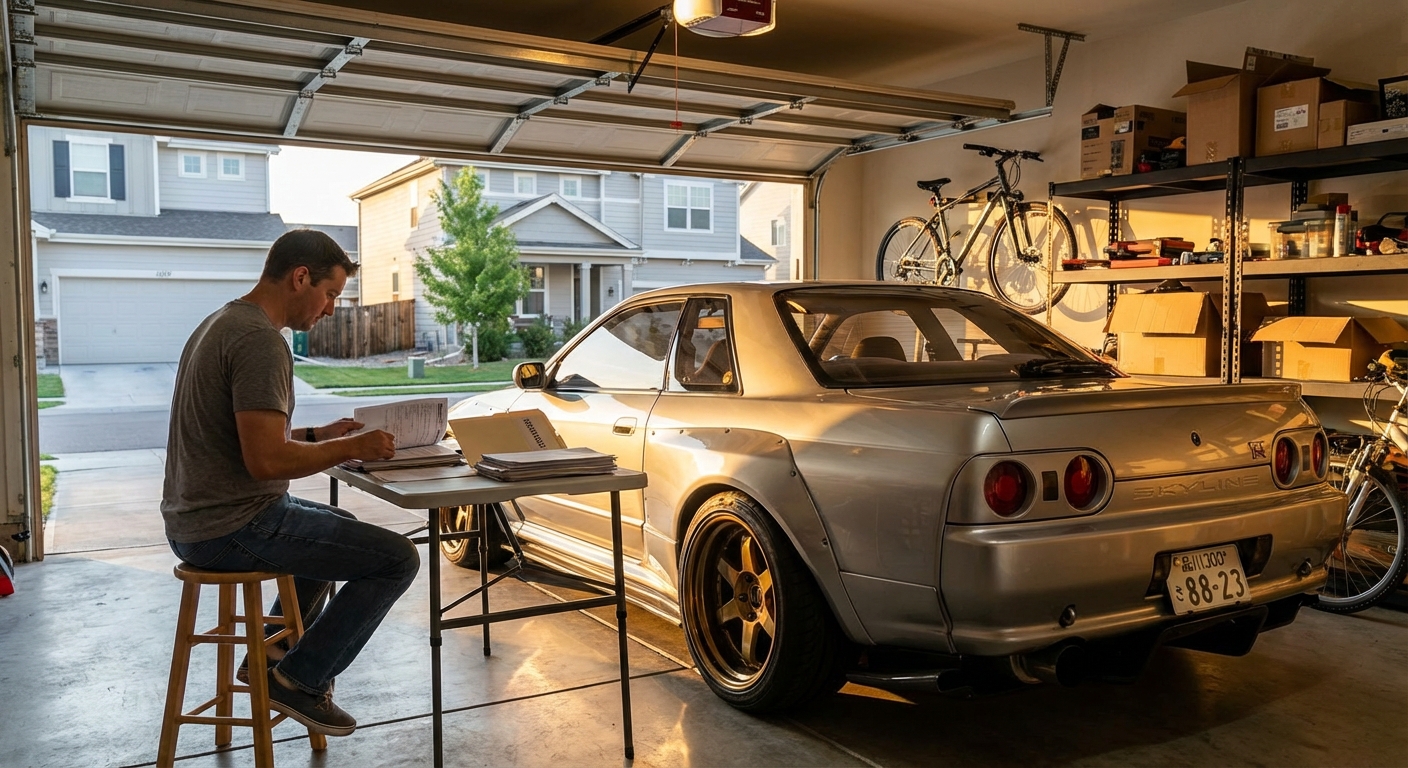
Owning a JDM Nissan Skyline GT-R, a Euro-spec BMW M3, or a right-hand drive (RHD) Mitsubishi Delica is a dream for many enthusiasts, but turning that dream into a properly insured reality in the United States is another story entirely. Standard insurance carriers are built around US-spec vehicles with predictable parts costs, crash-test data, and VIN structures. Grey market imports break almost every one of those assumptions.
Here are the core reasons why car insurance for imported vehicles is significantly more difficult to obtain than coverage for a standard US-market car:
The Problem With Non-Standard VINs
Every US-market vehicle comes with a 17-digit Vehicle Identification Number (VIN) that carries detailed information about the make, model, safety ratings, and country of manufacture. JDM and other foreign-market vehicles typically carry shorter, non-conforming chassis numbers that online quoting tools simply cannot process. When a VIN doesn't match the expected format, most insurance company systems automatically reject the application, forcing owners to work directly with specialist brokers rather than comparison websites.
Missing Claims Data and Actuarial Risk
Standard carriers use decades of US crash-test results, repair cost histories, theft rates, and claims data to calculate premiums accurately. For vehicles never officially sold in the US, none of that domestic data exists. Without it, insurers can't accurately price the risk, and when they can't, they either decline coverage outright or build in a substantial safety margin that inflates your premium by 30 to 50% or more compared to an equivalent US-spec vehicle. For context, Insurify's August 2026 data pegs the national full-coverage average at $187/month ($2,237/year), and an imported RHD Skyline typically prices well above that once specialty underwriting is factored in.
Parts Availability and Repair Complexity
Grey market imports require parts that may need to be sourced internationally, from Japanese auction houses, niche overseas suppliers, or enthusiast networks. Extended wait times for specialized components translate directly into higher claims costs for insurers. The 25% Section 232 tariff on imported auto parts remains fully in force in 2026 and continues to push repair costs higher across the board for import owners. Bilateral deals have reduced the effective rate to 15% for parts from Japan, the EU, and South Korea, and 10% on most UK-origin components, but parts from other countries still carry the full 25% duty. Finding a qualified mechanic familiar with RHD vehicles or JDM-spec engines also limits options and raises labor costs, both major red flags in any insurer's underwriting process. Learn more about how auto tariffs are affecting insurance costs for all import-heavy vehicles.

Compare Car Insurance Rates in Ohio
See if you qualify for a lower rate in less than 2 minutes
Compliance, Modifications & The 25-Year Rule
Before you can even think about insurance, your imported vehicle must be street-legal in the United States. This is where the regulatory picture gets complicated, and expensive.
The 25-Year Import Rule
Under US federal law, a vehicle must be at least 25 years old from its month of manufacture before it can be imported without meeting Federal Motor Vehicle Safety Standards (FMVSS) or EPA emissions requirements. As of 2026, vehicles manufactured in 2001 or earlier are eligible for import under this exemption, with each individual vehicle clearing the threshold on its exact 25th month-of-manufacture anniversary. A January 2001 build is eligible in January 2026, while a June 2001 build has to wait until June 2026. This rolling threshold has already opened up several iconic models in 2026, with more crossing the line each month:
| Eligibility Window in 2026 | Notable Model |
|---|---|
| February 2026 | Mitsubishi Lancer Evolution VII (CT9A) |
| July 2026 | Honda Integra Type R DC5 (JDM-only, distinct from US Acura RSX) |
| August 2026 | Mazda RX-7 FD3S Bathurst |
| December 2026 | Honda NSX (facelift) & Honda Civic Type R EP3 |
| Late 2026 | Nissan Silvia S15 Spec-R (late-2001 builds) |
| Late 2026 / early 2027 | Nissan Skyline R34 GT-R V-Spec II Nür & M-Spec Nür (late-2001 / early-2002 builds) |
| Rolling monthly | Honda S2000 (JDM AP1), Toyota MR-S / MR2 Spyder, Subaru Impreza WRX STI (GDB), Toyota Altezza RS200 |
Important 2026 Tariff Update: Vehicles 25 years or older are exempt from the 25% Section 232 auto tariff and are classified under a separate HTS heading, generally paying the 2.5% base customs duty. However, depending on the country of origin, reciprocal or baseline tariffs may apply on top of the base rate. Vehicles from Japan, the EU, and South Korea now face a 15% total effective rate under bilateral arrangements, and most UK vehicles are at 10%. On August 19, 2026, the US and Canada announced a trade framework targeting a 15% top-line rate on Canadian-built vehicles, though details are still being finalized. Always verify the exact duty with US Customs and Border Protection before importing.
Vehicles that are under 25 years old must go through a Registered Importer (RI) authorized by NHTSA, a process that can easily cost $10,000 or more and may involve:
| Modification Required | Purpose |
|---|---|
| Speedometer conversion (km/h to mph) | DOT readability compliance |
| DOT-approved headlights (US beam pattern) | FMVSS visibility standards |
| 5 mph impact-compliant bumpers | US crash protection standards |
| Amber side markers and turn signals | FMVSS visibility requirements |
| US-spec airbags and seatbelt pretensioners | DOT crash protection |
| Catalytic converter and emissions upgrades | EPA compliance |
Vehicles 25 years or older are exempt from FMVSS and EPA requirements at the federal level, though states like California still require additional smog compliance testing and state registration inspections.
Right-Hand Drive Considerations
RHD vehicles are legal to own and drive in all 50 states, but many insurance carriers aren't familiar with them and may decline coverage or apply higher premiums due to perceived increased accident risk. Some states also have restrictions on RHD use in commercial or mail carrier applications, which can complicate fleet-level coverage.

Protect your car with Farmers
Average Rate:
Find coverage options that fit your budget.

The insurance savings you expect.
Average Rate:
Enjoy personalized policies, comprehensive coverage & more.

See how much you could save today!
Average Rate:
Drivers who switch their auto insurance and save with State Farm save $764 on average!

Safe Drivers Save with Allstate®
Average Rate:
Get rewarded with savings for having a clean driving record.
Which Companies Insure Imported Vehicles?
The short answer: not many standard carriers will. But there are specialized options, and for daily drivers versus collector use, your choices differ significantly.
Here are the main categories of insurers to explore:
Specialty Collector and Enthusiast Insurers
Companies like Hagerty, American Collectors Insurance, and Grundy specialize in collector and exotic vehicles and are experienced with agreed value policies for cars with no US-market equivalent. Hagerty's Exotic & Import program explicitly covers collector vehicles 1980 and newer, including low-production and import models, with Guaranteed Value® coverage. As of January 2026, Hagerty moved to a 100% quota share arrangement with its long-term reinsurance partner Markel, retaining 100% of the premium and risk on its underwriting book. Hagerty's Vehicle Under Construction option automatically increases your car's Guaranteed Value® by 10% per quarter (up to a $25,000 max increase) and adds $750 of coverage for automotive tools, ideal for imports being brought into compliance. The Cherished Salvage® option lets you keep the car after a total loss and still receive the full agreed value, a huge win for irreplaceable imports.
Learn more about how classic car insurance works, since many JDM imports qualify as collector vehicles. JDM imports remain among the strongest-appreciating collector vehicles, with clean R34 GT-Rs trading in the $150,000 to $270,000+ range in 2026. Classic.com data shows R34 V-Spec II auction averages around $232,599, while V-Spec II Nür examples average nearly $384,000, and 2002 M-Spec Nür examples have set records above $675,000. A recent Broad Arrow auction estimated a 2002 V-Spec II Nür at $440,000 to $530,000, and museum-grade examples continue to break into the $700,000+ range at top-tier sales.
Import-Focused Brokers
Traction Insurance remains one of the few US brokers that explicitly specializes in covering JDM, British (UKDM), German (DTM), and other grey market imports, including non-standard and short VINs. Traction works with several carrier partners that understand import vehicle complexities and can often deliver rates lower than traditional collector car insurers. Confirm state availability before applying, and be ready to provide detailed documentation on import status and vehicle condition. For daily-driven imports, Traction is frequently the most viable path to real coverage.
Mainstream Carriers (Limited Basis)
Progressive is one of the more accommodating mainstream carriers for JDM daily drivers, but coverage must be arranged through a licensed agent who can manually override the VIN format requirement, as online quoting will be rejected. Progressive caps its coverage at $150,000 in vehicle value, so ultra-rare imports like a pristine R34 GT-R V-Spec II Nür may require a specialty insurer instead. State Farm and USAA may also offer basic liability or standard coverage for some legally imported and registered vehicles, but they are unlikely to provide agreed value coverage and may significantly undervalue the vehicle in a total loss claim. For non-standard vehicles, also consider reading about non-standard auto insurance options. If your import falls in the high-value range, luxury and exotic car insurance carriers like Chubb or AIG Private Client may also be worth exploring.
Agreed Value Policies & Documentation
Why Agreed Value Coverage Matters for Imports
An agreed value policy sets a fixed payout amount, mutually agreed upon by you and the insurer, at the start of the policy period. If your vehicle is totaled or stolen, you receive that agreed amount in full, with no depreciation deducted. This is the preferred policy type for grey market and JDM imports because:
- There is no US-market equivalent to establish an "actual cash value" baseline
- Import values often appreciate, not depreciate, especially iconic JDM models with growing demand under the 25-year rule (top-tier R34 GT-Rs now range from $150K into the $600K to $700K+ tier for Nür variants as more late builds become US-eligible)
- Compliance modifications, tariff-inflated parts, and aftermarket upgrades add significant value not captured by ACV models
The alternative, an actual cash value (ACV) policy, pays the depreciated market value at the time of the claim, which for a rare import with no US comps can be highly subjective and frequently results in a settlement far below what the owner invested. A stated value policy is a middle ground, but it pays the lesser of your stated amount or the ACV at time of loss, still leaving you exposed. For a deeper dive on how depreciation-based payouts are calculated, see our guide on actual cash value in car insurance.
For help understanding how modifications interact with your coverage, review custom parts and equipment coverage if your import has significant aftermarket or compliance upgrades.
| Policy Type | How It Pays | Best For |
|---|---|---|
| Agreed Value | Full pre-set amount, no depreciation | JDM imports, collector cars, appreciating vehicles |
| Stated Value | Lesser of stated amount or ACV | Budget option, some risk of underpayment |
| Actual Cash Value | Depreciated market value at time of claim | Standard daily drivers with US-market comps |
Documentation You'll Need
Specialty carriers and brokers will require thorough documentation to write an agreed value policy on an imported vehicle. Gather the following before approaching an insurer:
| Document | Purpose |
|---|---|
| US Title (state-issued) | Proof of legal ownership and registration |
| CBP Entry / Customs Clearance Forms (CBP 7501) | Proof vehicle legally cleared US customs |
| NHTSA / DOT Compliance Certificate (HS-7) | Confirms FMVSS compliance or 25-year exemption |
| EPA Compliance / Exemption Letter (Form 3520-1) | Confirms emissions compliance |
| Original Foreign Title (Japanese, UK, etc.) | Provenance and history documentation |
| Professional Appraisal | Establishes agreed value for the policy |
| High-Resolution Photos | Exterior, interior, engine bay, and undercarriage |
| JDM Auction Sheet (if applicable) | Provides grading history and factory spec verification |
| Import/Purchase Invoice | Documents landed cost including shipping and duties |
| Modification Receipts | Documents compliance and upgrade costs |
If your vehicle is from Japan, providing auction data from platforms like Goo-net or USS Tokyo can help establish a defensible market value for the appraisal. JDM values have continued to appreciate as iconic 2001 builds cross the 25-year line in 2026, and with tariff-driven demand pushing prices higher, locking in an agreed value policy sooner rather than later is a smart move.
Also remember: disclose all modifications to your insurer before binding coverage. Undisclosed modifications can void your policy in the event of a claim, a risk that's particularly costly on a high-value import. See our modified car insurance guide for a full breakdown of what must be declared and how it affects your rate.
Frequently Asked Questions
Can I insure a grey market or JDM car with a regular insurance company?
Some mainstream carriers like Progressive, State Farm, and USAA may offer basic coverage for legally registered imports, but they often can't process non-standard VINs through their online systems and rarely offer agreed value policies tailored to these vehicles. For Progressive, you'll need to work directly with a licensed agent who can manually override the VIN field, and be aware of the $150,000 vehicle value cap. For meaningful protection that reflects the true value of your import, a specialist insurer or broker is almost always the better path. Explore non-standard auto insurance options if mainstream carriers decline your application.
Is right-hand drive car insurance available in all US states?
Yes, RHD vehicles are legal to own and insure in all 50 states. However, not all insurance carriers are comfortable underwriting them, which can limit your options considerably. Specialist brokers like Traction Insurance and collector insurers like Hagerty handle RHD vehicles regularly and can connect you with carriers that understand the configuration. Some states may have specific registration inspection requirements for RHD vehicles, so always confirm local DMV rules before completing your purchase.
What is the 25-year rule and how does it affect insurance?
The 25-year rule is a federal regulation that allows vehicles aged 25 or more years to be imported into the US without meeting FMVSS safety or EPA emissions standards. As of 2026, vehicles manufactured in 2001 or earlier are now eligible, opening up models like the Mitsubishi Lancer Evolution VII (February), Honda Integra Type R DC5 (July), Mazda RX-7 FD Bathurst (August), and the Honda NSX facelift and Civic Type R EP3 arriving in December 2026. From an insurance standpoint, vehicles imported under this rule are generally easier to insure because they're compliant by default, and they are exempt from the 25% Section 232 tariff. Learn how classic car insurance policies are often the best fit for these newly eligible imports.
How do 2026 tariffs affect the cost of insuring an imported vehicle?
The 25% Section 232 tariff on imported passenger vehicles and auto parts remains fully in force in August 2026 and continues to affect all import owners by raising the cost of sourcing replacement components. Bilateral deals have set the effective rate at 15% for Japan, the EU, and South Korea, and 10% on most UK vehicles, but parts from other countries still carry the full 25% duty. Replacement part costs are running 15 to 25% higher for tariff-affected vehicles, and Insurify's August 2026 data shows the national full-coverage average at $2,237/year (with a projected year-end figure of about $2,242, up 1%). See our deep-dive on how tariffs are driving up car insurance rates for the full picture.
What's the difference between agreed value and stated value insurance?
An agreed value policy pays the full pre-set amount in the event of a total loss, with no depreciation applied. What you and the insurer agreed to at policy inception is what you receive. A stated value policy, by contrast, pays the lesser of the stated amount or the actual cash value at the time of loss, meaning you may receive significantly less than expected if your vehicle's ACV is assessed below your stated figure. For imported vehicles with no domestic market equivalent, agreed value coverage is strongly recommended to avoid an unexpected shortfall after a claim, particularly as JDM values continue appreciating in 2026.