
Compare Car Insurance Rates in Ohio
See if you qualify for a lower rate in less than 2 minutes



What Is Concurrent Causation and Why Does It Matter?
Concurrent causation is a concept that arises when two or more perils, one covered by your policy and one excluded, act together to produce a single, indivisible loss. Under the traditional concurrent causation doctrine, courts generally held that if a covered peril was part of the causal chain, the entire claim should be paid. This was considered the fair, policyholder-friendly standard.
For example, imagine floodwaters weaken a riverbank, causing a landslide that damages your parked vehicle. The landslide (an excluded peril) and the flood (also often excluded) combine to total your car. But what if a covered peril like wind or collision was also involved? That's where things get complicated, and that's exactly where the anti-concurrent causation clause enters the picture.
| Type of Causation | What It Means | Default Coverage Outcome |
|---|---|---|
| Single covered peril | Only a covered cause damages your vehicle | Claim is paid |
| Single excluded peril | Only an excluded cause damages your vehicle | Claim is denied |
| Concurrent causation | Covered + excluded peril combine to cause loss | Traditionally covered under the doctrine |
| Anti-concurrent causation | Insurer applies ACC clause to concurrent loss | Entire claim denied, even covered portion |

Compare Car Insurance Rates in Ohio
See if you qualify for a lower rate in less than 2 minutes
How the Anti-Concurrent Causation Clause Works to Deny Claims
The anti-concurrent causation (ACC) clause is a provision insurers include in policy exclusion sections to override the pro-policyholder concurrent causation doctrine. It states that a loss is excluded if an excluded peril contributed to the damage in any way, in any sequence, or at any time, even if a covered peril also played a role.
The language typically reads something like:
"We will not pay for loss or damage caused directly or indirectly by [excluded peril]. Such loss is excluded regardless of any other cause or event that contributes concurrently or in any sequence to the loss."
This is a sweeping clause. It doesn't require the excluded peril to be the primary cause. It only requires that the excluded peril be somewhere in the chain of events. The result: insurers can deny the entire claim, including the covered portion, without having to separate or apportion the two causes of damage.
As of August 2026, ACC clauses remain enforceable in most U.S. states, with no uniform federal prohibition. Their enforceability continues to vary significantly by jurisdiction, and 2025 through 2026 has produced a mix of pro-insurer and pro-policyholder rulings. Federal decisions like Dalmac Realty LLC v. Scottsdale Insurance Co. (D. Conn., late 2025) and Lawrence v. State Farm Fire & Cas. Co. (N.D. Iowa, June 25, 2025) enforced broad ACC language, holding that even a covered burst pipe that triggered excluded earth movement resulted in a full denial. The Illinois Appellate Court's Bozek v. Erie Insurance Group decision, a case of first impression in Illinois, broadly enforced ACC language, holding as a matter of law that coverage was barred where the loss resulted from the "convergence of two causes," at least one of which was excluded. On June 26, 2026, the Third Circuit (applying New Jersey principles) enforced ACC and anti-sequential language in Riya Dev Corp. v. Amguard Insurance Co., requiring the insured to produce expert evidence rebutting the excluded cause's contribution. Note that Riya Dev was designated nonprecedential under Third Circuit IOP 5.7, meaning it carries persuasive rather than binding weight. On the policyholder side, on February 4, 2026 the Florida Third District Court of Appeal affirmed a jury verdict for the insured in Citizens Property Insurance Corp. v. Blanco (No. 3D23-2271), rejecting the carrier's ACC defense and reinforcing that causation is often a fact question for a jury. Learn more about your rights when it comes to disputing claim denials if an ACC clause is used against you.

Protect your car with Farmers
Average Rate:
Find coverage options that fit your budget.

The insurance savings you expect.
Average Rate:
Enjoy personalized policies, comprehensive coverage & more.

See how much you could save today!
Average Rate:
Drivers who switch their auto insurance and save with State Farm save $764 on average!

Safe Drivers Save with Allstate®
Average Rate:
Get rewarded with savings for having a clean driving record.
Real-World ACC Claim Denial Examples
Understanding the ACC clause in abstract terms is helpful, but seeing how it plays out in actual claim scenarios makes the risk much more concrete. If your claim has ever been denied, learning why claims get denied and how to fight back can give you a solid starting point.
Example 1: Flood + Collision
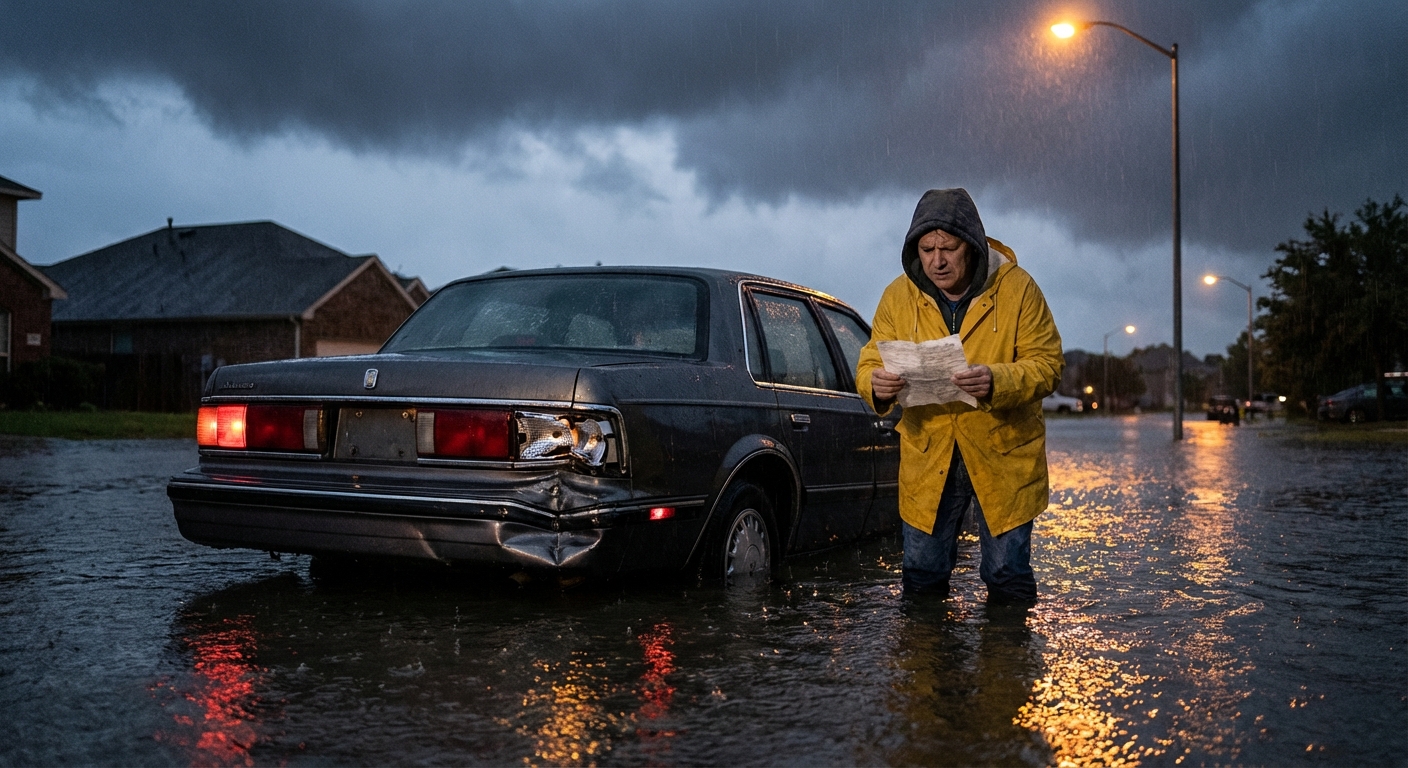
You're driving during a flash flood and hydroplane off the road, striking a guardrail. Your vehicle sustains collision damage (a covered peril under your collision coverage) and flood damage (an excluded peril under most standard auto policies). When you file your claim, the insurer discovers that floodwater entered the engine compartment and contributed to the total loss.
Result with ACC clause: The insurer denies the entire claim, including the collision portion, because flood, an excluded peril, contributed to the loss "in any sequence." Florida's OIR issued a February 20, 2025 informational memorandum reminding insurers to properly evaluate concurrent causation claims, and followed up with an April 9, 2025 announcement expanding required reporting on closed-without-payment claims from the 2024 hurricane season (Debby, Helene, and Milton). Commissioner Yaworsky's OIR now publishes expanded closed-without-payment data on its public website, and has warned that improper ACC denials will result in administrative action and consumer restitution. Learn more about hurricane and flood coverage for your car if you live in a storm-prone area.
Example 2: Earthquake + Vandalism
An earthquake causes a retaining wall to collapse onto your vehicle (excluded peril). During the chaos, vandals also break your windows and slash your tires (covered under comprehensive). You file a comprehensive claim for the vandalism.
Result with ACC clause: If your policy excludes earthquake damage and contains an ACC clause, the insurer may deny the vandalism portion entirely because the earthquake, an excluded peril, "contributed concurrently to the loss." Understanding what comprehensive coverage protects and how it applies to natural disasters can help you evaluate whether an ACC-based denial in this scenario is defensible.
Example 3: Mechanical Breakdown + Collision
Your brakes fail (mechanical breakdown, often excluded), causing you to rear-end another vehicle. The collision caused the physical damage.
Result with ACC clause: In policies where mechanical or electrical failure is excluded and ACC language is present, the insurer may attempt to deny coverage by arguing that the excluded mechanical failure was a contributing concurrent cause. This is one of the most frequently cited exclusions in ACC-related auto claim disputes. A thorough damage assessment that clearly separates mechanical-failure damage from collision damage is critical in these cases.
States That Limit or Prohibit ACC Clauses
Not all states allow insurers to use anti-concurrent causation clauses freely. Enforceability varies significantly depending on where you live. As of August 2026, four states clearly refuse to enforce ACC clauses: California, North Dakota, Washington, and West Virginia. California and North Dakota invalidate ACC language by statute, while Washington and West Virginia do so through high-court precedent. No additional states enacted full ACC prohibitions in the 2025 or 2026 sessions. New York's S6205 (introduced March 6, 2025 by Senator James Skoufis) remains stalled in the Senate Insurance Committee as of August 2026, with no floor action or committee vote recorded, and its Assembly companion A6205 is similarly stuck in committee. New Jersey's A3902, pre-filed for the 2026 session, would prohibit ACC clauses in homeowners policies but has not been enacted and does not currently apply to auto coverage.
| State | ACC Clause Status | Governing Rule |
|---|---|---|
| California | Prohibited / Unenforceable | Efficient proximate cause doctrine (Insurance Code §§ 530, 532); Garvey v. State Farm (1989); Julian v. Hartford Underwriters |
| Washington | Prohibited / Unenforceable | Efficient proximate cause rules override ACC; Safeco v. Hirschmann (1989); McDonald v. State Farm voids ACC |
| North Dakota | Prohibited / Unenforceable | State statute (N.D. Cent. Code § 26.1-32-03) invalidates ACC language |
| West Virginia | Prohibited / Unenforceable | Murray v. State Farm deems ACC clauses unconscionable |
| Mississippi | Limited | ACC applies only when two causes occur simultaneously, not sequentially; Corban v. USAA (2009) |
| Arizona | Limited | ACC enforced generally but invalid in fire policies; Millar v. State Farm (1990); Stankova v. Metro. P&C (9th Cir. 2015) |
| Maryland | Limited | Insurers must provide annual written notices explaining the ACC clause; Insurance Code § 19-215 |
| New Jersey | Enforced (Homeowners Bill Pending) | Third Circuit's June 2026 Riya Dev Corp. v. Amguard enforced ACC under NJ principles; A3902 (2026) would ban ACC in homeowners policies only |
| New York | Enforced (Pending Legislation) | S6205 (Skoufis) referred to Senate Insurance Committee March 6, 2025; still in committee as of August 2026 |
| Illinois | Enforced (2026 appellate ruling) | Bozek v. Erie Insurance Group upheld ACC as a matter of law where two causes converged |
| Florida, Texas, Colorado, Alabama | Enforced as Written | ACC clauses generally upheld if clearly worded; Texas JAW The Pointe v. Lexington |
In California and Washington, the efficient proximate cause doctrine is the controlling standard. Under this rule, courts look at which peril was the dominant or primary cause of the loss, and if that peril is covered, the claim must be paid regardless of secondary excluded causes. California Insurance Code § 530 codifies this rule, and the California Department of Insurance has issued formal notices confirming that insurers cannot contract around it through ACC language. This makes ACC clauses largely unenforceable in those states. North Dakota and West Virginia similarly decline to enforce ACC clauses under their respective statutory and common-law rules.
New York's S6205 would add Insurance Law § 3463 to prohibit insurers from denying coverage for a loss caused by a covered peril solely because a flood event contributed as a concurrent or simultaneous factor. It has remained in the Senate Insurance Committee throughout the entire 2025-2026 legislative session, with its Assembly companion similarly stalled in committee. Because it was not enacted, ACC clauses remain fully enforceable in New York homeowner and auto policies.
Florida's regulatory push has intensified through 2025 and into 2026. Following the February 20, 2025 informational memorandum, Commissioner Yaworsky's April 9, 2025 announcement made clear OIR is scouring closed-without-payment data from the 2024 storms, demanding more detailed answers, and updating its public reporting to show every reason claims were closed without payment, particularly those involving concurrent causation. Florida also enacted HB 527 (CS/CS/HB 527), effective July 1, 2026, which prohibits insurers, workers' comp carriers, and HMOs from using AI or machine learning as the sole basis for denying or reducing a claim, and requires a qualified human professional to make the final denial decision. That new rule adds a layer of protection against automated ACC-based denials, especially in complex claims where causation is a fact question. OIR's mid-2026 proposed market-conduct exam methodology rules would also treat post-catastrophe claim-handling complaint ratios in the top 20% as an independent trigger for regulatory examination.
How to Find ACC Language in Your Policy
ACC clauses are intentionally buried in the exclusions section of your policy. Here's how to locate them:
- Open your policy's Declarations or Full Policy Document, usually available via your insurer's online portal or by request.
- Navigate to the "Exclusions" or "Causes of Loss" section, where excluded perils are listed.
- Search for these trigger phrases:
- "concurrently"
- "in any sequence"
- "regardless of any other cause"
- "directly or indirectly"
- "whether or not combined with"
- Look at the preamble to exclusions. Many ACC clauses appear as a blanket statement that applies to all listed exclusions, not just one.
If you find language stating the exclusion applies "regardless of any other cause or event that contributes concurrently or in any sequence to the loss", that is a classic ACC clause.
If you can't find this language, your policy may default to the pro-policyholder concurrent causation doctrine. However, you should confirm this interpretation with an insurance attorney or licensed public adjuster. You can also reference this glossary of car insurance terms to help decode confusing policy language before it becomes a claim problem.
How to Dispute an ACC-Based Claim Denial
If your claim has been denied citing the anti-concurrent causation clause, you have options. The process requires persistence, documentation, and in many cases professional help. Understanding how the insurance appraisal clause works can also be a powerful tool in your arsenal.
Step 1: Request the Full Denial Letter
Demand a written denial letter that specifically cites the exact policy language used to deny your claim, including the section, page, and paragraph of the exclusion. Vague denials are harder for insurers to defend and may signal a weak legal foundation for the ACC invocation. In Florida, HB 527's July 1, 2026 human-review mandate also gives you grounds to challenge any denial that appears to have been generated primarily by an AI or automated system without qualified human review.
Step 2: Document Each Cause of Loss Separately
Hire an independent forensic engineer, mechanic, or damage assessor to provide a written report attributing specific damage to specific causes. This is often called "segregation of damages," and it means physically isolating one peril's damage from another's. If flood caused engine damage but the collision caused frame damage, having that clearly separated gives you significant leverage. The Third Circuit's 2026 Riya Dev Corp. decision made clear that policyholders who fail to produce expert evidence rebutting the excluded cause's contribution risk losing on summary judgment. Consider filing a supplemental car insurance claim to document newly identified damage once causation is separated and established.
Step 3: Challenge ACC Enforceability in Your State
Review your state's rules. If you're in California, Washington, North Dakota, West Virginia, or another state with efficient proximate cause protections, cite those laws directly in your appeal. Reference the specific court precedents that make ACC clauses unenforceable in your jurisdiction. In Florida, cite the 2026 Blanco decision, which reaffirmed that causation is often a jury question and not an automatic coverage bar. Also remember your duty to mitigate damages, since insurers may reduce your recovery further if you failed to take reasonable protective steps.
Step 4: File a Formal Appeal with Your Insurer
Submit a written appeal with supporting documentation. Include:
- A clear timeline of events showing the sequence of causes
- Independent expert reports
- Your state's legal standard on concurrent causation
- The argument that the covered peril was the efficient proximate cause
Step 5: File a Complaint with Your State Insurance Department
If the insurer refuses to reconsider, file a formal complaint with your state's Department of Insurance. Regulators take bad-faith denial patterns seriously. Florida's OIR, for example, has already confirmed it will pursue administrative action and consumer restitution for improper concurrent causation denials tied to the 2024 hurricane season, and its 2026 market-conduct rulemaking makes those examinations more likely for carriers with elevated complaint ratios. Florida policyholders can also request free mediation of a disputed claim through the Department of Financial Services. For context on full escalation options, review the full dispute resolution process.
Step 6: Consult an Insurance Attorney or Public Adjuster
For large claim amounts, retaining a licensed public adjuster or bad-faith insurance attorney can make a significant difference. Attorneys who specialize in insurance disputes understand how to argue concurrent causation cases and can shift the burden of proof back to the insurer. You can also learn how car insurance claims work step-by-step to strengthen your understanding of every stage of the process.
Frequently Asked Questions
Does the anti-concurrent causation clause apply to all car insurance policies?
Not all auto insurance policies contain an ACC clause. It is more commonly found in homeowners and commercial property policies, but many standard personal auto policies include exclusion language that mirrors ACC intent, particularly for flood, earthquake, and mechanical breakdown exclusions. Always read your full policy exclusions section, not just the summary from your claim adjuster. When in doubt, ask your agent to walk you through each exclusion and whether ACC language applies to it.
Can an insurer use the ACC clause to deny a collision claim if flooding also contributed?
Yes, in states where ACC clauses are enforceable, an insurer can deny a collision-related claim if floodwater also contributed to the vehicle's damage. The insurer does not need to prove flood was the primary cause, only that it contributed "in any sequence." This is why comprehensive coverage matters, and why understanding hurricane coverage for cars is critical if you live in a flood-prone area.
What is the difference between the ACC clause and the efficient proximate cause doctrine?
The efficient proximate cause doctrine asks: what was the dominant cause of the loss? If that dominant cause is covered, the whole claim is covered. The ACC clause eliminates this analysis entirely, saying that if any excluded peril contributed to the loss, the whole claim is denied. States like California, Washington, North Dakota, and West Virginia apply the efficient proximate cause doctrine, which makes ACC clauses largely unenforceable there.
How can I protect myself from an ACC clause denial before a loss happens?
The best protection is thorough coverage. Purchase comprehensive auto coverage that includes as many perils as possible, minimizing the chance that any contributing cause is excluded. Review your policy exclusions annually, ask your agent about ACC language specifically, and consider adding endorsements for flood or earthquake if you live in high-risk areas. Reviewing your damage assessment process rights before a loss occurs is another good way to stay one step ahead of your insurer.
Is an ACC-based claim denial considered bad faith insurance?
In some states and under specific circumstances, yes. If an insurer applies an ACC clause to deny a clearly covered loss, or invokes the clause in a state where it is legally unenforceable, that conduct could rise to the level of bad faith insurance. Courts in several states have issued significant bad faith verdicts against insurers for improper claim denials. In Florida, that may include filing a Civil Remedy Notice under Statute 624.155 if the facts support it. Filing a complaint with your state's Department of Insurance and consulting with an attorney experienced in claim denials and appeals is the right course of action in those situations.