
Compare Car Insurance Rates in Ohio
See if you qualify for a lower rate in less than 2 minutes

How We Ranked the Top Car Insurance Apps
Every major U.S. insurer now has a mobile app, but the feature depth varies wildly. To build the 2026 rankings, we scored each app on eight functions consumers actually use: digital ID cards, photo-based claims, roadside assistance requests, bill pay, mid-term policy changes, telematics integration, virtual accident help, and document access. We then cross-referenced App Store and Google Play scores, J.D. Power telematics satisfaction data, independent editorial rankings from Insurify, ValuePenguin, Forbes, and The Zebra, plus recent 2026 industry data on AI claims workflows.
A quick note on ratings: individual review sites report slightly different scores because ratings shift daily, and each source is a snapshot. Still, the top tier is consistent. Geico, State Farm, Progressive, Liberty Mutual, USAA, and Allstate all cluster near 4.8 out of 5 stars on the App Store, while Root and Lemonade land a step behind on Google Play despite strong iOS marks.
2026 App Store Ratings at a Glance
| Insurer | App Store (iOS) | Google Play | Standout Feature |
|---|---|---|---|
| Geico Mobile | 4.8 | 4.5 | Easy Photo Estimate + virtual assistant "Kate" |
| Progressive | 4.8 | 4.6 | Snapshot telematics + Photo Estimate |
| State Farm | 4.8 | 4.7 | Drive Safe & Save + agent chat |
| Liberty Mutual | 4.8 | 4.6 | Express Estimate + easy bill pay |
| Allstate Mobile | 4.8 | 3.8 | Crash detection + Drivewise |
| USAA | 4.8 | 4.0 | Deep policy management (military only) |
| Lemonade | 4.8 | 4.0 | AI-driven instant claims payouts |
| Root | 4.7 | 3.3 | Full usage-based pricing |

Compare Car Insurance Rates in Ohio
See if you qualify for a lower rate in less than 2 minutes
Core Feature Comparison
Every app on this list covers the basics: digital ID cards, bill pay, and claim reporting. The real differentiator in 2026 is how deep those features go and how smoothly they handle edge cases (like adding a new vehicle on a Sunday night or filing a claim from an accident scene with spotty signal).
Photo Claims and Virtual Accident Help
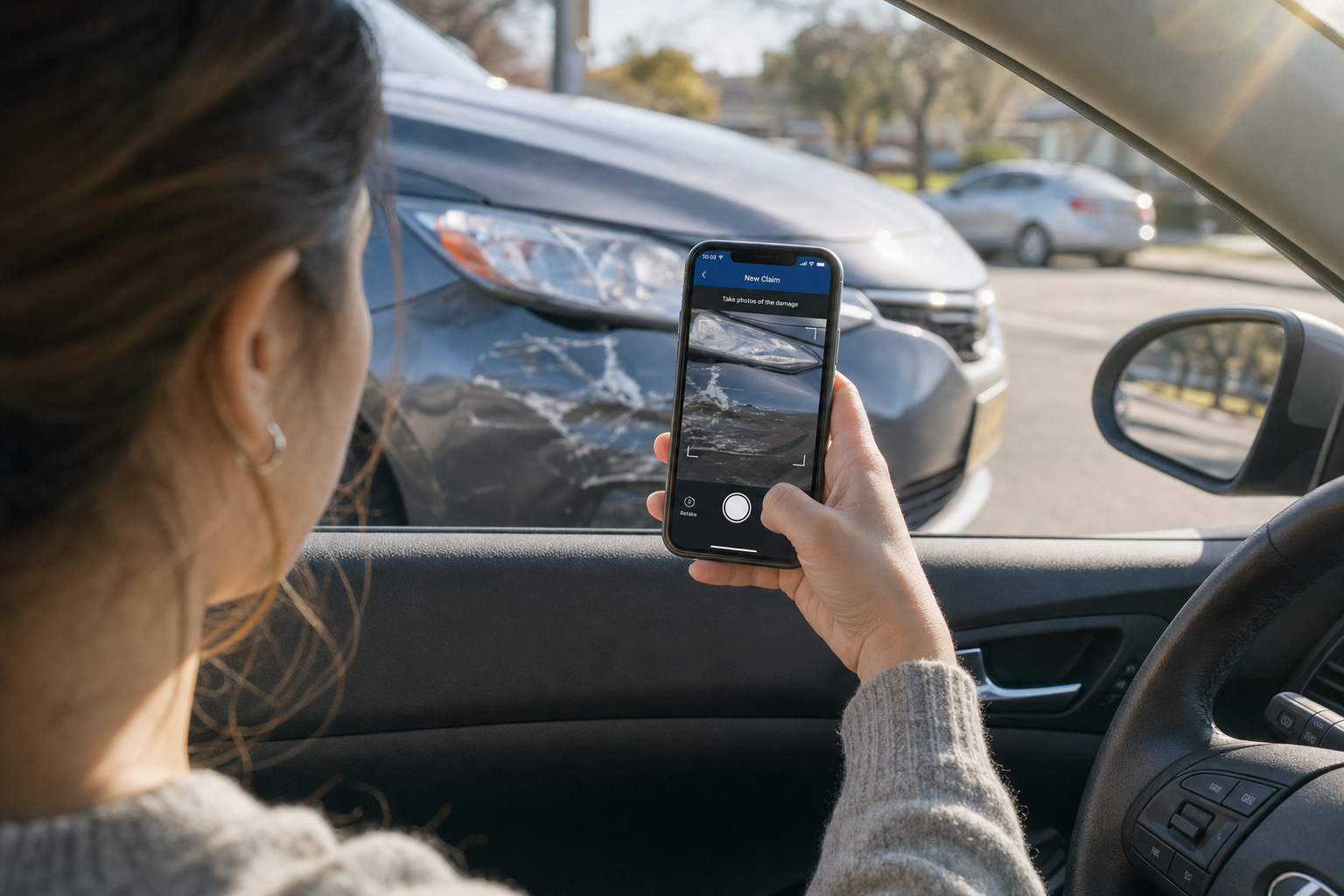
Photo-based claim submission is the single biggest time-saver in modern insurance apps. Instead of waiting days for an adjuster, you upload photos of the damage and computer vision generates a repair estimate, often within minutes. Photo estimating now accounts for roughly 26.4% of all repairable claim inspections, and AI-powered estimates deliver damage assessments within 24 hours for about 78% of claims (versus 5 to 7 days for traditional field inspection). For a deeper dive on how this works behind the scenes, see our guide to photo estimating car insurance claims.
- Geico Easy Photo Estimate: Upload damage photos through the app and receive a repair estimate in minutes. Widely considered the smoothest flow.
- Progressive Photo Estimate: Text-invitation flow with guided capture and real-time status tracking inside the Progressive Mobile App.
- Liberty Mutual Express Estimate: AI-powered photo damage estimator that produces a preliminary repair cost from customer-submitted photos.
- Allstate QuickFoto Claim: Guided photo capture designed to replace an in-person adjuster visit.
- State Farm: Solid photo upload for damage and documents, with the added option of chatting with a real agent.
- Lemonade: AI bot handles filing, and roughly 40% of claims are paid instantly per Lemonade's own reporting.
For a fuller picture of how these tools work under the hood, our guide to AI-powered car insurance claims breaks down accuracy rates and where human adjusters still matter.
Telematics Integration
If you drive safely and want a discount, telematics is where your app choice starts to move real money. All four major programs, plus Root and Lemonade, now run primarily off your smartphone rather than a plug-in device.
Progressive Snapshot advertises average annual savings of about $322 at renewal and roughly $94 at signup for safe drivers, though unsafe drivers can see a rate increase. State Farm's Drive Safe & Save offers a 10% signup discount plus up to 30% ongoing (and cannot penalize you for bad trips in most states). Allstate Drivewise still leads on maximum discount potential at up to 40%, includes automatic crash detection when the vehicle is moving at least 25 mph, and unlike State Farm, Allstate can raise your rate if driving data is risky. Geico DriveEasy added AI-powered distracted-driving detection in early 2026 but continues to draw complaints for over-sensitive phone-use flags. If telematics is important to you, our full breakdown of telematics car insurance compares every major program side by side.
Protect your car with Farmers
Average Rate:
Find coverage options that fit your budget.
The insurance savings you expect.
Average Rate:
Enjoy personalized policies, comprehensive coverage & more.

See how much you could save today!
Average Rate:
Drivers who switch their auto insurance and save with State Farm save $764 on average!
Safe Drivers Save with Allstate®
Average Rate:
Get rewarded with savings for having a clean driving record.
Ranking the Apps by Task
Not every driver needs every feature. Below is a task-by-task ranking so you can match the app to the way you actually use insurance.
Fastest Claim Filing: Geico and Progressive
Geico Mobile and Progressive are neck-and-neck for pure speed. Both let you file a claim, upload photos, and get a preliminary estimate without ever calling a human. Geico's Easy Photo Estimate returns a number in minutes for straightforward damage, and its virtual assistant "Kate" handles policy, billing, and document questions through natural-language conversation instead of forms. Progressive's Photo Estimate offers the same core benefit. If you want to see how Geico compares as an overall carrier, our Geico car insurance review has the full breakdown, and our head-to-head Geico vs Progressive comparison covers price, claims scores, and telematics.
Best Telematics UX: State Farm Drive Safe & Save
State Farm wins for two reasons. First, Drive Safe & Save is primarily a discount program, so risky trips generally will not increase your premium the way Snapshot or Drivewise can. Second, its integration with OnStar (for GM vehicles) plus Apple CarPlay and Android Auto delivers more accurate trip data than phone-only tracking. Progressive Snapshot is the runner-up thanks to granular real-time coaching and superior score transparency, which is especially valuable for low-mileage drivers.
Best for Policy Management: USAA and State Farm
For everyday policy tasks (adding a vehicle, updating a lienholder, requesting an SR-22, viewing declarations pages) USAA and State Farm lead the pack. USAA's app is famously polished but limited to military families and eligible dependents. State Farm's app pairs full self-service with agent chat, which matters when you need a human sign-off. For a deeper look at how State Farm's digital tools stack up against its agent network, see our State Farm car insurance review.
Best AI-First Experience: Lemonade
Lemonade built its entire business around app-first insurance. Quoting, ID cards, claims, and cancellations all live inside the app, and its AI bots handle most interactions (roughly 96% of first notice of loss submissions are AI-handled). It shines for tech-forward drivers who never want to call a 1-800 number, though the underwriter carries a B+ AM Best rating and a NAIC complaint index around 10 (roughly ten times the industry baseline). Read our full Lemonade car insurance review for the tradeoffs, and our Root car insurance review for the other big app-first option.
Best for Crash Detection: Allstate Drivewise
Allstate is the only major carrier whose telematics app automatically detects a major collision (when the vehicle is moving at least 25 mph for over 30 seconds) and pushes a notification that lets you call 911, request roadside assistance, or start a claim. That single feature could be the difference between a fast rescue and a long wait if you are injured or unconscious. Allstate's iOS app is polished at 4.8 stars, though its Google Play score sits around 3.8, so the crash-detection edge comes with real Android usability complaints.
User Complaints and Where Apps Fall Short
App store ratings tell you what people love, but the one-star reviews tell you where things break. A few patterns show up across nearly every carrier.
Common Complaints by Carrier
Geico draws the most volume of app-specific complaints simply because it has the largest user base. Common themes in 2026 reviews include login failures, error messages that force users to call support, DriveEasy flagging false phone-use or hard-braking events, and billing confusion around auto-pay. Lemonade users generally love the interface but occasionally hit friction on complex claims, where the AI-first workflow struggles with anything outside a standard scenario. Root's app itself works well, but a full usage-based pricing model means a few weeks of aggressive driving can spike your renewal.
Should App Quality Factor Into Insurer Choice?
Yes, but it should be a tiebreaker rather than the deciding vote. App quality now affects how you pay bills, prove coverage, file claims, and request help, so it is a real quality-of-life factor. Some 2026 rating frameworks weight digital experience as much as 25% of an insurer's overall score, while others cap it at 5%.
The strongest test: would you still choose this carrier if the app were merely average? If the answer is no, you are probably overvaluing polish and undervaluing coverage, price, and claims reputation. Start by comparing rates and financial strength using our guide to comparing car insurance companies, then let app quality settle a close race. You can also use our Progressive car insurance review to see how one of the largest carriers stacks up in 2026.
For drivers who plan to self-service everything (adding vehicles, filing photo claims, running telematics), app quality matters more. For drivers who prefer an agent relationship, it matters less. Either way, confirm the basics: does the app store your ID card offline, does it support photo claims, and can you request roadside assistance with two taps? If you want ultra-flexible coverage that lives entirely inside an app, our guide to on-demand car insurance covers pay-per-mile options too.
Frequently Asked Questions
Which car insurance app has the fastest claim filing in 2026?
Geico Mobile and Progressive are tied for the fastest. Both offer photo-based estimate tools (Geico's Easy Photo Estimate and Progressive's Photo Estimate) that return a preliminary repair number in minutes for minor damage. Lemonade's AI can pay some approved claims almost instantly, though its scope is narrower. For anything beyond simple bumper damage, expect a human adjuster to touch the file regardless of which app you use.
Are digital insurance ID cards accepted at traffic stops?
Digital ID cards are accepted as proof of insurance in 49 states plus Washington, D.C., with New Mexico as the only state that does not accept them. Massachusetts is a mild exception because proof is handled through the vehicle's registration document. Most modern apps let you save the card to Apple Wallet or Google Wallet for quick access. It is still smart to keep a printed copy in your glove box and a screenshot on your phone, since some apps require a login when they are offline.
Which telematics app pays the biggest safe-driver discount?
Allstate Drivewise advertises the highest potential discount at up to 40%, followed by State Farm Drive Safe & Save at up to 30% (which may exceed 30% in some states, though New York is capped at 30%). Progressive Snapshot averages about $322 per year in renewal savings for safe drivers, but it can also raise your rate if your driving is flagged as risky. State Farm is generally the safest choice if you want the biggest upside without downside risk.
Does app quality really matter when picking car insurance?
It matters more in 2026 than it used to, but coverage, price, and claims reputation should still come first. Most independent rating frameworks weight digital experience between 5% and 25% of an insurer's overall score. Use app quality as a tiebreaker between two similarly priced insurers, and prioritize it more heavily if you strongly prefer self-service over calling an agent.
Can I switch insurance companies just for a better app?
You can, but do the math first. A slick app is not worth $400 more per year on your premium, and it does not fix a carrier with a poor claims reputation. Run an apples-to-apples quote comparison across three to five insurers, weigh their J.D. Power and NAIC scores, and only then let app quality break the tie. If two companies are within $100 per year on identical coverage, choosing the one with the better app is a reasonable call.