
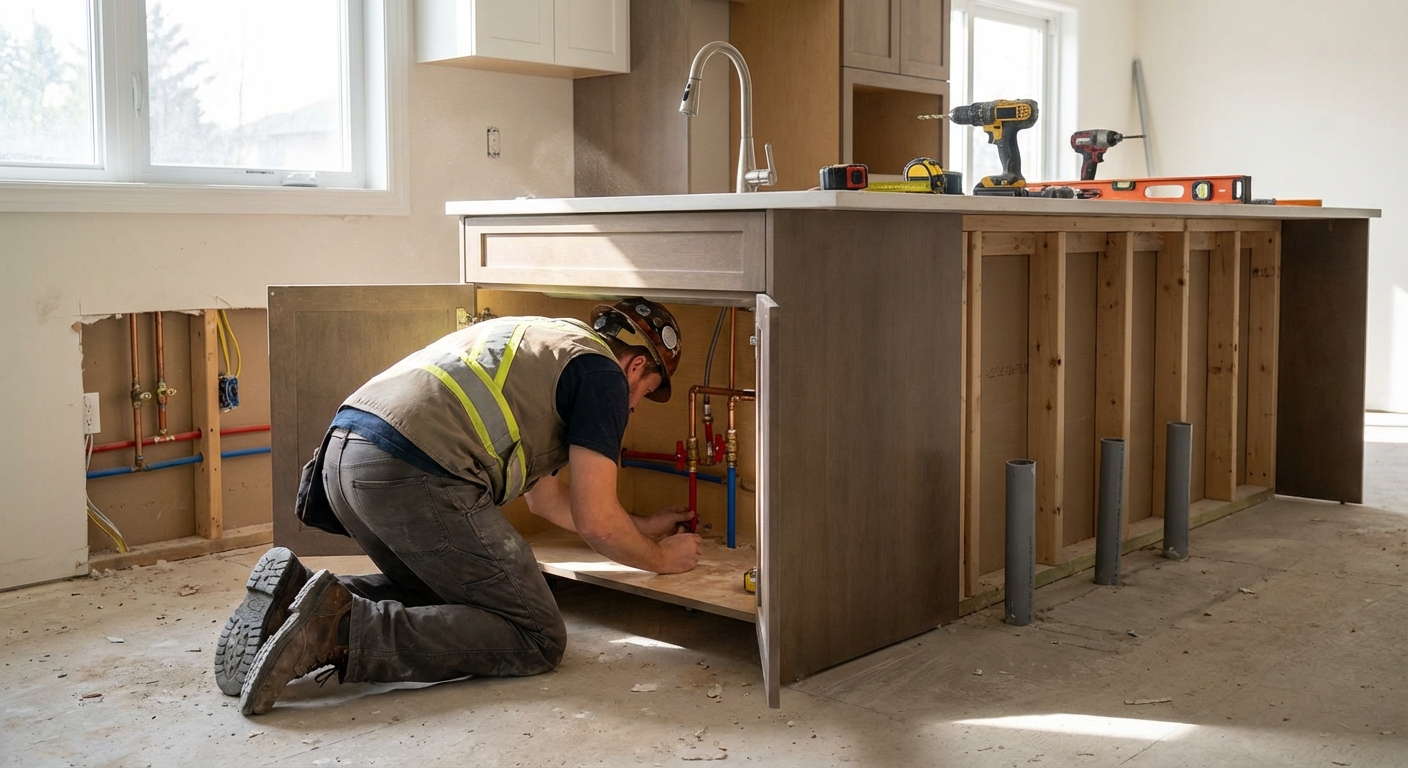
The True Cost of Moving vs. Keeping Your Existing Plumbing Layout
One of the first and most consequential decisions in any kitchen remodel is whether to keep your existing plumbing in place or move it. This single choice can swing your budget by thousands of dollars, and it affects everything from cabinet placement to your project timeline.
Keeping existing plumbing in place is almost always the budget-friendly path. When your sink, dishwasher, and refrigerator water line stay where they are, your plumber's work is minimal (new supply lines, updated shutoff valves, and fixture swaps). You save on labor, permits may be simpler, and walls stay closed.
Moving plumbing, on the other hand, triggers a cascade of costs. According to 2026 remodel data, relocating sink, stove, and refrigerator plumbing runs $3,000 to $6,000, and keeping plumbing in place can save $4,000 to $8,000 on a typical mid-range remodel.
| Plumbing Task | Estimated Cost Range (2026) |
|---|---|
| Minor sink relocation (same wall, a few feet) | $1,000 to $3,000 |
| Major sink relocation (new wall or island) | $3,000 to $6,000+ |
| Adding a kitchen island sink | $2,500 to $5,000 (plumbing only) |
| Prep sink with garbage disposal on island | $3,500 to $6,500 |
| Relocating a dishwasher drain/supply | $300 to $1,200 |
| Adding a refrigerator ice maker line | $150 to $500 |
| Wall/floor repair after pipe work | $500 to $2,000 |
Residential plumbers typically charge $80 to $130 per hour in 2026, with most homeowners paying around $90 to $125 per hour. In high-cost markets like Northern Virginia, master plumbers can command $100 to $150 per hour, and rates have climbed 8% to 10% over 2025 due to skilled trade shortages. A major relocation can easily eat 16 to 30 hours of labor once you factor in demolition, rerouting drain lines through floor joists, and patching everything back up. The golden rule: keep plumbing in place wherever your design allows.

Find Trusted & Licensed Plumbers in Ohio
Get matched with companies for your specific needs
Kitchen Island Plumbing: The Venting Challenge You Can't Ignore
Adding a sink to a kitchen island is one of the most popular, and most misunderstood, remodeling requests. It's not just about running a water line; the real complexity lies in venting.
Why Island Sinks Are Uniquely Challenging
Standard sinks vent through a wall. An island sits in the middle of the room with no nearby wall to tap into. To solve this, plumbers must install a specialized "island vent" or "foot vent" system: a below-floor vent that rises inside the island cabinet, reaches its highest point at drainboard height, then returns downward to connect to the horizontal drain line beneath the floor.
IPC vs. UPC Requirements for Island Sink Venting
The rules differ depending on which code your jurisdiction adopts. The IPC's island fixture venting section allows the method for sinks and lavatories only, and permits residential kitchen sinks combined with a dishwasher waste connection, food waste grinder, or both. The vent must rise vertically above the drainage outlet before offsetting, and any branch vent for multiple island fixtures must extend at least 6 inches above the highest island fixture before connecting to the outside vent terminal.
Under the UPC, Section 909 "Special Venting for Island Fixtures" applies a stricter loop vent and dedicated foot vent design.
| Requirement | Detail (UPC §909) |
|---|---|
| Minimum vent height | Must reach drainboard height before returning downward |
| Return slope | Not less than 1/4 inch per foot back toward the drain |
| Fittings | Drainage fittings below floor; return bend must be a one-piece fitting or a 45°-90°-45° elbow assembly |
| Foot vent | Wye branch taken off vertical fixture vent, run to nearest partition, then through the roof (or tied to other vents at least 6 inches above the flood-level rim) |
| Cleanout | Required in the vertical portion of the foot vent |
| Fixture limitation | Island sink drain upstream of the returned vent shall serve no other fixtures |
Some IPC jurisdictions also allow air admittance valves (AAVs) as an alternative when properly located at least 4 inches above the horizontal branch drain and installed accessibly (such as inside the island cabinet with an access grille). UPC jurisdictions typically do not permit AAVs without a local amendment.
Because island plumbing requires cutting through floor joists, installing below-floor piping with precise slope, and meeting strict venting codes, it's one of the more expensive single plumbing tasks in a kitchen remodel. Budget $2,500 to $5,000 for basic island sink plumbing, or up to $6,500 for a prep sink with disposal. If you're also expanding your home, learn more about venting requirements for home additions.
Pipe Upgrades, Gas Lines & Fixture Additions
When walls are already open during a remodel, it's the perfect time to address plumbing issues that would otherwise require tearing things apart again later.
Upgrading Old Galvanized Pipes
Galvanized pipes have a lifespan of 40 to 50 years and haven't been installed in new homes since the 1980s. If your kitchen has them, a remodel is the ideal time to upgrade because your walls are already open and the cost of access is built into your project. For a broader look at supply line planning, see our bathroom plumbing layout planning guide as many of the same principles apply.
Signs you should upgrade during your remodel:
- Rust-colored water from the tap
- Noticeably low water pressure at the kitchen faucet
- Visible corrosion or flaking on exposed pipe sections
- Pipes are 40+ years old
2026 Replacement Cost Comparison
| Pipe Material | Cost Per Linear Foot (Installed) | Best For |
|---|---|---|
| PEX | $1.50 to $4.00 | Flexibility, freeze resistance, tight spaces |
| Copper | $3.00 to $8.00 | Longevity, heat resistance, proven track record |
| PVC/CPVC | $0.50 to $2.00 | Drain lines, cold water supply |
For a kitchen-only scope, expect $1,500 to $4,000 with PEX or $3,000 to $6,000 with copper. A whole-home repipe in 2026 typically runs $4,000 to $15,000 with a national average near $7,500, and PEX costs $3.50 to $7.00 per square foot installed compared to $8.00 to $14.00 per square foot for copper. Copper materials can be up to 68% more costly, and labor accounts for as much as 70% of the total bill. PEX is popular for kitchen remodels because it's easier to snake through existing cavities. For a deeper look at pipe options, see our guide on plumbing rough-in costs and inspection.
Gas Line Work for Kitchen Ranges
If you're upgrading to a gas range or relocating an existing one, gas line work is non-negotiable and must be performed by a licensed professional. Gas lines cannot be DIY'd safely or legally in most jurisdictions.
Typical 2026 gas line costs for kitchen ranges:
| Scenario | Cost Range |
|---|---|
| Appliance hookup to existing line | $243 to $823 |
| New stove/oven gas line (Thumbtack national average) | $376 to $1,278 |
| Standard install (10 to 25 ft of new pipe) | $500 to $1,200 |
| Complex relocation, slab, or long runs | $1,500 to $2,500+ |
| Permits and inspection for gas work | $100 to $250 |
Gas line work uses black iron pipe ($4 to $9 per linear foot), copper tubing ($2 to $4), or CSST (Corrugated Stainless Steel Tubing) at $15 to $50 per linear foot. Pipe sizing must account for your home's total gas load and the distance from the meter. Always have a licensed gas fitter pull the permit and perform a pressure test before any appliance is connected.
Adding a Second Sink or Dishwasher
If your new layout calls for a prep sink, a bar sink, or a relocated dishwasher, factor in both supply and drain line extensions. For dishwasher connections specifically, review dishwasher plumbing requirements and costs to understand backflow prevention rules and installation code compliance. If you're also swapping the sink itself, see our kitchen sink installation cost guide.
Permits, Inspections & Timeline Considerations
Do You Need a Plumbing Permit?
Yes. In almost every US jurisdiction, any work that moves, adds, or significantly alters plumbing lines requires a permit. Simply replacing a faucet in the same location is usually exempt, but the moment you reroute a drain line or add a new fixture, you need to pull a permit. Standalone plumbing permits in 2026 typically cost $50 to $500 nationally, with many jurisdictions charging a flat $150 for basic residential permits. In New York City, a plumbing permit alone starts at $130 base under the new Local Law 128 formula (up from $100), but total DOB soft costs for a kitchen ALT-2 filing (building + electrical + plumbing + architect fees) commonly reach $1,500 to $6,500.
Consequences of skipping permits:
- Fines and stop-work orders
- Required demolition of completed work for inspection
- Insurance claim denials related to unpermitted systems
- Complications or failed disclosures during home resale
For a complete breakdown of when permits are needed and how to apply, read our guide on plumbing permits and requirements.
The Inspection Process
Most 2026 kitchen remodels have at least a rough plumbing inspection and a final inspection. Simple permits are often approved in 1 to 5 business days, while remodels with structural changes (or NYC ALT-2 filings) can take 4 to 8 weeks for plan review.
| Inspection Stage | What's Checked |
|---|---|
| Rough-in inspection | Pipe sizing, materials, drainage slope, venting, leak testing, before walls close |
| Gas line pressure test | Leak-free joints, correct materials, proper shutoffs |
| Final inspection | Fixtures installed per approved plan, air gaps, backflow prevention, functional testing |
How Plumbing Affects Your Timeline
Plumbing is typically one of the first rough-in trades to enter the job site after demolition, ahead of cabinets, countertops, and appliances. Here's a general sequencing overview:
- Demolition (remove old cabinets, flooring, and drywall as needed)
- Rough-in plumbing (reroute lines, stub out new locations, set drains)
- Rough-in inspection (must pass before walls close)
- Gas line work (completed and pressure-tested before appliances are set)
- Wall and floor close-up (drywall, tile, and flooring installed)
- Cabinet and appliance installation
- Finish plumbing (connect fixtures, faucets, dishwasher, refrigerator line)
- Final plumbing inspection
Moving plumbing adds 1 to 3 weeks to a typical timeline depending on complexity. If you're flipping the property, our guide on plumbing for house flipping can help you decide which upgrades pay off at resale.
Frequently Asked Questions
How much does plumbing for a kitchen remodel typically cost?
Total plumbing cost for a 2026 kitchen remodel varies widely based on scope. If you're keeping plumbing in place with minor upgrades, expect to pay $1,500 to $3,000. If you're relocating a sink, adding island plumbing, upgrading pipes, and running a gas line, costs can reach $5,000 to $15,000 or more. Always get at least three quotes from licensed plumbers before finalizing your budget.
Can I move my kitchen sink to the other side of the kitchen?
Yes, but it comes at a cost. Moving a sink across the kitchen typically runs $3,000 to $6,000 in 2026, and slab-on-grade foundations that require concrete cutting can easily exceed that range. If the move crosses the kitchen to an island, you'll also need a specialized island vent system. The further the move, the higher the cost, so consider whether the design benefit justifies the expense.
Is it worth replacing galvanized pipes during a kitchen remodel?
In most cases, yes, especially if your pipes are 40+ years old or you're already experiencing low water pressure or rust-colored water. Since your walls will already be partially open during the remodel, the cost of access is minimized. Replacing galvanized with PEX now typically costs $1,500 to $4,000 for a kitchen scope and can prevent burst pipes, water damage, and a far more disruptive whole-home repipe averaging $7,500 down the road.
Do I need a permit just to move my kitchen sink a few feet?
In most jurisdictions, yes. Even a minor sink relocation that involves extending or rerouting drain and vent lines typically requires a plumbing permit and a rough-in inspection, with fees running $50 to $500. In many states, a licensed master plumber must be listed on the permit application. Always check with your local building department or ask your licensed plumber to pull the appropriate permits.
Will 2026 gas stove restrictions affect my kitchen remodel?
Probably not, if you're remodeling an existing home. Most 2026 electrification laws (New York State, D.C., Montgomery County MD) target new construction and buildings 7 stories or less, not routine kitchen remodels. However, if your project is classified as a gut renovation or creates a new dwelling unit, new gas hookups may be restricted. Always confirm with your local building department before designing around a gas range.