
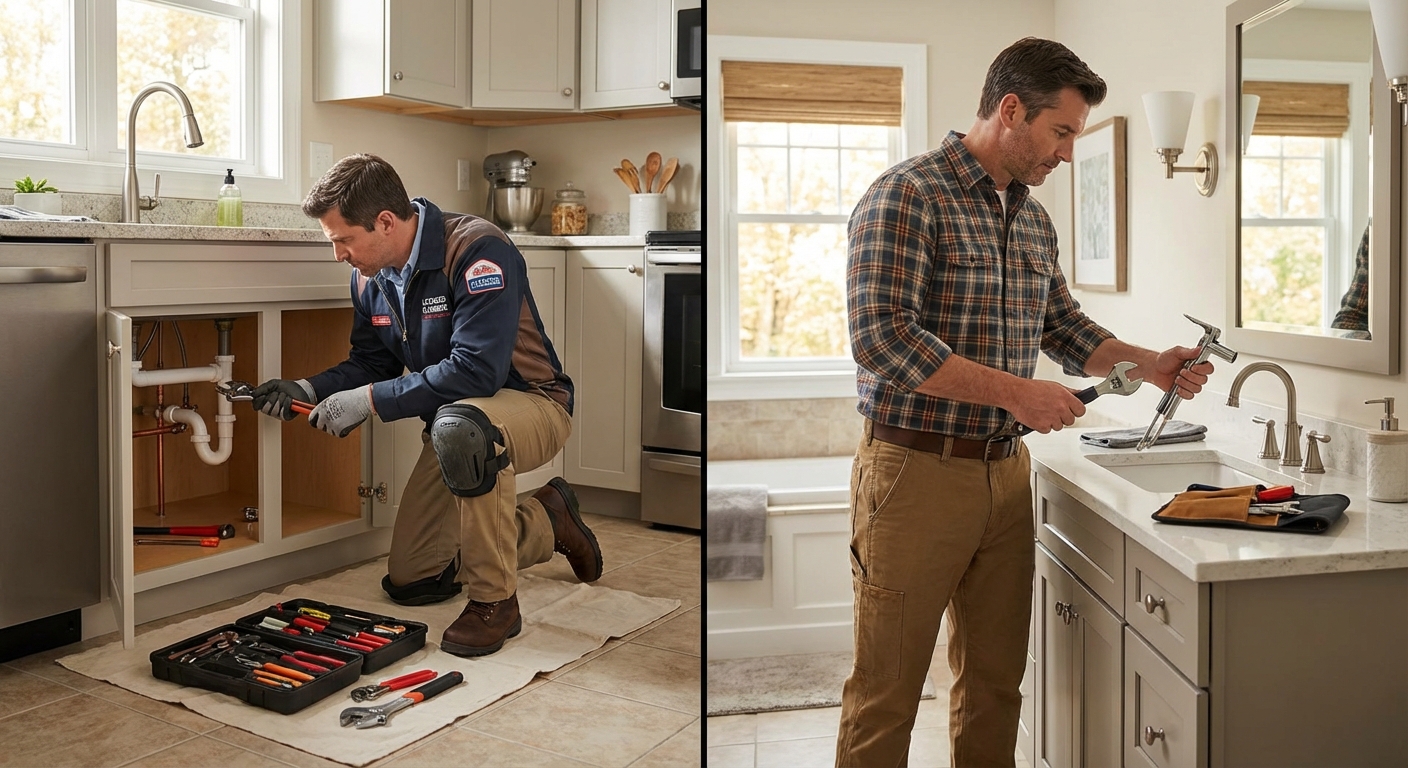
Licensing, Training and Credentials: A Major Divide
When it comes to plumbing, the gap between a licensed plumber and a handyman isn't just a matter of experience. It's a legal distinction. Understanding what each professional brings to the table is the first step in making the right hire.
What It Takes to Become a Licensed Plumber
Licensed plumbers undergo a rigorous path to earn their credentials. Most states require aspiring plumbers to complete 4,000 to 8,000 hours of supervised apprenticeship, pass both a trade knowledge exam and a law/business exam, carry liability insurance, and post a surety bond. The typical licensing progression includes three levels:
| License Level | Requirements | What They Can Do |
|---|---|---|
| Apprentice | Enrolled in apprenticeship program | Work under supervision only |
| Journeyman | 4-5 years experience + exam | Perform most plumbing work independently |
| Master Plumber | 2+ years post-journeyman + advanced exam | Pull permits, supervise, run a business |
Learn more about licensed plumber training levels to understand exactly what your plumber had to go through before stepping into your home.
What Qualifies a Handyman?
Handymen typically have no state-issued plumbing license and no formal plumbing training program. Many are skilled general repair workers with years of hands-on experience, but that experience doesn't carry the legal weight of a state license. In most states, handymen are permitted to perform minor general repairs up to a dollar threshold, but they are not authorized to perform licensed plumbing work.
California's AB 2622 raised the unlicensed contracting limit from $500 to $1,000 per project (effective January 1, 2025), but the work must be "casual, minor, or inconsequential," cannot require a building permit, and cannot involve behind-the-wall mechanical, electrical, or plumbing work. The unlicensed handyman must also work alone with no helpers. Notably, an earlier proposal to adjust that $1,000 cap annually for inflation starting in 2026 was struck from the final bill, so the cap is not increasing this year.

Find Trusted & Licensed Plumbers in Ohio
Get matched with companies for your specific needs
What Jobs Can a Handyman Do vs. a Licensed Plumber?
Knowing which professional is appropriate for which task can save you both money and serious legal trouble.
Jobs a Handyman Can Handle
For minor, surface-level plumbing tasks that don't involve altering pipe systems or require permits, a handyman can be a cost-effective option:
- Fixing a leaky faucet (replacing washers, cartridges, or O-rings)
- Unclogging a drain (using a plunger or hand snake on accessible drains)
- Replacing a showerhead or faucet fixture
- Swapping out a toilet seat or flapper valve
- Replacing a garbage disposal (like-for-like swap, no new wiring or pipe changes)
- Installing a pre-assembled bathroom vanity
Jobs That Require a Licensed Plumber
The following tasks require a licensed professional in virtually every state. Attempting them with an unlicensed handyman can result in fines, failed inspections, denied insurance claims, and unsafe conditions:
- Gas line work of any kind
- Water heater installation or replacement (permits are required in nearly every U.S. jurisdiction in 2026, whether tank or tankless)
- Repiping or any modification to supply/drain lines
- Installing new plumbing fixtures in new locations
- Sewer line repair or replacement
- Backflow prevention device installation
- Any work that requires pulling a permit
Understanding when plumbing permits are required is critical. In 2026, water heater replacement typically triggers a plumbing permit costing $50 to $400 depending on your city, with tankless upgrades almost always requiring one because of gas, venting, and electrical changes.
Cost Comparison: Plumber vs. Handyman
Money is often the deciding factor when homeowners choose between a handyman and a licensed plumber. Here's a realistic breakdown of what you'll pay in 2026.
Hourly Rate Comparison
Based on 2026 industry data, homeowners can expect to pay around $90 per hour on average for licensed plumbing services, with typical residential rates ranging from $45 to $200 per hour. Specialized work or urgent service can push rates to $150 to $300 per hour. Journeyman plumbers in high-cost markets like New York, San Francisco, and Chicago frequently earn wages north of $45 per hour, which translates to even higher billable customer rates. Handymen typically bill $50 to $100 per hour for common jobs, with rates in some markets stretching up to $150.
| Professional | Typical Hourly Rate | Service/Dispatch Fee |
|---|---|---|
| Handyman | $50 - $100/hr | $0 - $75 |
| Apprentice Plumber | $50 - $100/hr | $75 - $150 |
| Journeyman Plumber | $80 - $160/hr | $100 - $175 |
| Master Plumber | $100 - $200+/hr | $120 - $200 |
For a deeper look at flat rate vs hourly plumbing pricing and what drives these numbers, review our full plumbing service cost guide or dive into current plumber hourly rates for 2026.
Task-by-Task Savings Breakdown (2026 Pricing)
| Task | Handyman Cost | Licensed Plumber Cost | Estimated Savings |
|---|---|---|---|
| Leaky faucet repair | $60 - $120 | $125 - $350 | ~50% |
| Running toilet fix | $75 - $150 | $150 - $400 | ~50% |
| Showerhead replacement | $50 - $100 | $100 - $200 | ~50% |
| Simple drain clog | $60 - $120 | $150 - $400 | ~55% |
| Garbage disposal swap | $100 - $180 | $200 - $450 | ~40% |
Getting an accurate plumbing estimate is critical before committing to any professional. Always compare a formal plumbing quote vs estimate before you sign anything.
Insurance, Liability and Warranties: The Hidden Risks
This is where the choice between a handyman and a licensed plumber becomes most consequential, and where the cost savings of hiring a handyman can evaporate instantly.
Insurance Coverage Differences
Licensed plumbers are required by most states to carry general liability insurance as a condition of licensure. In New Jersey, for example, master plumbers must maintain at least $500,000 per occurrence in liability coverage plus a $3,000 surety bond. This protects you if a plumber accidentally causes water damage, a structural issue, or injury during the job. Handymen, on the other hand, often carry little to no liability insurance, leaving you, the homeowner, on the hook for any damage or injuries that occur.
Beyond the job itself, your homeowner's insurance policy can absolutely deny claims tied to unlicensed or unpermitted work. Per GEICO's 2026 policy guidance, if an unlicensed plumber performs substandard work that leads to a plumbing failure, the insurer may deny the claim. Policies generally cover sudden and accidental water damage but exclude damage tied to faulty workmanship, negligence, or unpermitted installations. A very common 2026 scenario: an unpermitted water heater installed off-code that floods a house often results in a fully denied claim once the insurer confirms there was no permit and no inspection. Learn more about the risks of hiring an unlicensed plumber before making a decision.
Warranty Protection
Licensed plumbers typically offer formal workmanship warranties. In 2026, the industry standard is 1 year on workmanship for minor repairs, with 2-5 years common on larger installations like water heaters, sump pumps, or repiping. New home construction plumbing warranties can extend up to 10 years for major issues. Parts are covered separately by manufacturer warranties ranging from 1-10 years, with water heater tanks and major components often on the higher end.
Handymen rarely offer any formal warranty on plumbing work, and even informal verbal assurances carry no legal weight if something fails. Additionally, most manufacturer warranties on fixtures and appliances require professional installation by a licensed plumber to remain valid. A handyman-installed water heater or fixture may void the product warranty entirely.
State Legal Requirements
Plumbing licensing requirements vary by state, but virtually no state allows unlicensed individuals to perform full plumbing work. Some key 2026 points:
- California: A C-36 Plumbing Contractor license is required for any plumbing project valued over $1,000 in combined labor and materials. Below that, the AB 2622 handyman exemption applies only if no permit is required and the work isn't behind-the-wall MEP or structural.
- Florida: State plumbing contractor licensure is required to advertise or perform plumbing work for compensation, regardless of project size.
- Arkansas: Beginning August 2025, a plumbing contractor license is required for projects valued at $10,000 or more, and all master plumber licenses must be on file with the State Licensing Board for Contractors.
- Georgia: The state adopted the 2024 IPC with 2026 Georgia amendments. Any permit application after February 1, 2026 must comply with the new code, including mandatory WaterSense fixtures for new construction and a prohibition on reusing salvaged plumbing materials.
- Washington: 2026 legislative session (ESSB 6197) updated plumbing licensing rules under RCW 18.106 and WAC 296-400A, tightening the boundary between contracting and exempt work.
- Nevada: A C-1 Plumbing and Heating Contractor license is required to advertise or perform plumbing work for compensation.
- Everywhere: Gas line work, sewer work, and water heater replacement require a licensed plumber and a permit, with virtually no exceptions.
If you're unsure about the scope of a project before hiring, review our guide on how to choose a plumber to vet any professional you bring into your home.
Frequently Asked Questions
Can a handyman legally do plumbing work?
In most states, a handyman can legally perform very minor plumbing tasks such as fixing a leaky faucet, replacing a showerhead, or unclogging a visible drain without a plumber's license. However, anything that involves altering pipe systems, installing new fixtures in new locations, working behind walls, or pulling permits requires a licensed plumber by law. In California, the AB 2622 exemption caps unlicensed work at $1,000 total (labor plus materials), and it does not apply to permit-required or behind-the-wall plumbing.
What happens if a handyman does plumbing work that requires a permit?
If unpermitted plumbing work is discovered during a home sale, refinance, or insurance inspection, you may face fines, be required to redo the work with a licensed plumber, and encounter complications closing your home sale. Your homeowner's insurance may also deny water damage claims tied to unpermitted work. In 2026, nearly every U.S. jurisdiction requires permits for water heater and gas line work at a typical cost of $50 to $400. It's always worth pulling the proper permit even if it adds to the cost.
Is a licensed plumber worth the extra cost?
For anything beyond a simple fixture swap or minor drain clog, yes. Licensed plumbers bring verified training, code knowledge, insurance protection, and workmanship warranties (typically 1 year on labor, plus manufacturer parts warranties) that a handyman simply cannot offer. The cost difference on a complex job like a water heater installation is a small price compared to the liability exposure and potential damage from work done incorrectly.
How do I verify if a plumber is actually licensed?
Every state maintains a contractor licensing lookup tool through its licensing board or department of consumer affairs. You can search by name, company, or license number to verify active status, license type, expiration date, and any disciplinary history. Always do this before work begins. Our guide on how to choose a plumber walks through this verification process step by step.
Are handymen insured for plumbing work?
Most handymen carry general liability insurance for basic repair work, but coverage varies widely and many operate with minimal or no insurance at all. Even when a handyman does carry insurance, their policy may exclude plumbing-related work if they are not licensed for it. Always ask for proof of insurance before any work starts, and confirm with your own homeowner's insurer what documentation you need to protect your coverage.