
The 3 Levels of Plumber Licensing Explained
Plumbing licenses are not one-size-fits-all. There are three distinct tiers, each representing a different level of training, experience, and responsibility. Understanding these levels helps you know exactly who you are inviting into your home.
Apprentice Plumber
An apprentice is an entry-level worker who is learning the trade under direct supervision. They cannot work independently or make decisions about your plumbing system on their own.
- Typically enrolled in a 4 to 5 year formal apprenticeship program
- Must log roughly 4,000 to 8,000 hours of supervised on-the-job training, depending on the state
- Complete several hundred hours of classroom instruction (Idaho's model, for example, is 576 classroom hours over 4 years)
- Must register with the state plumbing board in most states, with background check and fingerprinting increasingly required
- No licensing exam is required at this stage
- Entry-level or apprentice plumbers typically earn roughly $18 to $26 per hour in 2026
Journeyman Plumber
A journeyman plumber has completed their apprenticeship and passed a licensing exam. They can perform most plumbing work independently but cannot run their own plumbing business or pull permits in most states.
- Requires 2 to 4 years of apprenticeship experience, typically 8,000 hours of supervised field experience in states like Texas, before you can sit for the journeyman exam
- Must pass a state-administered journeyman plumbing exam covering trade knowledge, IPC/UPC codes, and safety
- Most exams are now computer-based with expanded test sites and scheduling in 2026
- Can work independently as an employee of a licensed plumbing contractor
- Journeyman plumbers in the U.S. earn between $28 and $52 per hour depending on market, sector, and experience level, with a national median around $34 to $36 per hour as employees in 2026, and employer billing rates are significantly higher
Master Plumber
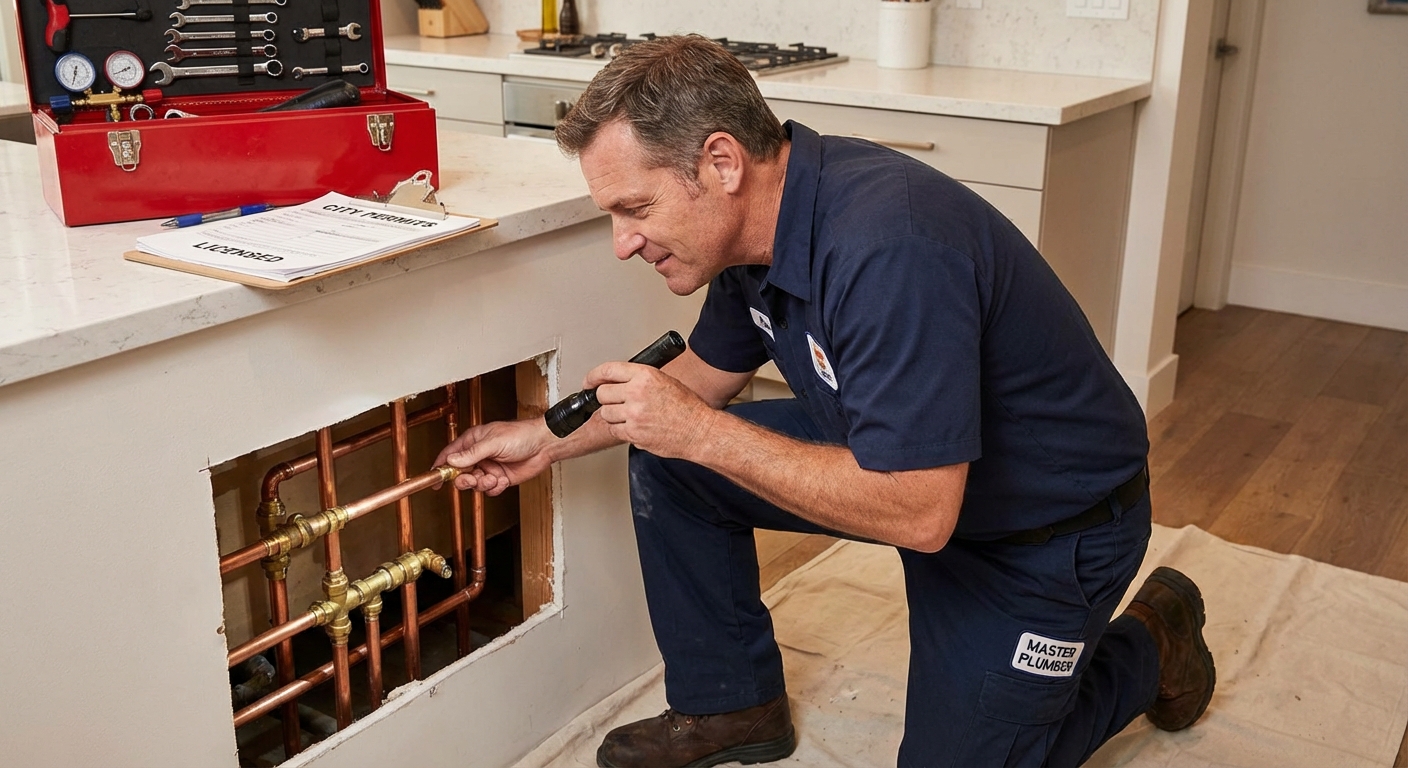
A master plumber is the highest level of licensing. They can supervise other plumbers, run a plumbing business, pull permits, and handle the most complex jobs.
- Requires additional journeyman experience beyond initial certification (reduced to 2 years in Texas as of September 1, 2025)
- Must pass both a trade exam and a business and law exam in most states
- Required to carry proof of bonding and insurance (typically $300,000+ in commercial liability)
- Only master plumbers can legally own and operate a plumbing contracting business in most states
- Senior, master, or foreman plumbers often earn $35 to $50+ per hour, translating to customer rates well above $150/hour
| License Level | 2026 Billing Rate | Works Independently? | Can Pull Permits? | Runs Own Business? |
|---|---|---|---|---|
| Apprentice | $45 to $70/hr | ❌ No | ❌ No | ❌ No |
| Journeyman | $80 to $130/hr | ✅ Yes | ❌ Usually No | ❌ No |
| Master Plumber | $120 to $200+/hr | ✅ Yes | ✅ Yes | ✅ Yes |
If you are weighing your options for a smaller fix, our guide on the plumber vs handyman decision can help you avoid overpaying for simple work. For big jobs, learn how to get an accurate plumbing estimate before you sign anything.

Find Trusted & Licensed Plumbers in Ohio
Get matched with companies for your specific needs
Plumber License Requirements by State
One of the most important things to understand is that there is no single national standard for plumber licensing in the United States. Each state sets its own rules, and several made notable changes heading into 2026.
The Big Picture
In 44 states plus DC, plumbers must hold a state-level license, and six states issue no statewide plumbing license (cities and counties in those states usually license locally instead). Those six states without statewide licensing are Kansas, Missouri, Nebraska, New York, Pennsylvania, and Wyoming. Around 25 states now require state or FBI background checks for certain license tiers, and most boards require ongoing continuing education (CE) to keep plumbers current on evolving codes.
Big 2025 to 2026 Law Changes
- Texas (HB 3214, effective Sept. 1, 2025): Starting September 1, 2025, the experience requirement for a licensed Journeyman Plumber to become a Master Plumber was reduced from four years to two years. This change was passed by the Texas Legislature and signed by the Governor. Applications submitted before that date still had to meet the old 4-year requirement.
- California (SB 779, operative July 1, 2026): As of July 1, 2026, the minimum civil penalty for unlicensed contracting in California rose from $200 to $1,500. The maximum remains $15,000 per violation. For related violations like entering into contracts with unlicensed contractors, penalties now range up to $30,000.
- California (SB 216, effective Jan. 1, 2026): As of January 1, 2026, every licensed California contractor must carry workers' compensation regardless of whether they employ anyone. Previously, sole-proprietor plumbers without employees could file for an exemption.
- California (AB 2622): As of January 1, 2025, AB 2622 increased the contractor licensing threshold from $500 to $1,000. Projects valued at $1,000 or more now require a valid CSLB contractor license.
- California Plumbing Code: The 2025 CPC (based on the 2024 UPC) became the enforceable code for new permit applications in most jurisdictions starting January 1, 2026.
- Georgia (2024 IPC, effective Jan. 1, 2026): As of January 1, 2026, the landscape of plumbing in Georgia has undergone its most significant transformation in years. The Georgia Department of Community Affairs (DCA) has officially transitioned to the 2024 International Plumbing Code (IPC), supplemented by specific 2026 Georgia State Amendments, including stricter high-efficiency fixture requirements.
- Oregon: The 2026 Oregon Plumbing Specialty Code (based on the 2024 UPC) is now in effect.
- Washington and Nevada: Both continue to operate under UPC-based plumbing codes with state and local amendments.
State-by-State Snapshot
| State | Experience Required | Exam Required | Notes |
|---|---|---|---|
| California | 4 years journey-level for C-36 | ✅ Trade + law/business | CSLB license required on jobs over $1,000; SB 779 raised fines July 2026 |
| Texas | 8,000 hrs for journeyman; 2 yrs journeyman for master | ✅ Trade exam (now CBT) | Master path shortened to 2 years under HB 3214 |
| Florida | 4 years experience | ✅ Trade + business exam | Statewide CFC license through DBPR; CE required for renewal |
| Arizona | 4 years experience | ✅ Trade + business exam | C-37, R-37R, or CR-37 classifications |
| Michigan | 6,000 hrs over 3+ years for journeyman | ✅ Written + practical | Master requires 4,000 hrs over 2+ yrs as journeyman |
| New Jersey | 5 yrs (1 yr journeyman + 4 yrs apprentice) | ✅ Trade, business & law, practical | CE required each 2-year cycle |
| Connecticut | ~2 years for P-1 unlimited | ✅ Yes | No reciprocity with any other state |
| Pennsylvania | No state license | Varies locally | Philadelphia requires master license + exam |
| New York | No state license | Varies locally | NYC master plumber needs 7 years experience |
License Reciprocity
Some states offer license reciprocity, allowing licensed plumbers to obtain a license in a new state through an expedited process rather than starting from scratch. Reciprocity is limited and often still requires passing a business and law exam. California and Connecticut, notably, do not have reciprocity with any other jurisdiction. If you are hiring a plumber who recently relocated or works across state lines, confirm their license is valid in your specific state.
Why Hiring a Licensed Plumber Protects You
Choosing a licensed plumber is not just about quality. It is about protecting your finances, your home's safety, and your legal standing as a homeowner. For a deeper dive, see our breakdown of the risks of unlicensed plumbers.
Home Insurance & Claims Protection
Licensed plumbing companies carry liability insurance that acts as an additional layer of protection for your property. If an unlicensed plumber causes water damage, your homeowner's insurance may deny the claim outright because the work was not performed by a licensed professional. That means you are on the hook for every dollar of repairs.
Code Compliance in 2026
Plumbing codes are evolving rapidly. The 2024 IPC and UPC are being adopted by states throughout 2025 through 2027, bringing tighter water efficiency standards, expanded greywater and rainwater allowances, stricter backflow rules, and updated seismic and gas piping requirements. Georgia's 2026 amendments require WaterSense-listed fixtures for new construction and explicitly prohibit reuse of plumbing materials, equipment, and devices.
On top of that, the EPA's Lead and Copper Rule Improvements (LCRI) now require water systems to inventory every service line and plan for replacement. On October 8, 2024, the EPA issued a final rule requiring drinking water systems across the country to identify and replace lead pipes within 10 years. The Lead and Copper Rule Improvements also require more rigorous testing of drinking water and a lower threshold requiring communities to take action. Beginning November 1, 2027, water systems must comply with the LCRI, which requires water systems to replace lead and galvanized requiring replacement (GRR) service lines, reduces the lead action level to 0.010 mg/L, and strengthens tap sampling procedures. That means a modest kitchen remodel in an older home can trigger a $5,000 to $10,000 service line replacement requirement, and the replacement can extend onto the homeowner's property depending on ownership.
Water heater rules are also tightening. Many jurisdictions now require thermal expansion tanks on closed systems, ASSE-listed mixing valves for scald protection, and in some markets, heat pump water heaters in place of traditional gas tanks.
Unlicensed work that violates these codes can result in fines, mandatory tear-outs, and expensive corrections, especially if discovered during a home sale inspection. A deeper look at plumbing code compliance is essential, and understanding when plumbing permits are required is critical. A licensed plumber will always know when a permit is necessary.
Liability & Worker Protection
If an unlicensed plumber is injured on your property, you could be held personally liable for their medical bills and damages since they typically do not carry workers' compensation insurance. A licensed plumber comes with their own bonding and workers' comp, shifting that liability away from you. In California, as of January 1, 2026 under SB 216, every licensed contractor must carry workers' compensation regardless of whether they employ anyone, which strengthens homeowner protection even further.
Quality & Long-Term Savings
Licensed plumbers use advanced diagnostic tools, follow best practices, and provide warranties on their work. While they may charge more upfront, their work is more likely to be done right the first time, avoiding the costly cycle of repairs that often follows substandard unlicensed work. This is especially important for commercial plumbing projects, where licensing and insurance requirements are even more stringent.
How to Verify a Plumber's License & What Happens If You Don't
Before any plumber sets foot in your home, take five minutes to confirm their credentials. Our full guide on how to choose a plumber walks through every step, but here is the essential verification process.
How to Verify a Plumber's License
Step 1: Ask for the license number. Any legitimate plumber will provide this without hesitation. It should also appear on their business card, invoice, and vehicle in many states.
Step 2: Visit your state's plumbing board website. Search for "[your state] plumbing license lookup" to find the official verification portal. Examples include:
- California: Contractors State License Board (CSLB) at cslb.ca.gov
- Texas: Texas State Board of Plumbing Examiners (TSBPE) at tsbpe.texas.gov
- Florida: DBPR at myfloridalicense.com
- Washington: Department of Labor & Industries at lni.wa.gov
- Michigan: LARA Bureau of Construction Codes at michigan.gov/lara
Step 3: Confirm key details. Check that the license is active, the license type matches the work being done (journeyman vs. master), the expiration date is current, continuing education requirements are met, and there are no disciplinary actions or complaints on record.
Step 4: Verify insurance. Request a current Certificate of Insurance showing general liability coverage (typically $1 million or more) and workers' compensation.
Consequences of Hiring an Unlicensed Plumber
The financial consequences can be severe. In California, under B&P Code §7028, those caught contracting without a license likely will have to appear before a Superior Court judge to answer to misdemeanor charges that can carry a potential sentence of up to six months in jail and/or a $5,000 fine, as well as an administrative fine of $200 to $15,000. As of July 1, 2026, CSLB civil penalties now range from $1,500 to $15,000 per violation. Beyond fines, California law imposes severe penalties on unlicensed contractors, including mandatory disgorgement of all compensation paid under Business and Professions Code §7031(b), potential treble damages, and criminal penalties. In Texas, employing or subcontracting an unregistered individual now carries a mandatory $4,000 fine per violation as of January 1, 2026, with no settlement discounts. In Florida, knowingly hiring an unlicensed contractor is treated as aiding and abetting under Statute 455.228, with civil penalties from $500 to $5,000 per offense, and DBPR can impose administrative fines of up to $10,000 on the unlicensed contractor. Doing unlicensed work during a declared state of emergency in Florida can be a third-degree felony with up to 5 years in prison.
Beyond fines, unpermitted and non-code-compliant plumbing discovered during a home sale can derail your closing or require costly remediation. A properly detailed plumbing scope of work is one of the best ways to keep the job code-compliant from day one.
What can unlicensed individuals legally do? This varies by state, but in general, unlicensed workers may only assist a licensed plumber under direct supervision, or perform very minor repairs that do not require a permit (such as replacing a faucet aerator or toilet flapper in some jurisdictions). Any structural work, pipe installation, or gas line work requires a licensed professional in virtually every state.
Frequently Asked Questions
Do I need a master plumber for all home plumbing work?
No, a master plumber is not required for all jobs. Licensed journeyman plumbers are fully competent to handle routine repairs like fixing leaks, replacing fixtures, and clearing clogs. Master plumbers are typically necessary for complex work such as full system installations, gas line work, new construction, or any job requiring a permit pulled in the contractor's name. Check your local requirements to be sure.
How long does it take to become a licensed plumber?
Becoming a licensed journeyman plumber typically takes 4 to 5 years, including an apprenticeship of roughly 4,000 to 8,000 hours of supervised training, several hundred classroom hours, and passing the journeyman exam. Reaching the master plumber level requires additional years of experience beyond journeyman, usually 2 to 5 years depending on the state. As of September 2025, Texas reduced its master plumber experience requirement from 4 years to just 2 years under HB 3214, making it one of the fastest master paths in the country.
Can a plumber work in multiple states with one license?
Not automatically. Plumbing licenses are issued at the state level, so a license from one state is not automatically valid in another. Many states offer license reciprocity through an expedited process, but some, like California and Connecticut, have no reciprocity at all. Always confirm a plumber's license is valid in your specific state before hiring.
How much more does a licensed plumber cost than an unlicensed one?
Licensed plumbers in 2026 typically charge $75 to $200+ per hour depending on license level and location, with a national average around $90 to $125/hour for standard residential work. Unlicensed individuals may charge less, but the savings are often illusory. Unlicensed work can result in code violations, denied insurance claims, failed inspections, and costly repairs down the road. For most homeowners, the premium paid for licensed work is well worth the protection it provides.
What should I do if a plumber cannot provide a license number?
Walk away. Any reputable, licensed plumber will provide their license number on request without hesitation. If a plumber refuses, cannot produce documentation, or provides a number that comes back invalid on your state's licensing board website, do not hire them. The risks to your property, finances, and safety far outweigh any potential cost savings from hiring an unverified contractor.