
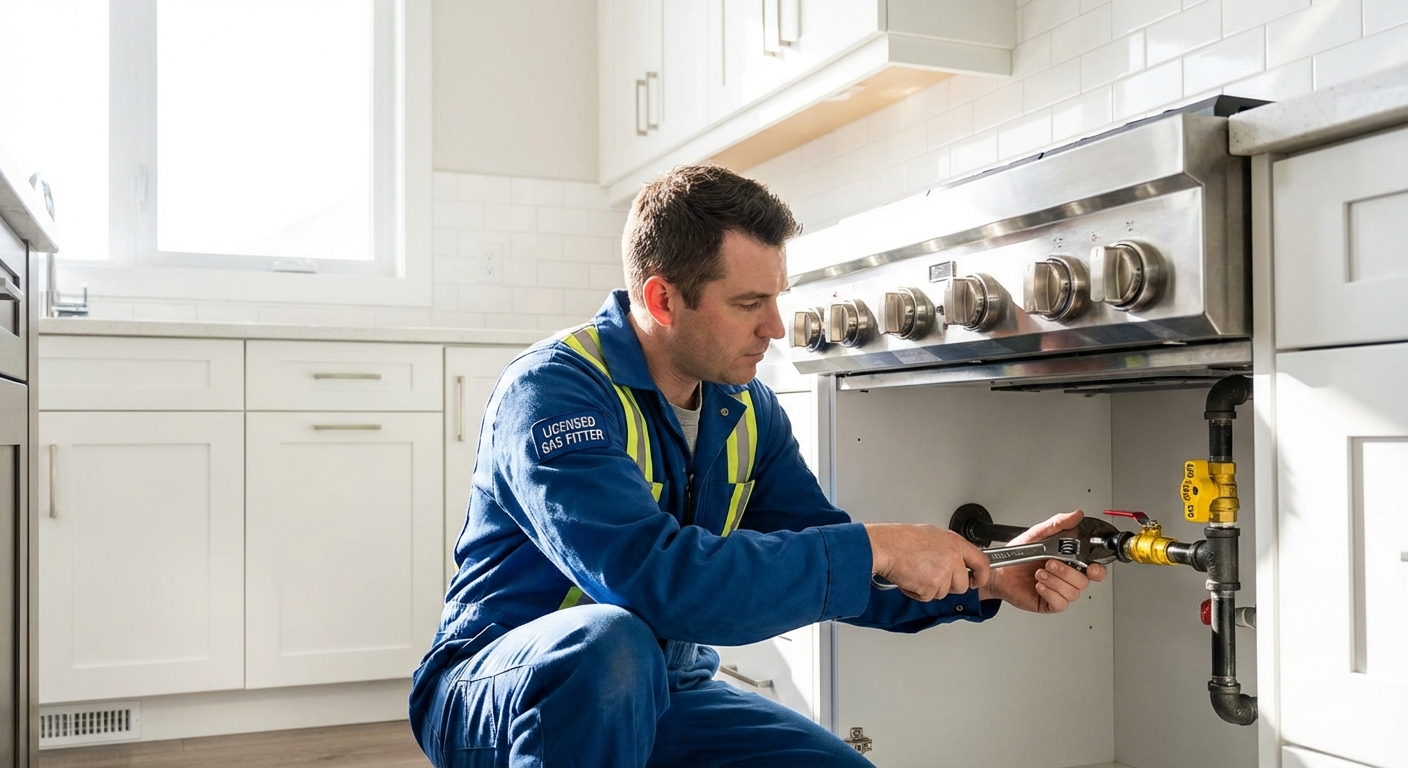
Gas Line Installation Costs in 2026
Whether you're hooking up a new gas stove, adding a dryer line, or running fuel to a standby generator, understanding what drives costs is the first step toward making a smart financial decision. Gas line installation costs vary widely depending on the scope of work, materials used, and local labor rates.
National Average Cost Breakdown
According to 2026 national cost data, homeowners pay an average of $864 to $1,060 per piping run for a typical gas line installation, with most projects falling between $612 and $2,238 all-in. Larger or more complex projects, such as whole-home gas system retrofits or generator hookups, can range from $2,000 to $11,000+. The installed cost per linear foot typically runs $15 to $30 for standard residential work in 2026, with interior CSST installations averaging $22 to $35 per foot and exterior underground polyethylene lines averaging $28 to $42 per foot.
| Installation Type | Estimated 2026 Cost |
|---|---|
| Gas line from existing connection | $400 – $800 |
| Single appliance hookup (stove/dryer) | $400 – $1,100 |
| Gas line from meter to appliance | $600 – $2,200 |
| Water heater line (with valve/vent upgrades) | $600 – $1,100 |
| Whole-house generator connection | $6,000 – $11,000+ |
| Underground/outdoor gas line | $15 – $42 per linear foot |
| Permits | $100 – $300 |
| New gas meter installation | $300 – $600 |
Key Cost Factors
Several variables push a project's price up or down:
- Distance from the meter or main line. Longer pipe runs mean more materials and labor. A line extension near existing piping averages $11 to $22 per linear foot, while new or complex runs average $17 to $33 per linear foot.
- Materials. Black iron pipe is common for main lines. Corrugated Stainless Steel Tubing (CSST) is flexible and often used for branch lines, but requires additional bonding work per code. Polyethylene (PE) is required for underground outdoor runs.
- Trenching for outdoor lines. Expect to pay $5 to $12 per linear foot for trenching alone on buried lines.
- Labor rates. Plumbers and gas fitters charge $45 to $200 per hour depending on your region and the complexity of the work.
- Existing connections. Tapping into an existing gas main is significantly cheaper than running a new line from the street.
If you're also planning plumbing work nearby, bundling projects with the same contractor can reduce your total labor costs. Learn more about how new construction plumbing costs are structured to see how gas and plumbing work often overlap.

Find Trusted & Licensed Plumbers in Ohio
Get matched with companies for your specific needs
Appliance-Specific Considerations
Not all gas appliances are created equal when it comes to line sizing, pressure, and installation complexity. Here's what to know for the most common 2026 installations.
Gas Stove & Range
A gas stove hookup is one of the most straightforward installations, typically requiring a ½-inch flexible connector and a shutoff valve near the appliance. If your kitchen already has a gas stub-out, the connection cost can be as low as $150 to $400. Running a new line from the meter typically costs $450 to $900 in 2026, with longer runs across finished walls pushing toward the high end.
Gas Dryer
Installing a gas line for a dryer is similar in scope to a stove hookup. Most dryers require 20,000 to 30,000 BTUs of gas, so line sizing is straightforward. In 2026, costs typically range from $400 to $800, depending on distance from the existing gas supply.
Gas Water Heater
Water heaters demand more from a gas line, up to 200,000 BTUs for larger units, which may require a larger diameter pipe than stoves or dryers. If multiple appliances share the same run, a licensed plumber must properly size the entire system to ensure adequate pressure at every outlet. Total gas line costs for water heaters in 2026 typically run $600 to $1,100, including valve upgrades and minor venting work. Learn more about tankless water heater installation requirements, which often involve dedicated gas line upgrades.
Whole-House Generator
Generators carry the highest gas demand of any residential appliance, often exceeding 100,000 BTUs. Outdoor installations are common, meaning buried lines, proper burial depths (typically 12 to 18 inches minimum per code), and utility coordination. This is one of the most expensive and technically demanding gas line jobs, with the gas line alone running $800 to $2,200+, and total generator installations reaching $6,000 to $11,000+.
Natural Gas vs. Propane: Which Is Right for You?
The type of fuel you use significantly affects installation logistics, pipe sizing, ongoing costs, and appliance compatibility.
How They Differ
Natural gas is delivered via utility pipelines at lower pressure (approximately 0.25 psi), while propane is stored in on-site tanks at higher pressure (approximately 0.4 psi). Because propane contains nearly twice the BTUs per cubic foot of natural gas, appliances burn less of it, but they require different orifices, regulators, and fittings. You cannot interchange natural gas and propane lines without proper conversion by a licensed professional.
The biggest safety distinction: propane is heavier than air (it sinks and pools in low areas), while natural gas is lighter than air (it rises and dissipates). This affects how leaks behave and what leak detection measures you need.
Which Is Cheaper in 2026?
Natural gas tends to be the more cost-effective long-term choice where it's available. The U.S. residential average is currently around $16.25 per thousand cubic feet (about $1.63 per therm) according to recent EIA data. By comparison, propane has been running around $2.80 per gallon in many regional markets, which translates to roughly $3.04 per equivalent therm. On a per-BTU basis, propane heat is often 30% to 65% more expensive than natural gas in 2026.
However, if you're in a rural area without access to a natural gas utility, propane is often the only practical option. Extending a natural gas main to a remote property can exceed $10,000, which may take years of fuel savings to recoup.
Safety Codes, Permits & Who Can Install Gas Lines
Gas line work is one of the most tightly regulated residential trades in the US, and for good reason. Improper installation can cause leaks, fires, and carbon monoxide hazards.
Governing Codes in 2026
Most jurisdictions adopt one of two national standards:
- NFPA 54 / ANSI Z223.1 (National Fuel Gas Code), which sets minimum safety requirements for fuel gas piping systems in homes and buildings. The 2024 edition is the most recent and includes updated purging requirements and a refined definition of "interruption of service."
- International Fuel Gas Code (IFGC), with the 2021 edition still widely adopted in 2026 (and some jurisdictions moving to the 2024 edition with local amendments).
CSST (flexible gas lines) must be electrically bonded with a minimum #6 AWG copper conductor connected to the building's grounding electrode system. The bonding clamp must attach to rigid steel pipe, a malleable iron fitting, or a brass CSST fitting (never directly to the corrugated tubing itself) and must be installed downstream of the meter or second-stage regulator. Newer arc-resistant (black-jacket) CSST may satisfy code without an added bonding jumper in some configurations, but most inspectors still require bonding in mixed systems.
Permit & Inspection Requirements
Permits are required for virtually all gas line installations, modifications, and even repairs in the US. Here's what the process typically looks like:
- Submit plans to your local building or plumbing department before work begins.
- Licensed contractor pulls the permit. It's illegal in most states for homeowners to self-perform gas line work.
- Rough-in inspection is conducted before walls are closed or ground is backfilled.
- Pressure test is performed for at least 10 minutes (for systems under 10 cubic feet) to verify no leaks exist in the system.
- Final inspection is required before the utility will connect service or restore gas flow.
Permit fees typically range from $100 to $300 depending on your jurisdiction. For more on the broader permit process, see our guide to plumbing permits and when they're required.
Who Is Licensed to Install Gas Lines?
Licensing requirements vary by state and municipality, but the most common professionals who perform gas line work are:
| Professional | Typical Scope | Notes |
|---|---|---|
| Licensed Master Plumber | Full gas line installation, sizing, and appliance connection | Most common for residential gas work; may require a gas-specific endorsement |
| Journeyman Plumber | Gas line installation under supervision | Must be supervised by a Master Plumber in most states |
| Licensed Gas Fitter | Specialist in gas piping and appliance connections | Separate license in some jurisdictions; requires 2+ years supervised experience |
| HVAC Technician | Gas lines for heating equipment only | Limited scope; typically cannot perform full residential gas line installs |
In California, for example, gas piping work beyond a simple appliance reconnection requires a CSLB-licensed contractor holding a Class C-36 (Plumbing), Class B, or Class C-34 license. Always verify your contractor's license with your state licensing board and confirm they carry liability insurance. For related projects, you may also want to review how dishwasher plumbing installation and similar tasks are handled, as many licensed plumbers bundle these services.
Frequently Asked Questions
Do I need a permit to install a gas line for a stove or dryer?
Yes, in virtually every US jurisdiction, a permit is required before any gas line work begins, including new appliance hookups. The permit ensures the work is inspected by a local authority before gas service is connected. Skipping a permit can void your homeowner's insurance and create serious liability issues if you ever sell your home.
Can I install a gas line myself in 2026?
In most states, homeowners are not legally permitted to install or modify gas lines themselves. This work must be done by a licensed plumber, gas fitter, or other qualified professional. Even in states where DIY is technically allowed for minor work, it's strongly discouraged due to the serious safety risks involved. Always check with your local building department first.
How long does gas line installation take?
A simple single-appliance hookup from an existing gas supply can be completed in a few hours. More complex projects, such as running a new line from the meter, outdoor burial work, or whole-house generator connections, can take one to several days. Permit approval timelines can also add days or weeks to the overall project schedule.
What's the difference between black iron pipe and CSST for gas lines?
Black iron pipe is a rigid, threaded steel pipe widely used for main gas lines and long runs. CSST (Corrugated Stainless Steel Tubing) is a flexible alternative commonly used for branch lines and appliance connections. CSST installs faster and can navigate around obstacles more easily, but it requires mandatory #6 AWG copper bonding per current NFPA 54 and IFGC codes to prevent lightning-related damage.
How do I know if my existing gas line can handle a new appliance?
Your existing gas system has a finite capacity measured in BTUs per hour. Adding a high-demand appliance, like a generator or a large water heater, without properly sizing the main line can reduce pressure to all other appliances on the system. A licensed plumber or gas fitter can perform a load calculation under NFPA 54 Chapter 6 sizing methods to determine whether your current system can support the addition or whether an upgrade is needed.