
Compare Home Insurance Plans in Ohio
Find your best options in less than 2 minutes



What Is a Public Adjuster and How Are They Different?
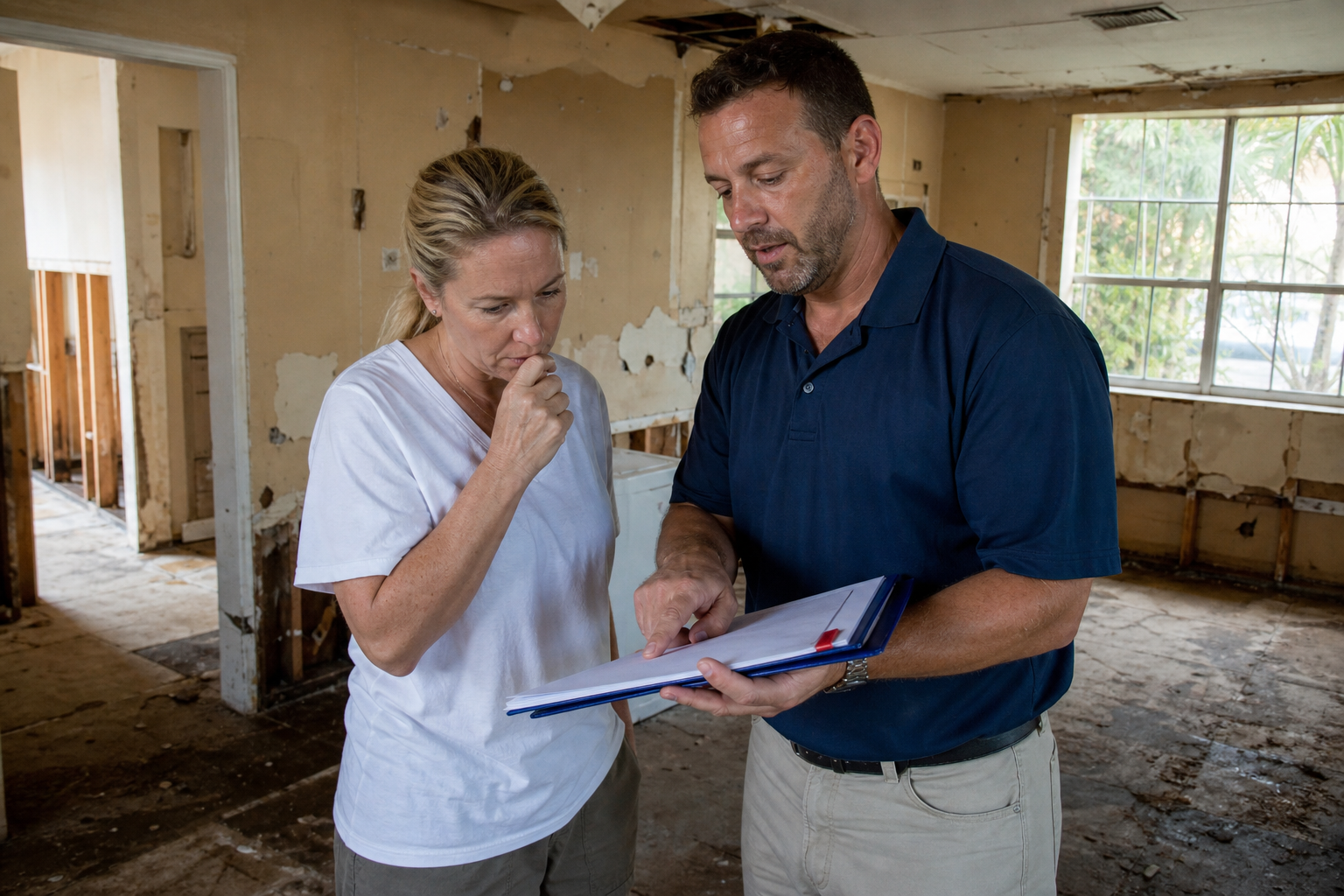
A public adjuster is a licensed insurance professional you hire to prepare, document, and negotiate your insurance claim. Unlike the adjuster your insurer sends out, a public adjuster has a fiduciary-style duty to advocate exclusively for the policyholder. They read your policy, scope the damage, build an independent estimate, and push back against lowball offers or undervalued depreciation.
There are three types of adjusters you'll encounter in the home insurance world, and they answer to very different bosses.
Public adjuster vs. company adjuster vs. independent adjuster
A company (staff) adjuster is a salaried employee of your insurer whose job is to apply the policy and control claim costs. An independent adjuster sounds neutral but is actually a third-party contractor hired by the insurance company, often deployed after hurricanes or wildfires when staff is overloaded. Both work for the carrier. Only a public adjuster works for you.
If you want to understand the playbook the insurer's adjuster is using on the other side of the table, our breakdown of home insurance adjuster tactics explains exactly what to say and what to avoid during an inspection, including the AI-driven estimating tools carriers now lean on.

Compare Home Insurance Plans in Ohio
Find your best options in less than 2 minutes
When Hiring a Public Adjuster Makes Financial Sense
Public adjusters aren't worth the fee on every claim. Recent 2026 industry data shows the average U.S. homeowners claim reaches about $9,100, with water damage claims averaging $12,400. Historical Triple-I data pegs the average claim payout at roughly $15,749, and homeowners claim severity climbed from $13,884 in 2019 to over $20,000 in 2023. Most routine claims sit well below the $25,000 mark, and on those, a contingency fee will eat into money you need for actual repairs. Public adjusters earn their keep on large, complex, or contested losses, generally those above $25,000.
Consider hiring one when:
- The loss is major or complex (fire, hurricane, tornado, extensive water or mold damage, partial or total losses)
- Your claim has been denied or the insurer is dragging its feet
- The offer is clearly too low and you've already asked for a re-inspection
- You don't understand your policy's coverage, sub-limits, or depreciation rules
- You don't have the time or capacity to manage hundreds of emails, inventories, and estimates while displaced
If your claim is already in the dispute phase, you may also want to read about the home insurance appraisal clause, which lets you resolve dollar-amount disputes without going to court and is sometimes a cheaper alternative. For larger disputes involving bad faith or denial, our guide on when to hire an attorney walks through how lawyers and public adjusters differ.

Protect your home with State Farm
Average Rate:
Homeowners who bundle and save with State Farm save an average of $1,000 per year!

You're in Good Hands® with Allstate
Average Rate:
Get comprehensive home coverage with flexible policy options.

Customize your home coverage
Average Rate:
Only pay for the coverage you need with personalized home insurance.

Smart coverage for your home
Average Rate:
Protect what matters most with award-winning home insurance.
How Public Adjuster Fees Work (and State Caps to Know)
Public adjusters almost always work on a contingency fee, meaning they only get paid if you collect. Their fee is deducted from your settlement and is not covered by your insurance policy. For standard residential claims in 2026, the most common range is 5% to 15%, with state statutory caps typically landing between 10% and 20%. On very small claims, some adjusters charge 25% or more because their fixed workload is the same regardless of claim size.
Many states cap these fees by law, especially after declared catastrophes, and several caps changed in 2026.
Public adjuster fee caps by state (2026)
| State | Standard Cap | Catastrophe / Emergency Cap |
|---|---|---|
| Florida | 20% | 10% (first year after declaration); 1% for fast policy-limit payouts |
| New York | 12.5% of recovery | 10% (catastrophic events) |
| Texas | 10% of entire settlement | 10% |
| Illinois (new 2026) | 10% for personal residences | 10% for catastrophic losses |
| Massachusetts | 10% | 10% |
| Michigan | 10% | 10% |
| Kentucky | 15% non-catastrophic | 10% catastrophic |
| Hawaii | 8% | 8% |
| West Virginia (new 2026) | 10% | 5% (catastrophic) |
| Delaware | 2.5% on first $25k, 12% above | Same |
| Georgia | Up to 33.3% | Same |
| Kansas | Commercial only (residential not recognized) | N/A |
| California | No general cap; market 10 to 15% | AB 597 proposes 15% cap on catastrophe claims (new money only) |
| New Jersey | No statutory cap | Pending legislation would set 12.5% |
Illinois's 2026 change is one of the biggest updates. The state now caps public adjuster compensation at 10% of the insurance settlement for personal residence claims and catastrophic event losses. Contracts must state clearly that compensation is subject to this cap, and adjusters generally cannot add expenses on top except for specific emergency mitigation or costs already covered by the policy. West Virginia enacted a similar 2026 statute, capping fees at 10% of the insured's total recovery for non-catastrophic claims and 5% for catastrophic claims.
Florida's cap structure remains distinctive. The state enforces a 20% cap on standard claims, a 10% cap on claims arising from a governor-declared state of emergency for one year after the declaration, and a 1% cap for any coverage part where the insurer pays policy limits quickly. Under Florida law, adjusters also cannot charge a fee on payments the insured already received before the contract date. Texas remains one of the strictest, capping the total commission at 10% of the entire insurance settlement under Texas Insurance Code § 4102.104.
For a deeper dive into how settlements are calculated in the first place (ACV vs. replacement cost, held-back depreciation, and how the math affects your net check), see our guide on how home insurance settlements are paid out. For clause-by-clause help before signing anything, read our public adjuster contract negotiation checklist.
How Much More Could You Actually Recover?
This is the question that matters: after paying a public adjuster's fee, do you really come out ahead?
Recent industry research points to substantial gains on the right claims. Studies show policyholders who use public adjusters often receive settlements roughly 2 to 3 times higher than those who don't, even after accounting for the fee. A 2024 meta-analysis of more than 47,000 property claims across 38 states found an average settlement increase of about 747% over the initial insurer offer, with a median increase of 340%, and a reduction in claim denial rates from 31% to just 4% when a public adjuster is involved. The average is skewed by heavily underpaid catastrophe claims, but even one South Carolina dataset showed offers rising from roughly $56,907 to $154,791 (a 415% increase). The well-known OPPAGA study of Florida 2005 hurricanes showed public-adjuster-represented claims paid 747% more than direct claims, a benchmark still cited in 2026 white papers.
Here's a simplified before-and-after example:
| Scenario | Without PA | With PA (15% fee) |
|---|---|---|
| Insurer's initial offer | $50,000 | $50,000 |
| Final settlement | $50,000 | $100,000 |
| Public adjuster fee | $0 | $15,000 |
| Net to homeowner | $50,000 | $85,000 |
In that example, the homeowner nets 70% more even after the fee. But the math flips the other way on small claims with no real dispute, which is why timing and case selection matter so much. The context also matters: with the five largest U.S. home insurers now leaving more than 44% of claims unpaid, disputed and denied claims are more common than they were even a few years ago.
How to Verify a License and Spot Red Flags
Every state that licenses public adjusters maintains a free online lookup tool through its Department of Insurance. Before signing anything, search the adjuster's name or license number and confirm the license is active, the type is specifically public adjuster, and there are no disciplinary actions. Major lookup portals include the California Department of Insurance license status tool, the Texas Department of Insurance license search, Florida's Licensee Search, and Illinois's SBS Lookup.
Red flags to walk away from
Regulators tightened their focus on public adjuster misconduct in 2025 and 2026. Florida's HB 427 / SB 266, effective July 1, 2026, gives the Department of Financial Services expanded authority to discipline adjusters for exploiting vulnerable adults and lets vulnerable adults (or their legal representatives) rescind a public adjuster contract at any time without penalty. The DFS can now impose administrative fines of up to $5,000 per act for unfair or deceptive practices, kickbacks, split-fee arrangements with non-adjusters, or payment for unperformed services. Florida also caps solicitation to Monday through Saturday, 8 a.m. to 8 p.m. California requires public adjusters to wait seven days after a declared catastrophic event before soliciting business in the disaster area, and other states impose similar cooling-off windows.
Given all that, walk away when you see:
- Door-to-door solicitation right after a storm or fire, especially outside legal hours or during a state solicitation blackout
- Pressure to sign immediately or claims that you'll "lose your chance"
- No verifiable license in your state, or evasiveness when you ask
- Demands for an upfront fee or cash payment before any work begins
- The same person offering to be both adjuster and contractor (illegal in several states, including Texas)
- Roofers or restoration firms who offer to "handle your claim" without a public adjuster license (many states treat this as unlicensed public adjusting)
- A guaranteed settlement dollar amount before any inspection or policy review
- Tells you not to talk to your own insurance company or attorney
- Refuses to give references or won't specify whether the fee applies to the whole claim or only new money
- Assignment of Benefits or broad power of attorney slipped into the packet without explanation
You should also check your policy for anti-public-adjuster endorsements. Several Florida property insurers have added language discouraging or restricting public adjuster use, and similar efforts have surfaced in Kentucky. Read your endorsements before hiring anyone.
Timing: when in the claim process to bring one in
You can hire a public adjuster at any point in the claim, but timing affects the value they bring.
- Right after the loss (before filing): Best for catastrophic, total-loss, or highly complex claims where scoping the damage correctly from the start prevents undervaluation.
- After the insurer's first inspection but before accepting an offer: The most common entry point. You see what the carrier is offering, then decide if the gap justifies the fee.
- After a denial or lowball offer: Common and often productive, especially when paired with a supplemental claim.
- After cashing the check: Late, but supplemental claims are still possible within your state's deadline. Florida, for example, has tightened supplemental and reopened claim windows in recent years, as covered in our home insurance claims process guide.
Before you even decide whether a claim is worth filing in the first place, it's worth running the numbers on deductibles, premium increases, and your CLUE report, which we break down in when to file a home insurance claim. If your claim has already been denied, our guide on common denial reasons and what to do next covers the appeal path in detail. For a look at how the payout actually reaches you (direct check, joint mortgage check, or escrow disbursement), see our breakdown of home insurance payout options.
Frequently Asked Questions
Are public adjusters worth it for a home insurance claim?
On large, complex, denied, or disputed claims, public adjusters frequently recover enough additional money to more than cover their fee, with studies showing settlements 2 to 3 times higher than self-handled claims. A 47,000-claim meta-analysis also found denial rates drop from 31% to 4% when a public adjuster is involved. On small, smoothly-paid claims (typically under $25,000), they usually aren't worth the cost because the fee eats into your repair budget. The deciding factor is the size of the gap between what the insurer is offering and what you believe the loss is actually worth.
What does a public adjuster cost in 2026?
Most public adjusters charge a contingency fee of 5% to 15% of the final settlement for standard residential claims, paid out of your claim proceeds rather than upfront. Many states cap the percentage by law: Florida at 20% (10% during declared emergencies, 1% for fast policy-limit payouts), Texas at 10%, New York at 12.5%, Illinois at 10% for personal residences (new in 2026), Massachusetts at 10%, and Hawaii at 8%. West Virginia added new 2026 caps of 10% for non-catastrophic claims and 5% for catastrophic claims.
How do I verify that a public adjuster is licensed?
Search your state Department of Insurance's online license lookup tool using the adjuster's name or license number. Confirm the license status is "Active," the license type is specifically "Public Adjuster," and review any listed disciplinary actions. Most state portals (California, Texas, Florida, Illinois, Georgia, Arizona, and others) provide this lookup for free in under a minute, and you should also report suspected unlicensed activity to the consumer services division.
Can a public adjuster get me more than my policy limits?
No. A public adjuster cannot legally recover more than your policy entitles you to under its terms and limits. Their value is in making sure every covered item, code upgrade, additional living expense, and depreciation calculation is properly documented and pushed for, so you get a full and fair settlement within those limits rather than an undervalued one.
When is the best time to hire a public adjuster?
The most common and effective timing is after the insurer's first inspection or offer, when you can see the gap between what they're proposing and what you believe the loss is worth. For catastrophic total losses, hiring before filing can help scope damage correctly from day one. You can also bring one in after a denial or lowball offer, but the earlier you involve them in a disputed claim, the more documentation and leverage they can build. Just be aware of state solicitation blackout periods (like California's seven-day post-disaster rule) that restrict adjusters from approaching you right after the loss.