
Compare Home Insurance Plans in Ohio
Find your best options in less than 2 minutes



Average Florida Home Insurance Costs in 2026
Florida remains the most expensive state in the country to insure a home. Major 2026 rate studies from Insurify put the statewide average at roughly $6,060 per year for a $300,000 dwelling policy, while other analyses that lean heavily on coastal data push the figure as high as $11,759 annually. By comparison, the national U.S. annual average sits at roughly $2,868 per year, meaning Florida homeowners are still paying anywhere from 2x to 4x what the rest of the country pays.
Where you live inside Florida matters more than almost any other factor. Coastal exposure, distance to saltwater, county wind tier, and reinsurance pricing all combine to create dramatic regional swings. The table below shows typical 2026 premiums for a standard policy with $300,000 in dwelling coverage.
| Region / City | Typical Annual Premium (2026) | Risk Profile |
|---|---|---|
| Orlando (Central FL) | ~$5,000 | Lower wind exposure, inland |
| Jacksonville (Northeast FL) | $3,000 - $4,000 | Moderate wind, some coastal risk |
| Tampa Bay | $5,800 - $6,400 | Gulf-coast hurricane exposure |
| Miami / South FL | $12,000 - $14,500 | High wind, coastal, flood risk |
| Florida Keys (Monroe) | $10,000 - $18,000+ | Extreme exposure |
Our average home insurance cost guide breaks down rates state-by-state if you want to see how Florida stacks up nationally, and our roundup of the cheapest and most expensive states confirms Florida sits firmly at the top of the cost list.

Compare Home Insurance Plans in Ohio
Find your best options in less than 2 minutes
Why Home Insurance Is So Expensive in Florida
There is no single reason Florida rates are so high. The market is shaped by a stack of overlapping pressures, several of which have finally started to ease in 2026.
Hurricane and catastrophe exposure
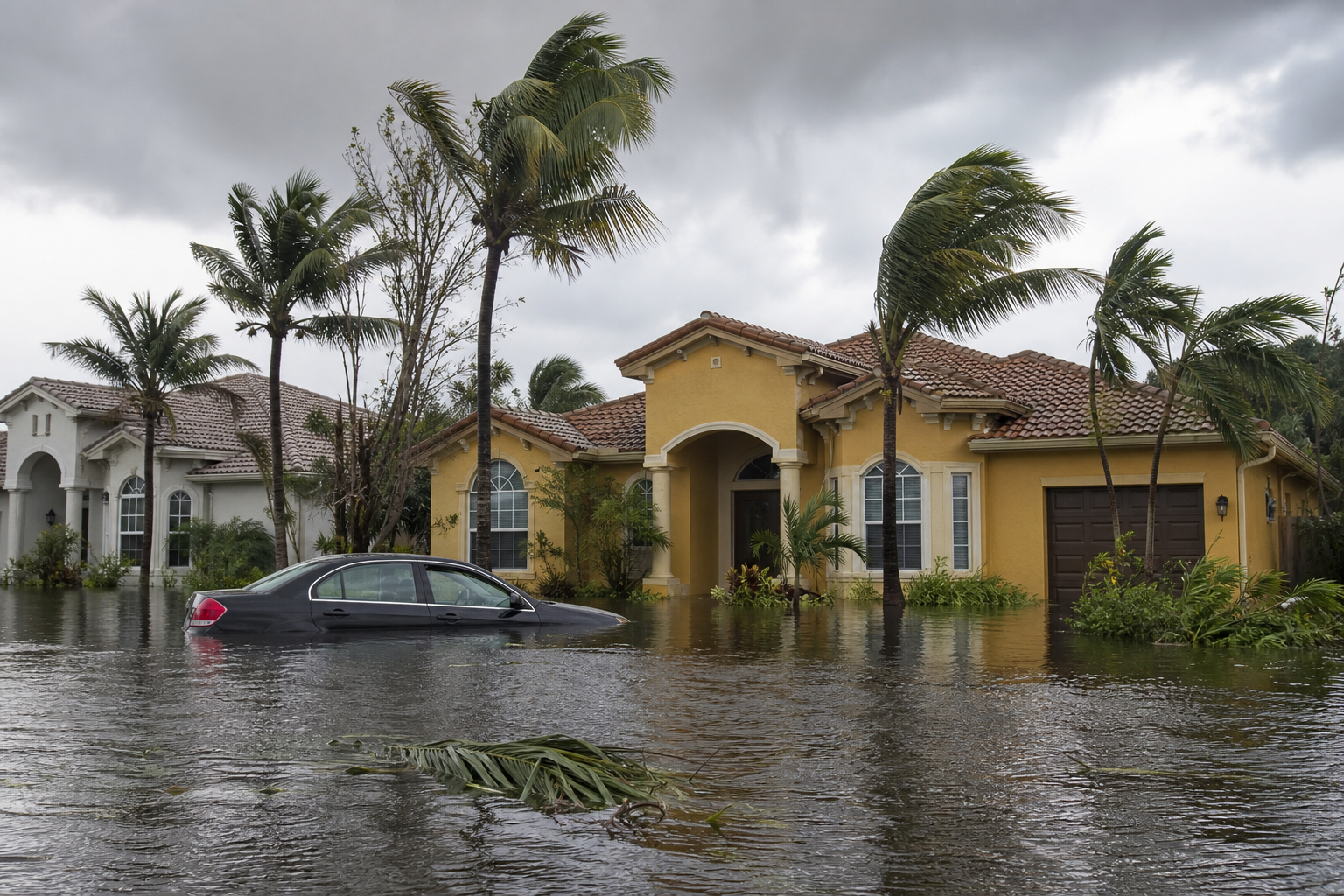
Florida has roughly 1,350 miles of coastline and a narrow peninsula shape that leaves almost every county vulnerable to hurricanes, storm surge, and windstorm damage. Major storms like Hurricane Ian (2022) and Hurricane Milton (2024) caused tens of billions in insured losses. The 2025 season did offer some relief: it was the first season in a decade with no U.S. hurricane landfalls and no direct tropical storm or hurricane hits on Florida. But insurers price on multi-year risk, so one quiet season alone will not reset premiums.
Reinsurance costs
Florida insurers buy reinsurance (insurance for insurance companies) to survive catastrophic storm seasons. The 2026 reinsurance renewal season was actually softer than the past three years thanks to abundant capacity and Citizens' shrinking exposure, with U.S. property-catastrophe reinsurance prices down roughly 16% year-to-date through mid-2026. Those savings are starting to flow through to Florida policyholders through smaller rate filings.
Litigation and assignment of benefits abuse
For years, Florida accounted for a disproportionate share of national property insurance lawsuits. One-way attorney fees and assignment of benefits (AOB) contracts let contractors (especially roofers) sue insurers aggressively, and the resulting legal costs were baked into every homeowner's premium. The 2022 SB 2-A reforms eliminated one-way attorney fees and restricted AOBs, and litigation share of claims has since dropped sharply.
Rising reconstruction costs
Home insurance is priced based on what it costs to rebuild your home, not what it would sell for. Materials and labor inflation since 2020 has pushed national reconstruction costs up roughly 45%, and post-hurricane labor shortages make Florida rebuilds even more expensive. For more detail on national pressures, see our breakdown of why home insurance rates are rising.

Protect your home with State Farm
Average Rate:
Homeowners who bundle and save with State Farm save an average of $1,000 per year!

You're in Good Hands® with Allstate
Average Rate:
Get comprehensive home coverage with flexible policy options.

Customize your home coverage
Average Rate:
Only pay for the coverage you need with personalized home insurance.

Smart coverage for your home
Average Rate:
Protect what matters most with award-winning home insurance.
Hurricane Deductibles and Windstorm Coverage Rules
Florida law requires every home insurer to offer specific hurricane deductible options: $500 (only available on homes insured up to $250,000), 2%, 5%, or 10% of your dwelling limit. Most homeowners end up with a 2% or 5% deductible, and choosing a higher percentage is one of the fastest ways to lower your premium.
How the hurricane deductible is triggered
The hurricane deductible is calculated as a percentage of your Coverage A (dwelling) limit and only applies during a named hurricane event. The "event" begins when a hurricane watch or warning is issued anywhere in Florida, continues while hurricane conditions exist in the state, and ends 72 hours after the last watch or warning is lifted.
| Dwelling Limit | 2% Deductible | 5% Deductible | 10% Deductible |
|---|---|---|---|
| $250,000 | $5,000 | $12,500 | $25,000 |
| $400,000 | $8,000 | $20,000 | $40,000 |
| $600,000 | $12,000 | $30,000 | $60,000 |
Hurricane vs. windstorm vs. all-other-perils
Most Florida policies have three different deductibles. The hurricane deductible only applies to named storms. Damage from unnamed tropical systems, severe thunderstorms, or tornadoes typically falls under a standard windstorm or all-other-perils (AOP) deductible, usually $1,000 to $2,500. For a deeper dive into how this structure compares to other coastal states, our hurricane insurance explainer and our coastal home insurance guide break it down further.
Citizens Property Insurance: The Insurer of Last Resort
Citizens Property Insurance Corporation is Florida's state-backed, not-for-profit insurer of last resort. It was created by the Florida Legislature to provide property coverage to homeowners who genuinely cannot find an affordable policy in the private market. Citizens is not designed to compete on price, and most homeowners are better off in the private market when they can qualify.
Depopulation and 2026 rate relief
Citizens has been actively shrinking its book of business through a program called depopulation, which transfers eligible policies to vetted private carriers. The numbers are striking:
- Citizens peaked at about 1.41 million policies in October 2023.
- By early 2026 it had dropped to about 395,000 policies, and by spring 2026 it was down to roughly 336,000, a decline of about 76% from the peak.
- As of March 31, 2026, Citizens holds only 1.93% of the Florida homeowners market (voluntary carriers make up the other 98.07%).
- Regulators approved a statewide average premium reduction of 8.7% for 2026 renewals, the first personal-lines rate cut since 2015. Multiperil rates ultimately dropped 8.8% on average (with wind-only policies down 5.5%), effective July 1, 2026 for new policies and at renewal for existing ones. Over 330,000 policyholders across all 67 counties will see decreases, and more than 150,000 will see reductions of 10% or more. South Florida cuts run as high as 14% in Miami-Dade and Broward.
Under current rules, a private carrier can take you out of Citizens if the new premium is within 20% of what you would pay at Citizens. You generally have the right to reject the offer and stay with Citizens, but doing so can limit your future options.
2026 flood insurance requirement
As of January 1, 2026, Citizens policyholders with homes insured for more than $600,000 must carry flood insurance as a condition of keeping their wind coverage. Under current statute, the threshold steps down each year until January 1, 2027, when the requirement extends to all Citizens personal residential policyholders with wind coverage, regardless of home value or flood zone. The flood policy must cover at least the dwelling amount up to the NFIP's $250,000 limit.
Impact of Recent Legislative Reforms
Florida's 2022-2023 reform package (primarily SB 2-A, SB 76, and HB 837) was the most aggressive property insurance overhaul in the state's history. The reforms eliminated one-way attorney fees, restricted assignment of benefits, tightened roof claim rules, and raised minimum hurricane deductible caps. Three-plus years in, the results are finally showing up in rate filings.
According to the Florida Office of Insurance Regulation, since the reforms took effect the state has received over 190 residential filing requests for rate decreases or 0% increases. The 30-day average requested rate change for homeowners was -1.2% in mid-2026, and the 180-day average was -2.9%. FLOIR's July 2026 stability report confirms 21 new companies have been approved to write residential property policies in Florida since the reforms, backed by more than $850 million in fresh capital. Multiple private carriers have also filed for reductions in the 5% to 15% range, including State Farm (about -10.1% cumulative), AAA (roughly -15%), Florida Peninsula (-8.4%), Security First (about -8%), and Universal Property & Casualty (around -5%).
For a national look at how Florida's reforms fit into a broader trend, see our roundup of home insurance legislation and reform in 2026 and the broader 2026 market stabilization outlook.
Top-Rated Companies Still Writing Florida Policies
Many national carriers have pulled back from Florida, but several strong options remain, alongside well-capitalized Florida-only specialists. The right pick depends on your county, your home, and whether you need standard or high-value coverage.
| Carrier | Best For | Why It Stands Out |
|---|---|---|
| State Farm | Standard inland homes | Consistently ranked #1 overall in 2026 studies, low complaint ratio |
| Tower Hill | Coastal and inland FL homes | Best for customer service, complaint ratio about 1/10 of average |
| Security First | Hurricane-prone areas | LendingTree's "best overall" for Florida 2026 |
| Florida Peninsula | Central and North FL homes | Named a top Florida carrier in 2026 rankings |
| American Integrity | Wind-mitigated homes | Stable Florida-focused regional carrier |
| Chubb | High-value homes | Top-rated nationally, broader limits |
| Slide Insurance | Depopulation takeouts, digital-first | Modern InsurTech, one of the largest takeout carriers |
| Citizens | Last-resort coverage | When private market will not write you |
Our complete ranking of best home insurance companies of 2026 covers national carriers in more depth if you want to compare.
How to Lower Your Florida Home Insurance Premium
The single most powerful lever Florida homeowners have is the wind mitigation credit system. Florida Statute §627.0629 requires every insurer to give premium credits for documented wind-loss mitigation features, and those credits can reduce the wind portion of your premium by 30% to 50% (and in some cases up to 88% for a fully hardened home). On a coastal home where wind makes up half of the total premium, that is real money.
Get an updated wind mitigation inspection
Florida's Uniform Mitigation Verification Form (OIR-B1-1802 Rev. 04/26) took effect April 1, 2026 after being adopted by the Florida Cabinet in September 2025. Any inspection done on or after that date must use the new form, which reorganizes questions, adds performance-based options for roof-to-wall attachments, and includes new fields for FORTIFIED Home Roof, Silver, and Gold designations. Existing inspections on the old Rev. 01/12 form remain valid for up to five years from the inspection date, so you do not need to re-inspect immediately.
Inspections cost roughly $75 to $150 and can pay for themselves many times over in the first year of savings.
Features that earn the biggest credits
- Roof shape. Hip roofs (sloped on all four sides) earn larger credits than gable roofs.
- Roof-to-wall connections. Hurricane clips, single wraps, and double wraps are one of the highest-ROI upgrades you can make. The new 2026 form adds performance-based options that let engineers classify by actual capacity.
- Secondary water resistance (SWR). A membrane under the roof covering that prevents interior damage if shingles blow off.
- Opening protection. Impact-rated windows, doors, and a reinforced garage door (a common failure point).
- FORTIFIED designation. The new form now specifically recognizes FORTIFIED Roof, Silver, and Gold certifications and can streamline how those features are documented.
- Roof age and code compliance. Roofs built to the 2002 or later Florida Building Code earn default credits with most carriers.
Use the My Safe Florida Home program
The My Safe Florida Home program, administered by the Department of Financial Services, offers free wind mitigation inspections and matching grants (often $2-for-$1 up to roughly $10,000) for qualified upgrades like new roofs, impact windows, and reinforced garage doors. Pairing a state grant with mandatory wind credits can dramatically reshape your annual cost.
For more universal premium-cutting tactics, our guide on how to lower your home insurance premium walks through 17 proven strategies that work in any state, and our cheap home insurance guide covers 12 more affordability tactics.
Other Florida-specific savings tactics
- Raise your hurricane deductible from 2% to 5% if you can comfortably cover the higher out-of-pocket exposure.
- Bundle home and auto for a 10-25% multi-policy discount with most carriers.
- Re-shop annually. With 20+ new carriers entering Florida since 2022, the cheapest option changes constantly.
- Document your roof. Keep permits, invoices, product approvals, and photos of any roofing work.
- Avoid small claims. A single claim can push your premium up by roughly $1,600 per year; two claims can add $3,000+.
If affordability is genuinely out of reach, our home insurance affordability crisis guide covers FAIR plans, surplus lines, and other last-resort options, and our overview of climate change and rising home insurance costs explains why coastal states remain under long-term pressure.
Frequently Asked Questions
Why is home insurance so expensive in Florida?
Florida insurance is expensive because of a stack of overlapping pressures: extreme hurricane exposure along 1,350 miles of coastline, elevated reinsurance costs, a recent history of litigation and assignment-of-benefits fraud that triggered carrier insolvencies, and roughly 45% inflation in reconstruction costs since 2020. Even with the 2022-2023 reforms finally producing rate cuts in 2026, baseline premiums remain 2x to 4x the national average.
Is hurricane insurance separate from home insurance in Florida?
No. Hurricane and windstorm damage is built into your standard Florida homeowners policy, but it comes with a separate, higher percentage-based deductible (usually 2%, 5%, or 10% of your dwelling limit). Flood damage, including hurricane storm surge, is not covered and requires a separate NFIP or private flood policy. Citizens now requires flood insurance as a condition of wind coverage for a growing share of policyholders.
What is the cheapest home insurance company in Florida?
There is no single cheapest carrier statewide. State Farm consistently ranks #1 in 2026 studies and tends to be competitive inland, Tower Hill and Security First often win on the coast, and takeout carriers like Slide and American Integrity are frequently competitive for newer, well-mitigated homes. The cheapest insurer changes by county, ZIP code, roof age, and wind mitigation features, so always quote at least four carriers before renewing.
Should I stay with Citizens or switch to a private insurer?
If a private insurer offers to take you out of Citizens within the legal 20% premium threshold and the coverage is comparable, switching is usually the smarter long-term move. Citizens has assessment authority (meaning policyholders can be charged extra after major storms) and may be subject to coverage limits that private carriers do not impose. With Citizens delivering an 8.7% to 8.8% rate cut in 2026 and stronger financial footing, staying can still be a legitimate fallback if no affordable private quote is available.
How much can wind mitigation credits actually save me?
Verified wind mitigation features can cut the wind portion of your premium by 30% to 50%, and a fully hardened home can see the wind premium drop by up to 88%. On a coastal Florida home that can mean $1,000 to $3,000 or more in annual savings. The biggest credits come from a hip roof, hurricane clips or straps, secondary water resistance, impact-rated openings, and roof features now documented on the updated OIR-B1-1802 Rev. 04/26 form.