
Compare Car Insurance Rates in Ohio
See if you qualify for a lower rate in less than 2 minutes



Most and Least Expensive Vehicles to Insure by Category
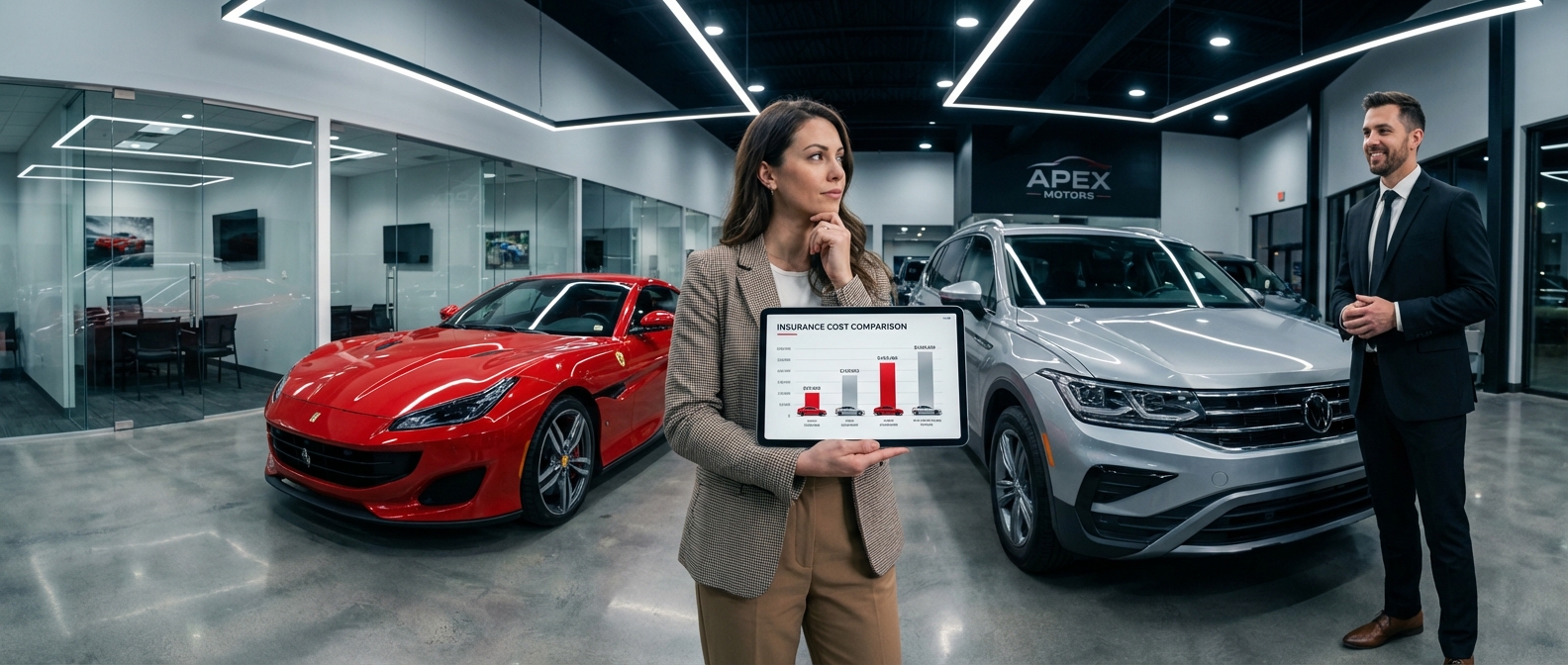
The difference between the cheapest and most expensive cars to insure in 2026 can be thousands of dollars per year, and that gap can turn a seemingly great deal into a costly ownership mistake. Whether you're shopping for a family SUV, a performance sedan, or a weekend sports car, knowing the insurance cost before you sign the paperwork is just as important as knowing the sticker price.
Below are the 2026 rankings by vehicle category based on average annual full coverage premiums. For a broader look at how your vehicle type affects your rates, see our full breakdown by body style.
Sedans
| Model | Avg. Annual Premium | Notes |
|---|---|---|
| Toyota Corolla | ~$2,029 | MotiveGrid's cheapest sedan to insure for 2026 |
| Nissan Versa | ~$2,150 | WalletHub's cheapest sedan overall for 2026 |
| Subaru Impreza | ~$2,120 | Insure.com's cheapest sedan; ~$177/month |
| Subaru Legacy | ~$2,148 to $2,529 | Insurance.com's cheapest sedan at $179/month |
| Honda Civic | ~$2,678 | Consistently ranks as an affordable sedan |
| Toyota Camry | ~$2,697 | 2026 IIHS Top Safety Pick+ winner |
| Mazda 3 | ~$2,725 | Both hatchback and sedan earn 2026 IIHS TSP+ |
| Audi RS 7 | ~$8,034 | Performance sedan; USA TODAY 2026 ranking |
| Audi RS 6 | ~$8,039 | Tied for one of the priciest sedans to insure |
| BMW M5 | ~$6,593 to $7,819 | Varies by dataset; among the most expensive overall |
| BMW M8 Gran Coupe | ~$6,744 to $7,938 | One of the priciest coupes to insure |
| Maserati Ghibli | ~$10,141 | Ranked #2 most expensive by USA TODAY |
| Maserati Quattroporte | ~$7,090 to $10,737 | Consistently ranked #1 most expensive to insure |
SUVs
| Model | Avg. Annual Premium | Notes |
|---|---|---|
| Subaru Outback | ~$1,969 to $2,242 | USA TODAY's cheapest car to insure at $1,969/year |
| Subaru Forester | ~$1,887 to $2,270 | Low repair costs and strong safety scores |
| Honda CR-V | ~$1,932 to $2,316 | Cheapest SUV to insure at $161/month per Insurance.com 2026 |
| Honda HR-V | ~$1,870 to $1,936 | MotiveGrid's cheapest to insure vehicle for 2026 at $1,870 |
| Buick Envista | ~$1,932 | The Zebra's cheapest new car to insure at $161/month |
| Mazda CX-5 | ~$1,895 to $2,016 | Forbes-ranked top-5 cheapest SUV |
| Volkswagen Tiguan | ~$1,979 | 3rd cheapest new car to insure at $165/month per Insurance.com |
| Hyundai Santa Fe | Category leader | Mercury Insurance's most affordable new SUV for 2026 |
| Mercedes-Benz G-Class | ~$5,357 to $5,623 | Luxury SUV with elevated MSRP and repair costs |
Trucks
| Model | Avg. Annual Premium | Notes |
|---|---|---|
| Ford Maverick | ~$1,958 to $2,488 | Compact hybrid; MotiveGrid's cheapest truck 2026 at $1,958 |
| Toyota Tacoma | ~$1,989 to $2,389 | WalletHub top-10 cheapest to insure |
| Jeep Gladiator | ~$2,460 | Affordable parts; among cheapest trucks to insure |
| Nissan Frontier | ~$2,539 | Budget-friendly midsize option |
| Chevrolet Colorado | ~$2,546 | Midsize, strong safety, low claims history |
| GMC Hummer EV Pickup | ~$4,584 | High value and EV repair complexity push costs up |
| Ram 1500 TRX | Top of most expensive lists | Now-discontinued high-performance trim |
Sports Cars
| Model | Avg. Annual Premium | Notes |
|---|---|---|
| Nissan Z | ~$2,916 | Sporty but more accessible insurance |
| Chevrolet Corvette Stingray | ~$3,201 | High performance, elevated premiums |
| Chevrolet Corvette Z06 | ~$3,411 | Performance coupe with near-exotic premiums |
| Toyota GR86 | ~$3,816 | Sporty coupe with near-supercar premiums |
| BMW M4 | ~$3,828 | Compare.com's most expensive vehicle to insure at $319/month full coverage |
| Nissan GT-R | ~$6,188 to $7,267 | Near-supercar territory for insurance |
Electric Vehicles
EVs are a growing consideration for buyers in 2026, and their insurance costs deserve their own look. On average, EVs are 42% more expensive to insure than gas-powered vehicles, according to Insurify data. In 2026, a full coverage policy for an EV averaged $3,159 per year, compared to $2,218 for a combustion-engine vehicle. The gap narrows to about 18% when comparing only newer top-selling models (2024 or later), and other analyses (including Autoblog and CNBC reporting on Insurify data that factors in luxury EVs) land as high as $4,058/year, or 49% more. The gap is driven primarily by expensive battery repairs, high vehicle values, and limited specialized repair networks. Learn more about electric vehicle insurance costs and coverage in our dedicated guide.
| Model | Avg. Annual Premium | Notes |
|---|---|---|
| Chevy Bolt | ~$2,075 | Affordable EV with lower repair costs |
| Chevrolet Equinox EV | ~$1,800 to $2,400 | One of the most accessible EV insurance options |
| Hyundai Ioniq 5 / 6 | ~$1,900 to $2,276 | Budget EV with competitive premiums |
| Ford Mustang Mach-E | ~$2,100 to $2,800 | Mid-range EV with moderate premiums |
| Tesla Model Y | ~$2,400 to $3,836 | Mid-range EV with above-average premiums |
| Tesla Model 3 | ~$3,871 to $4,675 | Higher premiums due to repair complexity |
| Porsche Taycan | ~$2,915 to $3,700 | Luxury EV with premium repair costs |
| Audi e-tron GT | ~$6,413 to $7,512 | Performance luxury EV among the priciest to insure |
| Tesla Model X | ~$5,285 to $5,700 | Among the most expensive EVs to insure |
| Tesla Cybertruck | ~$4,415 to $6,000+ | 2026 IIHS Top Safety Pick and only large pickup to earn TSP+ recognition; proprietary parts drive up repair costs |
| Lucid Gravity | ~$4,888 | MotiveGrid's most expensive vehicle to insure in 2026 |

Compare Car Insurance Rates in Ohio
See if you qualify for a lower rate in less than 2 minutes
Why Some Cars Cost So Much More to Insure
Insurance companies don't set rates randomly. Every premium is built on data about how much a specific vehicle costs to own, fix, and replace after a claim. Understanding these four core factors helps explain why your next car choice can dramatically shift what you pay. For a complete breakdown of all the variables at play, see what affects car insurance rates.
Repair Costs
Luxury and performance vehicles use specialized parts, proprietary materials, and advanced electronics that cost far more to replace than standard components. This is why a Maserati and a Honda can sustain the same fender-bender but generate claims that are thousands of dollars apart. Even minor collisions on modern vehicles now routinely trigger repair bills of $2,500 to $4,000+ due to ADAS sensor recalibration and advanced materials. Electric vehicles face a similar issue, with battery damage and limited repair shops driving EV repair bills far higher than their gas counterparts. Battery replacements alone range from $5,000 to $30,000+ depending on the model. The 25% Section 232 tariffs on imported vehicles (effective April 2025) and imported auto parts (effective May 2025) remain firmly in place and continue to accelerate repair cost inflation. Industry analysis projects an average 8% increase in tariffs auto insurance rates attributable to the 25% parts tariffs, on top of baseline rate movement. Insurify noted that tariff-driven cost spikes could push the 2026 increase from 1% to 4%. Learn more about how insurance premiums are calculated and why repair cost inflation flows straight through to your rate.
Theft Rates
If your vehicle is a popular target for thieves, your insurer knows it. Vehicles with higher theft likelihood raise premiums because comprehensive coverage must account for frequent theft claims, and insurers track models prone to theft using detailed historical data and ZIP code-level claims information. Per National Insurance Crime Bureau data, U.S. vehicle thefts fell 23.2% from 2024 to 2025, falling from 850,708 thefts in 2024 to 659,880 thefts in 2025. That decrease represents 190,828 fewer vehicle thefts year over year. That marked the second consecutive year of historic declines, building on the 17% decline recorded in 2024. That trend has helped moderate comprehensive coverage premiums for many models. Still, certain high-performance imports and popular truck models retain above-average theft exposure that meaningfully affects your annual premium.
Safety Ratings
IIHS and NHTSA ratings have a direct and measurable impact on what you pay. For 2026, 63 vehicles qualify as IIHS award winners: 45 earn Top Safety Pick+ and 18 earn Top Safety Pick, with no minicars, minivans, or small pickups earning awards. Vehicles earning top honors, like the Toyota Camry (TSP+), Mazda3 (TSP+), Hyundai Ioniq 5 (TSP+), and Honda HR-V (TSP+), consistently earn lower rates because they result in fewer injury claims and reduced collision severity. On the other hand, poor or unrated safety scores signal elevated risk to insurers and can push premiums 5 to 25% higher. Insurers reward crash-avoidance technology and strong occupant protection through meaningful discounts.
Horsepower & Vehicle Weight
Bigger engines and higher horsepower correlate with higher speeds and greater accident severity. Insurers factor in a vehicle's performance profile because high-powered cars are statistically more likely to be involved in costly, high-speed crashes. This is why sports cars and performance trims always carry a premium over their base-model counterparts. Vehicle weight plays an equally important role, since heavier vehicles cause more damage in crashes, which raises liability costs significantly for other parties involved. Understanding how vehicle weight affects insurance rates is a key piece of the premium puzzle. The average new car sold in the U.S. today weighs 4,354 pounds, according to the EPA's 2025 Automotive Trends Report, which covers final data through model year 2024, and that number continues to climb as SUVs, trucks, and heavy EVs dominate new-vehicle sales.

Protect your car with Farmers
Average Rate:
Find coverage options that fit your budget.

The insurance savings you expect.
Average Rate:
Enjoy personalized policies, comprehensive coverage & more.

See how much you could save today!
Average Rate:
Drivers who switch their auto insurance and save with State Farm save $764 on average!

Safe Drivers Save with Allstate®
Average Rate:
Get rewarded with savings for having a clean driving record.
How to Research Insurance Costs Before You Buy
One of the smartest things you can do as a car buyer in 2026 is check insurance costs before you step foot in a dealership. This five-minute step could save you hundreds or even thousands per year.
Step 1: Use an Online Insurance Calculator
Free tools like the car insurance calculator from NerdWallet, Insurify, MoneyGeek, Bankrate, and Policygenius let you enter a vehicle's make, model, year, and your ZIP code to get a real-time rate estimate. Check the average cost of car insurance in 2026 to understand where your vehicle sits relative to the national baseline. As of mid-2026, the annual average cost of full-coverage car insurance is $2,237 nationwide, up 1% since the end of 2025 per Insurify, with Experian at $2,266/year, The Zebra at $2,256, NerdWallet at $2,356/year for full coverage, Forbes Advisor at $2,459/year, and ValuePenguin at $208 per month ($2,496/year), depending on driver profile and methodology.
Step 2: Compare Multiple Carriers
Don't just accept the first quote you receive. Shopping across providers can reveal significant differences. Learn more about comparing car insurance companies to see how the top-rated carriers stack up. State Farm Mutual Automobile Insurance recently began distributing a record $5 billion dividend to qualifying auto insurance customers, marking the largest payout of its kind in the company's more than 100-year history. Qualifying auto customers across more than 49 million State Farm Mutual auto vehicles will receive a one-time cash back dividend, averaging about $100 per vehicle. State Farm confirmed the plan on its website on July 31, 2026, and created a portal for auto insurance customers to claim their checks. Carrier competitiveness has shifted meaningfully compared to a year ago, so shopping at renewal makes more sense than ever.
Step 3: Factor In Your Driver Profile
Your age, credit score, driving record, and location all affect how much any given car will cost to insure. Rates vary dramatically above or below the national baseline depending on your personal profile. A DUI can spike premiums by 70 to 100% and poor credit can add 69 to 98% or more. See our full breakdown of car insurance cost per year vs. per month to understand what you'll truly pay, including how installment fees can add $36 to $180+ annually if you pay monthly instead of in full.
Step 4: Look at State-Level Data
Insurance costs are heavily influenced by where you live. Insurify projects that five states are on track to finish 2026 up 6% or more since the end of 2025: Connecticut (+15%), Kentucky (+8%), West Virginia (+8%), Illinois (+6%), and Nevada (+6%). Insurify also projects that 32 states will see rate increases by year-end. Check how to find cheap car insurance locally to understand the baseline for your area before shopping.
Tips to Lower Insurance Costs on Expensive-to-Insure Vehicles
Already driving or committed to buying a higher-cost-to-insure vehicle? These strategies can meaningfully reduce what you pay.
Shop Aggressively and Switch When It Makes Sense
Loyalty doesn't always pay in auto insurance. Switching providers is one of the most effective ways to lower your rate, and competition among carriers is intensifying. Over the past year, State Farm Mutual has reduced auto rates by an average of roughly 10 percent, resulting in approximately $4.6 billion in annual premium savings for customers, which reshapes the value equation for many drivers. Explore proven ways to lower car insurance to start comparing top-rated carriers side by side.
Stack Every Discount You Qualify For
Most drivers leave significant money on the table by missing discounts they're already eligible for. Combining multiple qualifying discounts can save 30 to 50% off your base rate. Common options include:
- Multi-policy bundling (home + auto): saves 10 to 25%
- Good driver / accident-free history: saves 10 to 30%
- Telematics / usage-based programs: saves up to 30 to 40% for low-risk drivers
- Multi-car discount: saves 10 to 25%
- Defensive driving course: saves 5 to 15% (as little as $25 for online courses)
- Paid-in-full or auto-pay: saves 5 to 9%
- Anti-theft device installation: saves 5 to 20%, varies by carrier
Keep tabs on car insurance industry trends in 2026. Insurers are rapidly expanding telematics programs and AI-based pricing that reward safe drivers more aggressively than ever, with roughly 76% of insurers now running AI in at least one function.
Raise Your Deductible Strategically
Increasing your deductible from $500 to $1,000 can lower your collision and comprehensive premium by 15 to 40%. Just make sure you have enough in savings to cover the out-of-pocket difference if you file a claim. Bankrate estimates this alone can save an average of about $302 annually, with some drivers seeing $500+ in savings.
Consider Dropping Unnecessary Coverage on Older Models
If you're driving an older vehicle in the $5,000 to $8,000 value range, full coverage may cost more annually than your car is worth. Use the 10% rule as your guide: if your annual premium for collision and comprehensive exceeds 10% of your car's market value, it may be time to drop down to liability-only. Learn when to drop full coverage on older vehicles before making changes to your policy. With the average U.S. vehicle now 12.8 years old (and projected to hit 13.0 in 2026 per CCC), this decision applies to more drivers than ever.
Compare Specialized Insurers for High-Value Vehicles
Not all insurers price vehicles the same way. If you own a luxury or exotic vehicle, specialized carriers like Chubb, AIG Private Client, PURE Insurance, and Hagerty often offer better coverage terms and more competitive rates than standard carriers, including agreed value coverage, lower mileage program options, and flexible eligibility for modified or collectible vehicles.
Frequently Asked Questions
What is the most expensive car to insure in 2026?
The Maserati Quattroporte tops most 2026 rankings as the most expensive car to insure, with average annual premiums ranging from about $7,090 (Insure.com) to $10,737 (USA TODAY's multi-source analysis). The Maserati Ghibli ($10,141), Audi RS 6 ($8,039), Audi RS 7 ($8,034), BMW M8 Gran Coupe ($6,744 to $7,938), and BMW M5 ($6,593 to $7,819) round out the top of the list. Among luxury SUVs, the Mercedes-AMG G63 (~$5,357/year per Insure.com) stands out as the priciest body-on-frame SUV to insure. If you're considering any of these vehicles, comparing options from specialized luxury and exotic carriers is strongly recommended.
What is the cheapest car to insure in 2026?
The Subaru Outback leads USA TODAY's 2026 ranking with the lowest average annual insurance cost at $1,969, followed closely by the Subaru Forester, Honda CR-V, Honda HR-V, and Buick Envista. The Honda CR-V and Honda HR-V are tied as the cheapest new cars to insure at $161 a month, followed by the Volkswagen Tiguan at $165, per Insurance.com's 2026 rankings. These vehicles earn low rates thanks to strong IIHS safety ratings, widely available and affordable replacement parts, and historically low theft and claim rates. Among sedans, the Toyota Camry and Toyota Corolla are standouts.
Do electric vehicles cost more to insure than gas cars?
On average, yes. Per Insurify's 2026 data, EVs cost 42% more to insure than gas cars ($3,159/year vs. $2,218/year, or about $941 more annually). The gap narrows to just 18% when comparing only top-selling newer models (2024 or later). Other analyses reach as high as 49% more when luxury EVs are factored in ($4,058/year per Autoblog and CNBC reporting). The difference is driven by higher repair costs, expensive battery replacements ($5,000 to $30,000+ depending on the model), higher average vehicle values, and limited specialized repair networks. Learn more in our full Tesla insurance cost guide.
Can I lower insurance costs on a high-premium vehicle?
Absolutely. Key strategies include aggressively comparing quotes across 3 to 5 insurers, stacking all eligible discounts (bundling, telematics, good driver, defensive driving), raising your deductible if financially feasible, and enrolling in a usage-based insurance program. Combining multiple qualifying discounts can save 30 to 50% off your base rate. With State Farm issuing its historic $5 billion dividend plus roughly 10% rate cuts across 40 states, this is one of the best windows in years to shop for a better deal.
Why do some affordable cars have surprisingly high insurance rates?
Some budget-priced vehicles carry elevated insurance premiums due to poor safety ratings, high theft rates, or repair costs that are expensive relative to their value. A car's purchase price and its insurance cost are not always correlated, because insurers care about how much it costs to repair or replace, not how little you paid for it. Understanding what affects car insurance rates can help you identify which vehicle-specific factors are working against you. Always verify insurance costs for any specific make and model before purchasing, using free tools from MoneyGeek, Bankrate, or Insurify.